
SENSIT P100 Single-Gas Monitor: Pick Your Gas, Wear It for Two Years
The SENSIT P100 is a single-gas personal monitor built for the long, boring reliability the category demands: one sensor — your choice of hydrogen sulfide, hydrogen cyanide, oxygen, carbon monoxide, or sulfur dioxide — in an IP65-sealed, shock-absorbing housing, powered by a 3.6V lithium battery rated for more than two years of operation. Configured, it runs $281.80–$636 at CPS Calibrations across 14 builds — the spread is the gas: configurations differ by the sensor you choose, so the range, not any single figure, is the honest price.
Single-gas monitors are the fleet workhorses nobody writes poems about: issued by the dozens, worn by everyone, and judged on exactly two things — do they alarm when they should, and are they ever the reason for a delay. The P100's design answers both plainly. Two-button operation for power, zero, and calibration. A warning array of multiple LEDs under a frosted lens that stays visible in bright sunlight — the condition under which a dim alarm gets missed. STEL and TWA alarms with alarm event memory, so exposure is managed across the shift, not just at the peak. And a battery that removes the charging queue from the instrument's life entirely. This spotlight covers the five gas choices and their ranges, the ownership model (manual calibration or the SCAL-100 station), and where a one-gas monitor honestly belongs. The instrument itself is the Sensit P100, on CPS's single-gas monitors shelf.
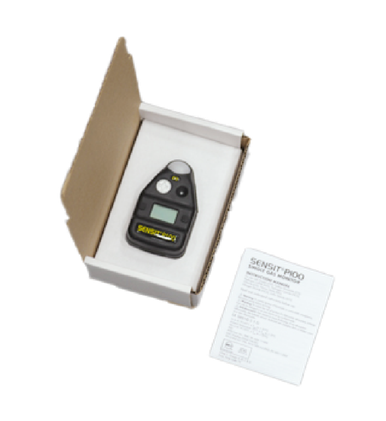
Sensit P100 Single-Gas Monitor
Rugged single-gas personal monitor — pick H2S, HCN, O2, CO, or SO2 — on a 2+ year lithium battery.
$281.80–$636 configured
See the P100Which Gas Should Your P100 Carry?
The configuration decision is the hazard decision. The five sensor choices, with their ranges from the instrument's specification:
- Hydrogen sulfide (H₂S), 0–100 ppm at 1 ppm resolution — the oil-and-gas, wastewater, and pulp-mill staple; the P100's most common fleet assignment.
- Carbon monoxide (CO), 0–999 ppm at 1 ppm resolution — for furnace, boiler, warehouse, and fire-service-adjacent work where CO is the named risk. (The product record notes a detection range to 0.2% volume — 2,000 ppm equivalent.)
- Oxygen (O₂), 0–25% at 0.1% resolution — the confined-space sentinel, worn where nitrogen, argon, or process gases can displace air.
- Hydrogen cyanide (HCN), 0–30 ppm at 0.1 ppm — the smoke-toxicant channel, for overhaul and specialty industrial work.
- Sulfur dioxide (SO₂), 0–20 ppm at 0.1 ppm — for the chemical, paper, and power applications where SO₂ is the process gas.
One gas per instrument — that is the category's honest limit, and it decides the fleet math: a worker whose hazards are H₂S *and* oxygen depletion needs either two singles or a multi-gas instrument. Singles win when the hazard is genuinely singular and the fleet is large; the price, the simplicity, and the 2-year battery all compound across dozens of units.
What Does Ownership Look Like Over Two Years?
Start with what is missing: no charging routine. The 3.6V lithium battery is rated for 2+ years of operation, and the instrument carries a 2-year warranty that includes the sensor (an extended warranty is available). The daily ritual collapses to turning it on — or not even that, with the optional always-on mode — and the periodic ritual is calibration, two ways: manually, with the two-button sequence the instrument is designed around, or on the SCAL-100 calibration station (bump test stations are also offered) for fleets that calibrate in batches. Infrared communication handles the data side, and alarm event memory keeps the exposure record.
The housing earns its keep meanwhile: durable ABS with shock-absorbing material, sealed to IP65, at 3.81 × 2.31 × 0.8 in. and 3.6 oz — small enough to be worn without negotiation, tough enough for the outdoor, wet, knocked-around service the −4 to 104 °F operating range implies. When a P100 does come to CPS, it calibrates at the published $55 single-gas rate with as-found and as-left data on the certificate — so even a two-year-battery instrument carries a documented accuracy record, which is what your safety program is actually audited on.
Where Does the P100 Earn Its Keep?
The P100's natural habitats are the fleets where one gas dominates the risk register. H₂S service fleets — oilfield, wastewater, rentals — issue the H2S build by the case and calibrate in batches on the SCAL-100, with the 2-year sensor-inclusive warranty capping the surprises. Oxygen sentry duty — the O2 build rides on workers around nitrogen and inert-gas systems, where the hazard is the air itself disappearing. HCN and SO₂ niche crews — overhaul support and chemical-plant tasks — get a specialty channel in the same cheap, tough housing as the commodity builds, instead of a specialty price. In every case the pattern repeats: the hazard is named, singular, and constant; the workforce is large; and the administrative cost per instrument — charging, tracking, training — is the real budget line. That is the arithmetic the P100 was designed to win.
Frequently Asked Questions
How much does the Sensit P100 cost?
Configured, $281.80–$636 at CPS Calibrations across 14 builds. The variable is the gas — sensor choice sets the configuration and its price — so the range is the honest figure and any single number would describe only one build. The live configurations are on the Sensit P100 product page.
What gases can the P100 detect?
One gas per instrument, chosen at configuration: hydrogen sulfide (0–100 ppm), hydrogen cyanide (0–30 ppm), oxygen (0–25%), carbon monoxide (0–999 ppm), or sulfur dioxide (0–20 ppm). A P100 built for H2S cannot be re-purposed to CO in the field — the gas choice is the purchase decision, so make it from your hazard assessment.
How long does the P100 battery last?
More than two years of operation from its 3.6V lithium battery — there is no charging routine and no battery rotation to manage. That battery life, matched to a 2-year warranty that includes the sensor, is the instrument's ownership proposition: issue it, calibrate it on schedule, and it simply runs.
Is the SENSIT P100 waterproof?
It is sealed to IP65 — protected against dust and water jets — in an ABS housing with shock-absorbing material. IP65 suits outdoor, wet, dirty field work; it is not a submersible rating, and it does not need to be for a worn personal monitor.
What are STEL and TWA alarms?
Two exposure clocks every toxic-gas program runs. The TWA (time-weighted average) alarm tracks your average exposure across the shift against the 8-hour limit; the STEL (short-term exposure limit) alarm tracks any 15-minute window against its higher ceiling. A monitor can pass every instantaneous glance and still be failing your TWA — which is why the P100 alarms on both clocks and keeps an alarm event memory.
How do you calibrate a P100?
Two ways: manually, using its two-button operation with the correct span gas for its sensor, or on the SENSIT SCAL-100 calibration station for fast, repeatable fleet calibration (bump test stations are also available). Or send it to CPS — in-house calibration is the published $55 single-gas rate with a full as-found/as-left certificate. Whichever route, the interval is the one in the instrument's manual, and sooner after a failed bump test or a hard knock.
Does the P100 have an always-on mode?
An always-on mode is available as an option — the instrument stays powered rather than being switched per shift. Fleets choose it to remove 'forgot to turn it on' from the failure list; the 2+ year battery is what makes the option practical.
What warranty does the P100 carry?
A 2-year warranty that includes the sensor — the sensor being warranted matters, because on most instruments the sensor is the wear part the warranty excludes. An extended warranty is also available. Exact terms are on the product page and in the manual.
P100 or a multi-gas monitor — which do I need?
Count the hazards. If the hazard assessment names one gas for that worker's tasks, a single-gas monitor like the P100 is the right-sized, fleet-priced answer. If it names two or more — H2S plus oxygen depletion is the common pair — the worker needs a multi-gas instrument or multiple singles, and worn singles do not combine into confined-space protection. Buy to the hazard list, not to the unit price.
Where do I get a P100 calibrated near me?
If you are not near a bench, mail it in: CPS calibrates the P100 in-house at Rockwood, Tennessee for the published $55 single-gas rate and returns it with a full certificate and enrollment in the CPS Calibration Program, which reminds you before the next due date. The calibration services page covers the process.
The Bottom Line
The P100 is single-gas done as a fleet instrument: five gas choices with honest ranges, a 2+ year battery that deletes the charging queue, IP65 sealing, STEL/TWA alarming, and a sensor-inclusive 2-year warranty — $281.80–$636 configured, priced by the gas you pick. Where the hazard is singular, it is the efficient protection. Where it is not, it will tell you nothing about the gases it does not carry — buy accordingly.
Outfitting a fleet and unsure which gas belongs on which crew? Call CPS Calibrations at 865-900-8844 with your hazard assessments — matching sensors to tasks is the whole purchase.
--- CPS Calibrations · 109 S. Front Street, Rockwood, TN 37854 · Sensit P100 · Single-Gas Monitors · Calibration Services
Need a calibration you can file?
In-house calibration at CPS in Rockwood, Tennessee — $55 for single-gas instruments, $90 for 4- and 5-gas — every channel, as-found and as-left data, full certificate.
See Calibration Servicesor call 865-900-8844
Recent Posts
-

What Is Remote Monitoring for Fixed Gas Detection?
Remote monitoring for fixed gas detection means a fixed system's live readings, trends, and alarm hi …Nov 23rd 2026 -

What Are the Key Differences Between the GX-6000 and GX-6100?
The RKI GX-6100 is the current replacement for the discontinued GX-6000: both are pumped 6-gas monit …Nov 22nd 2026 -

How to Read a PID Correction Factor Chart
To read a PID correction factor chart, find your vapor’s row, take the factor under your own lamp en …Nov 21st 2026