
Should You Buy a Gas Detector on Amazon or eBay? The Gray-Market Trap
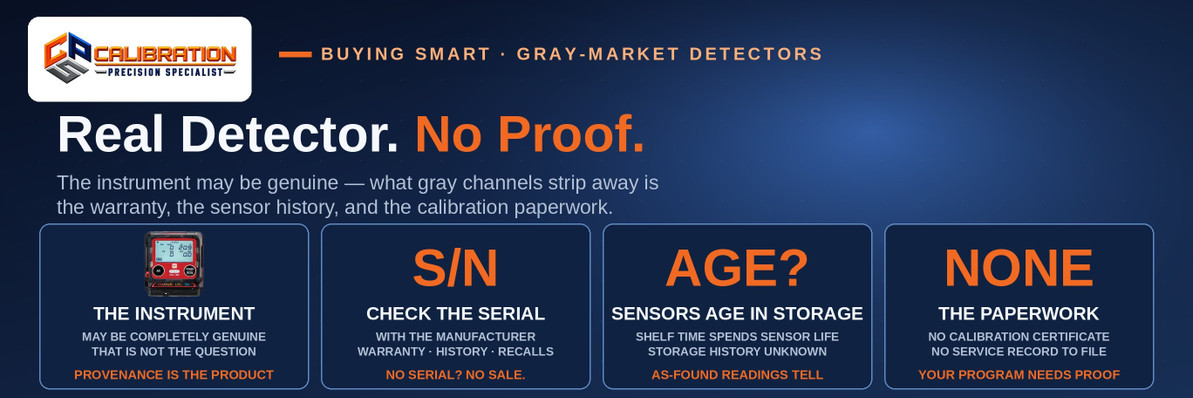
You can buy a gas detector on Amazon or eBay — and the instrument in the box may be completely genuine — but a gray-market purchase usually strips away the four things that make a detector a safety instrument instead of a gadget: a factory warranty you can actually use, sensors with a known age and storage history, a calibration certificate and service record, and a configuration built for your market. Buy the instrument for a work crew and those four missing pieces, not the sticker price, are what you are really saving on.
This is not an anti-marketplace rant, and it names no sellers — there are legitimate dealer storefronts on Amazon, and there are honest used instruments on eBay. The problem is narrower and more mechanical than 'marketplace bad': a gas detector is a dated, calibrated, documented safety device, and gray channels — imported stock, resold stock, liquidation stock, listings with no distribution history — are very good at moving the hardware and very bad at moving everything that makes the hardware trustworthy. Here is the trap, piece by piece, and how to check each one before your crew clips the instrument on.
What Does 'Gray Market' Mean for a Gas Detector?
Gray market means genuine goods sold outside the manufacturer's authorized distribution for your market: parallel imports meant for another region, stock that passed through liquidators or resellers, surplus and returned inventory relisted as new. It is different from counterfeit — a counterfeit instrument is fake, full stop — and different from buying from an authorized dealer's own storefront on a marketplace, which is just a dealer with a different shop window. The gray part is the provenance: nobody in the chain can tell you where this specific serial number has been, and as the next sections show, provenance is most of what you are paying a dealer for.
What Happens to the Factory Warranty?
Warranty and factory service normally run through authorized distribution, because the manufacturer can see the instrument's history: when it was built, who it was sold to, whether it has been serviced. A gray unit breaks that chain. Depending on the manufacturer and the unit's history, a warranty claim can be slowed, redirected, or denied — and the honest answer is that it varies, which is itself the problem: at the moment a sensor fails on a job, 'it varies' is not a support plan.
There is a check, and it is free: the serial number. Before a gray-market instrument goes into service — ideally before the return window closes — give the serial number to the manufacturer and ask three questions: Is this serial registered, and where was it originally sold? Is it under warranty, and through whom? Is there any service or recall history? A seller who will not give you the serial number before purchase has answered the first question for you.
Why Do Sensor Age and Storage History Matter?
A gas detector's sensors are consumables with a clock, and the clock does not only run at work. Sensors age in storage; an instrument that sat in a hot warehouse, a container, or a liquidation pallet for a long stretch can arrive with a meaningful part of its sensor life already spent — and with no storage history, you cannot know how much. Shelf time is also invisible in the listing photos: gray stock looks new because the plastic is new. The sensors inside are the part that matters, and they do not care how the box looks.
This is also why a first calibration on any gray or used instrument is not a formality. A proper calibration records as-found readings before adjustment — the one measurement that tells you whether this individual instrument, with its individual history, was reading true when it reached you. If it was far off, you have learned something the listing never told you, while there is still time to return it.
What Paperwork Should a Safety Instrument Arrive With?
From an authorized channel, a new detector normally arrives with its factory documentation and a calibration behind it, and — just as important — it enters a service system: the dealer and manufacturer can see it, calibrate it, and keep its record. A gray unit typically arrives with the instrument and whatever was in the box. No calibration certificate your safety program can file. No record an auditor, an insurer, or an incident investigator can follow. If your written program, your customer's site requirements, or your insurer expects calibration documentation — and most do — a detector without paperwork is a detector you cannot prove was ever right.
The fix, if you already own one, is real but partial: a documented calibration creates a record from today forward. CPS calibrates instruments whatever channel they came from — we calibrate every channel an instrument carries — at published in-house rates of $55 for a single-gas instrument and $90 for a 4- or 5-gas instrument, with a certificate showing as-found and as-left readings, and the instrument enters the CPS Calibration Program for due-date reminders. What a calibration cannot recreate is the missing warranty path or the unknown years before it arrived.
What Else Goes Wrong With Gray-Market Detectors?
Wrong-region configuration. Instruments are built and configured for the market they were sold into: sensor combinations, alarm conventions, language, and certifications can differ by region. A unit configured for another market may not match the configuration your program specified — and the mismatch is in menus and paperwork, not on the label in the listing photo.
Counterfeit risk at the edges. Most gray stock is genuine — but the same opaque channels that move genuine surplus also move counterfeits and remarked instruments, and the buyer has no chain of custody to sort one from the other. The serial-number check with the manufacturer is again the tool: a serial that does not resolve, or resolves to a different model, ends the conversation.
Accessories and support. Chargers, sampling pumps, calibration adapters, and replacement sensors for a current US-market instrument are stocked by its dealers. An orphaned import can turn a routine sensor swap into a parts hunt — for a safety instrument your crew needs back in service, not on a shelf.
When Can a Marketplace Buy Still Make Sense?
Honestly: sometimes. A clearly-described used instrument, at a used price, for training, backup, or non-critical duty — bought with the serial number checked, the sensor life treated as unknown and probably short, and a documented calibration booked the week it arrives — can be a rational buy for a buyer who goes in with eyes open. So can a marketplace listing that turns out to be an authorized dealer's own storefront: verify the seller against the manufacturer's dealer list and the gray-market concerns mostly fall away.
What never makes sense is the pattern the trap is built on: a 'new' detector, priced just enough under list to feel smart, bought for front-line crew use, with no serial check, no calibration, and no paperwork — where the savings are spent, all at once and invisibly, on warranty, sensor life, and proof. If you are equipping a crew, buy from the manufacturer or an authorized dealer — browse the categories the way your program specifies them, portable multi-gas monitors or single-gas monitors — and keep calibration services on the calendar from day one. And if a gray unit is already on your shelf, call 865-900-8844: a calibration and a serial check will tell you exactly what you actually own.
Frequently Asked Questions
Is it safe to buy a gas detector on eBay?
It depends on what 'it' turns out to be. The instrument may be genuine — the risks are everything around it: no reliable factory warranty path, sensors with an unknown age and storage history, no calibration certificate or service record, possible wrong-region configuration, and counterfeit risk in the most opaque listings. If you buy one, check the serial number with the manufacturer before relying on it and get a documented calibration — with as-found readings — immediately, so you know what the instrument was doing when it reached you.
Will the manufacturer honor the warranty on a gray-market gas detector?
Not reliably, and the honest answer varies by manufacturer and by the individual unit's history — which is precisely the trap. Warranty and factory service normally run through authorized distribution, where the manufacturer can trace the serial number. A gray unit's chain is broken, so a claim can be slowed, redirected to another region's channel, or denied. Before purchase, ask the seller for the serial number and put the question to the manufacturer directly; a seller who will not share the serial has told you what you need to know.
How can I check if a gas detector is genuine by serial number?
Contact the manufacturer with the serial number from the instrument's label and ask: does this serial resolve to this model, where and when was it originally sold, is it under warranty, and is there service or recall history? A genuine, traceable instrument answers all four cleanly. A serial that does not resolve, resolves to a different model, or shows a sales history inconsistent with the listing is a counterfeit or remarked-unit warning — walk away, whatever the price.
Do gas detector sensors expire if the detector was never used?
Yes — sensor life is not measured only in hours worn. Sensors age in storage as well as in service, and storage conditions (heat, time on a shelf or in a warehouse) spend that life invisibly. That is the core gray-market problem: the box can look factory-fresh while the sensors inside have an unknown amount of life already gone. The only individual answer for a specific instrument is a calibration with as-found readings, which shows whether its sensors are still responding accurately today.
Does a gas detector bought online come with a calibration certificate?
From an authorized dealer, a new instrument normally arrives with factory documentation and calibration behind it, and it enters the dealer's and manufacturer's service records. Gray-market and many used listings typically include no certificate you can file — no proof an auditor, insurer, or customer can follow. If your safety program requires calibration documentation, budget for a documented calibration on arrival: CPS charges $55 in-house for a single-gas instrument and $90 for a 4- or 5-gas, with a certificate showing as-found and as-left readings.
Are gas detectors on Amazon all gray market?
No. Amazon itself and authorized dealers operating real storefronts on Amazon sell through the normal channel, and an instrument bought that way carries its normal documentation and warranty path. The gray-market risk lives in third-party listings with no distribution history — imported, liquidated, or resold stock. The test is the seller, not the website: verify the storefront against the manufacturer's authorized dealer list, and verify the individual serial number after it arrives.
What is a wrong-region gas detector configuration?
Manufacturers build and configure instruments for the market they are sold into, so sensor combinations, alarm conventions, display language, and certifications can differ between regions. A parallel-imported unit can therefore arrive configured differently from what your safety program specified — legally sold somewhere, but not the configuration your crew trained on or your paperwork describes. It is one more thing the serial-number check with the manufacturer reveals: where the unit was originally sold tells you which configuration it was built as.
Can CPS calibrate a gas detector I bought on eBay?
Yes. CPS calibrates instruments whatever channel they were bought through — we calibrate every channel the instrument carries — at published in-house rates of $55 for a single-gas instrument and $90 for a 4- or 5-gas instrument. You get a certificate with as-found and as-left readings (the as-found line is the one that tells you what your marketplace buy was really doing), and the instrument joins the CPS Calibration Program for due-date reminders. Calibration cannot restore a missing factory warranty, but it replaces guesswork with a dated, documented record.
Why is a used gas detector cheaper even when it looks new?
Because the discount is usually being taken out of things a photo cannot show: remaining sensor life, warranty status, storage history, and paperwork. The plastic, screen, and case age slowly; sensors and documentation are where the value quietly leaves. A used instrument priced as used, bought for backup or training with a serial check and a fresh calibration, can be a fair deal. A 'new' gray instrument priced just under list, carrying all of those unknowns into front-line service, is where buyers overpay while thinking they saved.
What should I check before putting a marketplace gas detector into service?
Four checks, in order: (1) Serial number — verify it with the manufacturer: model, original market, warranty status, service history. (2) Configuration — confirm the sensor mix and setup match what your program specifies. (3) Calibration — get a documented calibration with as-found readings before the crew relies on it, not after the first job. (4) Paperwork — file the certificate and start the instrument's record from today, with a due-date reminder set. If check one fails, the other three do not matter: return it while you still can.
The Bottom Line
The gray-market trap is not that the detector is fake — it usually is not. The trap is that warranty, sensor life, configuration, and paperwork are most of what a safety instrument is, and those are exactly the parts a gray channel cannot deliver. Check the serial, calibrate before service, and buy crew instruments through channels that can prove what they sold you.
Already bought one, or about to? Call CPS Calibrations at 865-900-8844 — we'll calibrate it with full as-found documentation and tell you, in writing, exactly what you have.
CPS Calibrations · 109 S. Front Street, Rockwood, TN 37854 · Calibration Services · The CPS Calibration Program · Portable Gas Detection
Need a calibration you can file?
In-house calibration at CPS in Rockwood, Tennessee — $55 for single-gas instruments, $90 for 4- and 5-gas — every channel, as-found and as-left data, full certificate.
See Calibration Servicesor call 865-900-8844
Recent Posts
-

What Is Remote Monitoring for Fixed Gas Detection?
Remote monitoring for fixed gas detection means a fixed system's live readings, trends, and alarm hi …Nov 23rd 2026 -

What Are the Key Differences Between the GX-6000 and GX-6100?
The RKI GX-6100 is the current replacement for the discontinued GX-6000: both are pumped 6-gas monit …Nov 22nd 2026 -

How to Read a PID Correction Factor Chart
To read a PID correction factor chart, find your vapor’s row, take the factor under your own lamp en …Nov 21st 2026