
What Gas Detection Does a Laboratory Need?
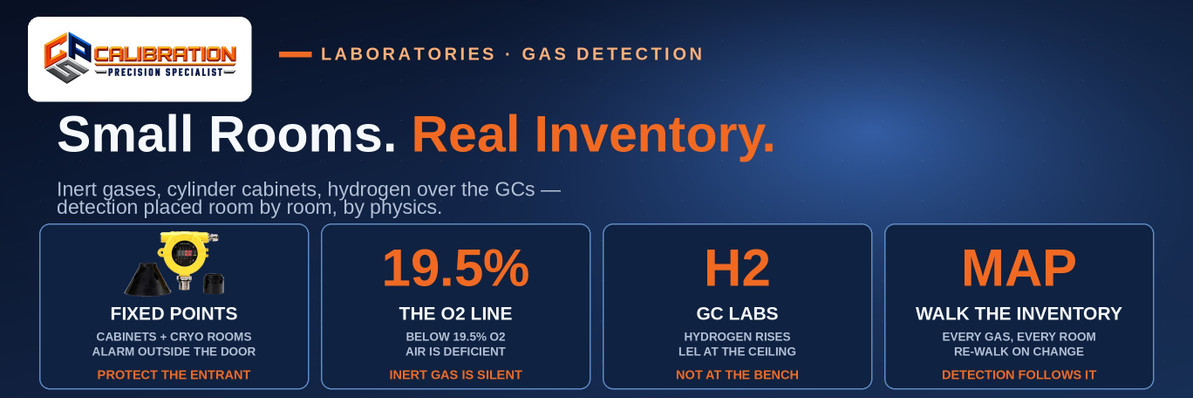
A laboratory needs gas detection matched room by room to its inventory: fixed oxygen-depletion monitoring wherever nitrogen, argon, or helium is stored or used in quantity — air below 19.5% oxygen is oxygen-deficient, and inert gases get there silently, with no smell and no warning — hydrogen (LEL) detection in GC labs, watch over cylinder cabinets and toxic-gas storage, and portable monitors for the people who move between rooms. Labs rarely lack hazards; they lack a map of them, because the risks arrive one cylinder and one cryogen Dewar at a time.
The deep dive on the biggest lab hazard is its own post: oxygen deficiency hazards from nitrogen, argon, and helium. This post is the survey — how to walk a laboratory, room by room, and decide what detection each space has earned. The method matters more than any single product: labs accumulate risk incrementally (a new instrument, a bigger Dewar, a cylinder bank that grew), while detection tends to be whatever was installed when the room was built.
Start With the Inert Gases: Oxygen Depletion Is the Lab Hazard
Nitrogen generators and liquid-nitrogen Dewars, argon for instruments and gloveboxes, helium for GCs and cryogenics — the modern lab breathes inert gas, and every liter of it that escapes displaces a liter of air. In a small, closed, or below-grade room, a Dewar venting overnight or a line failure can take oxygen below the 19.5% deficiency line with no odor, no color, and no irritation to announce it; the first symptom of oxygen-deficient air is impaired judgment, which is why it claims people who walk in to help.
Fixed oxygen monitoring belongs in those rooms: a sensor at breathing height where a person would stand, an alarm that reports outside the door as well as inside it (the entrant is the person being protected), and ventilation interlocked where the design allows. Bulk cryogen storage gets the same treatment as the rooms it feeds. If a lab does only one detection job on this entire list, it is this one.
Cylinder Cabinets and Toxic Storage: Small Quantities, Real Teeth
Lab toxics arrive in lecture bottles and small cylinders — chlorine, ammonia, hydrogen sulfide, carbon monoxide, specialty mixtures — stored in gas cabinets and cylinder racks. The quantities are small; the concentrations in the containers are not, and a fitting weep inside a cabinet is precisely what ventilated cabinets and point detection exist to catch before the room does. Detection here is placement-specific: in or at the cabinet exhaust for stored toxics, at the cylinder bank for the gases actually stocked — which means the detection inventory has to be re-walked every time the gas inventory changes.
The honest limit belongs in the plan: no fixed system covers a gas nobody told it about. The lab habit that makes detection work is administrative — new gas arrives, detection gets asked the question — backed by portables for the survey work in between.
Hydrogen in the GC Lab: The Gas That Rises
Hydrogen is the GC lab's fuel and carrier gas, plumbed to instruments across benches, often from a generator or a cylinder bank, in rooms full of ignition-capable equipment. It is colorless, odorless, leaks readily through fittings that hold other gases, burns across a wide range — and rises. LEL detection for hydrogen belongs high: above the instruments and lines, at the ceiling and its pockets, where the gas will actually collect, not at bench height where a generic detector happened to fit.
Generator-based hydrogen changes the leak points (fewer cylinders, more plumbing and a water system) without changing the physics. Either way, the GC lab's detection answer is a fixed combustible point placed by buoyancy — the same discipline, inverted, as a lab watching for a heavy vapor at the floor.
Portables, and Putting the Map Together
Fixed points guard rooms; portables guard the people who move — the technician entering the cryogen room, the staffer changing a cylinder, the facilities tech answering an alarm in a room they do not work in. Portable multi-gas monitors with an oxygen channel are the entry tool: no entry into a suspect room on a fixed system's say-so alone when a portable can verify the air at the door. Around both layers sits the service discipline — fixed systems installed and commissioned properly (see fixed system installation) and every instrument, fixed and portable, on a calibration schedule, because lab detection that has drifted is decor.
- Cryogen/inert-gas rooms: fixed O₂, alarm outside the door, breathing-height sensing.
- Gas cabinets & cylinder storage: point detection matched to the gases actually stocked, re-walked when inventory changes.
- GC labs: fixed hydrogen LEL, placed high.
- Everywhere people enter suspect air: portables with O₂, and a rule that uses them.
Walk the inventory, place by physics, calibrate on schedule — that is the whole method, and it scales from a single research lab to a campus.
Frequently Asked Questions
What is the most important gas detection in a laboratory?
Fixed oxygen-depletion monitoring where inert gases — nitrogen, argon, helium — are stored or used in quantity. Inert gases displace air silently, with no warning properties; below 19.5% oxygen the atmosphere is oxygen-deficient by definition, and the first symptom is impaired judgment. Sensor at breathing height, alarm outside the door, and the entrant protected before they enter.
At what oxygen level should a lab alarm?
19.5% is the published deficiency threshold — alarm thinking starts there, at the line where air stops being air. Systems are commonly arranged to warn at that threshold so nobody enters or remains in deficient air. Exact setpoints and any second-stage actions (ventilation, evacuation) are set by the institution's EHS design for the room.
Do small labs with a few cylinders need fixed detection?
It depends on the rooms, not the cylinder count. A single liquid-nitrogen Dewar in a small, closed, or below-grade room can displace enough air to matter — volume-for-volume, inert gas is inert gas. Well-ventilated spaces with small quantities may be served by portables and procedure; closed cryogen and storage rooms earn fixed O₂ monitoring.
Where does hydrogen detection go in a GC lab?
High. Hydrogen rises and collects at ceilings and in high pockets, so combustible (LEL) sensing belongs above the instruments, lines, and cylinder or generator supply — placed by the gas's buoyancy, not by mounting convenience. Bench-height placement is the classic GC-lab miss.
What about toxic gases in cylinder cabinets?
Detect the gases actually stocked, at the cabinet or its exhaust and at the cylinder bank — small cylinders hold full-strength gas, and a fitting weep is what ventilated cabinets and point detection exist to catch. The discipline is administrative as much as technical: when the gas inventory changes, the detection gets re-walked, because no system senses a gas nobody specified.
Should lab staff carry portable monitors?
The people who enter suspect rooms should: cryogen rooms, cylinder stores, any space answering an alarm. A portable with an oxygen channel verifies air at the door instead of trusting a fixed display from the hallway. Portables also cover survey work — leak checks at fittings, cabinet inspections — that fixed points cannot.
Does a fume hood replace gas detection?
No. A hood captures what is released inside it, at the sash, while it runs. It does nothing for a Dewar venting across the room, a cylinder leaking in a cabinet with its own exhaust path, or hydrogen collecting at the ceiling. Hoods and detection solve different release geometries; labs need the one matched to each source.
Who designs a lab's gas detection?
The institution's EHS/lab-safety function with its AHJ's requirements — they own the inventory and the code picture. CPS supplies, installs support, and calibrates the fixed and portable instruments (call 865-900-8844) and keeps them honest on schedule; the room-by-room risk decisions sit with the lab.
How often do lab detectors need calibration?
On their manuals' and the institution's schedule — fixed heads and portables alike, with records an audit can read. Lab detection justifies itself in inspections and incident reviews, and both ask for calibration paper. CPS calibrates in-house at $55 single-gas and $90 for 4- and 5-gas instruments, with as-found/as-left certificates.
What is the first step if our lab has no detection at all?
Walk the inventory: list every gas, its quantity, its room, and the room's ventilation and occupancy. The walk itself produces the map — inert-gas rooms first (fixed O₂), then cylinder storage and cabinets, then hydrogen in GC labs, then portables for entry. Most labs find the priorities obvious once the inventory is on one page.
The Bottom Line
Laboratory detection is an inventory exercise with sensors attached: fixed oxygen monitoring where inert gases can silently take a room below 19.5%, cabinet and storage watch matched to the toxics actually stocked, hydrogen sensing placed high in GC labs, and portables for the people who enter suspect air — all of it calibrated, all of it re-walked when the inventory changes.
Mapping a lab's detection, or calibrating what's already there? Call CPS Calibrations at 865-900-8844 — 109 S. Front Street, Rockwood, TN 37854.
--- CPS Calibrations · 109 S. Front Street, Rockwood, TN 37854 · Oxygen Deficiency Hazards · Portable Gas Detection · Calibration Services
Need a calibration you can file?
In-house calibration at CPS in Rockwood, Tennessee — $55 for single-gas instruments, $90 for 4- and 5-gas — every channel, as-found and as-left data, full certificate.
See Calibration Servicesor call 865-900-8844
Recent Posts
-

What Is Remote Monitoring for Fixed Gas Detection?
Remote monitoring for fixed gas detection means a fixed system's live readings, trends, and alarm hi …Nov 23rd 2026 -

What Are the Key Differences Between the GX-6000 and GX-6100?
The RKI GX-6100 is the current replacement for the discontinued GX-6000: both are pumped 6-gas monit …Nov 22nd 2026 -

How to Read a PID Correction Factor Chart
To read a PID correction factor chart, find your vapor’s row, take the factor under your own lamp en …Nov 21st 2026