
Oxygen Deficiency Hazards: Monitoring Labs That Use Nitrogen, Argon, and Helium
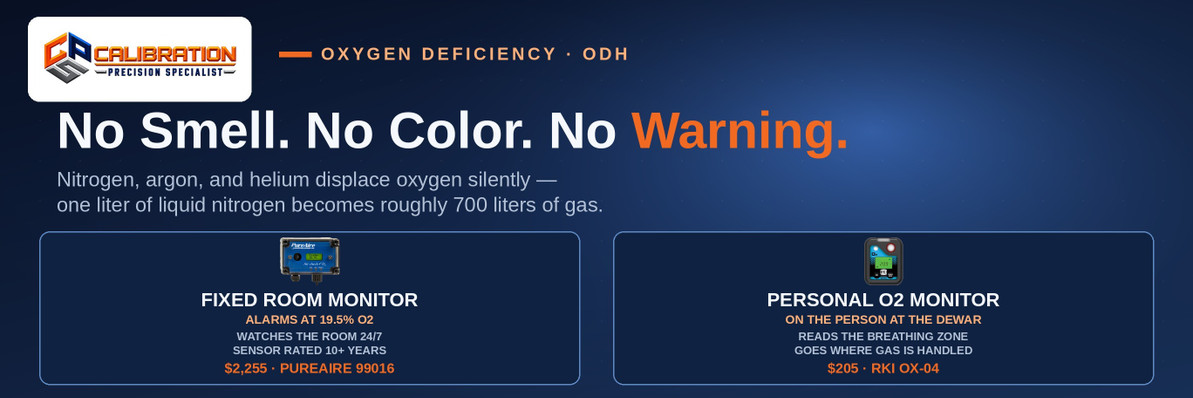
An oxygen deficiency hazard (ODH) exists in any lab where nitrogen, argon, or helium can displace the air: one liter of liquid nitrogen expands to roughly 700 liters of gas as it warms, so a single dewar failure or a steady inert-gas release in a small, closed room can pull oxygen below the 19.5% alarm level with no smell, no color, and no warning a person can sense. Labs that store or use these gases manage ODH with fixed oxygen monitors mounted in the breathing zone near dewars, fill points, and storage — alarming typically at 19.5% O₂ — backed by personal O₂ monitors on the people who fill, transport, and work around the gas.
Nitrogen, argon, and helium are not toxic. That is precisely the problem: nothing about the gas itself hurts you, so nothing about it warns you. What hurts is the oxygen that is no longer there. This post works through the math of how fast a room can go unsafe, where monitors belong for each gas, and how fixed room monitors and personal monitors divide the job — the same monitoring pattern used in the research, fuel, and advanced-nuclear support labs we cover in our companion post on gas detection for small modular reactor and advanced nuclear facilities.
What Is an Oxygen Deficiency Hazard (ODH)?
ODH is the formal term safety programs use for the risk created when an inert or otherwise non-breathing gas reduces a room's oxygen below the level people need. Normal air is 20.9% oxygen. Oxygen monitors for this duty typically alarm at 19.5% O₂ — the level used as the oxygen-deficient threshold in the factory set points of the monitors in this post — with a second, lower alarm (18.0% on the monitors below) as the atmosphere worsens. Three properties make ODH a monitoring problem rather than a senses problem:
- No warning properties. Nitrogen, argon, and helium have no odor and no color, and they do not irritate eyes or lungs. A room can be oxygen-deficient while feeling completely normal to the person standing in it.
- The gas is not the poison. These gases do not need to reach a toxic concentration — they only need to take up space that oxygen used to occupy. The hazard is a subtraction, not an addition.
- It can develop faster than a shift. A release does not wait for a rounds schedule. A dewar failure, a venting relief, or a line left flowing can change a room between one entry and the next — which is why ODH monitoring is continuous and fixed, not occasional and carried.
How Can One Dewar Make a Whole Room Unsafe?
Run the expansion math. Liquid nitrogen boils off and expands to roughly 700 times its liquid volume — one liter of liquid becomes about 700 liters of gas. A lab dewar does not hold one liter; it holds tens of liters. Let 30 liters of liquid nitrogen escape and warm in a small closed lab and you have added roughly 21,000 liters — 21 cubic meters — of nitrogen gas to a room that may only hold a few tens of cubic meters of air in total. The nitrogen does not remove the oxygen molecule by molecule; it dilutes and displaces it, and the room's oxygen percentage falls by the share of the room the new gas takes up. In a small room with the door closed and ordinary ventilation, a single dewar-scale release is easily enough to cross 19.5% — and to keep going toward levels where a person has little time and less judgment to get out. That is the whole ODH argument in one calculation: the inventory in one ordinary lab vessel is large compared with the air in the room holding it. Helium and argon stored as compressed gas carry the same dilution logic — a cylinder's contents are measured in cubic meters of gas, released into a room measured in tens of cubic meters.
Two honest qualifiers. Ventilation fights the math: a room with strong, running exhaust dilutes a slow release, which is why ODH assessments consider ventilation rather than assuming the worst. And a slow leak is a different event from a dewar failure — which is why the monitor has to be there for both, alarming on the slow drift at 19.5% long before a fast release becomes an emergency.
Where Do Oxygen Monitors Mount in a Nitrogen, Argon, or Helium Lab?
Start with the rule that governs all of it: oxygen is monitored where people breathe, because people are what the reading protects. From there, place points against the actual sources and the actual gas behavior:
- In the breathing zone. The primary point mounts at standing breathing height, where staff work — not at the floor, and not at the ceiling. A PureAire 99016 oxygen deficiency monitor ($2,255) is built for this duty: a wall-mounted room monitor with factory alarm set points at 19.5% and 18.0% O₂ and a zirconia sensor rated for 10+ years of service — the long sensor life matters in a room that must never be unmonitored. Remote-sensor versions separate the sensing point from the display, so the reading and alarm can also be visible outside the door, before entry.
- Near dewars, fill points, and storage. Put the point near where gas is stored, dispensed, and connected — the dewar cluster, the fill station, the cylinder manifold — because that is where releases start and where a person will be standing when one happens.
- Low spots for argon. Argon is heavier than air. Released argon sinks and pools — in pits, trenches, below-grade areas, and at floor level — so argon areas need attention at low points as well as the breathing zone, and a person kneeling or working low can be in deficient air while a standing-height reading still looks acceptable.
- Nitrogen mixes; helium rises. Nitrogen is close to air's density and dilutes the room broadly, which is why breathing-zone placement carries the nitrogen case. Helium is far lighter than air and rises, but the exposure still happens in the breathing zone as the room's overall oxygen fraction falls — mount for the people, and consider the room's high pockets where helium collects as it displaces air downward.
The general placement method behind these rules is in where fixed gas detectors should be placed, and the fixed-system layer these monitors belong to is the fixed systems range — stand-alone detectors for single-room duty, or points reporting to a controller where several rooms need central alarming.
Fixed Room Monitors or Personal O₂ Monitors — Which Do You Need?
Both, doing different jobs — the same layered logic as fixed vs. portable gas detection generally:
| Fixed room monitor | Personal O₂ monitor | |
|---|---|---|
| What it protects | The room — anyone who enters it, at any hour | The person wearing it, wherever they go |
| Where it samples | One point: breathing zone, near the sources | The wearer's breathing zone, continuously, as they move |
| When it works | 24/7, including nights, weekends, and empty hours | Only while worn, charged, and turned on |
| Alarm | In the room and, with remote display or controller, outside the door — warning before entry | At the wearer — warning the person already exposed |
| Best at | Storage rooms, dewar and fill areas, labs with standing inert-gas inventory | Filling, transporting, and connecting dewars and cylinders; work in rooms without fixed coverage; entry checks |
The personal instrument is the RKI OX-04 pattern: a dedicated pocket O₂ monitor at $205 that reads 0–40% Vol. in 0.1% increments, with factory set points at 19.5% and 18.0% on the way down (and 23.5% for oxygen enrichment, the opposite hazard), running up to 3,000 hours continuously. Staff who also need the standard four gases carry a 4-gas monitor with an O₂ channel instead — the RKI GX-3R at $640. Browse both routes in single-gas monitors and portable multi-gas monitors.
Use this when: the room holds a standing inventory of inert gas — dewars, cylinders, a manifold, a cryogenic system — it gets a fixed monitor, full stop, because the hazard exists when nobody is wearing anything. People whose work takes them to the gas — filling, swapping, transporting, connecting — also get personal monitors, because the highest-exposure minutes of the day happen at the dewar, not at a desk. A personal-monitor-only program leaves the room unwatched 160-plus hours a week; a fixed-only program leaves the person at the fill point trusting a sensor across the room.
What Keeps an Oxygen Monitor Honest?
An O₂ monitor is a measuring instrument, and its sensor is the part that ages. The common galvanic oxygen cell is consumed by reacting with oxygen and typically lasts 1–2 years in a portable — the full fade pattern is in why oxygen sensors die and how to make them last. The PureAire 99016's zirconia sensor is the fixed-room answer to that clock, rated for 10+ years. Either way, the monitor's calibration has to be checked and documented on schedule: CPS in-house calibration is $55 for a single-gas instrument and $90 for a 4- or 5-gas instrument, we calibrate every channel on every instrument we service, and calibration gas from CPS carries no hazmat fee, with a QR code on each cylinder linking to that cylinder's SDS and certificate of analysis. An oxygen alarm is a life-safety device people will bet a room entry on — treat its calibration records that way. Full options are on our calibration services page.
Frequently Asked Questions
What is an oxygen deficiency hazard (ODH)? ODH is the formal term safety programs use for the risk that an inert gas — nitrogen, argon, helium, or another non-breathing gas — displaces the oxygen in an enclosed space. Normal air is 20.9% oxygen; an atmosphere below 19.5% O₂ is treated as oxygen-deficient, which is why oxygen monitors for this duty typically alarm at 19.5%. The hazard needs no toxic gas at all: the inert gas simply takes up space the oxygen used to occupy, with no smell, color, or irritation to warn anyone.
How much does liquid nitrogen expand when it turns to gas? Roughly 700 times its liquid volume — one liter of liquid nitrogen becomes about 700 liters of nitrogen gas as it warms and boils off. That expansion ratio is why the inventory math matters: a dewar holding tens of liters of liquid represents tens of cubic meters of gas, comparable to the entire air volume of a small lab, so one vessel failure can dilute a closed room below 19.5% oxygen.
At what oxygen level should an alarm sound? Typically 19.5% O₂ for the first alarm — the oxygen-deficient threshold reflected in the factory set points of the monitors CPS sells: the PureAire 99016 room monitor alarms at 19.5% and again at 18.0%, and the RKI OX-04 personal monitor uses the same 19.5% and 18.0% low set points, plus 23.5% for oxygen enrichment. Your facility's safety program sets its own alarm levels; 19.5% is the standard starting point those programs use.
Can you smell or sense low oxygen before it affects you? No — and that is the core of the hazard. Nitrogen, argon, and helium are odorless and colorless and do not irritate, and oxygen deficiency itself produces no reliable sensation a person can act on in time. The first effects are impaired thinking and coordination, which remove the ability to self-rescue. ODH is managed with continuous monitoring precisely because human senses cannot do the job.
Where should an oxygen monitor be mounted in a lab that uses nitrogen? In the breathing zone where people stand and work, near the sources — dewars, fill points, cylinder storage, and manifolds. Nitrogen is close to air's density and dilutes the room broadly, so a breathing-zone point near the inventory represents the exposure people actually get. Put the display or a remote alarm where it can be seen before entry as well, so a deficient room warns at the door, not after someone is inside it.
Does argon need different monitor placement than nitrogen? Yes, at the low end. Argon is heavier than air, so released argon sinks and pools at floor level and in pits, trenches, and below-grade spots. A breathing-zone monitor still belongs in the room, but argon areas also need attention at low points — a person kneeling, or working in a low area, can be in oxygen-deficient air while a standing-height sensor still reads normally. Helium is the opposite case: far lighter than air, it rises and collects high as it displaces the room's air.
Do I need a fixed oxygen monitor if my staff wear personal O₂ monitors? If the room holds a standing inventory of inert gas, yes. Personal monitors only protect while they are worn, charged, and turned on — they say nothing about the room at night, on weekends, or to the next person who walks in without one. A fixed room monitor watches continuously, alarms at 19.5% whether or not anyone is present, and can warn outside the door before entry. Personal monitors then cover the people doing the highest-exposure work — filling, moving, and connecting dewars and cylinders.
How much does an oxygen deficiency monitor cost? A dedicated fixed room monitor, the PureAire 99016, is $2,255 — a wall-mounted unit with alarm set points at 19.5% and 18.0% O₂ and a zirconia sensor rated for 10+ years of service. A personal oxygen monitor, the RKI OX-04, is $205. A 4-gas portable with an oxygen channel, the RKI GX-3R, is $640. Fixed installation beyond a stand-alone room monitor — controller, wiring, remote alarming — depends on the building and is quoted in writing.
How often does an oxygen monitor need calibration? On the manufacturer's recommended schedule, and documented — an oxygen monitor is a life-safety alarm, and its records are part of the safety program. Sensor type sets the replacement clock: a galvanic O₂ cell in a portable typically lasts 1–2 years, while the PureAire 99016's zirconia sensor is rated for 10+ years. CPS calibrates every channel on every instrument it services; in-house calibration is $55 for single-gas and $90 for 4- or 5-gas instruments.
Which labs and facilities need oxygen deficiency monitoring? Any enclosed space where nitrogen, argon, or helium is stored or used in quantities that could dilute the room: research and university labs, cryogenic and dewar storage and fill areas, analytical labs using inert gases, fuel and materials research facilities, and the support labs of advanced nuclear and SMR facilities — the setting of our companion post on gas detection for small modular reactor facilities. The test is inventory versus room volume: if one vessel or one cylinder holds gas comparable to a meaningful share of the room's air, the room needs a monitor.
The Bottom Line
Do the inventory math for every room: if the nitrogen, argon, or helium stored or used there — at roughly 700 liters of gas per liter of liquid nitrogen — is a meaningful share of the room's air, that room gets a fixed oxygen monitor in the breathing zone, alarming at 19.5%, near the dewars and fill points, with low points covered where argon can pool. Then put personal O₂ monitors on the people who fill, move, and connect the gas. Senses cannot detect ODH; only monitors can.
Not sure which of your rooms cross the line? Call 865-900-8844 or reach us through Contact Us. Bring the room sizes and the gas inventory — we will help you place the points, and we will calibrate every channel on schedule through our calibration services.
CPS Calibrations · 109 S. Front Street, Rockwood, TN 37854 · Calibration Gas · Calibration Services · Contact Us
Need a calibration you can file?
In-house calibration at CPS in Rockwood, Tennessee — $55 for single-gas instruments, $90 for 4- and 5-gas — every channel, as-found and as-left data, full certificate.
See Calibration Servicesor call 865-900-8844
Recent Posts
-

Can You Add a Pump to a SENKO SGT-P or MGT?
Yes — SENKO's SP-Pump101 external sampling pump ($330, part AAA006000) fits the SGT, SGT-P, and MGT, …Nov 12th 2026 -

What Refrigerant Detection Does a Grocery Store Need?
A grocery store needs refrigerant detection in three places: low-mounted carbon dioxide (R-744) sens …Nov 11th 2026 -

What Is LEL and UEL? The Explosive Range, Gas by Gas
The LEL is the lowest concentration of a gas in air that can explode, and the UEL is the highest: me …Nov 10th 2026