
Gas Detection for Small Modular Reactor and Advanced Nuclear Facilities
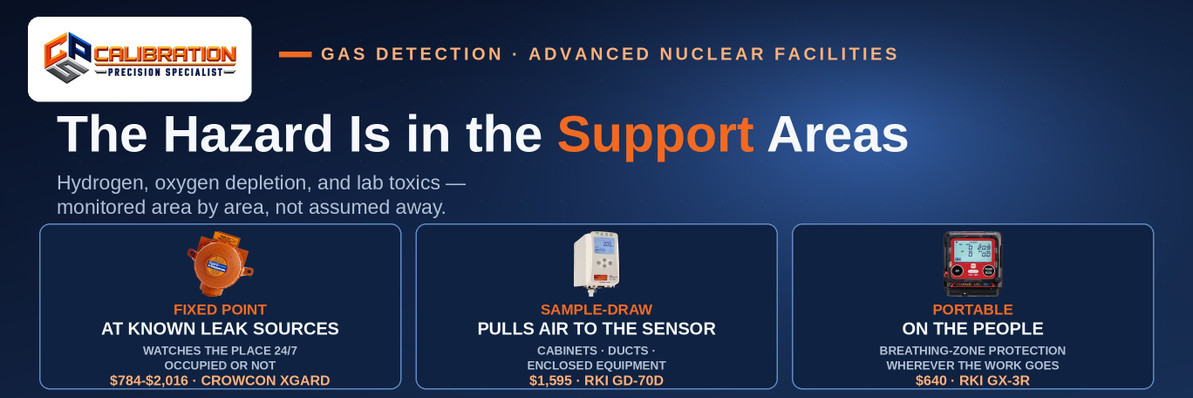
At a small modular reactor (SMR) or advanced nuclear facility, the gas detection that protects people day to day belongs mostly in the support areas: hydrogen monitoring in battery rooms and other areas where hydrogen is produced, stored, or can accumulate, oxygen monitoring wherever nitrogen, argon, or helium is stored or used indoors, and toxic-gas monitoring in support laboratories and chemical storage — built from fixed points at known leak sources, sample-draw systems for cabinets, ducts, and enclosed equipment, and portable monitors on the people who move between those areas. The reactor design changes; that support-area hazard map, and the layered way it is monitored, largely does not.
This post stays deliberately at facility-support level — the balance of plant, battery rooms, laboratories, and gas storage that every advanced nuclear facility operates, whatever reactor sits at its center. It does not describe reactor-process monitoring, and it does not quote nuclear regulatory requirements: a facility's licence, its own safety program, and its authority having jurisdiction set those, and they govern over any general guidance, including this post. What follows is what facilities monitor in those support areas, why, and with what — the layer CPS supplies, calibrates, and supports from Rockwood, about 30 minutes from the Oak Ridge corridor where several SMR and advanced-nuclear developers are setting up.
Which Gases Does an SMR or Advanced Nuclear Facility Actually Monitor?
Three hazard families cover most support-area monitoring:
| Hazard | Where it shows up | Why it is monitored |
|---|---|---|
| Hydrogen (H₂) | Battery rooms and battery-charging areas; anywhere hydrogen is produced, stored, or piped, including electrolysis equipment areas | Charging batteries off-gas hydrogen, and hydrogen is a flammable gas that is far lighter than air — it rises and collects at ceilings and in high pockets, so a leak builds an ignitable layer overhead while the floor-level air still reads clean |
| Oxygen depletion (O₂ low) | Rooms storing or using nitrogen, argon, or helium — cryogenic storage, dewar fill points, inert-gas manifolds, labs and process support areas using inert cover or purge gas | Nitrogen, argon, and helium are not toxic — they displace oxygen. A release indoors dilutes the air itself, with no smell, no color, and no irritation to warn anyone. Oxygen alarms are typically set at 19.5% O₂ |
| Toxic gases | Support laboratories, chemical storage, water-treatment and sample-analysis areas — the specific list follows the chemicals the facility actually keeps | Lab and support work uses and stores toxic gases and chemicals in ordinary industrial quantities. The gases monitored are the ones on the facility's own chemical inventory, each at its own point of storage or use |
Note what is not on that table: any claim about the reactor process itself. Process and radiological monitoring are engineered systems specified by the facility's design and licence. The support areas, by contrast, run on the same industrial gases as a research campus, a hospital, or a chemical plant — and they are monitored with the same industrial gas detection, which is exactly why they are sometimes under-planned: they look familiar, so they get assumed rather than mapped.
Why Do Battery Rooms Need Hydrogen Monitoring?
Because charging batteries make hydrogen continuously, in a room nobody stands in for most of the day. Hydrogen is roughly fourteen times lighter than air, escapes upward fast, and accumulates against ceilings and in high pockets — the placement and ventilation logic is covered in full in our post on why battery rooms need hydrogen detection. The monitoring answer is a fixed point mounted high, near the ceiling where the gas collects, watched around the clock — not a portable that visits on rounds. A fixed detector head from the fixed systems range — for example the SENKO SI-200E at $950 per point, or a point from the Crowcon Xgard family at $784–$2,016 — reports to a controller that can alarm outside the door and start ventilation before the next person walks in. Use this pattern anywhere hydrogen is handled indoors — battery rooms first, and any electrolysis or hydrogen storage area the facility operates — with the point placed where the gas goes, not where it is convenient to mount.
Why Is Oxygen Depletion a Separate Problem at Nuclear Facilities?
Because advanced nuclear sites are heavy users of inert gases. Nitrogen, argon, and helium show up across research, fuel, and support operations — cryogenic storage, inert atmospheres, purging, leak testing, and laboratory work. Every one of those uses can displace the oxygen in a room without adding anything toxic, which makes oxygen deficiency its own hazard class with its own name in formal safety programs: ODH — oxygen deficiency hazard. The physics, the mounting rules, and the single-dewar failure scenario are covered in our companion post on oxygen deficiency hazards in labs that use nitrogen, argon, and helium. The short version for facility planning: oxygen monitoring belongs in the breathing zone where people stand, near dewars, fill points, and storage, alarming typically at 19.5% O₂ — a dedicated room monitor such as the PureAire 99016 oxygen deficiency monitor ($2,255, factory alarm set points at 19.5% and 18.0% O₂, sensor rated for 10+ years of service) is built for exactly that duty, and remote-sensor versions put the sensing point in the room and the display where it will be seen before entry.
What About Toxic Gases in Support Laboratories?
Support labs at a nuclear facility do ordinary analytical chemistry — water chemistry, sampling, quality and materials work — and they store and use toxic gases and chemicals the way comparable labs do. The monitoring rule is inventory-driven, not template-driven:
- List what the lab actually keeps. The gases worth monitoring are the ones on the chemical inventory, in the quantities stored. A gas that is never on site needs no point; a gas stored in cylinders in a cabinet does.
- Put fixed points at storage and use. Gas cabinets, cylinder storage, and the benches or hoods where a gas is used are the leak sources — mount detector heads or stand-alone detectors at those points, at the height the gas occupies.
- Use sample-draw where a point cannot sit. Some points — inside a gas cabinet, a duct, or enclosed equipment — cannot host a detector or cannot be reached for calibration. That is the sample-draw case, below.
Fixed Points, Sample-Draw, or Portables — Which Goes Where?
All three, in layers. The deciding question for each area is where the gas is, and where the people are:
| Layer | Use it when | Example at CPS |
|---|---|---|
| Fixed point | The leak sources are known and stationary, and the room must be watched whether or not anyone is in it — battery rooms, gas storage, lab points of use | SENKO SI-200E, $950 per point; Crowcon Xgard family, $784–$2,016 |
| Sample-draw | The point that needs watching is inside a cabinet, duct, or enclosure, or cannot be reached safely or conveniently for service — a pump pulls the sample to a sensor mounted where people can reach it | RKI GD-70D, $1,595 |
| Portable | The exposure belongs to a person moving between areas — rounds, maintenance, sampling, contractor work — or an atmosphere must be tested before entry | RKI GX-3R 4-gas monitor, $640 per person |
The RKI GD-70D deserves its own line in a nuclear-support context: it is a fixed sample-draw transmitter whose built-in pump draws air at 0.5 L/min through tubing from the point being monitored to a plug-in sensor in the unit, and its sensor family covers specialty toxics — gases like arsine, phosphine, and silane that standard fixed heads simply do not offer. Where a support lab or process-support area handles specialty gases inside cabinets or enclosed equipment, sample-draw is how that point gets monitored continuously while the sensor stays reachable for the calibration it will need every six months, per RKI's recommendation.
The layer logic is the same one we lay out in fixed vs. portable gas detection: portables protect people, fixed systems protect places, and neither substitutes for the other. Placement height follows the gas — ceiling for hydrogen, breathing zone for oxygen and toxics — per the method in where fixed gas detectors should be placed, and the count follows the layout method in how many gas detectors a facility needs. How the signal path from sensor to controller to alarm works is explained in how a fixed gas detection system works.
What Does Support-Area Gas Detection Cost at a Facility Like This?
Hardware, per layer, at live CPS prices: fixed points run $950 per point for an SI-200E, with the Crowcon Xgard family spanning $784–$2,016 depending on gas and configuration; a dedicated oxygen room monitor is $2,255 for the PureAire 99016; a sample-draw point for a specialty toxic is $1,595 for the GD-70D; and portables run $640 per person at the GX-3R level. A controller, wiring or conduit, mounting, commissioning, and startup calibration sit on top of the fixed hardware and depend on the building — CPS quotes fixed work in writing after a site review rather than guessing an installed total. Then budget the program behind the hardware: calibration gas (CPS charges no hazmat fee on calibration gas, and CPS cylinders carry QR codes linking to that cylinder's SDS and certificate of analysis), scheduled calibration of every channel on every fixed point and portable, and sensor replacements over each instrument's life. CPS in-house calibration is $55 for a single-gas instrument and $90 for a 4- or 5-gas instrument; on-site work is quoted in writing. An uncalibrated detector network at a facility with a formal safety program is a finding waiting to happen — the calibration records are part of the system, not an afterthought.
Frequently Asked Questions
What gas detection does a small modular reactor facility need? In its support areas: fixed hydrogen monitoring in battery rooms and any area where hydrogen is produced, stored, or can accumulate; oxygen monitoring wherever nitrogen, argon, or helium is stored or used indoors; and toxic-gas monitoring in support laboratories and chemical storage, driven by the facility's own chemical inventory. Those areas are covered by fixed points at known leak sources, sample-draw systems for cabinets, ducts, and enclosed equipment, and portable monitors on people who move between areas. Reactor-process and radiological monitoring are separate engineered systems specified by the facility's design and licence.
Why do nuclear facilities monitor hydrogen in battery rooms? Because charging batteries off-gas hydrogen continuously, and hydrogen is a flammable gas roughly fourteen times lighter than air that rises and collects at ceilings and in high pockets of enclosed rooms. A battery room is unoccupied for most of the day, so the leak builds where nobody is standing to notice it. A fixed hydrogen point mounted high, reporting to a controller that can alarm outside the door and start ventilation, is the standard answer — the full reasoning is in our battery-room hydrogen post.
What is ODH, and why does it matter at advanced nuclear facilities? ODH stands for oxygen deficiency hazard — the formal term safety programs use for the risk that an inert gas such as nitrogen, argon, or helium displaces the oxygen in a room's air. It matters at research, fuel, and advanced nuclear facilities because they are heavy users of inert gases for cryogenics, inert atmospheres, purging, and laboratory work. Inert gases give no warning of their own — no smell, no color, no irritation — so the room is monitored for the oxygen that is missing, typically alarming at 19.5% O₂.
Do SMR facilities need portable gas detectors if they have fixed systems? Yes. A fixed system watches its points; it cannot test an atmosphere before a worker enters a space, follow a maintenance crew on rounds, or protect a contractor working in an area with no fixed coverage. Portables — a 4-gas monitor like the RKI GX-3R at $640 is the standard crew instrument — protect the person, in the breathing zone, wherever the work goes. Fixed and portable are layers, not alternatives.
What is a sample-draw gas detector, and where is it used at a nuclear facility? A sample-draw detector uses a built-in pump to pull air through tubing from the point being monitored to a sensor mounted somewhere reachable. It is used where the point itself cannot host a detector or cannot be reached for service — inside gas cabinets, ducts, and enclosed equipment. The RKI GD-70D ($1,595) draws at 0.5 L/min to a plug-in sensor and covers specialty toxics such as arsine, phosphine, and silane, which makes it the fit for support-lab and process-support points handling specialty gases.
Which toxic gases should a support laboratory monitor? The ones on its own chemical inventory, in the quantities it actually stores and uses — there is no universal list, and inventing one leaves the real gas unmonitored while adding points for gases that are never on site. Build the list from the inventory and storage locations, put fixed points at cabinets, cylinder storage, and points of use, and use sample-draw for gases or locations a standard fixed head cannot serve, such as the specialty toxics the GD-70D's sensor family covers.
How much does gas detection cost for an advanced nuclear facility's support areas? Per point and per person, at live CPS prices: fixed detector hardware runs $950 for a SENKO SI-200E and $784–$2,016 across the Crowcon Xgard family; a dedicated oxygen room monitor (PureAire 99016) is $2,255; a sample-draw specialty-toxic point (RKI GD-70D) is $1,595; and portable 4-gas monitors are $640 per person (RKI GX-3R). Controllers, wiring, installation, and commissioning for fixed systems are quoted in writing after a site review — there is no honest installed total without seeing the building.
Does the NRC require specific gas detectors in SMR support areas? This post does not make that claim, and you should not take gas-detection requirements for a licensed facility from a vendor blog. A facility's licence, its safety program, and its authority having jurisdiction set its monitoring requirements, and those govern. What this post describes is the monitoring practice facilities use in support areas — battery rooms, inert-gas storage and use areas, and support labs — and the equipment that performs it. Confirm requirements against your own licence and safety program.
Where should oxygen monitors be placed at a nuclear facility? Where the people are: in the breathing zone, in rooms where nitrogen, argon, or helium is stored, dispensed, or used — near dewars, fill points, manifolds, and storage — alarming typically at 19.5% O₂. Argon is heavier than air and can pool low, so low points and pits in argon areas deserve attention as well. The detailed placement rules are in our companion post on oxygen deficiency hazards in nitrogen, argon, and helium labs.
Who calibrates gas detectors for facilities near Oak Ridge? CPS Calibrations, in Rockwood, Tennessee — about 30 minutes from Oak Ridge — sells, installs support for, and calibrates the fixed and portable gas detection covered in this post, and we calibrate every channel on every instrument we service. In-house calibration is $55 for single-gas and $90 for 4- or 5-gas instruments; on-site work is quoted in writing. Call 865-900-8844 with your area list and we will help you map points to instruments.
The Bottom Line
Map the support areas, not the reactor. List every room where hydrogen can accumulate, every room where nitrogen, argon, or helium is stored or used, and every toxic gas on the support labs' inventory — then cover the stationary hazards with fixed points, the unreachable points with sample-draw, and the people with portables, and calibrate every channel on schedule. That layered map is the gas detection an SMR or advanced nuclear facility actually runs on.
Planning support-area monitoring for a new facility? Call 865-900-8844 or reach us through Contact Us. Browse the building blocks — fixed systems, portable multi-gas monitors, calibration gas, and calibration services — or bring us your area list and we will walk it room by room.
CPS Calibrations · 109 S. Front Street, Rockwood, TN 37854 · Calibration Gas · Calibration Services · Contact Us
Need a calibration you can file?
In-house calibration at CPS in Rockwood, Tennessee — $55 for single-gas instruments, $90 for 4- and 5-gas — every channel, as-found and as-left data, full certificate.
See Calibration Servicesor call 865-900-8844
Recent Posts
-

Can You Add a Pump to a SENKO SGT-P or MGT?
Yes — SENKO's SP-Pump101 external sampling pump ($330, part AAA006000) fits the SGT, SGT-P, and MGT, …Nov 12th 2026 -

What Refrigerant Detection Does a Grocery Store Need?
A grocery store needs refrigerant detection in three places: low-mounted carbon dioxide (R-744) sens …Nov 11th 2026 -

What Is LEL and UEL? The Explosive Range, Gas by Gas
The LEL is the lowest concentration of a gas in air that can explode, and the UEL is the highest: me …Nov 10th 2026