
Who Installs Monnit Wireless Sensors? Turnkey Remote Monitoring, Done For You
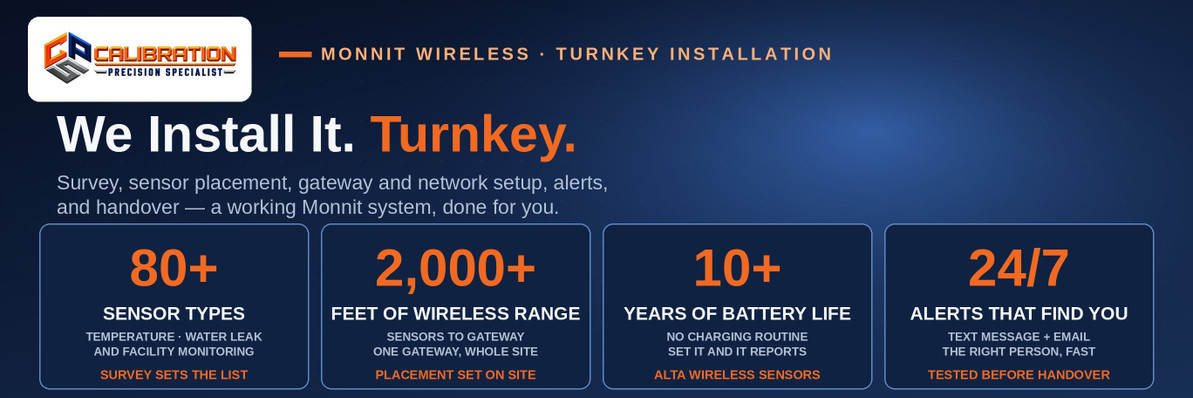
CPS Calibrations installs Monnit wireless sensor systems turnkey in East Tennessee: we survey the site, place the sensors, set up the gateway and network connection, configure the text and email alerts, and hand over a working system — you never have to unbox, mount, pair, or program anything. Monnit's ALTA line covers 80+ sensor types with 2,000+ feet of wireless range and 10+ year battery life, and the job most customers start with is freezer and cold-storage temperature monitoring, with water leak and general facility monitoring close behind.
Search for Monnit sensors and you will find plenty of places to buy them. What the search results skip is the part that decides whether the system ever saves you anything: somebody has to walk the building, decide what is worth monitoring, put each sensor where it reads the real risk, connect a gateway to the network, and make the alerts land on a person who will respond. That somebody is us. This post explains what a turnkey Monnit installation actually includes, what it monitors, and what the handover looks like — the same installation discipline we bring to fixed system installation work.
What Does a Turnkey Monnit Installation Include?
Five steps, all of them ours:
- 1. Survey. We walk the site with you and list what is actually at risk: the freezers and coolers whose failure costs inventory, the mechanical rooms and ceilings where a water leak runs the longest before anyone sees it, the doors, spaces, and equipment whose condition you currently learn about by walking past. The survey sets the sensor list and the count — not a catalog page.
- 2. Sensor placement. A temperature sensor reads the air where it sits, not the air you care about. Placement — inside the case or at the door, at product height or at the coil, above the pipe run or under it — is the difference between an early warning and a late obituary. Placement is decided on site, per sensor.
- 3. Gateway and network setup. Monnit sensors report through a gateway, and the ALTA wireless range of 2,000+ feet is what lets one gateway serve a whole building or site. We mount the gateway, connect it to your network, and confirm every sensor is reporting through it before anything else proceeds.
- 4. Alert configuration. Each monitored point gets its thresholds and its people: who gets the text message, who gets the email, at what reading, and after how long. A freezer alarm that lands in an inbox nobody opens at night is not an alarm. We configure alerts with you, contact by contact.
- 5. Handover. You get a working system and a walkthrough: what is monitored, where, what an alert means, and what to do when one arrives. From handover day, the system reports on its own — the sensors run 10+ years on a battery, so there is no charging routine and no daily check to forget.
What Do Most Customers Monitor First?
Cold storage and freezer temperature. This is the lead application, and the reason is arithmetic: a compressor or door failure overnight can destroy more inventory value than the entire monitoring system costs to install, and the failure is silent until someone opens the door in the morning. A temperature sensor in each freezer and cooler, alerting by text the moment the temperature leaves its band, converts a total loss into a service call. (Temperature monitoring watches the consequence — for the gas side of cold storage, ammonia itself, see ammonia detection in cold storage; the two systems answer different questions and neither replaces the other.)
Water leak. The second most common starting point: sensors where water does its damage quietly — mechanical rooms, under and around water heaters and HVAC equipment, ceilings over finished space, basements. A leak alert in the first hour is a mop and a fitting; the same leak found Monday morning is a renovation.
General facility monitoring. From there, the 80+ ALTA sensor types cover the long tail of things a building wishes it could report: temperature in rooms and ducts, door open/closed state, and other conditions across a plant, warehouse, school, restaurant, or office. The survey is where this list gets built — if a condition matters and a sensor exists for it, it goes on the plan.
Why Not Just Buy the Sensors and Install Them Yourself?
You can buy sensors from plenty of places — what you cannot buy in the same box is the afternoon of decisions that makes them a system. The honest failure list from self-installs is always the same: sensors placed where mounting was easy instead of where the risk lives, a gateway that half the sensors cannot reach, thresholds left at defaults that either cry wolf weekly or sleep through the real event, and alerts pointed at a generic inbox. None of those failures show up on installation day. They show up on the one night the system was for.
A turnkey install is priced as a job and finished as a job: surveyed, placed, connected, configured, and handed over, with the alert path tested end to end while we are standing there. If a sensor can be reached, an alert has been received, and the person who will get the 2 a.m. text has seen a test one — before we leave.
Where Does CPS Install Monnit Systems?
From our shop at 109 S. Front Street, Rockwood, TN 37854, across East Tennessee — the same territory our calibration services and fixed-system crews already work. Restaurants and grocers with walk-ins, warehouses and cold-storage operators, manufacturers, schools, churches, and offices: if the building has something in it that fails quietly, it is a candidate. Call 865-900-8844 and describe the building; the survey is where the system gets designed.
Frequently Asked Questions
Who installs Monnit wireless sensors?
CPS Calibrations installs Monnit ALTA wireless sensor systems turnkey in East Tennessee. Turnkey means the whole job: a site survey, sensor placement, gateway mounting and network setup, alert configuration, and a handover walkthrough. You describe the building and what you are worried about; the system arrives working, tested end to end, with alerts already pointed at the right people. Call 865-900-8844 to start with a survey.
What does turnkey installation actually include?
Five things: (1) a survey that lists what is worth monitoring and how many sensors it takes; (2) placement of every sensor where it reads the real risk; (3) gateway installation and network connection, with every sensor confirmed reporting; (4) alert configuration — thresholds, timing, and the specific people who receive each text and email; and (5) handover, a walkthrough of what is monitored and what to do when an alert arrives. Nothing is left in a box for you to finish.
What can Monnit sensors monitor in a freezer or cold-storage room?
Temperature — continuously, with an alert the moment it leaves the band you set. That is the difference between a compressor failure becoming a service call and the same failure becoming a spoiled inventory discovered the next morning. Monnit's ALTA line includes temperature among its 80+ sensor types, and cold storage is the most common first installation CPS performs. Temperature monitoring does not detect refrigerant gas — ammonia rooms still need gas detection, which is a separate system.
How far can Monnit wireless sensors reach?
Monnit's ALTA wireless range is 2,000+ feet from sensor to gateway, in the platform's published figures. In practice, range inside a building depends on walls, racking, and construction, which is exactly why placement and gateway position are set during an on-site survey rather than guessed from a floor plan — and why every sensor's reporting is confirmed through the gateway before the install is called finished.
How long do Monnit sensor batteries last?
10+ years, per Monnit's published platform figures for the ALTA line. That battery life is what makes wireless monitoring practical in freezers, ceilings, and mechanical spaces: there is no charging rotation, no battery swap schedule to manage in the first years of the system's life, and no sensor quietly dying because a routine was forgotten. When a battery finally does run low, the system itself can report it — the sensors are monitored, too.
How do Monnit alerts work?
By text message (SMS) and email, sent when a monitored reading crosses the threshold set for that sensor. During a CPS turnkey install, alerts are configured per point: this freezer alerts these two people by text after this long above this temperature; that water sensor alerts immediately. The alert path is tested live during the installation, so the first text you receive from the system is a test — not the real 2 a.m. event.
Can Monnit sensors detect water leaks?
Yes — water detection is one of the standard starting points for a Monnit system, alongside temperature. Leak sensors go where water runs longest before a person sees it: mechanical rooms, around water heaters and HVAC equipment, under sinks and pipes in finished spaces, and basements. An alert in the first hour of a leak usually means a mop and a fitting; the same leak found days later means flooring, drywall, and possibly mold work.
How many different things can one Monnit system monitor?
The ALTA line covers 80+ sensor types, and one gateway-based system can mix them: freezer temperatures, water leak points, room temperatures, door states, and other conditions across the same building, all reporting through the same alert setup. Most CPS installs start with the one or two applications that carry real money — cold storage first, water second — and add points later, because adding a sensor to a working system is the easy part.
Do I need Wi-Fi or an IT department for a Monnit system?
You need a network connection for the gateway, which CPS sets up as part of the install — you do not need to configure anything, and you do not need an IT department. The sensors themselves are wireless and battery powered, so there is no sensor wiring to run through walls or freezers. During the survey we confirm where the gateway will live and how it connects, so network questions are settled before installation day, not discovered during it.
How much does a Monnit installation cost?
It is scoped by the survey, because the real variables are the building and the risk list: how many freezers, leak points, and other conditions are being monitored, across how much space. What we can tell you before the survey is what you are buying — a finished, tested system with alerts configured and a handover walkthrough, not a box of parts and a login. Call CPS Calibrations at 865-900-8844, describe the building, and we will survey it and price the installed system as one job.
The Bottom Line
Buying Monnit sensors is easy; getting a working monitoring system is the install — the survey, the placement, the gateway, and alerts that reach a person who will act. CPS Calibrations installs Monnit ALTA systems turnkey across East Tennessee, starting where the money is lost quietly: freezers, cold storage, and water. One call, one finished system.
Want Monnit monitoring without installing it yourself? Call CPS Calibrations at 865-900-8844 for an installed system — surveyed, placed, connected, configured, and handed over working.
CPS Calibrations · 109 S. Front Street, Rockwood, TN 37854 · Fixed System Installation · Ammonia Detection in Cold Storage · Calibration Services
Need a calibration you can file?
In-house calibration at CPS in Rockwood, Tennessee — $55 for single-gas instruments, $90 for 4- and 5-gas — every channel, as-found and as-left data, full certificate.
See Calibration Servicesor call 865-900-8844
Recent Posts
-

What Is Remote Monitoring for Fixed Gas Detection?
Remote monitoring for fixed gas detection means a fixed system's live readings, trends, and alarm hi …Nov 23rd 2026 -

What Are the Key Differences Between the GX-6000 and GX-6100?
The RKI GX-6100 is the current replacement for the discontinued GX-6000: both are pumped 6-gas monit …Nov 22nd 2026 -

How to Read a PID Correction Factor Chart
To read a PID correction factor chart, find your vapor’s row, take the factor under your own lamp en …Nov 21st 2026