
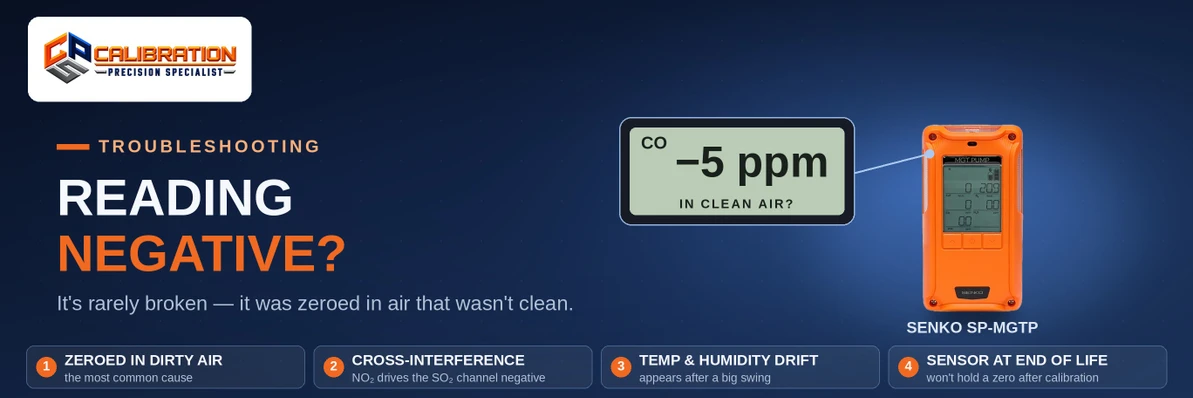
Why Does My Gas Detector Read Negative?
A gas detector reads negative most often because it was zeroed in air that wasn't clean: if 5 ppm of carbon monoxide is present when the sensor is zeroed, the instrument treats that 5 ppm as its baseline and then reads −5 ppm in genuinely clean air. The other sourced causes are sensor drift from temperature and humidity changes, negative cross-interference from a second gas (an SO₂ sensor exposed to NO₂ is the textbook case), and a sensor at end of life. The fix order is: re-zero in verified clean air, bump test, run a full calibration — and replace the sensor if the negative reading survives all three.
A negative number feels like a malfunction, and it is usually treated as one — the detector gets waved around, restarted, and eventually sent in as "broken." Most of the time it is none of that. It is an instrument reporting, accurately, that the air in front of it contains less of the target gas than the air it was zeroed in. This post works through the causes in the order they actually occur, using the explanation published by Industrial Scientific — the manufacturer whose support literature addresses this question most directly — plus OSHA's calibration guidance. Cross-sensitivity in general is a bigger subject, covered in our post on electrochemical toxic sensor cross-sensitivities; here the focus is the negative sign itself.
Cause 1: It Was Zeroed in Contaminated Air
This is the most common cause, and Industrial Scientific says so outright: negative sensor readings most commonly occur when an instrument has been "zeroed" in a contaminated atmosphere, where small levels of the sensor's target gases are present. The mechanism is exact arithmetic:
- The zero operation tells the instrument: whatever the sensors are seeing right now is zero.
- If the air at that moment holds 5 ppm CO — from a forklift two bays over, a running engine, a heater — the instrument records that signal as its baseline.
- Moved into clean air, the sensor signal drops below the recorded baseline by exactly the contamination amount: −5 ppm.
The size of the negative reading is therefore a measurement of how dirty the zero was. It is also why the classic places to create this problem are the classic places people power up and auto-zero: at the truck, in the plant doorway, at the edge of the work area instead of away from it. Auto-zero-on-startup features make it effortless — the instrument baselines itself wherever it happens to be switched on.
The fix: take the instrument to air you have reason to trust — outdoors away from vehicles and vents, or use a zero-air cylinder — let it warm up fully, and re-zero there. If the negative reading was a dirty zero, it clears immediately and stays cleared.
Cause 2: Negative Cross-Interference
Some gases push a sensor's output below its baseline. Industrial Scientific's example is the standard one: a sulfur dioxide sensor typically has a −100% cross-interference to nitrogen dioxide, so exposure to 2 ppm of NO₂ produces an SO₂ reading of −2 ppm — with no SO₂ present at all.
Two consequences follow, and the second is the dangerous one:
- A negative reading on one channel while a second channel shows a real gas is probably interference, not a fault. The NO₂ channel reading +2 next to an SO₂ channel reading −2 is a fingerprint, not a coincidence.
- Interference subtracts from real readings too. In an atmosphere holding 2 ppm SO₂ and 2 ppm NO₂, the SO₂ channel reads zero — the true SO₂ contribution and the NO₂ interference cancel. The hazard is present and the display says it isn't. This is why the answer is never to remove the "confusing" sensor: as Industrial Scientific points out, without the NO₂ sensor in the instrument you would have no way of knowing the NO₂ was there cancelling your SO₂ reading.
The fix: none, at the instrument — this is physics, and the remedy is interpretation. Know the cross-interference table for your sensor set (our cross-sensitivities post works through the common pairs), read the instrument as a system rather than channel by channel, and treat "one channel negative, another positive" as a pattern to explain before trusting either number.
Cause 3: Drift from Temperature and Humidity
Industrial Scientific's framing: all electrochemical and catalytic bead sensors can be prone to both positive and negative drift due to environmental factors like changes in temperature and humidity. A sensor zeroed in a cool, air-conditioned shop and carried into hot, wet outdoor air — or the reverse, off a cold truck into a warm plant — can sit a few ppm below its baseline until everything stabilises. OSHA's calibration bulletin lists use in extreme temperature and humidity among the routine causes of calibration drift, and Honeywell's BW Solo manual advises zeroing the detector once every 24 hours or after a change in environmental conditions for exactly this reason.
The fix: let the instrument acclimatise where it will be used, then zero it there, in clean air, at working temperature. Small negatives that appear after a big environmental swing and settle after a proper re-zero are drift, not damage. Negatives that greet you every morning in the same conditions are a pattern to investigate — see Cause 4.
Cause 4: The Sensor Is Dying
A sensor at end of life doesn't usually stop; it fades, and a wandering, increasingly negative baseline is one of the fade patterns. OSHA's catalogue of drift causes ends at degradation — gradual chemical degradation of sensors and drift in electronic components that occur normally over time, plus damage from high gas exposure, poisons, and corrosive gases. The tell is behaviour across the fix sequence: the negative reading survives a verified clean-air zero, the instrument takes a full calibration poorly or not at all (OSHA notes a failing sensor often displays a failure message or will not allow the reading to be fully adjusted), and the offset returns within days.
The fix: there isn't one at the instrument level, and that is the point of the sequence — a sensor that cannot hold a zero after a correct full calibration is finished. Replacement sensors for common instruments are a modest line item (a genuine RKI O₂ sensor is $160; a SENKO O₂ sensor is $121) next to the cost of trusting a detector that's quietly offset. When the channel in question is oxygen, our post on why oxygen sensors die covers the fade pattern in depth.
The Masking Trap: When Zero Is Lying to You
One more wrinkle that explains the complaint "my old detector never did this." Industrial Scientific notes that some manufacturers mask negative readings — displaying every negative value as zero — because they believe the negatives confuse users. If you have changed instrument brands and suddenly "see negatives all the time," the negatives were probably always there; the old instrument was hiding them.
Masking is not harmless cosmetics. Industrial Scientific's example: if an H₂S sensor has a −10 ppm offset from drift or a false zero and the instrument masks it, then a true 10 ppm exposure still displays zero, and a true 20 ppm exposure displays only 10. The worker sees a clean display inside a real hazard. An instrument that shows its negatives is giving you information the masked one conceals — including the early warning that its baseline has shifted.
What to Do, Step by Step
- Note the pattern. Which channel, how negative, and what else is on the display? A negative toxic channel beside a positive reading on another channel points at cross-interference (Cause 2) — interpretation, not repair.
- Move to air you trust and re-zero. Outdoors, upwind, away from engines and vents — or on a zero-air cylinder. Fully warmed up, at working temperature. Most negative readings die here (Causes 1 and 3).
- Bump test. Certified gas, alarms firing, channels responding in the right direction and to plausible values.
- Full zero-and-span calibration if the offset persists or the bump is off.
- Take it out of service if the negative survives a correct calibration, or returns within days. That is a sensor replacement or a bench diagnosis — send it in rather than zeroing it every morning and hoping. CPS's calibration services bench handles exactly this triage: we calibrate every channel, and when a channel won't calibrate, we tell you which sensor it needs.
The Bottom Line
A negative reading is rarely a broken detector. It is usually a receipt: for a zero taken in dirty air (the offset equals the contamination), for a second gas pushing a channel below baseline, for a temperature or humidity swing still settling out, or — when it survives a clean re-zero and a full calibration — for a sensor at the end of its life. Read it, work the sequence, and only then condemn the instrument. The detectors that never show a negative are not necessarily the healthier ones; some of them are just hiding the same information.
Detector reading negative and it won't clear? Send it to the bench or call us first — 865-900-8844 — or reach us through Contact Us. A five-minute conversation often separates a dirty zero from a dead sensor.
Frequently Asked Questions
Why does my gas detector read negative? Most commonly because it was zeroed in a contaminated atmosphere. As Industrial Scientific explains in its manufacturer guidance, if small levels of the sensor's target gas are present when the instrument is zeroed, the instrument records that level as its baseline — so in clean air it reads negative by exactly the amount that was present. Zeroed with 5 ppm of CO in the air, it reads −5 ppm in clean air. The other causes are negative cross-interference from a second gas, drift after temperature or humidity changes, and a sensor reaching end of life.
Is a negative reading on a gas detector dangerous? The reading itself is information, not a hazard — but what it implies can be. A negative offset means the baseline has shifted, so real readings are shifted too: with a −10 ppm offset, a true 10 ppm H₂S atmosphere displays as zero. Industrial Scientific makes the point sharply about instruments that mask negatives as zero: the worker sees a clean display at a real exposure. Treat a persistent negative as an accuracy problem to fix before trusting the instrument, not as a display quirk.
How do I fix a negative reading on my gas detector? Work the sequence. First, move to air you can verify is clean — outdoors away from engines and vents, or a zero-air cylinder — let the instrument warm up and acclimatise, and re-zero there; most negative readings are a dirty zero or environmental drift and clear at this step. Then bump test with certified gas, and run a full zero-and-span calibration if the offset persists. If the negative reading survives a correct full calibration, or keeps returning within days, the sensor is at end of life and needs replacement.
Can a gas detector read negative because of another gas? Yes — negative cross-interference. Industrial Scientific's textbook example: an SO₂ sensor typically has a −100% cross-interference to nitrogen dioxide, so 2 ppm of NO₂ produces an SO₂ reading of −2 ppm with no SO₂ present. More seriously, the interference subtracts from real readings on the same channel: 2 ppm of SO₂ alongside 2 ppm of NO₂ displays as zero on the SO₂ channel. A negative channel next to a positive channel is a pattern to interpret, not a fault to repair.
Why does my oxygen sensor read below 20.9% in fresh air? Start with the air: a zero or fresh-air calibration performed where oxygen was displaced — near vents, in a vehicle, in a low-lying pocket — anchors the channel wrong. Then consider drift: OSHA's calibration guidance lists environmental conditions including temperature, humidity, and atmospheric pressure among the factors calibration and testing must account for. Finally, age: the galvanic oxygen cell consumes itself in normal service and is usually the first sensor in the instrument to fade. Re-zero in verified fresh air; if the channel won't hold 20.9% through a full calibration, the cell is done.
Why did my old gas detector never show negative readings? Probably because it hid them. Industrial Scientific notes that some manufacturers mask negative readings — displaying all of them as zero — on the theory that negatives confuse users, and that customers who switch instruments suddenly "see negatives all the time." The offset existed on the old instrument; it was simply not shown, which also means real low-level exposures were being under-reported by the amount of the hidden offset.
What does a small negative reading like −1 or −2 ppm mean? Usually baseline noise or minor drift — a fraction of the zero that moved with temperature, humidity, or a slightly imperfect zero. Context decides: a −2 ppm CO reading that clears after a proper clean-air zero is a non-event; a −2 ppm that grows week over week, or appears beside odd behaviour on other channels, is an early drift pattern worth a bump test and a full calibration. What it should never get is a shrug plus an entry into a hazardous area — verify the instrument first.
Should I keep zeroing a detector that keeps going negative? No. Re-zeroing is the correct first step, once, in verified clean air. If the instrument goes negative again within days, repeated zeroing is masking a progressing problem — most often a sensor whose output is wandering as it dies. OSHA's guidance for an instrument that can't be brought back by full calibration is to remove it from service and have it serviced. Zeroing a dying sensor every morning gives you a detector that reads zero beautifully and everything else wrongly.
Can temperature changes make a gas detector read negative? Yes. Industrial Scientific states that all electrochemical and catalytic bead sensors can drift positive or negative with changes in temperature and humidity, and OSHA's calibration bulletin lists extreme temperature and humidity among the standard causes of calibration drift. The pattern is recognisable: the offset appears after a big swing — cold truck to warm plant, air-conditioned shop to humid outdoors — and settles once the instrument acclimatises and is re-zeroed at its working temperature.
When is a negative reading a sign the sensor needs replacing? When it survives the fix sequence: a verified clean-air zero at working temperature, a bump test, and a full zero-and-span calibration — and still returns, or when the instrument refuses to complete the calibration adjustment at all. OSHA notes that a sensor damaged by exposure or degradation often displays a failure message or won't allow the reading to be fully adjusted during calibration. At that point the diagnosis is made: the sensor is finished, and replacement (common sensors run $121–$255 at CPS) restores the instrument.
CPS Calibrations · 109 S. Front Street, Rockwood, TN 37854 · Calibration Gas · Calibration Services · Contact Us
Recent Posts
-

Why Does Gas Detector Data Logging Matter? The Paper Trail Your Incidents Need
Gas detector data logging matters because it is the only objective record of an incident: a data-log …Oct 22nd 2026 -

What Is a Confined Space? OSHA's Definition, the 3 Tests, and When It Becomes Permit-Required
A confined space is a space that passes all three of OSHA's tests at the same time: it is large enou …Oct 21st 2026 -

PID vs. LEL for VOC Detection: Which Sensor Do You Actually Need?
Use a PID to detect VOCs and an LEL sensor to detect explosive atmospheres — they measure different …Oct 21st 2026