
Blast Furnace Gas: Monitoring a Fuel That Is Mostly Carbon Monoxide
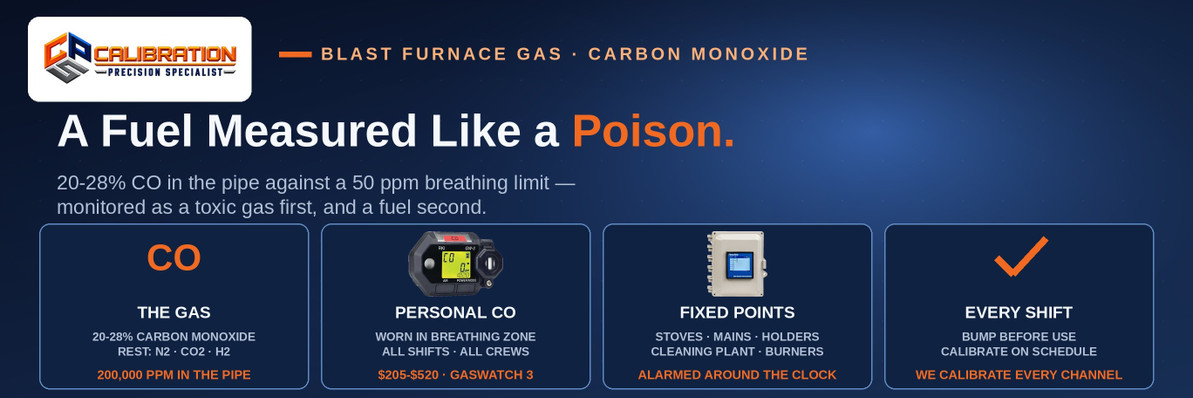
Blast furnace gas is a working fuel that is roughly 20–28% carbon monoxide — about 200,000 ppm CO in the pipe against an OSHA exposure limit of 50 ppm — so it is monitored as a toxic gas first and a fuel second: a personal CO monitor on every worker in the gas network, fixed CO points at the stoves, gas cleaning plant, holders, and burner fronts it feeds, and calibration records for every channel, because a leak too small to see or smell can put a breathing zone past the legal limit in seconds.
Most plant fuels announce a leak with an odor or a flame risk. Blast furnace gas announces nothing — CO is colorless and odorless — and the concentration that makes it useful as a fuel is thousands of times the concentration that endangers a person. This post covers what the gas is, where it travels, and how the monitoring is layered. For the whole-mill picture, see what gas detection does a steel mill need?
What Is Blast Furnace Gas Made Of?
Published industry composition tables put typical blast furnace gas at:
| Component | Typical share by volume |
|---|---|
| Nitrogen (N2) | About 40–60% |
| Carbon monoxide (CO) | About 20–28% |
| Carbon dioxide (CO2) | About 17–25% |
| Hydrogen (H2) | About 1–7% |
The nitrogen and CO2 are why the gas has a low heating value and needs large burners and big pipe: most of what flows is inert. The CO is why the gas exists at all — it is the recovered energy of the reduction process — and why it is handled with a toxic-gas discipline. The small hydrogen fraction and the CO together also make the gas flammable once mixed with air, but flammability is the second hazard, not the first: air becomes illegal to breathe at 50 ppm CO, while the gas stream itself carries roughly four thousand times that.
Why Is Blast Furnace Gas Monitored as a Toxic Gas First?
Run the numbers. A flange weeps gas that is 25% CO into a work area. Diluted a hundredfold — a barely noticeable leak in a ventilated space — the air is still 2,500 ppm CO, double the 1,200 ppm concentration NIOSH classifies as immediately dangerous to life or health. Diluted a thousandfold it is 250 ppm, five times OSHA's 50 ppm 8-hour limit. No realistic leak is "small" when the source is this rich, and none of it can be smelled: CO has no odor at any of those concentrations, which is why steel plants built their gas-safety culture on instruments instead of senses, and why the CO channel — not the LEL channel — is the one that leads on a blast furnace crew's monitor.
Where Does Blast Furnace Gas Travel in a Mill?
The gas leaves the furnace top dirty and hot, passes through dust catching and gas cleaning, and from there the network fans out: back to the hot blast stoves that heat the furnace's own air, to gas holders that buffer supply, and through large-bore mains to the boilers, power house, reheating furnaces, and other burners that run on it — often blended or supported by richer coke oven gas. Every leg of that network is a monitoring geography: cleaning-plant seals and water systems, stove domes and changeover valves, holder seals and roofs, main flanges, condensate points, valve stations, and every burner front where the gas is finally burned. Maintenance multiplies the exposure: line breaking, valve work, and stove repairs put people directly on equipment that held 25% CO an hour earlier, which is why entry and hot-work testing ride on the same instrument fleet.
Where Do the Fixed Detectors Belong?
Fixed CO points watch the leak sources around the clock, including the shifts when nobody is standing there:
- Stove area — around changeover valves, burner connections, and the dome base, where thermal cycling works on every seal.
- Gas cleaning plant — at scrubber and precipitator seals and the fan/blower room that moves the gas.
- Holders and boosters — at seal and roof level and in booster houses, where a small continuous leak can accumulate in still air.
- Mains and valve stations — at flange clusters, expansion joints, and condensate legs along elevated and tunneled runs.
- Burner fronts — where the gas is burned in boilers and reheating furnaces, paired with combustible-gas thinking at the burner itself.
A fixed toxic-gas transmitter of the Crowcon Xgard XG1 class (configured $1,022–$2,016) is the pattern for these points: continuous CO reading, relay and control-room alarming, and a calibration interval the plant can actually keep. Siting is survey work, not guesswork — the fixed system installation process starts from the pipework and airflow you actually have.
Why Does Everyone in the Network Wear a CO Monitor?
Because the fixed system knows the air at its sensors, and the worker is somewhere else — on a main platform, inside a stove base, at a condensate leg. The personal instrument is the layer that travels: a wrist- or clip-worn CO monitor like the RKI GasWatch 3 (configured $205–$520) for dedicated CO watch, or a 4-gas monitor like the RKI GX-3R ($590–$690) where the same worker also faces LEL, O2, and H2S channels in confined-space and maintenance work — the full single-gas monitor and portable multi-gas monitor ranges cover both patterns. The culture matters as much as the hardware: alarms are treated as information, not noise — leave, ventilate, find the source — because with a 200,000 ppm source gas, the second exposure is the one the first alarm was warning about.
Calibration is the quiet half of the system. An electrochemical CO cell in mill service drifts; a monitor reading 30% low turns a 70 ppm exposure into a displayed 49 ppm — under the limit on screen, over it in the lungs. We calibrate every channel, on portables shipped to our Rockwood shop and on fixed points serviced on site under written quote, through calibration services.
Frequently Asked Questions
What percentage of blast furnace gas is carbon monoxide?
About 20–28% by volume in published industry composition tables, alongside roughly 17–25% carbon dioxide, 1–7% hydrogen, and a balance that is mostly nitrogen. The exact share moves with furnace practice, but the safety conclusion does not: the gas in the main is on the order of 200,000 ppm CO, against an OSHA worker exposure limit of 50 ppm.
Is blast furnace gas toxic or flammable?
Both — but it is managed as toxic first. Its carbon monoxide makes diluted leaks dangerous to breathe at dilutions of a thousand to one, long before the mixture is a fire problem, and CO is colorless and odorless so there is no sensory warning. The gas is also flammable when mixed with air (it contains CO and hydrogen), which is why burner areas add combustible-gas discipline on top of CO monitoring.
What is the OSHA limit for carbon monoxide exposure?
50 ppm as an 8-hour time-weighted average. NIOSH recommends a lower 35 ppm TWA with a 200 ppm ceiling, and classifies 1,200 ppm as immediately dangerous to life or health (IDLH). Against a source gas of roughly 200,000 ppm CO, those numbers are why blast furnace areas run continuous personal and fixed monitoring rather than periodic spot checks.
Where is blast furnace gas used in a steel mill?
It is burned in the hot blast stoves that heat the furnace's air, and distributed through holders and large mains to boilers, the power house, reheating furnaces, and other plant burners — often blended with or supported by richer coke oven gas because blast furnace gas has a low heating value. Every part of that network — cleaning plant, stoves, holders, mains, burner fronts — is CO monitoring territory.
Where should fixed CO detectors be placed around a blast furnace?
At the leak sources: stove changeover valves and burner connections, gas cleaning seals and the blower room, holder seals and booster houses, flange clusters and valve stations along the mains, and the burner fronts the gas feeds. Placement follows a survey of the actual pipework, seals, and airflow; detectors watch breathing zones and accumulation points, not just the pipe itself.
Why do blast furnace workers wear personal CO monitors if fixed detectors are installed?
Fixed detectors report the air at fixed points; workers move — onto platforms, into stove bases, along mains, and into equipment during maintenance, often exactly where a leak is traveling. The personal monitor keeps the measurement in the worker's breathing zone. The two layers are complementary: fixed points catch the leak at its source around the clock, and personal monitors protect the person wherever the job takes them.
What monitor is used for blast furnace gas work?
For dedicated CO watch, a single-gas CO personal monitor such as the RKI GasWatch 3 (configured $205–$520 at CPS). For maintenance and confined-space work, a 4-gas monitor such as the RKI GX-3R ($590–$690) adds combustible-gas, oxygen, and hydrogen sulfide channels to the CO channel. The choice follows the task list: pure CO exposure routes take the single-gas instrument; entry and line-breaking work takes the 4-gas.
How is blast furnace gas different from coke oven gas?
Both are CO-bearing byproduct fuel gases, which is why both are monitored the same way. Coke oven gas is the richer fuel — it carries much more hydrogen and methane, so it has a higher heating value and is often used to support or blend with blast furnace gas at burners. Blast furnace gas is the leaner, larger-volume stream. The monitoring consequence is shared: any pipe carrying either gas is CO territory.
What happens when a CO alarm goes off in a gas area?
Treat it as real: leave the area by the planned route, account for the crew, and let the source be found with instruments and ventilation — not by sending someone back in to check by nose, which cannot detect CO at any concentration. With a source gas around 200,000 ppm CO, alarm response is an evacuation-and-investigate procedure, and re-entry follows measured clearance, not elapsed time.
How often do CO monitors on a blast furnace crew need calibration?
On the manufacturer's interval — commonly every 6 months for portables — with a bump test before each day's use, and immediately after a high-gas event or failed bump. Fixed points follow their transmitter schedule. A documented program that tracks every instrument's due date, like the CPS Calibration Program, keeps a large fleet from quietly expiring one monitor at a time.
The Bottom Line
Blast furnace gas earns its monitoring: a fuel that is 20–28% carbon monoxide — roughly 200,000 ppm in the pipe against a 50 ppm legal breathing limit — flowing through stoves, holders, mains, and burner fronts across the whole mill. Layer it: fixed CO points at the leak sources, a personal CO or 4-gas monitor on everyone in the network, and calibration records that prove every channel still reads true.
Working a blast furnace gas network? Call CPS Calibrations at 865-900-8844 — personal monitors, fixed points, and the calibration program behind them, from Rockwood, Tennessee.
Need a calibration you can file?
In-house calibration at CPS in Rockwood, Tennessee — $55 for single-gas instruments, $90 for 4- and 5-gas — every channel, as-found and as-left data, full certificate.
See Calibration Servicesor call 865-900-8844
Recent Posts
-

What Is Remote Monitoring for Fixed Gas Detection?
Remote monitoring for fixed gas detection means a fixed system's live readings, trends, and alarm hi …Nov 23rd 2026 -

What Are the Key Differences Between the GX-6000 and GX-6100?
The RKI GX-6100 is the current replacement for the discontinued GX-6000: both are pumped 6-gas monit …Nov 22nd 2026 -

How to Read a PID Correction Factor Chart
To read a PID correction factor chart, find your vapor’s row, take the factor under your own lamp en …Nov 21st 2026