
What Gas Detection Does a Steel Mill Need?
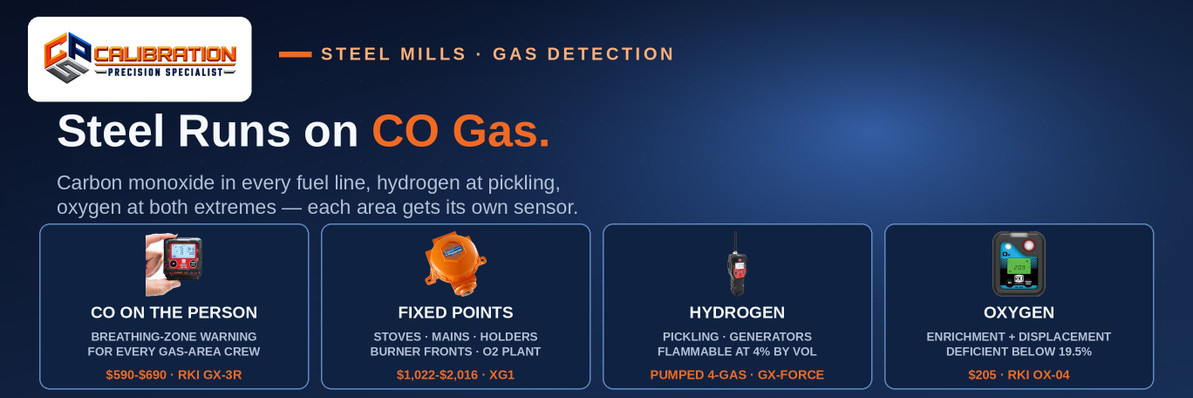
A steel mill needs carbon monoxide (CO) detection everywhere its fuel gases flow — blast furnace gas runs roughly 20–28% CO and coke oven and basic oxygen furnace gases are also CO-rich — backed by hydrogen monitoring at pickling lines and hydrogen-cooled generators, oxygen monitoring at oxygen plants and in confined spaces, and combustible-gas (LEL) points at fuel-gas burners. In practice that means a personal CO or 4-gas monitor on every worker in gas areas, plus fixed detectors at stoves, gas mains, holders, and burner fronts — because OSHA's CO limit is 50 ppm as an 8-hour average, and the fuel gas itself is about 200,000 ppm CO.
Steelmaking is a gas business that happens to pour metal. The mill makes its own fuel gases as byproducts, pipes them around the plant, and burns them in the next process — so a leak is rarely just a fire risk. It is a poisoning risk first. This hub walks the mill area by area; the deepest single hazard gets its own post: blast furnace gas: monitoring a fuel that is mostly carbon monoxide.
What Gases Does a Steel Mill Need to Monitor, Area by Area?
| Area | Main gases to monitor | Why |
|---|---|---|
| Blast furnace, gas cleaning, stoves | CO (personal + fixed) | Blast furnace gas is roughly 20–28% CO; leaks at flanges, valves, and stove changeovers expose crews directly |
| Coke ovens | CO, combustible gas (LEL) | Coke oven gas is a CO-bearing fuel gas distributed around the plant |
| Basic oxygen furnace (BOF) | CO | BOF off-gas is CO-rich and recovered or flared as fuel |
| Gas holders and distribution mains | CO, LEL | Miles of large-bore pipe move CO-rich gas between processes; a main leak fills low, still air fast |
| Pickling lines | Hydrogen (H2) | Acid reacting with steel generates hydrogen; H2 is flammable from 4% by volume in air |
| Power house / generators | Hydrogen (H2), CO | Hydrogen-cooled generators hold a large H2 inventory; boilers burn mill fuel gases |
| Oxygen plant and oxygen-enriched areas | Oxygen (O2) enrichment | Leaking oxygen enriches clothing and materials, which then burn far more readily |
| Confined spaces plant-wide | O2, CO, LEL, H2S (standard 4-gas) | Vessels, pits, flues, and mains are entered for maintenance under permit |
Why Is Carbon Monoxide the Hub Gas in Steelmaking?
Because the mill's fuels are built on it. Blast furnace gas — the largest byproduct stream — is roughly 20–28% CO, with carbon dioxide and nitrogen making up most of the rest and a few percent hydrogen. Coke oven gas and BOF gas are also burned as plant fuels and also carry significant CO. The exposure math is unforgiving: OSHA's permissible exposure limit for CO is 50 ppm as an 8-hour time-weighted average (NIOSH recommends 35 ppm, and 1,200 ppm is immediately dangerous to life or health) — while the gas in the main beside the walkway is about 200,000 ppm CO. A leak does not have to be large or last long to put a breathing zone over the limit, and CO gives no odor warning at any concentration. That is why steel's gas-detection culture starts with a CO channel on the person, not just a sensor on the wall.
What Belongs on the Person vs. on the Wall?
On the person: every worker whose job takes them into gas areas — furnace and stove crews, gas-main and holder maintenance, BOF and coke-oven crews — wears a CO instrument. A dedicated single-gas CO monitor like the RKI GasWatch 3 (configured $205–$520) keeps the warning in the breathing zone all shift; a standard 4-gas monitor like the RKI GX-3R ($590–$690) adds LEL, O2, and H2S channels for the confined-space and maintenance work mills do constantly. See the full range of portable multi-gas monitors and single-gas monitors.
On the wall: fixed points watch the places a leak starts, whether or not anyone is standing there — stove valves and burner fronts, gas-main flanges and seals, holder seals, booster and blower rooms, and oxygen-plant boundaries. A fixed toxic and oxygen transmitter of the Crowcon Xgard XG1 class (configured $1,022–$2,016) covers CO and O2 points; flammable-gas points at burners take a detector of the Crowcon Xgard XG3 class (configured $784–$1,162). Fixed systems only protect anyone if they are designed, installed, and kept calibrated as a system — that is the work covered by fixed system installation.
Where Do Hydrogen and Oxygen Fit In?
Hydrogen appears in two places that surprise people outside steel. On pickling lines, acid attacking steel generates hydrogen at the strip surface; ventilation normally carries it away, which is exactly why H2 or LEL monitoring belongs where that ventilation can fail or be shut down for maintenance. In the power house, hydrogen-cooled generators make H2 a stored, piped utility — and hydrogen is flammable from just 4% by volume, with a flame that is nearly invisible, so leak monitoring around generator seals and H2 supply skids is standard practice.
Oxygen cuts both ways. Mills make and pipe oxygen for the BOF and for enrichment, and an oxygen leak does not poison anyone — it makes everything nearby easier to ignite and faster to burn, which is why oxygen plants and enrichment lines get O2 monitoring and strict materials discipline. The reverse problem — oxygen displacement by nitrogen, argon, or fuel gas in pits, vessels, and flues — is the confined-space hazard, watched by the O2 channel on every 4-gas entry monitor (air is oxygen-deficient below 19.5% O2). A personal oxygen monitor like the RKI OX-04 ($205) covers workers whose whole job is in enrichment or displacement areas.
None of these channels means anything drifting. CO sensors in hot, dirty mill air work hard and drift like any electrochemical cell. We calibrate every channel — personal fleets and fixed points alike — through calibration services: ship the portables to our Rockwood, Tennessee shop, and fixed systems are serviced on site under a written quote (on-site work costs more than bench work and is never priced at in-house rates).
Frequently Asked Questions
What gas detection does a steel mill need?
Carbon monoxide detection everywhere fuel gases flow — blast furnace gas is roughly 20–28% CO, and coke oven and BOF gases are also CO-rich — plus hydrogen monitoring at pickling lines and hydrogen-cooled generators, oxygen monitoring at oxygen plants and in confined spaces, and combustible-gas (LEL) points at fuel-gas burners. The working pattern is a personal CO or 4-gas monitor on every worker in gas areas plus fixed detectors at stoves, mains, holders, and burner fronts.
What gases are in blast furnace gas?
Roughly 20–28% carbon monoxide, about 17–25% carbon dioxide, about 1–7% hydrogen, and the balance mostly nitrogen, per published industry composition tables. The CO fraction is what drives the safety program: at about 200,000 ppm CO in the pipe, even a small leak overwhelms OSHA's 50 ppm exposure limit in a breathing zone almost immediately.
What is the OSHA exposure limit for carbon monoxide?
50 ppm as an 8-hour time-weighted average. NIOSH's recommended limit is lower — 35 ppm TWA with a 200 ppm ceiling — and 1,200 ppm is the NIOSH concentration immediately dangerous to life or health (IDLH). Detector alarm settings are plant policy, but they are normally set well below the PEL so a rising leak is caught before anyone's shift average is at risk.
Does every steelworker need a personal CO monitor?
Every worker whose duties take them into gas areas — blast furnace and stove crews, coke-oven and BOF crews, gas-main and holder maintenance, and anyone entering confined spaces — should carry CO detection in the breathing zone, because fixed detectors only report the air at the sensor, not the air at the worker. Office, warehouse, and other non-gas areas are a different exposure picture and are handled by area assessment rather than a blanket rule.
Where should fixed gas detectors be installed in a steel mill?
At the leak sources and the occupied points downwind of them: stove valves and burner fronts, gas-main flanges, valves and seals, gas-holder seals, blower and booster rooms, pickling-line ventilation paths, hydrogen supply skids, and oxygen-plant boundaries. Placement follows a site survey of the actual pipework and airflow — a detector on the wrong wall is decoration, and mounting height follows the gas and the room, not a generic rule.
Why does a steel mill monitor hydrogen?
Hydrogen is generated where acid meets steel on pickling lines and is stored and piped as generator coolant in the power house. It is flammable from 4% by volume in air — a wide, easily reached flammable range — and burns with a nearly invisible flame, so leaks around seals, skids, and pickling ventilation are monitored rather than left to smell or sight, neither of which works for hydrogen.
What is the oxygen hazard in a steel mill?
Both directions. Oxygen made for the BOF and for enrichment can leak and enrich clothing and materials so they ignite easily and burn violently; and inert or fuel gases can displace oxygen in pits, vessels, and flues — air below 19.5% oxygen is oxygen-deficient. Oxygen plants and enrichment areas get O2 monitoring for enrichment; confined-space entries are tested with the O2 channel of a 4-gas monitor.
How often should gas detectors in a steel mill be calibrated?
On the manufacturer's stated interval — commonly every 6 months for portable monitors — with a functional bump test before each day's use as standard practice, and sooner after any high-gas event, failed bump, or physical abuse. Mill air is hot and dirty, which is hard on sensors; a calibration program with records per instrument, like the CPS Calibration Program, is what makes due dates auditable instead of remembered.
What is the difference between a bump test and a calibration?
A bump test is a quick functional check: a known gas is applied and the instrument must alarm and respond — it proves the sensor and alarms work today, in seconds, and it does not adjust anything. A calibration adjusts the instrument's readings against certified gas so the numbers it reports are accurate. A monitor can pass a bump test while reading meaningfully low; only calibration corrects the reading.
How much does it cost to calibrate a steel mill's gas detectors?
At CPS Calibrations, in-house calibration is $55 for a single-gas instrument and $90 for a 4- or 5-gas instrument, and ship-in calibration is billed at the same rates — mills commonly rotate portables through the mail to keep a calibrated spare pool. Fixed systems are calibrated on site at your facility, quoted in writing, and cost more than bench work.
The Bottom Line
Steel's gas problem is carbon monoxide at fuel-gas scale — a 20–28% CO fuel moving through every process — with hydrogen at pickling and generators and oxygen at both extremes. Cover the person first (a CO or 4-gas monitor on every worker in gas areas), cover the leak points second (fixed CO, LEL, and O2 points at stoves, mains, holders, and burners), and keep every channel calibrated, because a 50 ppm legal limit leaves no room for a drifting sensor.
Outfitting or auditing a mill's detection? Call CPS Calibrations at 865-900-8844 — monitors, fixed systems, and the CPS Calibration Program behind them, from Rockwood, Tennessee.
Need a calibration you can file?
In-house calibration at CPS in Rockwood, Tennessee — $55 for single-gas instruments, $90 for 4- and 5-gas — every channel, as-found and as-left data, full certificate.
See Calibration Servicesor call 865-900-8844
Recent Posts
-

What Is Remote Monitoring for Fixed Gas Detection?
Remote monitoring for fixed gas detection means a fixed system's live readings, trends, and alarm hi …Nov 23rd 2026 -

What Are the Key Differences Between the GX-6000 and GX-6100?
The RKI GX-6100 is the current replacement for the discontinued GX-6000: both are pumped 6-gas monit …Nov 22nd 2026 -

How to Read a PID Correction Factor Chart
To read a PID correction factor chart, find your vapor’s row, take the factor under your own lamp en …Nov 21st 2026