
Blog
LEL Correction Factors: Why a Methane-Calibrated Detector Reads Other Gases Wrong
A catalytic LEL sensor calibrated on methane does not respond equally to other gases — it responds less to most of them. In RKI Instruments' published conversion table for a methane-calibrated instrument, pentane's LEL factor is 1.95 and hexane's is 2.44, meaning the display shows roughly half the true pentane concentration and about 40% of the true hexane concentration: a calm 10% LEL reading over hexane vapor is really 24.4% LEL. The fixes are to calibrate to the target gas, apply the ma
…
Oct 20th 2026
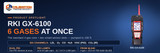
What Can the RKI GX-6100 Detect? The Pumped 6-Gas PID Monitor Explained
The RKI GX-6100 is a pumped portable gas monitor that measures up to six gases simultaneously: the standard confined-space four — combustible gas (LEL), oxygen (O₂), carbon monoxide (CO), and hydrogen sulfide (H₂S) — plus two interchangeable smart-sensor channels that can add a PID for VOCs (0–4,000 ppm, with a library of more than 600 gases), an infrared sensor for CO₂, methane, or hydrocarbons, a specialty toxic (NH₃, Cl₂, HCN, NO₂, PH₃, SO₂, or N₂H₄), or a thermal-conductivi
…
Oct 20th 2026
PID Correction Factors Explained: Why Your Isobutylene Reading Isn't Your Solvent Reading
A PID is calibrated on isobutylene, so its display reads in isobutylene equivalents — not in the concentration of the vapor actually being measured. To get the true concentration, multiply the reading by that compound's correction factor from Honeywell RAE's Technical Note TN-106: a 100 ppm display is 53 ppm of benzene (factor 0.53), 50 ppm of toluene (0.50), or 430 ppm of hexane (4.3). Until you apply the factor, the number on the screen is a well-organized estimate about a gas you are pr
…
Oct 20th 2026
How Do You Bump Test a Gas Detector? A Step-by-Step Guide
To bump test a gas detector, take it to air you know is clean, zero it, then apply certified test gas at a concentration high enough to trigger the alarms and confirm that every sensor responds and every alarm — audible, visual, and vibrating — activates. OSHA's Safety and Health Information Bulletin on direct-reading monitors, which carries the ISEA position statement, says a bump test or calibration check should be conducted before each day's use in accordance with the manufacturer
…
Oct 20th 2026
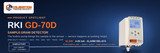
What Is the RKI GD-70D? A Sample-Draw Detector for Specialty Toxic Gases
The RKI GD-70D is a fixed, wall-mounted sample-draw sensor/transmitter ($1,595) whose built-in pump draws air at 0.5 L/min through tubing from the point being monitored to a plug-in sensor inside the unit, so a single accessible transmitter continuously watches one gas at a hard-to-reach point — a gas cabinet, duct, or scrubber — including specialty semiconductor toxics such as arsine (0–0.2 ppm), phosphine (0–1 ppm), silane (0–15 ppm), and vaporized hydrogen peroxi
…
Oct 20th 2026