
Calibration Gas With No Hazmat Fee
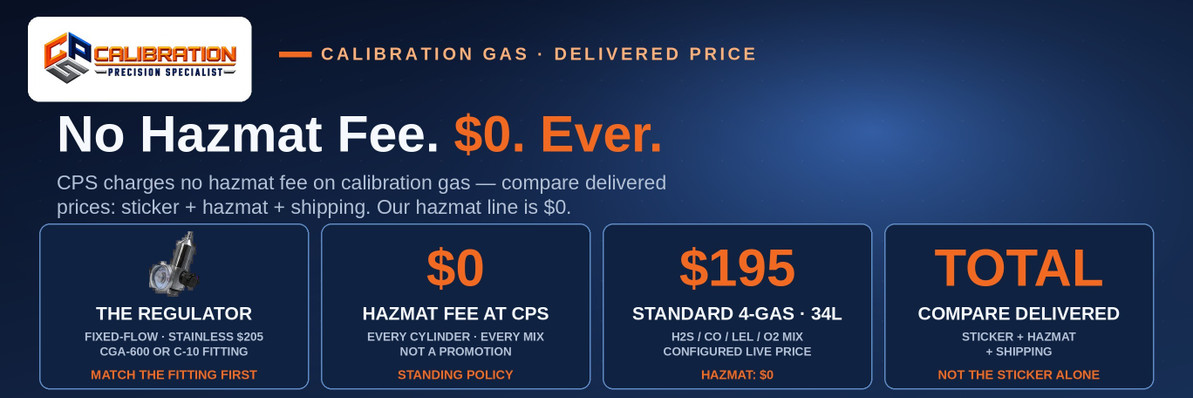
CPS Calibrations charges no hazmat fee on calibration gas — $0, ever, on every cylinder. Many sellers add a hazmat surcharge at checkout, after the sticker price has already won the comparison, so the only honest way to compare gas prices is delivered price: add any hazmat surcharge and shipping to the sticker price before you compare — and on a CPS order the hazmat line is always $0.
Calibration gas is one of the few things a safety department buys where the price on the product page and the price on the invoice routinely disagree. The cylinder price gets quoted, screenshotted, and approved — then a hazmat surcharge appears in the cart or at checkout, and the approved number is no longer the number being paid. This post is about that one line item: what it is, what we charge for it (nothing), and how to run a fair comparison when one seller's sticker price includes it and another's does not. If you are still working out which gas you need at all, start with the Calibration Gas Finder and how to choose calibration gas, then come back here to price it honestly.
What Is a Hazmat Surcharge on Calibration Gas?
Calibration gas ships as a pressurized cylinder, and many sellers treat the shipment as hazardous-materials handling and pass a hazmat surcharge to the buyer for it. The surcharge is not part of the cylinder price — it is an added fee, typically revealed late in the buying process, and it varies by seller. That structure is the problem, more than any single amount: two sellers can list the same cylinder at the same sticker price and deliver it at two different totals, and the buyer who compared sticker prices never sees the difference until the invoice arrives.
We are deliberately not putting a number on what other sellers charge. Their fees are theirs — they differ, they change, and quoting a figure here that we cannot stand behind would be exactly the kind of invented number this post exists to argue against. What we can tell you exactly is our own number, because it never changes.
What Does CPS Charge? $0 — and Here Is a Worked Example
CPS charges no hazmat fee on calibration gas — ever. Not above a threshold, not on certain sizes, not as a promotion that expires: the fee is $0 on every cylinder we sell. So a delivered-price comparison on our side is simple arithmetic: the cylinder's configured price, plus whatever shipping applies to your order, plus $0 hazmat.
Worked example, using live store pricing pulled for this post. The standard 4-gas mix most portable fleets run — H2S 25 ppm / CO 50 ppm / methane 50% LEL / O2 12%, balance nitrogen, the 4-gas calibration gas — RKI equivalent listing — is configured like this:
| Cylinder size (this mix) | CPS cylinder price | CPS hazmat fee |
|---|---|---|
| 11 liter (trigger valve, minimum order 6) | $90 | $0 |
| 34 liter | $195 | $0 |
| 44 liter | $210 | $0 |
| 60 liter | $245 | $0 |
| 66 liter | $275 | $0 |
| 120 liter | $295 | $0 |
So a 34-liter cylinder of the standard mix is $195 before shipping, with $0 added for hazmat — the delivered comparison for that cylinder is $195 plus shipping, full stop. Run the same cylinder through a seller who adds a hazmat surcharge at checkout and the delivered price is their sticker, plus their surcharge, plus their shipping. Compare those two delivered totals — not the two stickers — and you have the honest answer to which gas costs less.
How Do You Compare Two Calibration Gas Quotes Honestly?
- Write down the delivered price, not the sticker. Cylinder + hazmat surcharge + shipping. If a quote does not show the surcharge, ask for the checkout total before you approve it.
- Compare the same cylinder. Same mix, same concentrations, same size, same fitting. A cheaper quote for a smaller cylinder or a different mix is not a cheaper quote — it is a different product.
- Compare usable gas, not just price. Reactive mixes expire in about 6–12 months; a bargain cylinder you cannot finish before it expires costs more per test than a smaller one you empty. Our post on how to choose calibration gas works through the sizing decision.
- Price the regulator once, correctly. A steel 34L cylinder takes a CGA-600 fitting and a steel 103L takes C-10; aluminum cylinders take C-10. A stainless fixed-flow regulator is $205 in either fitting on our store — it is a one-time purchase that should not be re-bought because the fitting was guessed.
What Else Changes the Real Cost of a Cylinder?
Shelf life, mostly. Reactive gases such as H2S-containing mixes carry roughly a 6–12 month shelf life; stable mixes run about 36 months (established CPS copy, from the ISG warranty and shelf-life figures used across our gas listings). That is why the 120-liter size at $295 is not automatically the smart buy for a two-monitor shop: if the mix expires half-used, the effective price per bump test doubles. The right size is the one you finish before the date on the label — and repeat ordering is easier than it sounds, which is the subject of our companion post, never run out of calibration gas: standing orders and reorder points.
The full calibration gas range is on the store, and if the manual that specifies your mix is missing, the Calibration Gas Finder matches gas to instrument models. Questions about a specific mix or size: call 865-900-8844.
Frequently Asked Questions
Does CPS charge a hazmat fee for calibration gas?
No. CPS charges no hazmat fee on calibration gas — $0, ever, on every cylinder size and every mix we sell. The price you compare on our side is the cylinder's configured price plus shipping, with nothing added at checkout for hazmat handling.
Why do some sellers add a hazmat surcharge to calibration gas?
Calibration gas ships as a pressurized cylinder, and many sellers pass the cost of hazardous-materials shipment handling through to the buyer as a separate surcharge. It is usually separate from the cylinder price and often only appears in the cart or at checkout — which is why sticker-price comparisons between sellers can be misleading.
How much is a typical hazmat fee for calibration gas?
There is no single typical figure we can honestly quote — the surcharge is set by each seller, differs between them, and changes over time, so we do not publish a number for other companies' fees. The check that protects you is mechanical: before you approve any gas quote, ask for the delivered total — cylinder, plus any hazmat surcharge, plus shipping — and compare delivered totals. At CPS that surcharge line is $0.
How do I compare calibration gas prices fairly?
Compare delivered prices for the identical cylinder: same mix and concentrations, same size, same fitting. Add any hazmat surcharge and shipping to each sticker price, then compare the totals. Then sanity-check the size against shelf life — reactive mixes last about 6–12 months and stable mixes about 36 months — because a larger cylinder that expires half-used is not the cheaper cylinder per test.
How much does a standard 4-gas calibration cylinder cost at CPS?
For the standard mix most fleets run — H2S 25 ppm, CO 50 ppm, methane 50% LEL, O2 12%, balance nitrogen — live store pricing is $195 for 34 liters, $210 for 44 liters, $245 for 60 liters, $275 for 66 liters, and $295 for 120 liters, plus an 11-liter trigger-valve size at $90 with a minimum order of six. Every one of those carries a $0 hazmat fee; shipping is additional.
Does no hazmat fee mean free shipping?
No — they are different costs, and we keep them separate on purpose. The hazmat fee at CPS is $0, always. Shipping is the carrier cost of getting the cylinder to you, shown for your order rather than buried in the cylinder price. What you will never find on a CPS gas order is a third, surprise line for hazmat handling added after the price you approved.
Is the $0 hazmat fee a promotion?
No. It is not a sale or a limited-time offer — it is our standing policy on calibration gas, and it does not expire. The hazmat line on a CPS calibration gas order is $0 whether it is your first cylinder or your fiftieth.
Which regulator fitting does my cylinder need?
Match the fitting to the cylinder, not the other way around: a steel 34L cylinder takes CGA-600, a steel 103L cylinder takes C-10, and aluminum cylinders take C-10. On our store a stainless fixed-flow regulator is $205 in either fitting. If you are unsure which cylinder you are holding, call 865-900-8844 with the size and material and we will match the regulator before it ships.
How long does calibration gas last before it expires?
It depends on the mix. Reactive gases — H2S-containing mixes are the common example — carry roughly a 6–12 month shelf life. Stable mixes run about 36 months. The cylinder's label carries its own expiry date, and the practical rule is to buy the size you will finish before that date, not the largest size on the page.
Can I set up repeat gas orders so I do not have to remember?
Yes — arranged with a person, not a website subscription. CPS sets up standing orders by phone or email on your schedule, handled through recurring invoicing and scheduled shipment. The full method — par levels by shelf life and the reorder-point formula — is in our post on standing orders and reorder points. Call 865-900-8844 to set one up.
The Bottom Line
The honest price of calibration gas is the delivered price. CPS makes its half of that arithmetic easy: the cylinder's configured price, plus shipping, plus a hazmat fee of $0 — ever. Before you approve anyone else's quote, add their hazmat surcharge to their sticker and compare totals, not stickers.
Ready to price your mix? Use the Calibration Gas Finder or call CPS Calibrations at 865-900-8844.
CPS Calibrations · 109 S. Front Street, Rockwood, TN 37854 · Calibration Gas · Calibration Gas Finder · How to Choose Calibration Gas
Need a calibration you can file?
In-house calibration at CPS in Rockwood, Tennessee — $55 for single-gas instruments, $90 for 4- and 5-gas — every channel, as-found and as-left data, full certificate.
See Calibration Servicesor call 865-900-8844
Recent Posts
-

What Is Remote Monitoring for Fixed Gas Detection?
Remote monitoring for fixed gas detection means a fixed system's live readings, trends, and alarm hi …Nov 23rd 2026 -

What Are the Key Differences Between the GX-6000 and GX-6100?
The RKI GX-6100 is the current replacement for the discontinued GX-6000: both are pumped 6-gas monit …Nov 22nd 2026 -

How to Read a PID Correction Factor Chart
To read a PID correction factor chart, find your vapor’s row, take the factor under your own lamp en …Nov 21st 2026