
Never Run Out of Calibration Gas: Standing Orders and Reorder Points
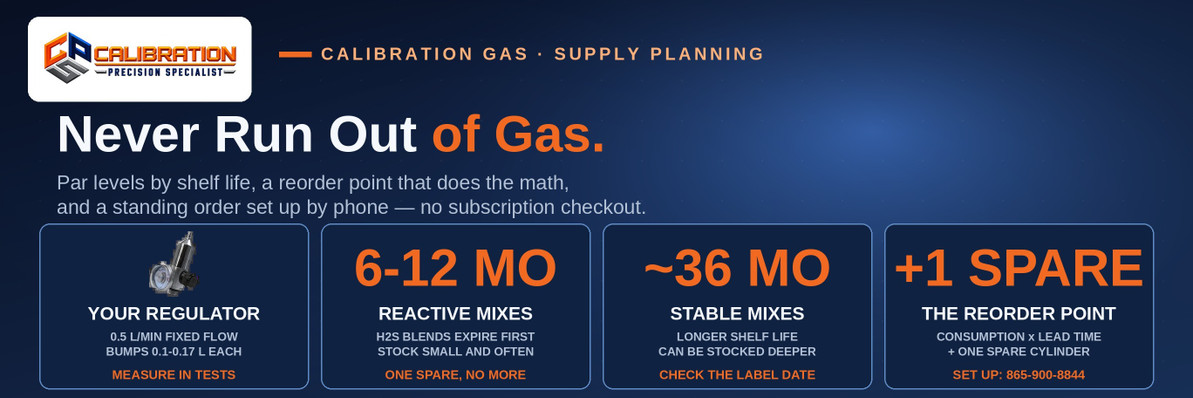
You never run out of calibration gas by setting a reorder point and a par level matched to shelf life — reactive H2S-containing mixes last only about 6–12 months, so they are stocked small and often, while stable mixes last about 36 months and can be stocked deeper — and, at CPS, by having a standing order set up by phone or email on your schedule. Honest limit, stated up front: our store has no subscription checkout, so a CPS standing order is a recurring order arranged with a person at 865-900-8844, handled through recurring invoicing and scheduled shipment — not a website autoship.
Running out of calibration gas does not look like a supply problem. It looks like a crew standing at a docking station on the morning of a confined-space job, holding a cylinder that hissed empty on the second bump test — with every instrument in the fleet suddenly unusable for permitted work. The fix is not a bigger storeroom. It is two numbers (a par level and a reorder point), one shelf-life fact per mix, and a standing order that turns reordering from someone's memory into a schedule. If you have not yet worked out which gas and which size you need, the Calibration Gas Finder settles the mix first; this post settles the supply.
The Honest Version: How a CPS Standing Order Actually Works
Terminology first, because the internet has trained buyers to expect something we do not offer. There is no subscription checkout on our store — no autoship button, no self-service subscription to pause or edit online, and we will not pretend otherwise. What exists today, and what works, is this:
- Step 1 — You call or email us. Call 865-900-8844. You talk to a person who calibrates gas detectors for a living, not a subscription dashboard.
- Step 2 — We agree the standing order together. The mix, the cylinder size, the quantity, and the schedule — matched to your actual bump and calibration usage and to the mix's shelf life, using the par-level math below.
- Step 3 — CPS handles it as a recurring order. The standing order runs through recurring invoicing and scheduled shipment on the cadence agreed, so a fresh cylinder leaves Rockwood before the reorder point becomes an emergency.
- Step 4 — Changing it means contacting us. Need to pause for a shutdown, add a cylinder, or change mixes because the fleet changed? Call or email and a person adjusts it. That is the whole mechanism — personal, adjustable, and exactly as automatic as a phone call set it up to be.
Set Par Levels by Shelf Life, Not by Price per Liter
The most common gas-supply mistake is buying depth in the wrong mix. Calibration gas runs on two very different clocks (established CPS copy, from the ISG warranty and shelf-life figures used across our gas listings):
- Reactive mixes — about 6–12 months. Anything containing H2S is the everyday example, which means the standard 4-gas mix most fleets bump and calibrate with lives on this clock. Stock it small and often: enough to cover the interval between standing-order shipments, plus one spare — not a year's worth quietly expiring on a shelf.
- Stable mixes — about 36 months. Non-reactive mixes can be stocked deeper without the expiry clock eating them, so a larger cylinder or a deeper par level can make sense where usage supports it.
A cylinder that expires half-full was not a bulk saving. It was two cylinders' price paid for one cylinder's gas. Par level follows the expiry date first and the price per liter second — never the other way around.
The Reorder Point: One Formula, Worked Openly
Reorder point = (your consumption rate × the lead time to get a cylinder to you) + one spare cylinder. Consumption rate is the piece most shops have never measured, so measure it in tests. Through a standard 0.5 L/min fixed-flow regulator, a bump test uses about 0.1–0.17 liters and a full calibration about 0.5–1 liter — the math our post on how long a bottle of calibration gas lasts works cylinder by cylinder. On those figures a 34L cylinder holds roughly 200–400 bump tests or about 35–65 full calibrations.
Worked example. A shop with ten 4-gas monitors, bumped daily and calibrated monthly, runs roughly 50 bump tests a week plus its calibrations — call it one 34L cylinder every five to eight weeks on bump volume alone, before calibrations are counted. If a replacement cylinder takes a week to arrive, the reorder point is not 'when the gauge looks low.' It is: when the last-but-one cylinder goes into service, the next one gets ordered — consumption during that week is covered, and the spare-cylinder term in the formula is the cylinder still sealed on the shelf. A standing order simply automates that moment: the shipment is scheduled to land as the working cylinder runs down, instead of depending on someone noticing.
What to Have Ready When You Set One Up
- The mix — exactly as your instrument manuals specify it, or the instrument models, and we will match it via the Calibration Gas Finder.
- Your test rhythm — how many instruments, bumped how often, calibrated how often. That sets the consumption rate, which sets everything else.
- Your current stock and its expiry dates — a standing order that ships a reactive mix while three unopened cylinders sit expiring is solving the wrong problem.
- The delivery address and who signs for gas — a scheduled shipment only prevents a stock-out if it lands with someone who puts it in the gas cabinet.
One cost note that applies to every standing order: CPS charges no hazmat fee on calibration gas — $0, ever — so a recurring order does not quietly accumulate a per-shipment surcharge. That policy is its own post: calibration gas with no hazmat fee.
Frequently Asked Questions
Is there a subscription for calibration gas on the CPS website?
No, and we will not dress one up. Our store has no subscription checkout, no autoship button, and no self-service subscription management. A CPS standing order is arranged by phone or email with a person — a recurring order on your schedule, handled through recurring invoicing and scheduled shipment. Call 865-900-8844 to set one up or change one.
How does a CPS standing order work?
You call 865-900-8844 or email us, and together we set the mix, cylinder size, quantity, and shipment schedule around your actual usage. CPS then runs it as a recurring order: invoiced on the recurring schedule and shipped on the agreed cadence, so fresh gas arrives before your working cylinder runs out. Any change — pause, quantity, mix — is made by contacting us, and a person makes it.
How much calibration gas should I keep on hand?
Enough to cover the interval between shipments at your real consumption rate, plus one spare cylinder — capped by shelf life. Reactive H2S-containing mixes last about 6–12 months, so their par level should be small and turning over. Stable mixes last about 36 months and can be stocked deeper. If your par stock would expire before you use it, the par level is too high, whatever the bulk price looked like.
What is a reorder point for calibration gas?
Reorder point equals your consumption rate multiplied by the lead time to get a cylinder to you, plus one spare cylinder. In plain terms: order early enough that the gas you burn while waiting for delivery, plus one sealed spare, is already on your shelf. For most small fleets, that moment is when the second-to-last cylinder goes into service.
Why not just buy the biggest cylinder and reorder less often?
Because of the expiry clock. A reactive mix has about 6–12 months of shelf life, and a large cylinder feeding a small fleet will expire with gas still in it — our bottle-math post shows a big cylinder can take years to empty at low usage, far past its date. Small-and-often on a reactive mix costs less per usable test than bulk-and-expired.
How many bump tests are in a 34-liter cylinder?
Roughly 200–400 bump tests, or about 35–65 full calibrations, through a standard 0.5 L/min fixed-flow regulator — a bump test uses about 0.1–0.17 liters and a full calibration about 0.5–1 liter. Hose purges, leaks, and long span times pull the real number down, which is why par-level planning uses the conservative end of the range.
Which calibration gas mixes expire fastest?
Reactive mixes — H2S-containing blends are the common case, including the standard 4-gas mix — at roughly 6–12 months of shelf life. Stable mixes run about 36 months. The expiry date is printed on each cylinder's label; plan the standing-order interval for the shortest-lived mix you stock.
Can I pause or change a standing order?
Yes — by phone or email, with a person. Shutdown coming, fleet shrank, new instruments changed the mix: contact us and the schedule, quantity, or mix is adjusted before the next shipment. What we do not offer is a login where you edit it yourself; the honest trade is that a person who knows your account makes the change and confirms it with you.
Does a standing order add any fees?
There is no hazmat fee on any CPS calibration gas order — $0, ever — standing order or one-off, so a recurring schedule does not accumulate a per-shipment hazmat surcharge. Each shipment is invoiced as an order on the recurring schedule we agreed; shipping applies as it does to any cylinder order.
How do I start a standing order for calibration gas?
Call CPS Calibrations at 865-900-8844 with three things: the mix your instruments need (or the instrument models, and we will match it), how many instruments you bump and calibrate and how often, and the expiry dates on the gas you already have. From those we set a par level, a reorder point, and a shipment schedule that fits inside the mix's shelf life.
The Bottom Line
Running out of calibration gas is a scheduling failure, not a purchasing failure — and it is preventable with two numbers and one phone call. Set the par level by shelf life (reactive mixes small and often, stable mixes deeper), set the reorder point at consumption times lead time plus one spare, and let a CPS standing order — arranged by phone, invoiced on a recurring schedule, shipped on time — carry the remembering for you.
Set yours up today: call CPS Calibrations at 865-900-8844.
CPS Calibrations · 109 S. Front Street, Rockwood, TN 37854 · Calibration Gas Finder · How Long Does a Bottle of Calibration Gas Last? · Calibration Gas With No Hazmat Fee
Ready to mail yours in?
Start the ship-in request, pack the meter, and we handle the rest — every channel calibrated as configured, full certificate returned with it.
Start Your Ship-In Requestor call 865-900-8844
Recent Posts
-

What Is Remote Monitoring for Fixed Gas Detection?
Remote monitoring for fixed gas detection means a fixed system's live readings, trends, and alarm hi …Nov 23rd 2026 -

What Are the Key Differences Between the GX-6000 and GX-6100?
The RKI GX-6100 is the current replacement for the discontinued GX-6000: both are pumped 6-gas monit …Nov 22nd 2026 -

How to Read a PID Correction Factor Chart
To read a PID correction factor chart, find your vapor’s row, take the factor under your own lamp en …Nov 21st 2026