
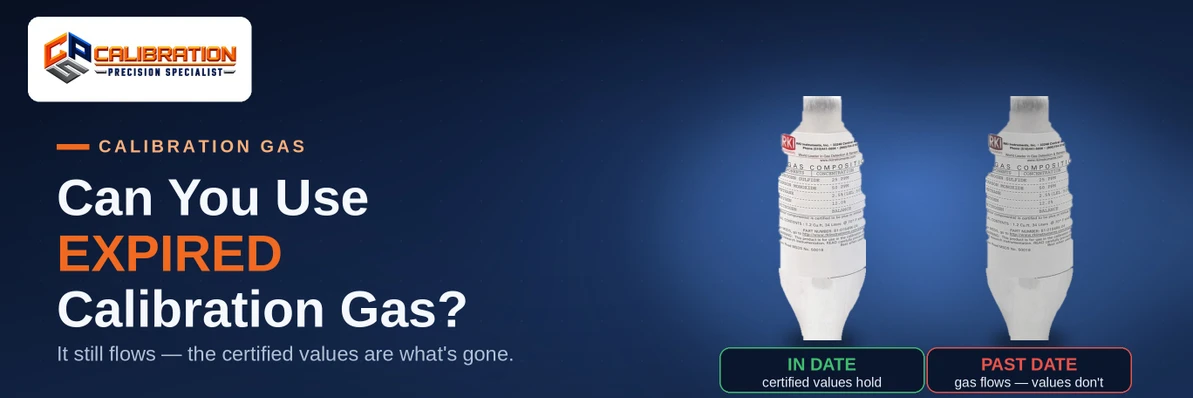
Can You Use Expired Calibration Gas? What Actually Goes Wrong
No — you cannot use expired calibration gas for calibration or bump verification, because the reactive components inside drift below their labeled concentrations over time, and spanning a detector with that weakened gas sets the instrument's gain too high, so it over-reads real gas by the same percentage until it is recalibrated with fresh gas. The date on the cylinder is a certification limit, not a suggestion: past it, the concentration is no longer certified, and a calibration performed with it cannot be defended.
That is the short version. The longer one matters, because the failure is silent, the direction of the error surprises most people, and the bottle usually looks perfectly fine — it still has pressure, it still flows, and the zero still sets cleanly. This post is about consequences and decisions: what the wrong gas does to the instrument, why pressure proves nothing, and what to do with the bottle. For how long each family of gas stays certified in the first place, start with our post on calibration gas shelf life — this post picks up where that one ends.
What Actually Goes Wrong Inside an Expired Bottle?
Nothing dramatic — and that is the problem. The gas does not vanish, sour, or stop flowing. What changes is the concentration of the reactive components. Molecules of hydrogen sulfide, chlorine, sulfur dioxide, ammonia, and their reactive relatives are slowly lost inside the cylinder — adsorbed onto the interior walls, reacted with trace moisture, or combined with valve materials — so month by month, the mixture gets weaker than the number printed on its label. Stable gases such as methane, carbon monoxide, and isobutylene barely change at all, which is why certified lives differ so sharply by mix (the table below is taken from the shelf lives stated on our own product listings).
Two things follow from that slow drift:
- The bottle gives no warning. There is no color change, no smell test, no gauge movement you can see. The only instrument that can tell you the concentration has fallen is a more accurate standard — which is what the bottle was supposed to be.
- The error is one-directional. Reactive gases drift low, never high. A bottle never comes back stronger than its label. Every consequence in this post flows from that single fact: expired gas is weak gas.
Which Way Do the Readings Go? The Direction Nobody Expects
Most people assume weak gas makes a detector read low. For a span calibration, the truth is the opposite — and it is worth working through once, slowly, because everything else depends on it.
A span calibration teaches the instrument what a known concentration looks like. Say your cylinder is labeled 25 ppm H₂S, but the gas inside has drifted 20% low and now actually delivers 20 ppm. You flow it over the sensor and set the span so the display reads 25 — the label value. The instrument has just learned that the sensor signal produced by 20 ppm of real gas means "25 ppm." Its gain is now set 25% too high.
From that moment, the instrument over-reads everything it meets, by that same 25%:
| Real H₂S in the air | What the display shows (after the bad span) |
|---|---|
| 20 ppm | 25 ppm |
| 40 ppm | 50 ppm |
| 80 ppm | 100 ppm |
| 100 ppm | 125 ppm |
For every 4 ppm of real gas, the display reports 5. And the zero gives nothing away: zero gas still reads zero, because the error is proportional, not an offset. The instrument looks healthy on every check that doesn't involve a known concentration — which is exactly why this failure survives in the field.
Is Over-Reading Actually Dangerous?
Over-reading sounds like the safe direction. It isn't, for four reasons:
- Alarm fatigue. A toxic channel that reads 25% high reaches its alarm point at 80% of the real concentration it was set for. Alarms that trip "early" again and again teach crews the instrument cries wolf — and an alarm people have learned to ignore is worse than a late one, because it gets silenced, bypassed, or worked around.
- Needless shutdowns and evacuations. An LEL channel spanned with weak gas trips processes and clears areas for gas that isn't there at the reported level. Each false event costs production and credibility, and the pressure afterward is to distrust the next — possibly real — alarm.
- You cannot correct for it. Nobody knows how far a given expired bottle has drifted — 5%, 20%, more. A known error can be compensated; an unknown one can't. Every reading after a bad span is a number you cannot stand behind, in either direction, by an amount you cannot state.
- It ratchets. Drift doesn't stop at the expiry date. Calibrate again next quarter with the same bottle — weaker still — and the gain gets cranked higher again. Each "successful" calibration makes the instrument more wrong while the records look better and better.
And underneath all of it: the calibration itself no longer counts for anything, which is the next section.
Is the Expiry Date a Real Limit, or Just a Suggestion?
It is a certification limit. A calibration cylinder is a certified reference: our ISG listings are NIST-traceable, and each cylinder carries a certificate of analysis, with the cylinder-specific SDS and CoA accessible by the QR code on the bottle. The maker certifies that the concentration matches the label — up to the stated date. Past that date, the certification has run out. The gas inside hasn't been measured and found bad; it has simply stopped being guaranteed, and for a measuring standard, "probably about right" and "wrong" are the same thing.
That distinction decides what happens when the paperwork is examined — after an incident, in an audit, in an insurance or regulatory review. A calibration record is only as strong as the standard behind it. If the gas lot on that record was past its certified date on the day of the calibration, the honest entry would be "calibrated with gas of unknown concentration" — which is to say, not calibrated in any way that can be defended. The instrument may have been adjusted carefully, by the book, and the record still has a hole in it, because the one number the whole procedure rested on was no longer certified.
Treat the date the way you treat the date on a torque wrench's calibration sticker: not as a prediction that the tool fails the next morning, but as the line past which nobody will vouch for it — including you, if you're the one signing the record.
The Bottle Still Has Pressure — Isn't It Fine?
No, and this is the misconception that keeps expired bottles in service. Pressure measures how much gas remains. It says nothing about what that gas is.
Run the numbers on the hero bottle above — a standard 4-gas mix with H₂S at 25 ppm. Twenty-five parts per million is 0.0025% of the cylinder's contents; the other 99.9975% is methane, oxygen, carbon monoxide, and nitrogen balance. If the H₂S component loses a fifth of itself to the cylinder walls — a serious, calibration-wrecking drift — the total pressure falls by roughly 0.0005%. No cylinder gauge made can show you that. The balance gas, which is most of what's in the bottle, doesn't drift at all, so the bottle keeps its pressure, keeps its flow, and keeps passing the squeeze test while the one component that matters most quietly fades.
The gauge answers "is there gas left?" The label's date answers "can I trust what's in it?" They are different questions, and only one of them is about calibration.
How Long Do Different Mixes Stay Certified?
Certified life is set per mix by the manufacturer, and the spread is wide. These are the shelf lives stated today on CPS's ISG calibration gas listings — the same figures printed in each product's specifications — with live prices:
| Mix (CPS ISG listing) | Reactive? | Stated shelf life | Price |
|---|---|---|---|
| Methane (CH₄) 2.5% (50% LEL) + O₂ 20.9% | No — stable | 48 months | $110 |
| Carbon monoxide (CO) listings | No — stable | 48 months | $110 |
| Isobutylene 100 ppm listings | No — stable | 48 months | $110 |
| Hydrogen sulfide (H₂S) 25 ppm | Yes | 24 months | $55 |
| Sulfur dioxide (SO₂) 10 ppm | Yes | 24 months | $163 |
| 4-gas mix — H₂S 25 / CO 50 / CH₄ 50% LEL / O₂ 12% | Mixed — the H₂S sets the clock | 24 months | $184 |
| Ammonia (NH₃) 25 ppm | Yes | 12 months | $265 |
| Chlorine (Cl₂) 10 ppm | Yes | 6 months | $265 |
Read the table the way a buyer should. The stable gases get four years. The reactive gases get months — and not the same months: chlorine's certified life on the ISG listing is 6 months, ammonia's is 12, while H₂S and SO₂ carry 24. There is no single "reactive gas" number you can safely generalize from, which is why the date and CoA on your bottle — not a chart, including this one — are the final word for your lot. A multi-gas mix inherits the shortest clock in the bottle: the standard 4-gas mix is three stable gases and one reactive one, and it is dated to the H₂S.
Can You Bump Test With Expired Gas?
A bump test doesn't adjust anything — it checks that the sensors respond and the alarms fire. That sounds like a lower bar than calibration, but the test is only meaningful against a known concentration, and expired gas is an unknown. Either way it resolves, the result tells you nothing you can rely on:
- Instrument calibrated with fresh gas, bumped with expired gas: the detector honestly reads the weakened gas at its true, lower concentration. If that reading no longer reaches the alarm setpoint, the bump "fails" — and now you're troubleshooting a healthy sensor, or worse, concluding the alarm works at a level it was never actually shown to reach.
- Instrument spanned with the same expired gas: it over-reads, so the bump passes effortlessly. The test has verified that an instrument with inflated gain responds to weak gas — not that it alarms at its setpoint in real gas.
A bump test that can pass a badly spanned instrument and fail a healthy one isn't a safety check; it's a coin flip with paperwork. Fresh gas is the test.
What Should You Do With an Expired Bottle?
Decide two things: what it will never do again, and where it goes.
What it will never do again is span a calibration or stand behind a bump verification — any instrument whose readings matter. Don't talk yourself into "just this once to get through the week": the calibration you perform becomes the record, and the record is the indefensible part. If instruments are due and the only bottle on the shelf is expired, the honest options are fresh gas first, or instruments out of service until it arrives.
Where it goes depends on what's left in it. An expired bottle that still holds pressure — especially a toxic mix — is not an empty, and it doesn't get emptied by venting it off in the shop. Our post on how to dispose of calibration gas cylinders walks the routes in full: use-in-date gas up, supplier take-back first for partial and expired bottles, hazardous-waste programs after that, and the vent-and-recycle steps reserved for genuinely empty disposables.
And then fix the cause, because an expired bottle is almost always a rotation failure, not a purchasing failure: buy the size you'll finish inside the mix's certified life, check the date on arrival, store bottles indoors and rotate oldest-first. Our post on how to store calibration gas covers the habits that keep a shelf from quietly aging out.
The Calibration Angle
On our benches, the standard is the standard: we calibrate every channel with fresh, in-date, NIST-traceable gas, and the certificate shows the gas lot behind the work. It's the same discipline we ask of our customers, applied to ourselves — a certificate is only as honest as the bottle it traces back to. If you've inherited a shelf of cylinders and you're not sure which ones are still inside their certified life, check the date on each label before your next calibration round — and if a fleet's instruments were spanned with a bottle that's since expired, treat those calibrations as unverified and redo them with fresh gas.
Fresh stock is on the calibration gas page, from the H₂S 25 ppm single-gas bottle at $55 to the standard 4-gas mix at $184 — and if you're not sure which mix your fleet needs, call us at 865-900-8844 and we'll match the gas to your instruments before you order.
The Bottom Line
Expired calibration gas doesn't fail loudly — it teaches quietly. The reactive components drift low, a span set with that weak gas sets the instrument's gain too high, and the detector over-reads real gas by an unknown percentage while its zero, its paperwork, and its pressure gauge all insist everything is fine. The date on the label is where the certification ends, and past it the bottle has exactly one correct destination — out of service, by the disposal routes, replaced by a fresh bottle sized to what you'll actually use.
Found an expired bottle on your shelf? Replace it from the calibration gas range, redo any calibrations it touched with fresh gas, and put the old bottle on the disposal route — or send your instruments to us through Calibration Services and we'll verify every channel against gas that's inside its certified life. Questions about a specific bottle? Call 865-900-8844 or reach us through Contact Us.
Frequently Asked Questions
Can I use calibration gas after the expiration date? No — not for calibration or for bump verification. Past its certified date, the concentration is no longer certified: reactive components such as H₂S, Cl₂, SO₂, and NH₃ drift below the labeled value over time, so the bottle no longer holds the number printed on it. Calibrating with it sets the instrument's span against an unknown concentration, and the resulting calibration can't be defended if the record is ever examined.
The bottle still has pressure — is it still good? Pressure doesn't tell you. Pressure measures how much gas is left in the cylinder, not what that gas is. In a 25 ppm H₂S mix, the H₂S is 0.0025% of the contents — losing a fifth of it changes total pressure by roughly 0.0005%, which no cylinder gauge can show. An expired bottle can read full pressure while its reactive component has drifted well below the label. The date, not the gauge, decides whether the gas is still a standard.
My bottle is only a month past its date — is it really a problem? The drift doesn't begin on the expiry date — it's continuous, and the date is simply where the manufacturer's certification stops. A month past the date, nobody certifies the concentration, and how far it has actually drifted depends on the mix: a month is a sixth of a chlorine bottle's entire 6-month certified life, but a small slice of a methane bottle's 48 months. Either way, a calibration done with it rests on an uncertified number, which is the part that can't be defended.
Can I bump test with expired gas? It won't verify what a bump test is for. If your instrument was calibrated with fresh gas, it will read the weakened expired gas at its true, lower concentration and may not reach the alarm setpoint — a "failure" that tells you nothing about the sensor. If the instrument was spanned with that same weak gas, it over-reads and passes too easily. A meaningful bump test needs a known concentration, and expired gas is by definition an unknown one.
If I calibrate with expired gas, will my detector read high or low? High. Span calibration sets the display to the label value using whatever gas actually comes out of the bottle. If a cylinder labeled 25 ppm H₂S has drifted to 20 ppm, setting the span teaches the instrument that 20 ppm of real gas is "25 ppm" — its gain ends up 25% too high, and it over-reads from then on: a real 100 ppm atmosphere displays as 125 ppm, until the instrument is recalibrated with fresh, certified gas.
Does expired gas mess up the zero calibration too? No — and that's what makes the problem hard to spot. The span error is proportional, not an offset, so zero gas still reads zero and the instrument looks perfectly healthy on any check that doesn't involve a known concentration. The bias only shows up in real gas, where it inflates every reading by the drift percentage built in at the bad span.
Can I use expired gas for training or practice? For familiarization — walking a new hire through menus, calibration procedure, and how an instrument responds to gas — an expired bottle shows response without consuming your certified stock, as long as everyone understands the numbers it produces are not real. It must never be the gas behind an actual calibration, a pass/fail bump verification, or anything that generates a record. Mark the bottle clearly as expired practice gas so it can't wander back into service by mistake.
How can I tell if my calibration gas is expired? Read the label: cylinders carry a certified shelf life and a use-by date, and each bottle's certificate of analysis — accessible by the QR code on our ISG cylinders, alongside the SDS — shows the lot behind it. Check the date when the bottle arrives, not just when you reach for it, and rotate stock oldest-first so the bottle approaching its date is the one in front. If the label is unreadable, treat the bottle as expired.
What do I do with an expired calibration gas cylinder? Take it out of calibration service first. If it still holds pressure — especially a toxic mix like H₂S, Cl₂, or NH₃ — don't vent it off casually to empty it: ask the supplier about take-back, or route it through a hazardous-waste program. A genuinely empty disposable can be vented to zero, have its valve removed, and be recycled as scrap metal where accepted. Our post on how to dispose of calibration gas cylinders covers each route step by step.
How do I keep calibration gas from expiring before I use it? Buy the size you'll finish inside the mix's certified life — a 34L bottle you use up beats a large cylinder that ages out half-full, especially for short-lived reactives like chlorine (6 months on our ISG listings). Check the date on arrival, store bottles indoors, upright, capped, and out of heat, and rotate first in, first out so the oldest bottle is always the next one used. Our post on how to store calibration gas lays out the full storage routine.
CPS Calibrations · 109 S. Front Street, Rockwood, TN 37854 · Calibration Gas · Calibration Services · Contact Us
Recent Posts
-

Why Does Gas Detector Data Logging Matter? The Paper Trail Your Incidents Need
Gas detector data logging matters because it is the only objective record of an incident: a data-log …Oct 22nd 2026 -

What Is a Confined Space? OSHA's Definition, the 3 Tests, and When It Becomes Permit-Required
A confined space is a space that passes all three of OSHA's tests at the same time: it is large enou …Oct 21st 2026 -

PID vs. LEL for VOC Detection: Which Sensor Do You Actually Need?
Use a PID to detect VOCs and an LEL sensor to detect explosive atmospheres — they measure different …Oct 21st 2026