
CO2 Monitoring in Greenhouses: Enrichment Gas Where People Work
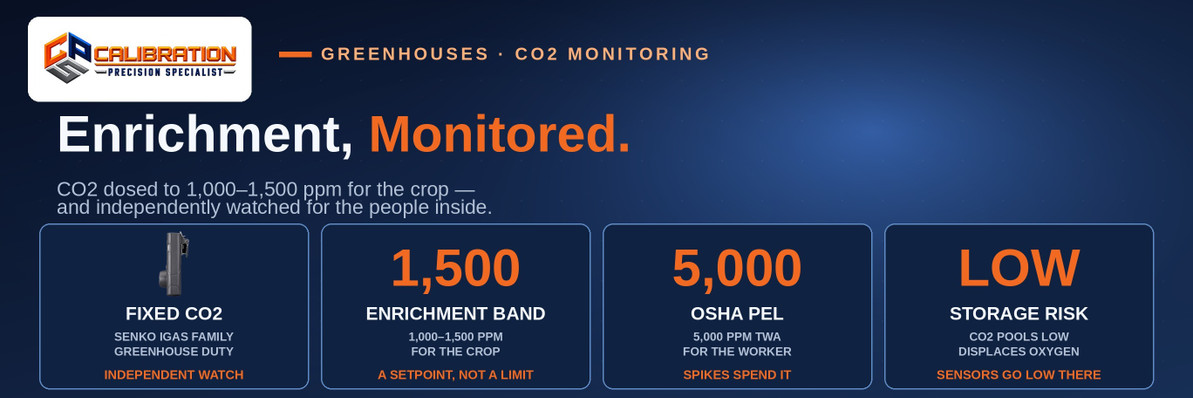
A greenhouse deliberately holds carbon dioxide at 1,000–1,500 ppm because the crop grows faster in it — and people work full shifts in that same enriched air, against OSHA's CO₂ PEL of 5,000 ppm as an 8-hour TWA (NIOSH: 30,000 ppm short-term, 40,000 ppm IDLH). Monitoring a greenhouse is therefore not about detecting a contaminant; it is about proving, continuously, that a gas you are adding on purpose stays in the band you chose — and catching the two failures that break the band: runaway injection and a bulk-storage leak pooling heavy, oxygen-poor CO₂ at floor level.
This is a different CO₂ problem from the ones in our brewery and beverage CO₂ post or the food-processing CO₂ post: there, CO₂ is a byproduct to be kept away from people; here, it is an input to be kept at a setpoint around people. That inversion changes the monitoring design. The enrichment controller already measures CO₂ to dose it — the safety question is whether anything independent is watching when the dosing itself is what fails.
The Enrichment Band Is a Crop Setpoint, Not a Safety Limit
Growers dose to roughly 1,000–1,500 ppm because photosynthesis responds there. Workers tolerate that band across a shift — it sits well under the 5,000 ppm PEL — but 'the plants are happy' is not a measurement of worker exposure, and the band only holds while the equipment behaves. A stuck injection valve, a dosing controller reading its own failed sensor, or a combustion CO₂ generator with a fault can push a sealed, sunlit house far past the setpoint with nobody noticing: CO₂'s early effects — headache, drowsiness, faster breathing — are easy to credit to heat and work.
So the safety layer is independent monitoring with its own alarm logic: a high alarm set with real margin above the enrichment band and real margin below the PEL, read by people who know that alarm means the dosing system, not the crop, needs attention. One number deserves emphasis: the PEL is a time-weighted average, and a house that spikes hard for an hour has spent exposure budget that a steady-state average on a controller screen will politely hide.
Two Rooms, Two Placements: Canopy Air and Bulk Storage
In the crop, sensors belong at breathing height where people work — the exposure being managed is the crew's, measured in the air they actually breathe across the shift. That placement also verifies the working band honestly, since canopy air in a dense crop is not automatically the same air the dosing sensor samples near the injector.
At bulk storage, the physics flips. CO₂ is heavier than air, and a leaking tank, manifold, or vaporizer line in a head-house or storage room pools gas low — floor level, sumps, pits — displacing oxygen as it builds. That is an asphyxiation scenario, not an over-enrichment one, and its sensor belongs low, near the storage and its low points, alarming before a person walks into air that cannot support them. Greenhouse ranges that generate CO₂ by combustion add a third watch, on the generator itself and its CO byproduct — a burner fault makes two gases, not one.
What Should the Alarm Actually Do?
An alarm nobody hears in a glasshouse is a log entry. Greenhouse monitoring has to report where people are: local indication at the house entrance (so nobody walks into a spiked house at the door), audible/visual alarm inside, and a signal to the grower's phone or control room for the unoccupied hours — because injection faults do not schedule themselves around shifts, and the first entrant of the morning is the exposed person the system exists to protect.
Tie the response to the cause: a high-CO₂ alarm should shut or flag the injection source, call for ventilation, and keep people out of storage areas until low-level air is verified. Fixed CO₂ detection built for this duty exists in the SENKO line — the iGas CO₂ is the fixed CO₂ monitor in that family — and whatever head is chosen, its calibration and bump discipline decide whether the number on the wall is evidence or decoration. CPS calibrates fixed and portable instruments; see calibration services.
The Greenhouse Checklist
- Independent safety monitoring — not only the dosing controller's own sensor; the failure you fear is the dosing system itself.
- Breathing-height sensors in the crop — measuring the crew's air, near where people spend the shift.
- Low placement at bulk storage — CO₂ pools; storage rooms, sumps, and pits get the asphyxiation watch.
- Entrance indication + remote alarm — the first entrant is the person to protect; faults happen at night.
- Alarm set with margin both ways — clearly above the 1,000–1,500 ppm band, clearly below the 5,000 ppm PEL, with injection shutoff/ventilation as the response.
- Calibration on schedule — an uncalibrated CO₂ head guarding an intentional-gas workplace is a story, not a system.
Greenhouses dose a gas to one set of numbers and employ people under another. Monitoring is how both stay true at once — and portable gas detection covers the personal layer for crews moving between houses and storage.
Frequently Asked Questions
What CO2 level is a greenhouse enriched to?
Typically 1,000–1,500 ppm — the band where the crop's photosynthesis responds. Workers can work a full shift in that band because it sits well below OSHA's CO₂ PEL of 5,000 ppm as an 8-hour TWA. But the enrichment band is a crop setpoint maintained by equipment, not a safety guarantee: monitoring exists to prove the band holds and to catch the day the equipment fails.
What is OSHA's CO2 exposure limit?
5,000 ppm as an 8-hour time-weighted average (PEL). NIOSH recommends the same 5,000 ppm TWA, adds a 30,000 ppm short-term exposure limit, and sets the IDLH at 40,000 ppm. Because the PEL is an average, a short, high spike spends exposure budget — a steady controller reading afterward does not refund it.
Why monitor a gas you are adding on purpose?
Because the failure mode is the adding itself: a stuck injection valve, a dosing controller trusting its own dead sensor, or a combustion generator fault can push a sealed house far beyond its 1,000–1,500 ppm setpoint unnoticed. CO₂'s early symptoms — headache, drowsiness — read as heat and hard work. Independent monitoring with its own alarm is the check on the dosing system.
Where do CO2 sensors go in a greenhouse?
Two placements for two hazards. At breathing height in the crop, where the crew's exposure actually happens. And low — near floor level, sumps, and storage — at bulk CO₂ storage, because CO₂ is heavier than air and pools, displacing oxygen. One sensor doing one of those jobs is not doing the other.
Is the dosing controller's sensor enough for safety?
No. It is a single point of failure shared with the hazard: if the dosing sensor drifts low, the controller injects harder while reporting comfort. Safety monitoring is independent — its own sensing, its own alarm, ideally its own path to shutting injection down. Independence is the entire point.
What about combustion CO2 generators?
They add a second gas to the watch: carbon monoxide from incomplete combustion, on top of the CO₂ they make on purpose. A burner fault can produce both a CO₂ overshoot and CO. Generation equipment needs its own maintenance and monitoring attention, and the house alarm logic should treat a generator fault as a gas event, not a heating issue.
Can CO2 build up dangerously overnight?
Yes — injection or storage leaks in a closed, unoccupied house can build high concentrations by morning, which makes entrance indication and remote alarming the important half of the system: the first person through the door is the exposure. Alarm at the entrance, signal to a phone or control room, and verify before entry.
What should a high-CO2 alarm trigger?
Source and air: shut or flag the injection supply, ventilate the house, and keep people out of storage and low areas until the air is verified — not merely silenced. An alarm whose only effect is noise trains a crew to ignore the one morning it is telling the truth.
Does CPS sell greenhouse CO2 monitoring?
CPS sells and calibrates fixed and portable gas detection, including fixed CO₂ monitoring in the SENKO iGas CO₂ family, and calibrates the instruments it sells — call 865-900-8844 with the house layout (enrichment method, storage type, crew pattern) and the monitoring gets matched to the actual risk points. System design and code compliance remain with the grower and their contractors.
How is greenhouse CO2 different from brewery CO2?
Direction. In breweries and beverage plants, CO₂ is a byproduct to keep away from people, and monitoring guards low spaces where fermentation gas pools. In a greenhouse, CO₂ is dosed intentionally to 1,000–1,500 ppm around workers, so monitoring additionally has to police the dosing system itself — same gas, opposite problem, different alarm philosophy.
The Bottom Line
A greenhouse holds a gas at 1,000–1,500 ppm for the crop and employs people under a 5,000 ppm limit — monitoring is the independent witness that both numbers stay true: breathing-height sensing in the crop, low sensing at storage, alarms set with margin both ways, and a response wired to the injection source. Dose confidently; verify independently.
Setting up or calibrating greenhouse CO₂ monitoring? Call CPS Calibrations at 865-900-8844 — 109 S. Front Street, Rockwood, TN 37854.
--- CPS Calibrations · 109 S. Front Street, Rockwood, TN 37854 · CO2 in Food Processing · Portable Gas Detection · Calibration Services
Need a calibration you can file?
In-house calibration at CPS in Rockwood, Tennessee — $55 for single-gas instruments, $90 for 4- and 5-gas — every channel, as-found and as-left data, full certificate.
See Calibration Servicesor call 865-900-8844
Recent Posts
-

What Is Remote Monitoring for Fixed Gas Detection?
Remote monitoring for fixed gas detection means a fixed system's live readings, trends, and alarm hi …Nov 23rd 2026 -

What Are the Key Differences Between the GX-6000 and GX-6100?
The RKI GX-6100 is the current replacement for the discontinued GX-6000: both are pumped 6-gas monit …Nov 22nd 2026 -

How to Read a PID Correction Factor Chart
To read a PID correction factor chart, find your vapor’s row, take the factor under your own lamp en …Nov 21st 2026