
Carbon Dioxide in Breweries and Beverage Plants: The Odorless Hazard in Cellars and Silos
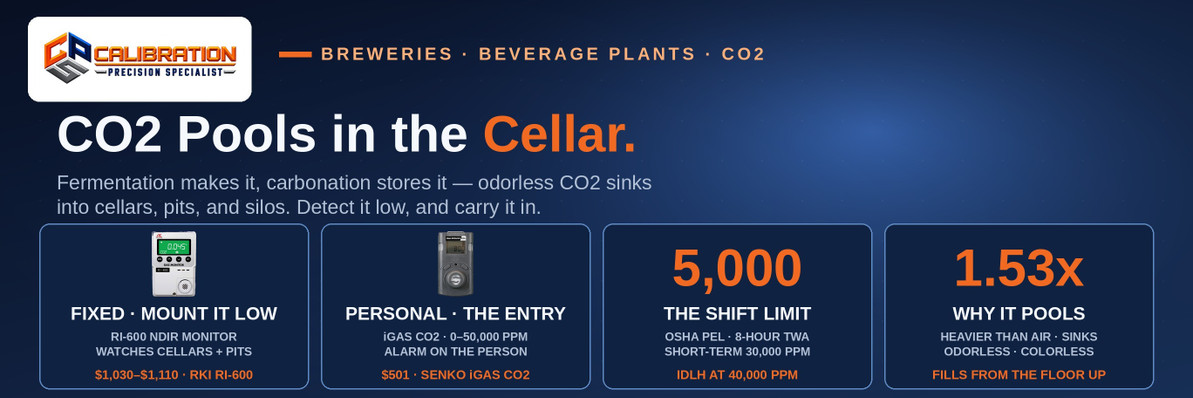
Carbon dioxide in breweries and beverage plants is dangerous because the process makes it and uses it in bulk while the gas itself gives no warning: CO2 is odorless, colorless, and about 1.53 times as dense as air, so it sinks and pools in cellars, pits, silos, and the bottoms of vessels, displacing oxygen as it builds — and the exposure numbers arrive fast, with OSHA's 8-hour limit at 5,000 ppm, a short-term limit of 30,000 ppm, and 40,000 ppm classed as immediately dangerous to life and health. The protection is layered: fixed CO2 detection mounted low where the gas collects, and a personal CO2 monitor on anyone who enters those low areas.
Most workplace gases announce themselves somehow — a smell, a color, an irritation. Carbon dioxide announces nothing. A brewery is also one of the few workplaces that manufactures its own hazard as a core part of the process: fermentation produces CO2 continuously, and carbonation systems store and inject it. The same story, with different equipment, runs through soda plants, seltzer and kombucha producers, and any beverage operation with bulk CO2 on site. The restaurant version of this hazard — bulk beverage CO2 in storerooms and walk-ins — is covered in do restaurants need a CO2 monitor; this post is about production: cellars, fermenters, silos, and pits.
Where Does CO2 Build Up in a Brewery or Beverage Plant?
Anywhere the gas is made, stored, or used — and anywhere low that sits downhill of those places. The areas that deserve detection first:
- Fermentation cellars and tank farms. Fermenting beer releases CO2 for days at a time, and cellars are usually the lowest, least ventilated rooms in the building. Gas vented or leaked at tank level settles to the floor and stays there.
- Bright tanks, carbonation, and filling areas. Beverage plants inject CO2 under pressure. A fitting, hose, or relief that lets go indoors releases gas far faster than fermentation does, and it flows downhill to the lowest point it can find.
- Pits, sumps, and below-grade spaces. Drainage pits, elevator pits, and below-floor service spaces are collection points for any heavy gas in the building. CO2 that escapes anywhere nearby ends up in the pit.
- Silos and grain-handling areas. Grain and adjunct storage brings its own low areas — silo bases, pits, and enclosed conveying spaces — where CO2 from stored product and from the rest of the plant can collect, and where a worker may be alone when they enter.
- Bulk CO2 storage and delivery points. The tank, the fill connection, and the lines between them are the plant's largest single inventory of the gas.
The pattern to teach every employee: CO2 problems in a brewery are floor problems. The dangerous layer starts at the floor and fills upward, which is why a person can feel fine standing, bend down into the layer to pick something up or work on a valve, and be overcome at knee height.
Why Is CO2 Dangerous If Your Body Produces It?
Two mechanisms, and both work silently. First, CO2 is toxic in its own right at elevated concentrations — that is what the exposure limits measure: OSHA's permissible exposure limit is 5,000 ppm as an 8-hour time-weighted average, NIOSH sets a short-term exposure limit of 30,000 ppm, and 40,000 ppm is the IDLH level — immediately dangerous to life and health. Second, pooled CO2 physically displaces air: as the CO2 layer deepens, the oxygen fraction in it falls, and OSHA classifies any atmosphere below 19.5% oxygen as oxygen-deficient. A deep enough pool is effectively an atmosphere with too little oxygen to sustain consciousness, reached by walking down a flight of cellar stairs. Because CO2 has no odor and no color, neither mechanism triggers the one alarm every worker carries — their nose. Detection has to be instrumental, because human senses are not on the list of things that work.
Fixed Detection Where It Pools, Portables Where People Go
The two layers do different jobs, and a brewery needs the thinking behind both.
Fixed detection watches the room when nobody is in it. A wall-mounted CO2 monitor at the low point of a cellar, pit, or tank room alarms before a person walks into a built-up layer — including at shift start, after a weekend of fermentation, when the building has been quietly filling. The fixed instrument CPS installs and calibrates for this duty is the RKI RI-600: a stand-alone indoor CO2 monitor, $1,030–$1,110 configured (its $980 headline price matches no actual configuration — buy the configured number). Mounting height follows the physics: low, near the floor and the pit, because that is where the gas is.
A personal monitor watches the person the wall cannot follow. Fixed detection covers known rooms; it does not cover the employee who drops into a pit, enters a silo area, or opens a vessel space the fixed system was never pointed at. The SENKO iGas CO2, $501, is a dedicated personal CO2 instrument: NDIR sensing over a 0–50,000 ppm range, audible, visual, and vibration alarms, short-term and time-weighted exposure tracking, and a rechargeable battery that runs about 14 days per charge. It is the right shape for entry work — the alarm is on the person, in the layer, at the moment it matters.
The two related hazards behave the same way in neighboring industries: CO2 in distilleries covers fermentation at spirit scale, and CO2 in food processing plants covers dry ice, packaging, and cold rooms. The pooling physics and the low-mount, layered answer are identical; only the room names change.
Keeping CO2 Monitors Honest: Calibration
A CO2 monitor is a measuring instrument, and NDIR sensors drift like any other sensor — a fixed monitor that reads low is worse than no monitor, because it certifies a dangerous room as safe. CPS sells and calibrates CO2 monitors: portable instruments come to our Rockwood bench at the published in-house rates — $55 for a single-gas instrument, $90 for a 4- or 5-gas instrument — and we calibrate every channel an instrument carries. Fixed systems are calibrated on site and are quoted in writing for the job; the in-house rates never apply to on-site work. Calibration intervals follow the instrument manufacturer's instructions and your safety program — what matters is that the interval exists, is documented, and the certificate shows as-found and as-left readings so drift is visible over time rather than discovered after an incident.
Frequently Asked Questions
Why is carbon dioxide dangerous in a brewery?
Because a brewery produces and stores it in bulk while the gas itself is undetectable by human senses. CO2 is odorless and colorless and about 1.53 times as dense as air, so it sinks and pools in cellars, pits, silos, and vessel bottoms, displacing oxygen as it builds. OSHA's 8-hour exposure limit is 5,000 ppm, the short-term limit is 30,000 ppm, and 40,000 ppm is immediately dangerous to life and health — concentrations a fermenting cellar can reach at floor level while the air at standing height still seems normal.
Where does CO2 accumulate in a brewery or beverage plant?
In the low areas near where it is made, stored, or used: fermentation cellars and tank farms, bright-tank and carbonation areas, filling lines, bulk CO2 storage and fill points, and any pit, sump, or below-grade space downhill of them — including silo bases and grain-handling pits. CO2 flows downhill and fills spaces from the floor up, so the collection point is not always the room the gas escaped in; a pit two rooms away from a leak can hold the deepest layer.
What are the OSHA and NIOSH limits for carbon dioxide?
OSHA's permissible exposure limit for carbon dioxide is 5,000 ppm as an 8-hour time-weighted average. NIOSH sets a short-term exposure limit of 30,000 ppm for brief exposures, and classifies 40,000 ppm as IDLH — immediately dangerous to life and health. Separately, pooled CO2 displaces air, and OSHA treats any atmosphere below 19.5% oxygen as oxygen-deficient. Those four numbers — 5,000, 30,000, 40,000 ppm, and 19.5% oxygen — are the numbers brewery CO2 detection is built around.
Can you smell carbon dioxide before it hurts you?
No. Carbon dioxide is odorless and colorless at every concentration, including lethal ones — there is no warning smell, taste, or irritation that reliably arrives before the exposure does its work. That is the entire reason breweries and beverage plants rely on instrumental detection: fixed monitors watching low areas continuously, and personal monitors on workers entering pits, silos, and cellar spaces.
Where should CO2 detectors be mounted in a brewery?
Low — near the floor, at pit level, and at the low points of cellars and tank rooms — because CO2 is about 1.53 times as dense as air and pools from the floor up. A CO2 sensor mounted at breathing height or on a ceiling can read normal air while a dangerous layer sits at knee height beneath it. Place fixed detection where the gas collects and where people enter that collection zone, and put a personal monitor on the worker for pits, silos, and vessel areas a fixed sensor does not cover.
Does a brewery need a fixed CO2 monitor or a portable one?
Both, doing different jobs. Fixed detection — CPS installs and calibrates the RKI RI-600, $1,030–$1,110 configured — watches cellars, pits, and tank rooms continuously, including nights and weekends when fermentation keeps producing CO2 and nobody is present. A portable personal monitor — the SENKO iGas CO2 at $501, with a 0–50,000 ppm range and about 14 days per battery charge — protects the individual worker entering a pit, a silo area, or any low space the fixed system does not cover. Fixed protects the room; portable protects the person.
How much does a CO2 monitor for a brewery cost?
On the CPS store, verified for this post: the SENKO iGas CO2 personal monitor is $501, and the RKI RI-600 fixed indoor CO2 monitor is $1,030–$1,110 configured — its $980 headline price matches none of its configurations, so budget the configured figure. Calibration is separate: portable instruments calibrate at CPS's published in-house rates of $55 for a single-gas instrument and $90 for a 4- or 5-gas instrument, and fixed or on-site work is quoted in writing.
Is a brewery cellar or fermenter area a confined space?
It can be — below-grade cellars, pits, silos, and vessel interiors are exactly the kinds of spaces confined-space programs exist for, and CO2 pooling is one of the classic reasons why. The classification of any specific space is a determination your own safety program has to make under its confined-space procedures; the detection lesson stands either way: test the air instrumentally before and during entry, because CO2 gives no sensory warning. Call CPS at 865-900-8844 if you want the monitoring side of an entry program equipped.
How often does a brewery CO2 monitor need calibration?
On the interval the instrument manufacturer specifies and your safety program adopts — there is no honest universal number, and this post does not invent one. What is universal is the failure mode: an NDIR CO2 sensor that has drifted reads low and certifies a dangerous room as safe. Keep the interval documented, keep the certificates, and make sure the calibration records as-found and as-left readings so drift shows up as a trend. CPS calibrates CO2 monitors at its Rockwood bench and on site for fixed systems.
Can CPS Calibrations supply and calibrate CO2 monitors for my brewery?
Yes. CPS sells the RKI RI-600 fixed CO2 monitor ($1,030–$1,110 configured) and the SENKO iGas CO2 personal monitor ($501), and calibrates CO2 monitors — portables at the Rockwood bench at published in-house rates ($55 single-gas, $90 for 4- or 5-gas instruments) and fixed systems on site, quoted in writing. We calibrate every channel an instrument carries, and every calibration returns a certificate with as-found and as-left data. Call 865-900-8844 or see calibration services.
The Bottom Line
A brewery's CO2 hazard is built into its process: the gas is made on purpose, stored in bulk, odorless, and heavier than air, so it collects silently in exactly the low rooms — cellars, pits, silos — that workers enter alone. The defense matches the physics: fixed detection mounted low where CO2 pools, a personal monitor on anyone entering those spaces, alarms set against the real numbers (5,000 ppm over a shift, 30,000 ppm short-term, 40,000 ppm IDLH), and calibration that keeps both layers honest.
Outfitting a brewery or beverage plant? Call CPS Calibrations at 865-900-8844 — fixed and personal CO2 detection, sold and calibrated from 109 S. Front Street, Rockwood, TN 37854.
CPS Calibrations · 109 S. Front Street, Rockwood, TN 37854 · Calibration Services · Do Restaurants Need a CO2 Monitor? · CO2 in Distilleries
Need a calibration you can file?
In-house calibration at CPS in Rockwood, Tennessee — $55 for single-gas instruments, $90 for 4- and 5-gas — every channel, as-found and as-left data, full certificate.
See Calibration Servicesor call 865-900-8844
Recent Posts
-

What Is Remote Monitoring for Fixed Gas Detection?
Remote monitoring for fixed gas detection means a fixed system's live readings, trends, and alarm hi …Nov 23rd 2026 -

What Are the Key Differences Between the GX-6000 and GX-6100?
The RKI GX-6100 is the current replacement for the discontinued GX-6000: both are pumped 6-gas monit …Nov 22nd 2026 -

How to Read a PID Correction Factor Chart
To read a PID correction factor chart, find your vapor’s row, take the factor under your own lamp en …Nov 21st 2026