
Community Air Monitoring During Remediation: Who Sets Up the CAMP Stations?
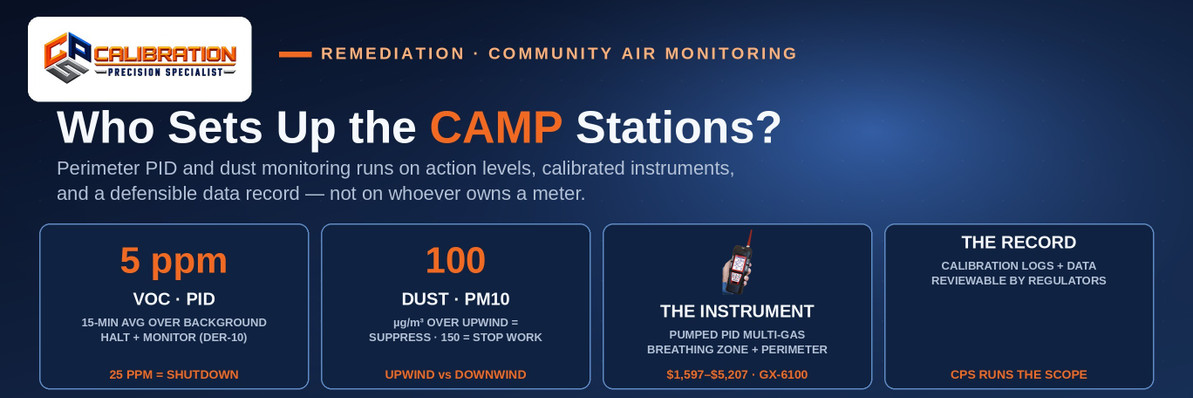
On a remediation site, the community air monitoring plan (CAMP) is run from perimeter stations — a photoionization detector (PID) watching total volatile organic compounds (VOCs) and a particulate monitor watching PM10 dust at the downwind edge of the work area, compared against an upwind background station on 15-minute averages. Under the model CAMP (the New York State Department of Health generic CAMP in Appendix 1A of NYSDEC DER-10), work pauses at 5 ppm of VOC over background and shuts down above 25 ppm — and those numbers are only defensible if a named party sets the stations up, calibrates the instruments, and keeps the data record. CPS Calibrations supplies and runs that monitoring scope.
Every remediation work plan has the paragraph. It promises the surrounding community — the homes, schools, and businesses downwind of the fence — that the air at the perimeter will be watched in real time while contaminated ground is opened, and that work will stop if the readings say so. Then excavation day arrives, and the paragraph meets its practical questions: whose instruments, set up where, calibrated when, watched by whom, and written down where?
This post walks the CAMP the way it actually runs: the framework, the action levels, the station setup, and the division of labor that makes the data worth the paper it is printed on.
What Is a CAMP, and When Does It Apply?
A community air monitoring plan is the perimeter protection half of a remediation site's health and safety program. The HASP protects the workers inside the fence; the CAMP protects everyone outside it. The most widely used model is the New York State Department of Health Generic Community Air Monitoring Plan, published as Appendix 1A of NYSDEC DER-10 (the state's Technical Guidance for Site Investigation and Remediation). It is New York's document, but it has become the template CAMPs across the country are adapted from — which is why its numbers are worth knowing even on a Tennessee site, with one honest qualification stated up front: the governing document on your site is your site's own approved CAMP. Where a site CAMP adopts different levels or methods, the site CAMP controls.
Under the generic CAMP, real-time monitoring for VOCs and particulates runs at the perimeter of the work area or exclusion zone during ground-intrusive activities — excavation, drilling, soil handling, demolition of contaminated structures. The monitoring is continuous while the work is, not a morning grab sample.
What Are the CAMP Action Levels?
The generic CAMP's levels are built on one idea: a downwind reading means nothing alone, so every number is a comparison — downwind minus upwind background, on a 15-minute running average.
Volatile organic compounds (total VOC by PID), downwind perimeter:
| 15-min average, over background | Required response |
|---|---|
| Above 5 ppm | Temporarily halt work; continue monitoring. If instantaneous readings readily fall below 5 ppm over background, work may resume with monitoring |
| Persists above 5 ppm but below 25 ppm | Halt work, identify the vapor source, take corrective action, continue monitoring. Resume only when the level 200 ft downwind of the exclusion zone — or half the distance to the nearest potential receptor, whichever is less, but never less than 20 ft — is below 5 ppm over background |
| Above 25 ppm | Shut down work activities |
Particulates (PM10), downwind vs. upwind perimeter:
| 15-min average | Required response |
|---|---|
| More than 100 µg/m³ above the upwind level, or visible dust leaving the work area | Employ dust suppression. Work may continue with suppression in place provided downwind PM10 stays at or below 150 µg/m³ above upwind and no visible dust migrates |
| More than 150 µg/m³ above the upwind level | Stop work and re-evaluate. Resume when suppression brings downwind PM10 to 150 µg/m³ or less above upwind, with no visible dust migrating |
Two properties of this table drive everything about how stations must be run. First, the decisions are comparative — which means the upwind background station is not optional equipment; without it, no downwind number can be evaluated. Second, the decisions are time-averaged — which means the instruments must log continuously, because a 15-minute average cannot be reconstructed from a notebook of spot checks.
What Does a CAMP Station Actually Consist Of?
A working perimeter station, upwind and downwind, is a small system:
- A PID for total VOCs at the downwind perimeter. The PID is a screening instrument: it reports total ionizable vapors as a single number in ppm. It does not identify which compound is present — an honest limit every CAMP lives with, and the reason action levels are set conservatively. Instruments in this role need a pump or a station enclosure arrangement suited to continuous perimeter duty, daily calibration checks, and logging.
- A real-time PM10 particulate monitor at both perimeters. The dust decision is a subtraction — downwind minus upwind — so the two stations run the same measurement on the same clock.
- Power, weather protection, and a data path. Stations run all day in field conditions; the data must be downloadable or telemetered in a form that survives review — the generic CAMP expects the monitoring record to be available for agency personnel to review.
- A person accountable for the day's record. Background established in the morning, stations repositioned when the wind shifts and the upwind station is suddenly downwind, exceedances called to the site manager in time for the response table to mean something, calibration documented.
For the portable-instrument side of perimeter and work-area VOC screening, a pumped PID multi-gas instrument is the workhorse — the RKI GX-6100 is the configuration we supply for this duty, a pumped six-gas monitor with PID VOC measurement alongside the standard worker-protection channels, configured $1,597–$5,207 depending on sensor loadout. It belongs to the pumped monitors family for a reason: perimeter and breathing-zone screening both need drawn samples, not diffusion and hope. Worker-side monitoring during the dig itself is a separate, HASP-driven scope — see gas monitoring during brownfield excavation.
So Who Sets Up the CAMP Stations?
In practice, one of three parties — and the work plan should name which, before mobilization:
- The environmental consultant of record staffs it with their own field team and instruments. Clean accountability, and the consultant's other duties compete for the same people's hours.
- The remediation contractor self-performs it as a bid line. Workable when the contractor owns logging PIDs and particulate monitors, keeps them calibrated, and assigns a named operator — and a common failure point when "the CAMP" is a meter in the job trailer that three people share.
- A monitoring specialist supplies and runs the scope. The stations, instruments, calibration, daily operation, and data record are one sub-scope under one accountable party, and the consultant and contractor get readings and reports instead of a second job.
That third model is the CPS scope. CPS Calibrations supplies and runs CAMP monitoring as field installation and monitoring work: stations selected and positioned for the work area and the day's wind, instruments calibrated before mobilization and checked on site — we calibrate every channel an instrument carries — data logged in the form the site's CAMP requires, and exceedances reported against the site CAMP's own action levels, not a generic table. This work is quoted in writing per project, because station count, duration, and reporting duties are site-specific. It sits alongside our fixed system installation practice: same discipline, temporary address.
The question in this post's title has a wrong answer, and it is the most common one: "whoever." A CAMP whose stations are nobody's named scope produces data nobody will defend — in front of the regulator reviewing the record, the community asking what the readings were, or the engineer certifying the remedy. Name the party in the work plan. If the plan has a gap where that name should be, call us — 865-900-8844.
Frequently Asked Questions
What is a community air monitoring plan (CAMP)?
A CAMP is the perimeter air monitoring program for a remediation site: real-time instruments at the edge of the work area watch volatile organic compounds and dust so the surrounding community is protected while contaminated ground is disturbed. The model document is the New York State Department of Health Generic CAMP, Appendix 1A of NYSDEC DER-10, which most site CAMPs are adapted from. The site's own approved CAMP is always the governing document for that site.
What are the CAMP action levels for VOCs?
Under the generic CAMP (DER-10 Appendix 1A), using 15-minute averages at the downwind perimeter measured against upwind background: above 5 ppm total VOC over background, work temporarily halts and monitoring continues; if the level persists above 5 ppm but below 25 ppm, work halts while the source is identified and corrected, and work resumes only when a point 200 ft downwind — or half the distance to the nearest receptor, whichever is less, but at least 20 ft — reads below 5 ppm over background; above 25 ppm at the perimeter, work activities shut down.
What are the CAMP action levels for dust (PM10)?
Under the generic CAMP: if the downwind PM10 15-minute average is more than 100 µg/m³ above the upwind level, or visible dust is leaving the work area, dust suppression is employed; work may continue with suppression provided downwind PM10 does not exceed 150 µg/m³ above upwind and no visible dust migrates. Above 150 µg/m³ over upwind, work stops and is re-evaluated, resuming when suppression brings the level to 150 µg/m³ or less with no visible dust migration.
Why does a CAMP need an upwind station if the work is downwind?
Because every action level in the framework is a comparison, not an absolute number. A downwind VOC reading of 6 ppm means one thing if background is clean air and another if the upwind station is already reading 5 ppm from an unrelated source. The upwind station establishes background continuously, on the same clock as the downwind station — without it, no exceedance can be established or defended, and no all-clear can either.
Does a PID tell you which chemical is in the air?
No — and any CAMP built on that assumption is misbuilt. A photoionization detector reports total ionizable vapors as one screening number in parts per million. It cannot speciate: benzene, solvent blends, and fuel vapors all register on the same scale, weighted by the lamp and correction factors. That is why CAMP action levels are framed as total-VOC triggers for pausing and investigating work, not as compound-specific health determinations.
How often do CAMP instruments need calibration?
On the schedule the instrument manufacturer specifies and the site CAMP requires — in practice, calibration or calibration verification before mobilization and daily function/calibration checks while the station is in service, all documented. An unlogged calibration is nearly as weak as an uncalibrated instrument, because the data record is what gets reviewed. CPS calibrates every channel on the instruments it deploys and keeps the calibration documentation with the monitoring record.
Who is qualified to run CAMP stations?
The site CAMP and the project team define the staffing, but the work itself requires someone who can position stations against wind and work area, establish background, maintain and calibrate PIDs and particulate monitors, watch 15-minute averages against action levels in real time, and produce a reviewable data record. It is instrument work, not laborer work — which is why it is increasingly placed as a named sub-scope with a monitoring provider rather than absorbed by whoever is on site.
What records does a CAMP produce?
Continuous logged readings from each station (the basis for the 15-minute averages), the upwind background record, calibration and function-check documentation, a log of any exceedances with the response taken and the readings that supported resuming work, and station location/wind notes. Under the generic CAMP model, the monitoring record is available for agency review — it should be assembled as if that review is certain, because on a contested site it is.
Can CPS run CAMP monitoring on a site outside Tennessee?
CPS is based in Rockwood, Tennessee, and CAMP work is field work quoted per project — station count, project duration, reporting duties, and travel all shape the quote, which we put in writing before mobilization. Call 865-900-8844 with the site CAMP and the excavation schedule and we will tell you plainly whether the project fits our service area and crew.
What does CAMP monitoring cost?
There is no honest shelf price: the scope is stations × days × reporting duties, on instruments that range from a single perimeter PID to multi-station upwind/downwind arrays. The instrument side is knowable — a pumped PID multi-gas unit such as the RKI GX-6100 runs $1,597–$5,207 configured — but the monitoring service is quoted in writing per project. What we will not do is quote a number before reading your site's CAMP; the document defines the work.
The Bottom Line
A CAMP is a promise made of numbers — 5 ppm, 25 ppm, 100 and 150 µg/m³, all on 15-minute averages against a live background — and a promise like that is only kept by named people, calibrated instruments, and a data record built for review. Put a name on the station scope in the work plan, or let CPS supply and run it.
Remediation mobilizing with a CAMP paragraph and no station crew? Call CPS Calibrations at 865-900-8844 — we set up, calibrate, run, and document the perimeter monitoring scope.
*CPS Calibrations · 109 S. Front Street, Rockwood, TN 37854 · Fixed System Installation · Pumped Monitors*
Need a calibration you can file?
In-house calibration at CPS in Rockwood, Tennessee — $55 for single-gas instruments, $90 for 4- and 5-gas — every channel, as-found and as-left data, full certificate.
See Calibration Servicesor call 865-900-8844
Recent Posts
-

What Is Remote Monitoring for Fixed Gas Detection?
Remote monitoring for fixed gas detection means a fixed system's live readings, trends, and alarm hi …Nov 23rd 2026 -

What Are the Key Differences Between the GX-6000 and GX-6100?
The RKI GX-6100 is the current replacement for the discontinued GX-6000: both are pumped 6-gas monit …Nov 22nd 2026 -

How to Read a PID Correction Factor Chart
To read a PID correction factor chart, find your vapor’s row, take the factor under your own lamp en …Nov 21st 2026