
Gas Monitoring During Brownfield Excavation: What the HASP Requires
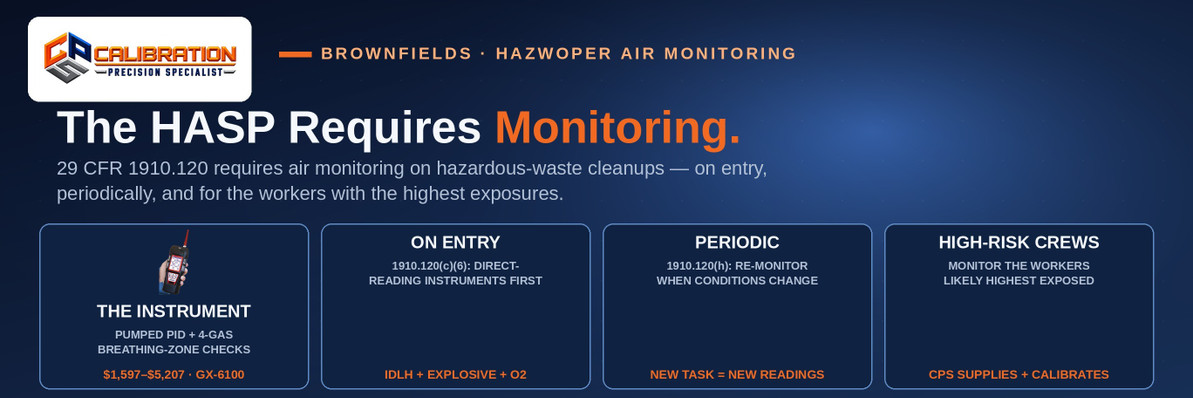
On a brownfield excavation that falls under OSHA's HAZWOPER standard (29 CFR 1910.120), the site health and safety plan (HASP) must define an air monitoring program — instrument types, monitoring frequency, and calibration methods — and the standard then requires monitoring at three moments: with direct-reading instruments on initial entry, periodically whenever conditions change, and personally on the workers likely to have the highest exposures once soil starts moving. In practice that program is a pumped PID for volatile organic vapors plus a 4-gas instrument (LEL, oxygen, carbon monoxide, hydrogen sulfide) in the breathing zone — calibrated, logged, and tied to action levels written into the HASP itself.
Brownfield excavation has a moment no other construction shares: the bucket opens ground whose contents are known from borings and reports, approximately, and the air above it starts telling the truth in real time. Worker protection in that moment is not a matter of good intentions — it is a written program, required by a specific standard, with the monitoring duties spelled out in regulatory text. This post reads that text: what 29 CFR 1910.120 actually requires of the air monitoring in your HASP, where the numbers do and do not come from, and how the worker-side program differs from the perimeter program running at the fence.
Does HAZWOPER Even Apply to a Brownfield Dig?
Often, yes — and the applicability question is answered by the standard's scope, not by the project's marketing name. Section 1910.120(a)(1) covers, among other operations, clean-up operations at uncontrolled hazardous waste sites, corrective actions under RCRA, and voluntary clean-up operations at sites recognized by a governmental body as uncontrolled hazardous waste sites. A brownfield excavation being performed as a cleanup — contaminated soil being removed or managed because it is contaminated — commonly lands inside that scope. A purely commercial dig on a parcel with an incidental finding may present a different analysis. The honest statement is the one the standard makes: scope is determined by the operation and its exposures, site by site, and the employer's safety organization makes that determination before mobilization — not after the first exceedance. The rest of this post addresses the sites where HAZWOPER applies, which is the frame most remediation excavation HASPs are written in.
What Must the HASP Itself Say About Monitoring?
The HASP is not a binder ornament; 1910.120(b) makes the site safety and health plan a required, written program, and its required contents speak directly to instruments. Among the elements the plan must address is the site's monitoring program, in the standard's own terms: the frequency and types of air monitoring, personnel monitoring, and environmental sampling techniques and instrumentation to be used — including the methods of maintenance and calibration of the monitoring and sampling equipment.
Read that requirement as a checklist, because an auditor will:
- Types — which measurements, where: direct-reading instruments for which hazards, personal sampling for which exposures.
- Frequency — when monitoring happens: entry, continuously during specified tasks, periodically, on condition changes.
- Instrumentation — named instrument classes capable of the measurements (a PID does not read oxygen; a 4-gas does not read VOC vapors — the plan's instrument list has to cover the hazard list).
- Maintenance and calibration methods — how instruments are kept honest, on what schedule, documented how. A HASP whose monitoring section names no calibration method is incomplete on its face, under the standard's own text.
What Monitoring Does the Standard Require, and When?
Three duties structure the whole program.
1. Initial entry — direct-reading instruments first (1910.120(c)(6) and (h)(2)). Before and during initial entry, where site information shows the potential for IDLH conditions — or where information is insufficient to rule them out — the air is monitored with appropriate direct-reading test equipment (the standard's examples are combustible gas meters and detector tubes) for the conditions that can cause death or serious harm: combustible or explosive atmospheres, oxygen deficiency, and toxic substances. Paragraph (h)(2) states the same duty in monitoring terms: representative air monitoring on initial entry to identify any IDLH condition, exposure over permissible exposure limits or published exposure levels, or other dangerous condition such as a flammable atmosphere. Only after characterization shows the site is safe for start-up does the ongoing program under paragraph (h) take over. In excavation language: the first bucket is a monitored event, not an assumption. (The standard also fixes a definition worth having in the plan: an oxygen-deficient atmosphere is one below 19.5% oxygen by volume.)
2. Periodic monitoring — when conditions change (1910.120(h)(3)). Monitoring is not a mobilization-week activity. Periodic monitoring is required when the possibility of an IDLH condition or flammable atmosphere has developed, or when there is indication exposures may have risen above permissible or published levels since prior monitoring. The standard lists the situations that should trigger the question — and they read like an excavation schedule: work begins on a different portion of the site; a different type of operation is started; different contaminants are handled. New area, new task, new material — new monitoring. A brownfield dig that moves from clean overburden into the impacted zone has changed conditions in exactly the standard's sense, even if the postal address of the work has not moved ten feet.
3. Monitoring the highest-exposed workers (1910.120(h)(4)). Once the actual clean-up phase commences — the standard's own example is when soil, surface water, or containers are moved or disturbed — the employer must monitor the employees likely to have the highest exposures, using personal sampling frequently enough to characterize those exposures. If the highest-exposed workers are over the limits, monitoring continues until all employees likely above the limits are identified. The logic is bounding: characterize the worst case properly, and everyone else's exposure is bounded by it. During excavation, the highest-exposed workers are not hypothetical — they are the operator at the face, the laborer in the cut, the spotter at the truck bed — the breathing zones closest to the opened ground.
Underneath all three sits paragraph (h)(1)'s purpose statement: monitoring is performed where there may be a question of exposure to hazardous concentrations, to assure the proper selection of engineering controls, work practices, and personal protective equipment. The readings are not record-keeping for its own sake; they are the input that decides PPE levels and work practices, in real time.
Where Do the Action Levels Come From?
From the HASP — and this is the point most often gotten wrong. HAZWOPER does not publish a single numeric action-level table for excavation. What it does is require monitoring against real benchmarks: permissible exposure limits and published exposure levels for specific substances, IDLH conditions, flammability, and the 19.5% oxygen-deficiency definition. The site HASP converts those benchmarks into working action levels for its instruments — the PID reading at which work pauses and the area is re-evaluated, the LEL percentage at which the cut is evacuated, the oxygen reading that stops entry — set by the site's safety and health professionals from the site's contaminants and the standard's benchmarks.
Two consequences follow. First, a HASP that copies action levels from another project's plan has imported numbers without their reasoning; the levels belong to this site's hazard assessment. Second, do not confuse the worker program with the perimeter program: the community air monitoring at the fence — the subject of community air monitoring during remediation — runs under the site's CAMP, protects the public, and uses its own framework levels. The HASP program protects the crew, is measured in the breathing zone, and answers to 1910.120. Sites under both documents run both programs, with different instruments in different places for different people — which is a feature, not a redundancy.
What Instruments Run a HASP Monitoring Program?
Mapped against the standard's duties, the kit is consistent:
- A pumped PID — the direct-reading answer for total VOC vapors on entry surveys, in the excavation breathing zone, and on changing-condition re-checks. Pumped, because the readings that matter are drawn from the face, the cut, and the bucket — not from wherever the instrument happens to be clipped.
- A 4-gas instrument — LEL (the combustible/explosive atmosphere duty), oxygen (the 19.5% deficiency duty), carbon monoxide, and hydrogen sulfide, in the breathing zone of the highest-exposed workers, continuously during the tasks the HASP specifies.
- Calibration behind both — because (b)(4) makes calibration method a plan element, the instruments arrive with a documented calibration state and get function-checked and calibrated on the plan's schedule. We calibrate every channel, and the record travels with the instrument file the HASP auditor will ask for.
One instrument covers most of this map in a single pumped platform: the RKI GX-6100 — a pumped six-gas monitor with PID VOC measurement alongside the LEL/O2/CO/H2S channels — configured $1,597–$5,207 depending on sensor loadout, from the pumped monitors we stock for exactly this work. CPS Calibrations supplies the instruments, calibrates them before they ship to your site, and — where the project's monitoring program needs a specialist's hands rather than a purchase — performs field monitoring and fixed system installation work under written, project-specific quotes. Call 865-900-8844 with the HASP's monitoring section in hand; that document, not a catalog, is where the specification starts.
Frequently Asked Questions
What does HAZWOPER require in a HASP about air monitoring?
29 CFR 1910.120(b) requires the site safety and health plan to address the monitoring program explicitly — including the frequency and types of air monitoring and personnel monitoring, the sampling techniques and instrumentation to be used, and the methods of maintenance and calibration of that equipment. A HASP that says "air monitoring will be performed" without those elements does not meet the plan-content requirement on its face.
When must air monitoring be performed during brownfield excavation?
At three points under 1910.120: on initial entry, using direct-reading instruments where IDLH conditions are possible or cannot be ruled out (paragraphs (c)(6) and (h)(2)); periodically, whenever conditions change — including starting work on a different portion of the site, starting a different type of operation, or handling different contaminants (paragraph (h)(3)); and, once the clean-up phase is disturbing soil or containers, on the employees likely to have the highest exposures (paragraph (h)(4)). Under (h)(1), monitoring is performed wherever there may be a question of exposure, to select controls, work practices, and PPE.
What is an IDLH condition, and why does it drive entry monitoring?
IDLH means immediately dangerous to life or health — an atmospheric concentration of a toxic, corrosive, or asphyxiant substance that poses an immediate threat to life, could cause irreversible or delayed adverse health effects, or could interfere with a worker's ability to escape. It drives entry monitoring because the first entrants are the ones who would discover such an atmosphere personally; the standard requires direct-reading instruments to make that discovery instead — testing for combustible/explosive atmospheres, oxygen deficiency (below 19.5% oxygen by volume), and toxic substances.
Does OSHA publish the action levels our HASP should use?
No single excavation action-level table exists in 1910.120. The standard supplies the benchmarks — permissible exposure limits and published exposure levels, IDLH conditions, flammability, and the 19.5% oxygen-deficiency definition — and the site's safety and health professionals set working action levels for the site's instruments in the HASP, based on the site's contaminants and hazard assessment. Action levels copied from another site or from a community air monitoring plan are not a substitute for that site-specific work.
What is the difference between HASP monitoring and CAMP monitoring?
Different documents, different protected populations, different instrument positions. HASP monitoring under 1910.120 protects the workers: it is measured in the breathing zone and at the work face, with PID and multi-gas instruments, against exposure limits and the standard's monitoring duties. CAMP monitoring protects the surrounding community: it is measured at the site perimeter with VOC and particulate stations, against the site CAMP's framework action levels. A remediation excavation commonly runs both at once.
Why a PID and a 4-gas — doesn't one instrument cover it?
The hazard lists are different. A PID reads total volatile organic vapors but cannot read oxygen or percent-LEL; a 4-gas instrument reads LEL, oxygen, CO, and H2S but cannot see VOC vapors at the ppm levels that matter for exposure decisions. HAZWOPER's entry duty names all of these hazard classes — explosive atmospheres, oxygen deficiency, and toxic substances — so the instrument set has to cover all of them. Pumped combination instruments like the GX-6100 put PID and the 4-gas channels in one platform, which is why they are the standard excavation configuration.
Who are the "highest-exposed employees" on an excavation crew?
The workers whose breathing zones spend the most time closest to the opened ground: typically the excavator operator at the face, laborers working in or at the edge of the cut, and spotters at loading — varying with the task. Paragraph (h)(4) requires monitoring those employees once soil is being moved or disturbed, frequently enough to characterize their exposures; if they are over the limits, monitoring extends to identify everyone likely above them. Characterizing the worst case bounds the rest of the crew.
How does calibration fit into HAZWOPER compliance?
Directly — the HASP's required contents include the methods of maintenance and calibration of monitoring equipment (1910.120(b)(4)). Beyond the plan text, every monitoring duty in paragraph (h) presumes readings that can be trusted for PPE and work-practice decisions. In practice: instruments calibrated before mobilization, function-checked in the field on the plan's schedule, recalibrated on the manufacturer's intervals, all documented. CPS calibrates every channel on the instruments it supplies, with the record kept per instrument.
What happens to the monitoring program when the dig moves into a new area of the site?
Paragraph (h)(3) is triggered: starting work on a different portion of the site is one of the standard's named situations for periodic monitoring — as are starting a different type of operation and handling different contaminants. Practically, that means entry-style direct-reading monitoring of the new area before and as work begins there, a review of whether action levels and PPE selections still fit, and documentation in the monitoring log. The program follows the work, not the calendar.
Can CPS supply or run the monitoring for our excavation?
Both models exist. CPS sells and calibrates the instruments — a pumped GX-6100 configured for excavation runs $1,597–$5,207 — so a contractor's own safety team runs the program with trustworthy tools. Where a project needs the monitoring performed as a scope, CPS performs field monitoring work under written, project-specific quotes. Either way, start with the HASP's monitoring section and a call to 865-900-8844; the plan defines the instruments, the frequency, and the calibration the work requires.
The Bottom Line
HAZWOPER's monitoring requirements are specific and structural: the HASP must name the monitoring types, frequency, instrumentation, and calibration methods (1910.120(b)); entry is monitored with direct-reading instruments ((c)(6), (h)(2)); changed conditions trigger re-monitoring ((h)(3)); and the highest-exposed workers are monitored once soil moves ((h)(4)). A PID + 4-gas program, calibrated and logged, is what those paragraphs look like in the field.
Writing or staffing the monitoring section of a brownfield HASP? Call CPS Calibrations at 865-900-8844 — we supply the instruments, calibrate every channel, and can perform the monitoring scope under a written quote.
*CPS Calibrations · 109 S. Front Street, Rockwood, TN 37854 · Fixed System Installation · Pumped Monitors*
Need a calibration you can file?
In-house calibration at CPS in Rockwood, Tennessee — $55 for single-gas instruments, $90 for 4- and 5-gas — every channel, as-found and as-left data, full certificate.
See Calibration Servicesor call 865-900-8844
Recent Posts
-

What Is Remote Monitoring for Fixed Gas Detection?
Remote monitoring for fixed gas detection means a fixed system's live readings, trends, and alarm hi …Nov 23rd 2026 -

What Are the Key Differences Between the GX-6000 and GX-6100?
The RKI GX-6100 is the current replacement for the discontinued GX-6000: both are pumped 6-gas monit …Nov 22nd 2026 -

How to Read a PID Correction Factor Chart
To read a PID correction factor chart, find your vapor’s row, take the factor under your own lamp en …Nov 21st 2026