
What Does It Cost to Keep a 4-Gas Detector Running for Three Years?
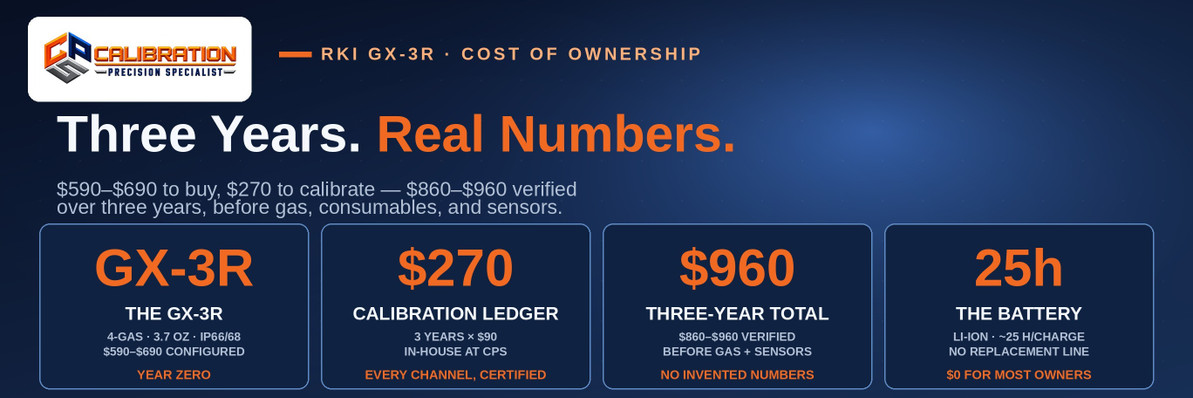
Keeping a 4-gas detector running for three years costs $860–$960 on the verified lines alone, worked on the RKI GX-3R: $590–$690 configured to buy it, plus three annual calibrations at CPS's published $90 in-house rate ($270) — before calibration gas, consumables, and the one cost years 2 and 3 hold that year 1 does not: sensors age, and a realistic three-year budget plans for it instead of being ambushed by it. The battery, by contrast, is a non-event — the GX-3R's rechargeable lithium-ion pack runs about 25 hours per charge and is not a replacement line in a normal three-year window.
This post extends our one-year cost breakdown across the full first ownership cycle, because year 1 is the cheap year: the detector is new, every sensor is young, and nothing has worn yet. Years 2 and 3 are where ownership actually costs — calibrations keep coming, gas gets consumed, and electrochemical sensors approach the end of their service life. The worked example is the RKI GX-3R — LEL 0–100%, O₂ 0–40.0%, CO 0–2,000 ppm, H₂S 0–200 ppm, about 3.7 oz with its boot, IP66/68 — because its store pricing is a clean configured range and its running gear is representative of a modern 4-gas monitor.
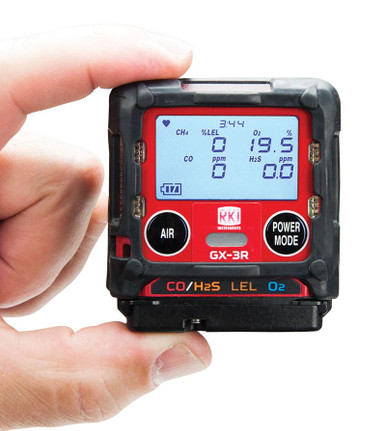
RKI GX-3R 4-Gas Monitor – LEL, O₂, CO & H₂S
Ultra-compact 4-gas monitor — LEL, O₂, CO & H₂S — about 3.7 oz with its boot, roughly 25 hours per charge.
$590–$690 configured
See the GX-3RThe Purchase and the Calibration Ledger: $860–$960
- Purchase, year 0: $590–$690 configured. The range is the charger/package configuration — the GX-3R with the rechargeable Li-ion pack and 100–240 VAC charger sits at $640 in that range.
- Calibrations, years 1–3: 3 × $90 = $270. Annual calibration at the published CPS in-house rate for 4-gas instruments — every channel, as-found and as-left data, full certificate. Bench rate only; on-site work is quoted in writing.
- Verified three-year total: $860–$960 ($590 + $270 at the low end; $690 + $270 at the high end), before gas, consumables, and any sensor work.
Two honest adjustments. First, if your program calibrates twice a year instead of annually, the calibration line doubles to $540 and the total becomes $1,130–$1,230 — the interval is your policy's call, and the arithmetic should show it. Second, every CPS calibration enrolls the instrument in the CPS Calibration Program at no extra charge, so the due dates in years 2 and 3 arrive with a reminder instead of a surprise audit finding.
What About Calibration Gas Over Three Years?
Gas is a real line, but it is a fleet line, not a per-detector line — one cylinder calibrates every compatible detector you own, so its per-instrument cost collapses as the fleet grows and balloons for a single-meter shop doing its own spans. That is why this ledger refuses to print a fake per-detector gas figure. What can be said exactly: reactive mixes keep 6–12 months and stable mixes about 36, so a three-year window consumes several cylinders of a reactive 4-gas mix on dates alone; CPS charges no hazmat fee on calibration gas; and the mail-in route converts the whole gas question into the $90 bench rate above, because the bench calibrates with its own documented gas.
Bump-test gas belongs in the same honest bucket: small per test, continuous across three years, and fleet-dependent. Budget it as a consumables line with your filters — field-replaceable on the GX-3R — rather than pretending it is zero.
The Sensor Question: What Years 2 and 3 Actually Hold
Electrochemical sensors are consumables with a service life measured in years, and the three-year window is exactly where that stops being theoretical — CO and H₂S cells age on exposure and time, and the O₂ cell is a galvanic consumable by design. The GX-3R carries a 3-year warranty on material and workmanship, and its sensors are field-replaceable, which is the good news. The budgeting news is this: plan for one sensor event somewhere in years 2–3 — a channel that stops holding calibration and gets replaced — priced when it happens, not invented here. CPS quotes sensor work in writing before doing it, and this post will not put a borrowed number on another shop's parts shelf.
The practical tell is in your own records: a channel whose as-found drift grows calibration over calibration is spending its life in front of you. That is the real value of as-found data on every certificate — by year 3, the sensor budget is a forecast from your own fleet's paper, not a guess from a blog post.
The Battery Question, Answered Honestly
For the GX-3R, the battery line across three years is $0 for most owners: a rechargeable lithium-ion pack, roughly 25 hours of operation per charge, about 3 hours to recharge, swapped only if it is damaged or genuinely worn. There is no alkaline habit to feed and no pack replacement scheduled into the model. The honest limits: very heavy daily cycling ages any lithium pack faster, and a pack that has been run flat and stored flat will not give you three kind years. Charge discipline is the whole battery budget — keep it on its charger rotation and the question answers itself.
Add it up with those realities included and the three-year story stays the same shape: $860–$960 verified, plus a fleet-shared gas/consumables line, plus one budgeted sensor event at a price quoted when it is real. A detector bought on purchase price alone and run without the calibration ledger is not cheaper — it is just unbudgeted, which is a different thing that feels similar until year 2. Calibration services carries the bench rates this ledger is built on.
Frequently Asked Questions
What does a 4-gas detector cost over three years?
On the verified lines for an RKI GX-3R: $590–$690 configured to buy, plus three annual calibrations at $90 ($270), for $860–$960 over three years — before calibration gas, consumables, and any sensor replacement. Calibrate twice a year instead and the total is $1,130–$1,230. Gas is a fleet-shared cost, so it is budgeted per fleet, not per detector.
How much of the three-year cost is calibration?
At annual intervals, $270 of it — three calibrations at CPS's published $90 in-house rate for 4-gas instruments, each with as-found and as-left data and a full certificate. That is a bench rate for work in our Rockwood shop; on-site calibration is quoted in writing and is never the $90 figure.
Will I need new sensors within three years?
Plan for one sensor event in years 2–3. Electrochemical CO and H₂S sensors age with exposure and time, and the oxygen cell is a consumable by design; whether a specific channel needs replacement inside three years depends on its exposure history. Your certificates forecast it — growing as-found drift is the tell. CPS quotes any sensor work in writing before doing it.
Does the GX-3R battery need replacing in three years?
For most owners, no — budget $0. The GX-3R runs a rechargeable lithium-ion pack at roughly 25 hours per charge with about a 3-hour recharge, and there is no scheduled pack replacement in a normal three-year window. Heavy daily cycling or storing the pack run-flat shortens any lithium pack's life; charge discipline is the entire battery strategy.
Why isn't calibration gas in the per-detector total?
Because it would be a made-up number. One cylinder calibrates every compatible detector in a fleet, so per-detector gas cost depends entirely on fleet size and how much spanning and bumping you do. What is fixed: reactive mixes keep 6–12 months, stable mixes about 36, and CPS charges no hazmat fee. Mail-in calibration sidesteps the question — the bench uses its own documented gas inside the $90 rate.
Is the GX-3R under warranty for the three years?
The instrument carries a 3-year warranty on material and workmanship, per its product data. That is not the same as a promise that consumable sensors will hold calibration for three years in every atmosphere — warranty covers defects, while sensor aging is wear. Both things belong in a three-year budget, in different columns.
What if I calibrate every six months instead of annually?
Then the calibration line doubles: 6 × $90 = $540, and the verified three-year total becomes $1,130–$1,230 for the GX-3R example. Neither interval is universally right — the instrument's manual and your safety program set the interval. The point of the ledger is that the interval you choose should appear in the budget you approve.
How does this compare to the one-year cost?
Our one-year post works the first-year picture — purchase plus the first calibration and setup costs. Year 1 is structurally the cheap year: young sensors, fresh gas, nothing worn. The three-year view adds what year 1 hides: repeat calibrations, gas consumed on shelf-life dates alone, and the first sensor event. Read the one-year post for the buying decision and this one for the ownership decision.
Can I cut the calibration cost by calibrating in-house?
You can trade money for work: your own gas, your own regulator and adapters, your technician's time, and your own record-keeping for as-found/as-left data across every channel. Some fleets come out ahead; many discover the bench rate was buying the documentation discipline as much as the span. Either way, the calibration itself is not the optional line — an uncalibrated 4-gas detector is a $590–$690 random number generator.
What does CPS charge to calibrate a GX-3R?
Ninety dollars in-house — the published rate for 4- and 5-gas instruments — with every channel calibrated, as-found readings recorded before adjustment, a full certificate with the calibration gas CoA trail, and enrollment in the CPS Calibration Program so the next due date comes with a reminder. Shipping is separate; repairs and sensors are quoted in writing first. Call 865-900-8844.
The Bottom Line
Three years of 4-gas ownership, honestly totaled on a GX-3R: $590–$690 to buy, $270 to calibrate annually at $90, $860–$960 verified — plus gas your fleet shares, and one sensor event budgeted for years 2–3 at a price quoted when it is real, with a $0 battery line for most owners. The detectors that get expensive are the ones whose owners only ever budgeted the first number.
Want the calibration years handled? Call CPS Calibrations at 865-900-8844, or ship your meter to 109 S. Front Street, Rockwood, TN 37854.
--- CPS Calibrations · 109 S. Front Street, Rockwood, TN 37854 · RKI GX-3R · One-Year Cost Breakdown · Calibration Services
Need a calibration you can file?
In-house calibration at CPS in Rockwood, Tennessee — $55 for single-gas instruments, $90 for 4- and 5-gas — every channel, as-found and as-left data, full certificate.
See Calibration Servicesor call 865-900-8844
Recent Posts
-

What Is Remote Monitoring for Fixed Gas Detection?
Remote monitoring for fixed gas detection means a fixed system's live readings, trends, and alarm hi …Nov 23rd 2026 -

What Are the Key Differences Between the GX-6000 and GX-6100?
The RKI GX-6100 is the current replacement for the discontinued GX-6000: both are pumped 6-gas monit …Nov 22nd 2026 -

How to Read a PID Correction Factor Chart
To read a PID correction factor chart, find your vapor’s row, take the factor under your own lamp en …Nov 21st 2026