
How Much Does It Cost to Own a Gas Detector for a Year?
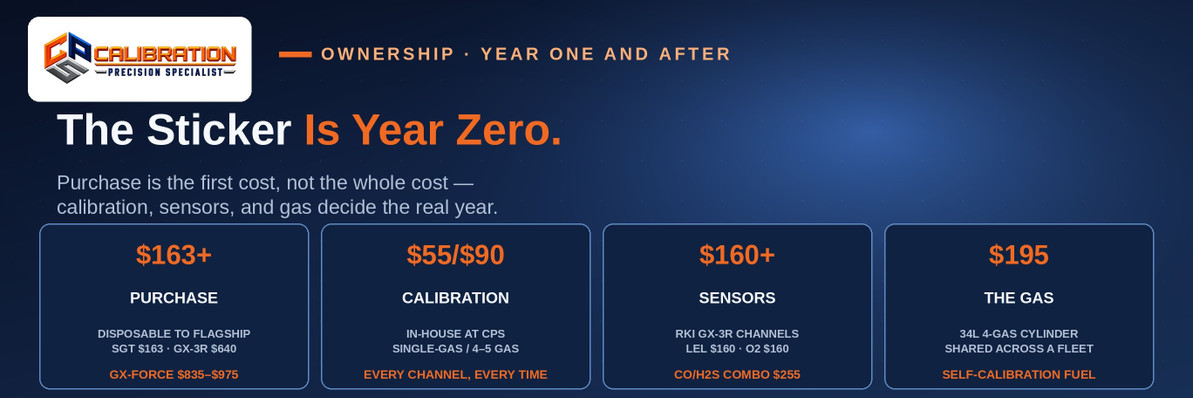
Owning a gas detector for a year costs the purchase price plus keeping it honest: a disposable single-gas detector like the SENKO SGT is $163 all-in for its CO and H2S versions with no sensor or calibration-service line at all; a serviceable 4-gas RKI GX-3R is $640 to buy plus $90 per in-house calibration — $820 across a first year at two calibrations — with replacement sensors at $160–$255 per channel only when a channel fails; and a pumped GX-Force runs $835–$975 configured on the same calibration economics. The purchase is year zero; calibration, sensors, and gas are the year.
Every detector budget we see makes the same mistake: it prices the instrument and stops. This post prices the whole year for the three classes buyers actually choose between — disposable single-gas, serviceable multi-gas, and pumped — using live store prices for every line, and stating its planning assumptions (two calibrations a year in the worked examples) where they appear. Your program's interval is set by the manufacturer's recommendation and your own policy; the arithmetic structure does not change. For the calibration line on its own, see how much gas detector calibration costs.
Class 1: Disposable Single-Gas — the $163 Year
The SENKO SP-SGT is the simplest ownership math in gas detection: $163 for the CO and H2S versions ($165 for O2; specialty gases run higher, to $412). There is no sensor to replace and no calibration service to buy across its service life — up to 24 months — because the instrument is the consumable: when its life ends, it is replaced whole. Annualized across a full 24-month life, the CO version costs about $82 a year before the trivial share of bump gas it consumes. That is the entire cost stack, and it is why disposables own the single-gas, single-hazard corner of the market.
The maintainable sibling prices the alternative: the SENKO SGT-P is $172 up front for CO/H2S, and when its sensor reaches end of life you replace the sensor — $121 for the CO or H2S sensor, $21 for a battery — rather than the instrument. Whether disposable or maintainable wins depends on how many replacement cycles you run, which is worked head-to-head in the SGT vs. SGT-P comparison in our Learning Center series.
Class 2: Serviceable Multi-Gas — the GX-3R Year
The RKI GX-3R is the reference 4-gas instrument: $590–$690 configured ($640 with the AC charger). Its year has three lines:
| Cost line | Verified price | Worked year |
|---|---|---|
| Purchase (GX-3R with AC charger) | $590–$690 configured | $640 (year one only) |
| Calibration, in-house at CPS | $90 per event | $180 at two calibrations |
| Replacement sensors (on failure only) | LEL $160 · O2 $160 · CO/H2S combo $255 | $0 in a normal year |
| Calibration gas (only if self-calibrating) | $90–$295 per cylinder; 34L $195 | Shared across the fleet |
Year one total: $640 + $180 = $820, assuming no sensor failure. Steady-state years: $180 in calibration, plus a sensor in the years one fails. The 5-gas step-up, the GX-3R Pro ($1,005–$1,575 configured), runs the identical structure at the $90 rate — the GX-3R vs. GX-3R Pro comparison covers what the extra money buys. Fleets that self-calibrate add a docking station, whose true per-instrument cost is worked in what a docking station really costs per instrument, per year — $33.10 per instrument per year for an SDM-3R in a 10-unit fleet.
Class 3: Pumped — the GX-Force Year
The RKI GX-Force adds an internal pump for entry and remote sampling work: $835–$975 configured (its $794 headline matches no variant — budget from the range). The ownership structure is the GX-3R's, because it shares the sensor family: $90 per in-house calibration, the same $160/$160/$255 sensor prices, the same gas. Year one at two calibrations: $1,015–$1,155. What the premium buys is the pump — the ability to draw a sample from a space before a person enters it — and what it costs beyond the GX-3R is almost entirely the purchase delta, not a heavier running cost. Pumped instruments earn their premium in entry programs and leak-hunting; for personal monitoring alone, the diffusion GX-3R carries the same channels for less.
What a Year of Ownership Never Includes — Until It Does
Three honest footnotes. First, downtime is a cost with no invoice: an instrument away for calibration or waiting on a sensor is an instrument not on a belt, which is why fleets carry spares and why the CPS Calibration Program exists — predictable per-instrument pricing instead of surprises. Second, a failed calibration discovered late is the expensive kind: sensors are replaced on failure, and the failure is only visible if you calibrate — the $90 line is also your inspection. Third, none of these numbers include on-site service: every rate here is in-house or ship-in at our Rockwood shop; calibration at your facility is quoted in writing and costs more, because the bench travels.
Frequently Asked Questions
How much does it cost to own a gas detector for a year?
By class, at verified CPS prices: a disposable single-gas SENKO SGT is $163 for CO/H2S with no sensor or calibration-service costs across its service life — about $82 a year annualized over 24 months. A serviceable RKI GX-3R 4-gas is $640 to buy plus $90 per calibration — $820 in year one at two calibrations, $180 a year after, plus sensors only when a channel fails ($160–$255 per channel). A pumped GX-Force is $835–$975 configured on the same running costs — $1,015–$1,155 in year one.
What are the ongoing costs of owning a gas detector?
Three recurring lines: calibration ($55 for a single-gas instrument, $90 for a 4- or 5-gas instrument, in-house at CPS), sensor replacement when a channel can no longer hold calibration (for the RKI GX-3R family: LEL $160, O2 $160, CO/H2S combo $255), and — if you calibrate in-house yourself — calibration gas ($90–$295 per cylinder by size, shared across a fleet). Disposable single-gas detectors collapse all three into the replacement price of the next unit.
How much does a replacement gas sensor cost?
On the CPS store, for the RKI GX-3R / GX-3R Pro / GX-Force family: the catalytic LEL sensor is $160, the O2 sensor is $160, and the CO/H2S combo sensor is $255 — $575 for a full set in parts, though sensors are normally replaced one channel at a time as they fail. For the SENKO SGT-P, CO and H2S replacement sensors are $121 each and a replacement battery is $21. Prices for other families vary by sensor type; exotic and PID sensors cost substantially more than the core four channels.
How often does a gas detector need calibration, and what does that cost per year?
Follow the manufacturer's recommendation and your program's policy — the worked examples in this post use two calibrations a year as a planning assumption. At CPS in-house rates that is $110 a year for a single-gas instrument (2 × $55) or $180 a year for a 4- or 5-gas instrument (2 × $90), with ship-in billed at the same rates. We calibrate every channel on every instrument at each event. On-site calibration at your facility is quoted in writing and costs more than bench work.
Is a disposable gas detector cheaper to own than a serviceable one?
For single-gas coverage, usually: a SENKO SGT is $163 with no further service costs across up to 24 months of life, while a serviceable single-gas instrument adds calibration events and eventual sensor replacement on top of a similar purchase price. The disposable's cost is that the whole instrument is replaced at end of life; the maintainable SGT-P ($172, with $121 sensor swaps) wins across multiple replacement cycles. For multi-gas coverage there is no disposable equivalent — serviceable instruments are the only route.
How much does calibration gas cost per year?
It depends on cylinder size and how much you calibrate, which is why this post prices the cylinder, not a yearly figure: the standard 4-gas mix on the CPS store runs $90–$295 by cylinder size, with the 34L cylinder at $195 — one cylinder serves an entire fleet's manual or docking-station calibrations. Fleets that outsource calibration to CPS at $90 per event buy no gas at all; the gas line and the service line are alternatives, not additions.
Does owning a docking station change the cost of owning a detector?
It moves the calibration line rather than removing it: instead of $90 per outsourced event, you carry a station share — $33.10 per instrument per year for an RKI SDM-3R in a 10-instrument fleet over a 5-year planning life — plus the same calibration gas, and you still pay for sensors and service when a channel fails. The full station math, including when a small fleet should not buy one, is in what a docking station really costs per instrument, per year.
How much does a pumped gas detector cost to own?
The RKI GX-Force pumped 4-gas configures at $835–$975 to buy (its $794 headline matches no variant), then runs on the same economics as the diffusion GX-3R — $90 per in-house calibration and the same sensor family at $160–$255 per channel — for a year-one total of $1,015–$1,155 at two calibrations. The pump premium is almost all purchase price; the running year costs little more than the diffusion instrument's.
What does it cost to replace all the sensors in a 4-gas detector?
For the RKI GX-3R family, a full set in parts is $575: LEL $160 + O2 $160 + CO/H2S combo $255. In practice a full set at once is uncommon — channels age at different rates and are replaced individually when they fail calibration, so most years replace zero or one sensor. When a quote for a full set surprises you, check whether every channel actually failed, or whether the set is being sold as a bundle of convenience.
How much does it cost to calibrate a gas detector?
At CPS Calibrations, in-house calibration is $55 for a single-gas instrument and $90 for a 4- or 5-gas instrument; ship-in calibration is billed at the same rates, and we calibrate every channel on every instrument. On-site work at your facility is quoted in writing and costs more. The complete rate breakdown is in how much gas detector calibration costs.
The Bottom Line
A year of gas detector ownership costs the purchase plus calibration, sensors on failure, and gas if you self-calibrate — $163 flat for a disposable single-gas unit, $820 in year one and $180 a year after for a serviceable GX-3R, and $1,015–$1,155 in year one for a pumped GX-Force, all at verified store prices. Budget the year, not the sticker: the instrument is the only line that is paid once.
Pricing a fleet's real year — or handing the calibration line to a program? Call CPS Calibrations at 865-900-8844 — instruments, sensors, gas, and the CPS Calibration Program behind them, from Rockwood, Tennessee.
CPS Calibrations · 109 S. Front Street, Rockwood, TN 37854 · Calibration Services · The CPS Calibration Program
Need a calibration you can file?
In-house calibration at CPS in Rockwood, Tennessee — $55 for single-gas instruments, $90 for 4- and 5-gas — every channel, as-found and as-left data, full certificate.
See Calibration Servicesor call 865-900-8844
Recent Posts
-
How Long Do Gas Detector Sensors Last?
Gas detector sensors do not share one lifespan: a traditional galvanic oxygen sensor typically lasts …Nov 16th 2026 -

The 15-Minute Weekly Gas Detection Checklist for Supervisors
A weekly gas detection check takes a supervisor about 15 minutes and covers four things: every instr …Nov 15th 2026 -

Calibration Gas for PID Instruments: Isobutylene and the 100 ppm Standard
A PID is calibrated on 100 ppm isobutylene — not on the gas you are measuring — because the instrume …Nov 14th 2026