
What Does a Docking Station Really Cost Per Instrument, Per Year?
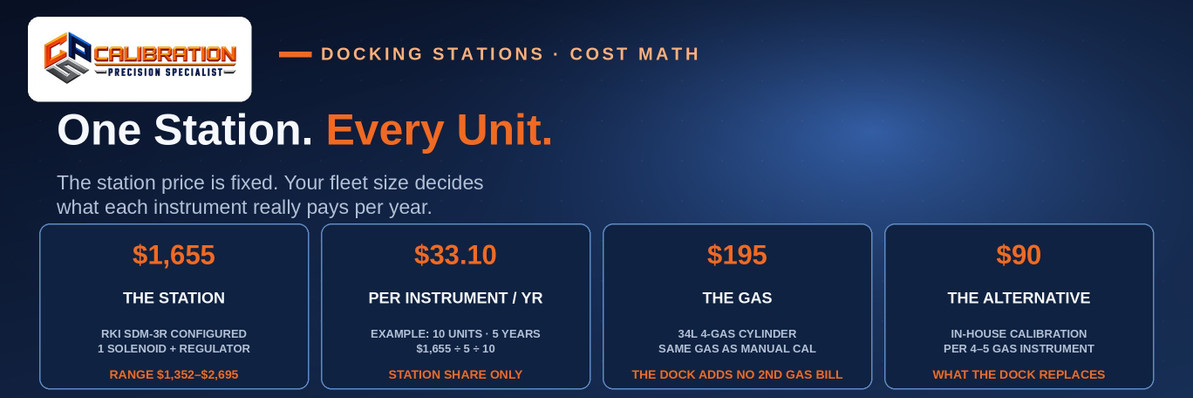
A docking station really costs its configured price divided by the years you run it and the instruments it serves — for the RKI SDM-3R bought the way fleets actually buy it ($1,655 configured with one solenoid and a demand-flow regulator), that is $33.10 per instrument per year in a 10-instrument fleet over a 5-year planning life, plus the same calibration gas you would buy for manual calibration anyway. The station is a fixed cost; your fleet size is what makes it cheap or expensive per instrument.
Nobody budgets a docking station correctly from its product page, for two reasons: the headline price often buys no working configuration, and the per-instrument cost depends entirely on how many instruments share the station. This post works the math on verified store configurations, shows the cost per instrument per year at three fleet sizes, and prices the alternative — sending instruments out — on the same per-instrument basis. The full picture of owning the instruments themselves is in how much it costs to own a gas detector for a year.
What Does a Docking Station Actually Cost to Buy?
Configured prices, verified against the live store for this post:
| Station | Serves | Configured price | Headline note |
|---|---|---|---|
| RKI SDM-3R | GX-3R / GX-3R Pro | $1,352–$2,695 | $1,322 headline matches no configuration |
| RKI SDM-03 | 03 Series | $1,326–$1,850 | $1,334 headline matches no variant |
| RKI SDM-04 | 04 Series / SC-04 | $1,675–$2,330 | Headline = minimum variant |
| RKI SDM-Force | GX-Force | $1,645–$2,430 | Headline = minimum variant |
| RKI SDM-6100 | GX-6100 | $2,020–$2,885 | Headline = minimum variant |
| SENKO MGT / SGT Docking Station II | MGT / SGT | $2,505 each | MGT Single Docking Station: $1,255 |
| Crowcon Gas-Pro Q-Test | Gas-Pro | $283–$1,240 | $283 variant has no regulator; with regulator $564–$1,240 |
| Crowcon Clip SGD docking station | Clip SGD | $2,446.25 | $296 headline is the IR link only |
| SENSIT SMART-CAL 360 | SENSIT fleets | $6,312–$8,100.40 | Network/pump options drive the range |
Two lessons before any math: buy the configured price, not the headline; and stations are model-family specific — an SDM-3R serves GX-3R and GX-3R Pro instruments, an SDM-Force serves the GX-Force, an SDM-6100 serves the GX-6100. A mixed fleet may need more than one station, and that changes the per-instrument math completely.
How the Per-Instrument, Per-Year Math Works
The formula is one line: station price ÷ years of service ÷ instruments served = station cost per instrument per year. Worked on the SDM-3R at $1,655, using a 5-year planning life — a planning assumption, stated plainly, not a promised lifespan:
| Fleet size | Math | Station cost per instrument per year |
|---|---|---|
| 5 instruments | $1,655 ÷ 5 years ÷ 5 | $66.20 |
| 10 instruments | $1,655 ÷ 5 years ÷ 10 | $33.10 |
| 25 instruments | $1,655 ÷ 5 years ÷ 25 | $13.24 |
Same station, same gas, a five-fold swing in the per-instrument answer — driven entirely by fleet size. Run it with your own numbers before you buy: your configured price, your honest planning life, your actual fleet count.
What About the Gas?
The dock does not create a second gas bill. A docking station consumes the same calibration gas a manual calibration consumes — the cylinder on the station is the cylinder you would otherwise connect by hand. On the CPS store, the standard 4-gas mix (H2S 25 ppm / CO 50 ppm / CH4 50% LEL / O2 12%) runs $90–$295 by cylinder size, with the 34L cylinder at $195 — one cylinder serves the whole fleet, so the per-instrument gas share falls as the fleet grows, exactly like the station share. What we will not do is quote you a cost-per-bump in cents: how long a cylinder lasts depends on how often you bump and calibrate and how the station is configured, and any exact figure would be invented. The honest statement is the structural one — gas is a shared, fleet-level cost in both the manual and the docked workflow, so it is not what separates them.
What Does the Dock Replace? The Outsourced Comparison
The cleanest comparison is against paying for calibration as a service. At CPS, in-house calibration is $90 for a 4- or 5-gas instrument — the full rate picture is in how much gas detector calibration costs. An instrument calibrated twice a year as a service costs $180 a year in fees alone, every year, forever. Against that, the $1,655 SDM-3R example equals about 9.2 instrument-years of outsourced calibration fees ($1,655 ÷ $180) — a 10-instrument fleet crosses that line in its first year of station ownership on fees alone.
Hold the comparison honestly, though. The dock does not make calibration free: it still consumes gas, someone on your crew still has to run it, and an instrument that fails calibration because a sensor is dying still needs parts and service — the station reports the failure, it does not fix it. What the dock actually buys is the recurring fee and the turnaround time: no shipping instruments out, no bench queue, and bump and calibration records generated by the station instead of by hand. Whether that trade wins depends on your fleet size and how often your program calibrates — which is why the per-instrument math above, not the product page, is the decision tool. Fleets that stay outsourced are exactly what the CPS Calibration Program is built for.
Frequently Asked Questions
What does a docking station really cost per instrument, per year?
Its configured price divided by its years of service and the instruments it serves. Worked example on verified prices: an RKI SDM-3R configured at $1,655 (1 solenoid with demand-flow regulator), over a 5-year planning life, costs $66.20 per instrument per year in a 5-instrument fleet, $33.10 in a 10-instrument fleet, and $13.24 in a 25-instrument fleet — station share only, plus calibration gas, which is the same gas a manual program buys anyway.
How much does a docking station cost to buy?
Configured, on the CPS store: RKI SDM stations run $1,326–$2,885 depending on the instrument family and configuration (SDM-3R $1,352–$2,695; SDM-Force $1,645–$2,430; SDM-6100 $2,020–$2,885); SENKO docking stations run $1,255–$2,505; the Crowcon Clip SGD docking station is $2,446.25; and the SENSIT SMART-CAL 360 runs $6,312–$8,100.40. Headline prices understate several of these — the SDM-3R's $1,322 headline matches no configuration, and the Clip SGD's $296 headline is an IR link, not the station.
Is a docking station worth it for a small fleet?
Run your own numbers first. The station cost per instrument per year is the configured price divided by years and fleet size, so small fleets carry the highest per-instrument share — $66.20 a year in the 5-instrument SDM-3R example, before gas and your crew's time. Compare that against outsourced calibration at $90 per 4- or 5-gas instrument per event: a small fleet that calibrates once or twice a year often finds the service route cheaper, while larger or frequently calibrated fleets cross over quickly.
Does a docking station eliminate calibration gas costs?
No. A docking station consumes the same calibration gas as a manual calibration — the cylinder mounted on the station replaces the cylinder you would connect by hand, it does not replace the gas. On the CPS store the standard 4-gas mix runs $90–$295 by cylinder size (34L at $195), and one cylinder serves the whole fleet. What the station eliminates is the outsourced calibration fee and the shipping-and-waiting cycle, not the consumable.
What is the difference between a bump station and a calibration station?
A bump test exposes the instrument to gas briefly to confirm the sensors respond and the alarms fire; a calibration adjusts the instrument's readings against a known gas concentration. Stations are sold in configurations that do one or both — RKI's SDM line is sold as docking stations (from $1,352 for the SDM-3R) and as calibration stations with solenoids and regulators (to $2,695), and Crowcon's Q-Test modules for Gas-Pro are priced by regulator and power options ($564–$1,240 with a regulator). Buy the function your program actually performs; a bump-only routine does not need a full calibration station's price.
Can one docking station serve different detector models?
Generally no — stations are built for an instrument family. The RKI SDM-3R serves the GX-3R and GX-3R Pro; the SDM-Force serves the GX-Force; the SDM-6100 serves the GX-6100; SENKO's stations serve the MGT or SGT lines. A mixed fleet may need a station per family, which multiplies the fixed cost and must be counted in the per-instrument math before buying.
How long does a docking station last?
There is no universal figure we can verify, and any exact lifespan printed in a sales pitch should be treated as marketing. The worked math in this post uses a 5-year planning life as a stated assumption — a conservative horizon for budgeting, not a promise about any unit. Run the formula at 3 years and at 7 years as well; if the purchase only makes sense at the optimistic end, that is your answer.
What does a docking station not do?
It does not repair instruments, replace sensors, or rescue a channel that has drifted beyond adjustment — it reports the failure. It does not remove the need for calibration gas, and it does not run itself: someone still docks the instruments and reviews the results. A failed calibration on a station is a service event, exactly as a failed manual calibration is.
How much does it cost to calibrate a gas detector without a docking station?
At CPS Calibrations, in-house calibration is $55 for a single-gas instrument and $90 for a 4- or 5-gas instrument, with a certificate — we calibrate every channel on every instrument; ship-in instruments are billed at the same rates. On-site calibration at your facility is quoted in writing and costs more. The full breakdown is in how much gas detector calibration costs.
Which is cheaper: a docking station or the CPS Calibration Program?
It depends on fleet size and calibration frequency — that is the whole point of the per-instrument formula. A 25-instrument fleet's station share can fall to $13.24 per instrument per year, which no service route matches; a 4-instrument fleet calibrating twice a year pays $720 a year in service fees at $90 per event, and a $1,655 station needs years to catch up once gas and crew time are counted. The CPS Calibration Program removes the fixed cost entirely — you pay per instrument, per calibration, and never own a station.
The Bottom Line
A docking station's real cost per instrument per year is arithmetic, not a price tag: configured price ÷ years ÷ instruments. On verified prices that is $33.10 a year for an SDM-3R in a 10-unit fleet — against $180 a year in outsourced calibration fees for the same instrument at two $90 calibrations — plus the same calibration gas either workflow buys. Fleet size decides whether the station is a bargain or a shelf ornament, and the configured price, never the headline, is the number to divide.
Working the dock-versus-service math for your fleet? Call CPS Calibrations at 865-900-8844 — stations, gas, and the CPS Calibration Program behind them, from Rockwood, Tennessee.
CPS Calibrations · 109 S. Front Street, Rockwood, TN 37854 · Calibration Services · The CPS Calibration Program
Need a calibration you can file?
In-house calibration at CPS in Rockwood, Tennessee — $55 for single-gas instruments, $90 for 4- and 5-gas — every channel, as-found and as-left data, full certificate.
See Calibration Servicesor call 865-900-8844
Recent Posts
-
How Long Do Gas Detector Sensors Last?
Gas detector sensors do not share one lifespan: a traditional galvanic oxygen sensor typically lasts …Nov 16th 2026 -

The 15-Minute Weekly Gas Detection Checklist for Supervisors
A weekly gas detection check takes a supervisor about 15 minutes and covers four things: every instr …Nov 15th 2026 -

Calibration Gas for PID Instruments: Isobutylene and the 100 ppm Standard
A PID is calibrated on 100 ppm isobutylene — not on the gas you are measuring — because the instrume …Nov 14th 2026