
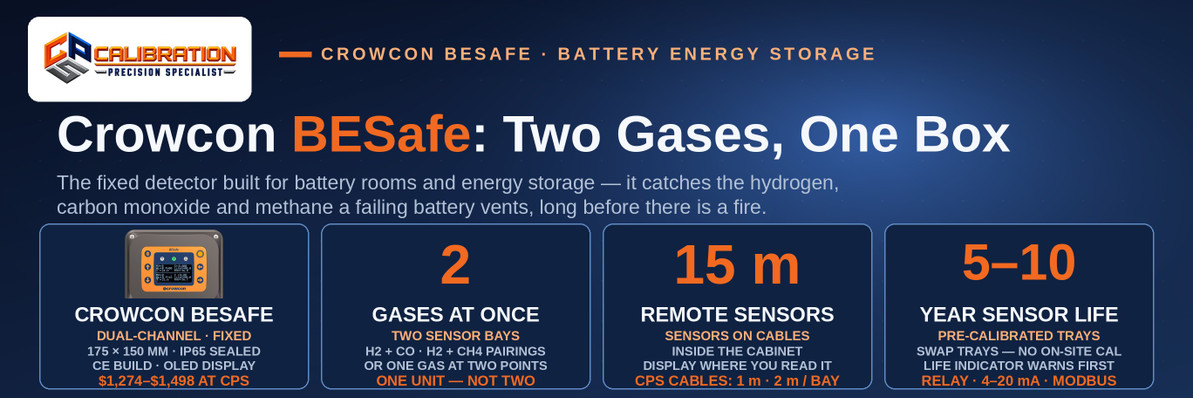
Crowcon BESafe: Dual-Gas Detection for Battery Energy Storage and Backup Power
The Crowcon BESafe is a fixed dual-channel gas detector built specifically for battery energy storage and backup power installations: it monitors two gases at once — chosen from hydrogen, carbon monoxide and methane, the gases a lithium-ion battery vents as it heads toward thermal runaway — using pre-calibrated smart sensor trays that can plug into the unit or sit on cables up to 15 m away. Its SPDT relays (alarm 1, alarm 2 and fault) can start ventilation fans or raise external alarms, backed by two 4–20 mA outputs and RS-485 Modbus RTU. At CPS, the five BESafe configurations run $1,274–$1,498 — and every one is a CE build, with no UL, CSA or ATEX certification, because this is a safe-area detector for battery installations, not a classified-area instrument.
Crowcon launched the BESafe in July 2025 for a hazard that barely existed in most plants a decade ago: large lithium-ion battery installations — grid-scale energy storage, UPS and backup-power battery rooms, modular storage cabinets. This spotlight covers what it watches and why, how the two-bay design works, exactly which configurations we stock and what they cost, and the limits that decide whether it's the right detector for your battery installation.
What Is the Crowcon BESafe — and What Is It Watching For?
The BESafe is a wall-mounted fixed detector (175 × 150 × 55 mm, IP65 polycarbonate housing) with two sensor bays, an OLED display, a built-in sounder and relay, analogue and Modbus outputs. The "BE" is the job: battery energy. Crowcon says it was "specifically developed for the demands of battery backup and energy storage systems."
What it's watching for is thermal runaway. When a lithium-ion cell fails — damaged, defective, overcharged or overheated — it begins to vent gas before it burns. Crowcon built the BESafe around the three vent gases that matter most: hydrogen (H2), carbon monoxide (CO) and methane (CH4). Those gases are the earliest actionable warning a battery gives. Smoke and heat arrive later in the failure; gas detection buys the minutes in which ventilation, alarms and a controlled shutdown can still change the outcome. (Hydrogen deserves particular respect: it is flammable across a wide range and its flame is nearly invisible — see our post on whether a flame detector can see a hydrogen flame. Gas detection is the layer that catches it before there's a flame at all.)
Two Bays: Two Gases, or One Gas at Two Points
A BESafe carries two sensor bays, and both channels run simultaneously. That one design decision covers the two ways battery installations actually need coverage:
- Two gases in one place. The classic thermal-runaway pairing is hydrogen plus carbon monoxide — the two earliest off-gases — or hydrogen plus methane where the fuel-gas picture matters. One BESafe does the work of two single-gas detectors, with one display, one power feed and one set of outputs to wire.
- One gas at two points. Put one sensor tray in the unit and the second on a cable inside the cabinet, at the far end of a battery rack, or in the spot the air actually moves through. The detector body and display stay where people can read them; the sensing points go where the gas will be.
Every configuration CPS stocks pairs a hydrogen bay with a CO or CH4 bay — Crowcon's thermal-runaway logic, not a generic two-gas menu. The full configuration list is below.
Remote Smart Sensors: Pre-Calibrated Trays You Swap, Not Calibrate
The BESafe's sensors are smart trays (65 g each) that arrive pre-calibrated. Crowcon's design removes the periodic on-site calibration routine: when a tray reaches the end of its life, you swap in a fresh pre-calibrated tray — no calibration gas, no manufacturer visit, minimal downtime. A sensor life indicator tracks remaining service life and flags end-of-life before it arrives, and the sensors support remote, non-intrusive testing so performance can be verified without interrupting operations. Sensor life runs 5–10 years depending on gas type, per Crowcon — a very different maintenance profile from a conventional fixed detector head.
The trays also don't have to live in the box. BESafe supports remote sensor mounting up to 15 m from the main unit — built for modular energy storage cabinets where space is tight and the enclosure can't be modified. The CPS configurations below offer sensors plugged into the unit, or on 1 m or 2 m cables per bay; longer remote runs within Crowcon's 15 m platform limit are a conversation at order time.
The unit itself is compact and sealed: 175 × 150 × 55 mm, base weight 550 g, polycarbonate enclosure rated IP65, M20 cable entry, rated for indoor and outdoor installation. The high-definition 128×64 OLED display shows both channels' readings and alarms clearly in any lighting, with simple button controls for setup.
Outputs and Alarms: It Doesn't Just Beep
Locally, the BESafe announces itself: an 85 dB sounder (measured at 3 m) plus LED status indicators — green for power, yellow for fault, red for alarm.
For the building, it speaks the standard fixed-system languages:
- SPDT relays — alarm 1, alarm 2 and fault (rated 1 A at 24 V DC). Crowcon documents the relay output for triggering external alarms or ventilation fans — exactly the two responses a battery room needs first: warn people, and move air.
- Two 4–20 mA analogue outputs, one per channel, for a controller, BMS or panel.
- RS-485 Modbus RTU, so both channels land in the site's monitoring system as data, not just contacts.
It also keeps 3,000 data logs on board. Power is 10–30 V DC (24 V nominal), drawing 150 mA typical — 3.6 W, 5 W maximum — so it runs happily from the same DC control power as the rest of the installation.
Which BESafe Configurations Does CPS Sell?
Five complete units, all CE builds, differing by gas pairing and whether the sensor trays ride on cables. The sensor bays decode as: methane catalytic 0–100% LEL, hydrogen 0–100% LEL, hydrogen 0–25% LEL (the early-warning range — a failing cell's hydrogen shows up long before it approaches 100% LEL), carbon monoxide 0–200 ppm and carbon monoxide 0–500 ppm.
| Bay 1 | Bay 2 | Sensor cables | List price |
|---|---|---|---|
| CH4 catalytic 0–100% LEL | H2 0–25% LEL | None — trays in unit | $1,274 |
| H2 0–100% LEL | CH4 catalytic 0–100% LEL | None — trays in unit | $1,274 |
| H2 0–100% LEL | CO 0–500 ppm | None — trays in unit | $1,372 |
| H2 0–100% LEL | CO 0–200 ppm | 2 m on bay 1 | $1,407 |
| H2 0–100% LEL | CO 0–500 ppm | 1 m on both bays | $1,498 |
The buying logic: if the unit can mount where the gas will be, the in-unit builds at $1,274–$1,372 are the whole job. The cabled builds earn their premium when the display needs to sit at a door or outside a cabinet while a sensor sits inside it. Pick CO 200 ppm where the earliest toxic warning matters most; CO 500 ppm where you want the wider range.
What the BESafe Doesn't Do
Honest limits, because they decide real purchases:
- CE certification only — and that's a real consideration. The CPS configurations are CE builds (EN 61010-1, EN 50270). There is no UL or CSA listing on them — Crowcon's datasheet prints UL 2075 only with a "contact Crowcon for availability" footnote — and no ATEX version exists: the BESafe is a safe-area detector, not certified for classified (hazardous) locations. If your battery room is a classified area, or your authority having jurisdiction requires a US-listed detector, tell us before you order and we'll point you at the certified fixed ranges instead.
- It is not a boiler-room combustible detector. Despite the similar "two gases, one box" shape, the BESafe's gas menu (H2, CO, CH4 in battery pairings) and design centre are battery installations. For plant-room and lab combustible duty — methane or propane in a safe area — look at the Crowcon XSafe and XSafe Bright instead.
- No internal battery backup. The name misleads people: the BESafe runs on 10–30 V DC from the installation, and the battery in its life is the one it's protecting. If detection at your site must ride through a power cut, the BESafe's DC supply has to be backed like any other life-safety load — a UPS or battery-backed control supply does that job.
- Two channels is the ceiling. One BESafe covers two sensing points. A large installation with many cabinets will use several units or a controller-based architecture — the BESafe is the per-cabinet/per-room building block, not the whole system.
Calibration and Service
The BESafe was designed to shrink the service burden: pre-calibrated trays, a life indicator that warns before a sensor expires, and non-intrusive testing. Crowcon warranties the transmitter and sensors for 2 years.
Where CPS comes in: we design and supply complete fixed installations — our fixed system installation work covers detector placement, wiring and integration with your ventilation and alarm responses — and our calibration services keep the rest of the plant's instruments honest. A battery room rarely holds only a BESafe; the portables your crew carries and the other fixed heads on site still need bump tests, calibration and calibration gas, and we handle all of it from Rockwood. We calibrate every channel on every instrument we service.
Frequently Asked Questions
How much does a Crowcon BESafe cost?
At CPS, the five BESafe configurations run $1,274–$1,498. The two builds with both sensor trays in the unit and no remote cables — methane + hydrogen, and hydrogen + methane — are $1,274; hydrogen + carbon monoxide builds run $1,372–$1,498 depending on the CO range and whether 1 m or 2 m remote-sensor cables are included.
What gases does the Crowcon BESafe detect?
Three gases, two at a time: hydrogen (H2), carbon monoxide (CO) and methane (CH4) — the gases Crowcon identifies with lithium-ion thermal runaway. CPS sensor bays are methane catalytic 0–100% LEL, hydrogen 0–100% LEL, hydrogen 0–25% LEL, carbon monoxide 0–200 ppm and carbon monoxide 0–500 ppm, and every CPS configuration pairs a hydrogen bay with a CO or CH4 bay.
What is the Crowcon BESafe used for?
It is a fixed gas detector designed for battery energy storage systems and backup power installations — battery rooms, UPS installations and modular energy storage cabinets. It provides early warning of thermal runaway by detecting the hydrogen, carbon monoxide and methane a failing battery vents, and its relays can start ventilation fans or raise external alarms.
What is thermal runaway, and why detect gas to catch it?
Thermal runaway is the self-accelerating failure of a lithium-ion cell: it overheats, vents flammable and toxic gas, and can ignite and spread the failure to neighbouring cells. The venting comes before smoke and flame, so gas detection — hydrogen and carbon monoxide in particular — is the earliest warning layer, arriving while ventilation, alarms and shutdown can still change the outcome.
Can BESafe sensors be mounted away from the main unit?
Yes. The smart sensor trays can be mounted remotely, up to 15 m from the main unit per Crowcon — designed for energy storage cabinets where the sensor belongs inside and the display belongs outside. CPS configurations offer the trays plugged into the unit, or on 1 m or 2 m cables per bay.
Does the BESafe have relay outputs?
Yes — SPDT relays for alarm 1, alarm 2 and fault, rated 1 A at 24 V DC. Crowcon documents the relay output for triggering external alarms or ventilation fans. The BESafe also provides two 4–20 mA analogue outputs (one per channel) and RS-485 Modbus RTU for connection to a controller or building monitoring system.
Does the BESafe need regular calibration?
No periodic on-site calibration routine: its smart sensor trays arrive pre-calibrated, and Crowcon rates sensor life at 5–10 years depending on gas type. A sensor life indicator tracks remaining life and signals end-of-life, and at that point the tray is swapped for a fresh pre-calibrated one. The sensors also support remote, non-intrusive testing to verify performance between tray changes.
Is the Crowcon BESafe UL listed or ATEX certified?
No. The configurations CPS sells are CE builds (EN 61010-1 and EN 50270); Crowcon's datasheet lists UL 2075 only with a "contact Crowcon for availability" note, and no CSA or ATEX version exists. The BESafe is a safe-area detector for battery installations — it is not certified for use in classified (hazardous) locations.
Does the BESafe have battery backup?
No — and the name causes this confusion often enough to answer plainly. The BESafe runs on 10–30 V DC external power (24 V nominal, about 3.6 W) and has no internal backup battery. "Battery" in its name refers to the battery energy storage systems it protects. If your detection must keep running through a power cut, feed it from a backed DC supply, as you would any life-safety device.
Can one BESafe monitor two battery cabinets or two spots in one room?
Yes — that is what the two bays are for. The two sensor trays can watch two gases at one point, or split between two points on remote cables (CPS offers 1 m and 2 m cables per bay; Crowcon's platform supports remote mounting up to 15 m). Beyond two sensing points, add another BESafe or step up to a controller-based system.
The Bottom Line
The Crowcon BESafe is the specialist answer to a new question: what watches the batteries? Two channels of the right gases — hydrogen paired with carbon monoxide or methane — on pre-calibrated trays that swap instead of calibrate, remote sensors that reach inside the cabinet, and relays and outputs that turn a gas reading into ventilation and alarms. At $1,274–$1,498 in CE builds, it is priced like the per-cabinet building block it is. Just buy it with eyes open: no UL/CSA/ATEX, no internal backup battery, and a gas menu aimed at batteries — plant-room combustible duty belongs to the XSafe family.
Planning gas detection for a battery room or energy storage installation?
Call 865-900-8844 or reach us through Contact Us. CPS Calibrations · 109 S. Front Street, Rockwood, TN 37854 · Calibration Services · Fixed System Installation · Calibration Gas
Need a calibration you can file?
In-house calibration at CPS in Rockwood, Tennessee — $55 for single-gas instruments, $90 for 4- and 5-gas — every channel, as-found and as-left data, full certificate.
See Calibration Servicesor call 865-900-8844
Recent Posts
-

Can You Add a Pump to a SENKO SGT-P or MGT?
Yes — SENKO's SP-Pump101 external sampling pump ($330, part AAA006000) fits the SGT, SGT-P, and MGT, …Nov 12th 2026 -

What Refrigerant Detection Does a Grocery Store Need?
A grocery store needs refrigerant detection in three places: low-mounted carbon dioxide (R-744) sens …Nov 11th 2026 -

What Is LEL and UEL? The Explosive Range, Gas by Gas
The LEL is the lowest concentration of a gas in air that can explode, and the UEL is the highest: me …Nov 10th 2026