
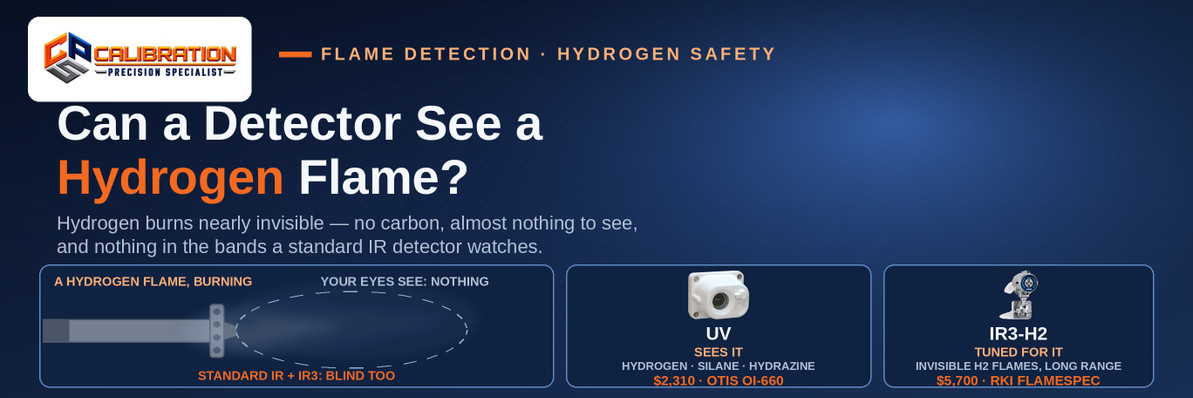
Can a Flame Detector See a Hydrogen Flame? The Invisible Fire Problem
Yes — some flame detectors can see a hydrogen flame, but only the ones built for it: UV detectors, UV/IR detectors, and the H2-tuned IR3, because a hydrogen flame pours its energy into ultraviolet light while putting almost nothing into the infrared carbon bands that a standard IR or IR3 detector watches. That distinction matters because a hydrogen flame is nearly invisible in daylight — a fire your people cannot see and a standard IR detector cannot see either. At CPS the hydrogen-capable choices run from the $2,310 OTIS OI-660 UV detector to the $5,700 RKI FlameSpec IR3-H2, a triple-IR detector tuned specifically to catch invisible hydrogen flames at long distance.
This is the post where the technology comparison in our UV vs. IR vs. UV/IR vs. IR3 overview stops being academic. Every flame detector technology makes a bet about which slice of a flame's radiation to watch. For gasoline, propane, and natural gas fires, almost any modern bet pays off. For hydrogen, most of them lose — not because the detectors are badly built, but because a hydrogen flame barely radiates in the bands they were built to watch. If hydrogen is produced, stored, piped, or fueled anywhere in your facility, this is the first question to settle, before range, before price, before brand.
Why Is a Hydrogen Flame Invisible?
Start with what makes an ordinary flame visible. A gasoline or wood flame glows orange because it is full of carbon: unburned soot particles heat up and radiate bright visible light, and the hot carbon dioxide in the exhaust radiates strongly in the infrared, around the 4.3–4.4 µm band that IR flame detectors watch. A hydrocarbon fire is, optically, a loud event.
Hydrogen removes the carbon from the equation entirely. Hydrogen is H₂ — there is no carbon atom in the fuel, so there is no soot to glow and no CO₂ in the exhaust. A hydrogen flame's combustion product is water vapor. What radiation it does emit is concentrated in the ultraviolet and in water-vapor bands, with very little in the visible spectrum and little radiant energy in the standard hot-CO₂ infrared band. The visible flame that remains is pale blue and faint — the kind of thing you might make out in a dark room if you knew exactly where to look. In daylight, against industrial backgrounds, for practical purposes it is not there.
Two consequences follow, and both are safety problems. First, people cannot be the detection layer: a hydrogen flame gives off comparatively little radiant heat at a distance, so a worker may not feel it until they are nearly in it, and accident reports in hydrogen service include people walking into flames they never saw. Second, any instrument keyed to the carbon signature of a flame inherits the same blindness as the human eye, for the same underlying reason — there is no carbon signal to find.
The Verdict, Technology by Technology
UV: Yes — Hydrogen Is Its Home Turf
A UV flame detector watches ultraviolet light in the solar-blind band, and ultraviolet is exactly where a hydrogen flame spends its energy. The OTIS OI-660 ($2,310) says so on its own listing: its UV sensing catches both hydrocarbon flames and non-hydrocarbon flames — hydrogen, silane, and hydrazine named explicitly — that IR-only detectors can miss. It is certified to catch a 1 sq ft gasoline flame at 50 ft within 1 second, across a 120° field of view, with an automatic through-the-lens self-test that continuously proves the eye can still see. OTIS lists it for, among other places, battery rooms and gas cabinets — two of the addresses where invisible-flame risk actually lives.
The familiar UV trade-offs still apply: welding arcs and lightning speak UV too, and smoke or a dirty lens shortens its reach. But on the single question of this post — can it see the flame at all — UV is the most direct yes on the board, and the least expensive one.
Standard IR: No — and More Bands Don't Fix It
A standard infrared flame detector watches the flickering infrared of burning carbon, centered on the hot-CO₂ band. Hydrogen puts almost nothing into that band, so the detector's input simply never arrives. This is not a sensitivity problem that a better amplifier solves; the signal the instrument is designed around does not exist in a hydrogen flame.
That includes the multi-spectrum designs. The OTIS OI-760 ($3,000) compares five IR bands — 2.2, 2.9, 3.7, 4.4, and 5.8 µm — and that comparison makes it excellent at telling a real hydrocarbon flame from sunlight and hot machinery. But five views of the carbon bands are still views of the carbon bands: the OI-760 is a hydrocarbon detector, and OTIS positions it for hydrocarbon fire risk in refineries, compressor stations, paint booths, and fuel-transfer areas. For hydrogen, it is the wrong tool, and no honest reading of its listing says otherwise.
UV/IR: Yes — the UV Channel Carries It, the IR Channel Vets It
A UV/IR detector requires an ultraviolet channel and an infrared channel to agree before it alarms. For hydrogen, the UV channel does the seeing — the flame's UV emission is strong — while the voting logic strips out the welding arcs and lightning that plague UV-only installations, because those events don't produce a matching flame-pattern IR signal.
Two CPS models cover this ground. The OTIS OI-860 ($2,810) pairs its UV and IR channels through a Fire Event Analysis algorithm and is listed for hydrocarbon and non-hydrocarbon flames — hydrogen and silane named — across aircraft hangars, fuel transfer, compressor stations, silane storage, paint booths, and gas cabinets. RKI's FlameSpec UV-IR ($4,690) combines a solar-blind UV sensor with an IR sensor at 2.7 µm — a water-vapor band rather than the carbon band — and its listing covers hydroxyl, hydrogen, metal, and inorganic fires alongside hydrocarbons. UV/IR is the balanced answer: hydrogen coverage, strong false-alarm manners, mid-line price.
IR3: No. IR3-H2: Yes — It Exists for Exactly This
The standard FlameSpec IR3 is the best hydrocarbon flame detector in this series — three infrared bands compared at once, the highest false-alarm immunity, and a 40 ms answer to a fast fire burst. It is also, plainly, a hydrocarbon detector. Hydrogen is not a hydrocarbon, and the standard IR3 is the wrong instrument for it.
The FlameSpec IR3-H2 ($5,700) is the exception that proves the rule about tuning: it is a triple-IR detector tuned for energy-transition fires, detecting invisible hydrogen flames at long distance alongside hydrocarbons — its listing uses the word "invisible" itself. Where the standard IR family's band selection leaves it blind, the H2 variant's tuning is aimed at hydrogen's actual emission profile, which is what buys back the IR3 virtues — distance and false-alarm immunity — for hydrogen service. If your hazard is hydrogen across a large open area, this is the instrument the category was missing until recently.
The Verdict Table
| Technology | Sees a hydrogen flame? | Why | CPS example |
|---|---|---|---|
| UV | Yes | Hydrogen's emission is concentrated in UV; the detector watches exactly that | OTIS OI-660 — $2,310 (hydrogen, silane, hydrazine named on the listing) |
| IR (standard / multi-spectrum) | No | Watches the hot-CO₂ carbon band; a hydrogen flame has no carbon and puts almost nothing there | OTIS OI-760 — $3,000 (hydrocarbon fires only) |
| UV/IR | Yes | The UV channel sees the flame; the IR channel's agreement requirement rejects arcs and sunlight | OTIS OI-860 — $2,810 · RKI FlameSpec UV-IR — $4,690 |
| IR3 | No | Three bands of carbon-watching is still carbon-watching; hydrocarbon detector | RKI FlameSpec IR3 — $5,700 |
| IR3-H2 | Yes — designed for it | Triple-IR tuned to hydrogen's emission profile; sees invisible hydrogen flames at long distance, plus hydrocarbons | RKI FlameSpec IR3-H2 — $5,700 |
Where Does Invisible-Flame Risk Actually Show Up?
- Hydrogen production, storage, and fueling. Electrolyzers, tube trailers, storage vessels, and vehicle fueling all concentrate the fuel whose flame nobody can see — and a leak that ignites at a fitting becomes a jet flame pointed at whatever is downstream.
- Battery rooms and battery energy storage. Charging lead-acid batteries off-gas hydrogen, which is why battery rooms need hydrogen detection in the first place. Gas detection handles the leak; if the accumulated gas ever finds an ignition source, the resulting flame is the invisible kind.
- Semiconductor and specialty-gas cabinets. Silane is pyrophoric — it ignites on contact with air — and its flame shares hydrogen's low-visibility problem. The OI-660 and OI-860 listings both name gas cabinets and silane explicitly, which tells you the manufacturers designed with this room in mind.
- Hydrazine and other non-hydrocarbon fuels. Named on the OI-660's listing alongside hydrogen and silane; aerospace and chemical users handle fuels whose flames are far easier to miss than a gasoline fire.
- Methanol and alcohol fuels. Methanol is the textbook second example: it burns with a flame so pale it is nearly invisible in daylight, a hazard racing learned about the hard way. The general answer there is the same as hydrogen's — detection keyed to the flame's UV emission, not to carbon bands or to human eyes.
- Ammonia and energy-transition sites. As ammonia, hydrogen blending, and carbon-capture projects multiply, more facilities are discovering that the fuel list they wrote their fire protection around no longer matches the fuels on site. The IR3-H2's "energy transition" framing is aimed at exactly these plants.
What Should You Specify for Hydrogen?
Four CPS options actually see the flame, at four points on the trade curve:
- OTIS OI-660 (UV) — $2,310. The direct answer and the lowest price: UV coverage of hydrogen, silane, and hydrazine, a 50 ft / 1 second certification on a 1 sq ft gasoline flame, a 120° field of view, and a high-temperature version to +125 °C. Choose it where distances are modest and welding arcs are not part of the scenery.
- OTIS OI-860 (UV/IR) — $2,810. Adds the voting logic: hydrogen and silane coverage with welding arcs and sunlight voted down, plus a 0–20 mA output that carries a 16 mA "UV or IR presence" level ahead of full alarm. The mixed-fuel, mixed-scenery default.
- RKI FlameSpec UV-IR — $4,690. Solar-blind UV plus a 2.7 µm IR channel, listed for hydroxyl, hydrogen, metal, and inorganic fires as well as hydrocarbons — the widest fuel list of the four, in the FlameSpec platform with 4–20 mA, three relays, and Modbus.
- RKI FlameSpec IR3-H2 — $5,700. The long-distance hydrogen instrument: triple-IR immunity and reach, tuned to invisible hydrogen flames, still covering hydrocarbons. Choose it for large open hydrogen areas where a UV-based unit's reach is the limiting factor.
Full specs for each are in the RKI flame detector and OTIS flame detector categories. And budget the aim: every optical detector needs its mount — RKI FlameSpec heads require one at $330–$350, and OTIS heads use the OI-208 swivel bracket at $180 in aluminum or $315 in stainless.
The Honest Limits
- Distance ratings are gasoline ratings. When a listing certifies detection of a 1 sq ft gasoline flame at 50 ft, that number describes a carbon flame with a big infrared and visible signature. Do not carry it across to hydrogen: a hydrogen flame at the same distance presents a very different signal, and published hydrogen-specific ranges are not something CPS's listings state. Plan hydrogen coverage conservatively, with sight lines well inside the gasoline numbers.
- Line of sight still rules. Invisible or not, the flame has to be inside the detector's cone with an unobstructed view. A hydrogen jet fire behind a vessel is as hidden from a UV detector as from a person.
- The lens is still part of the instrument. Dirt and oil film eat UV first, which is why the automatic optical self-test — standard across these models — matters, and why its fault output has to land somewhere a human will act on it.
- A flame detector is not a leak detector. Every alarm in this post happens after ignition. Hydrogen protection starts with fixed gas detection that catches the leak before it finds a spark — the layered approach our battery-room hydrogen post works through — and flame detection is the layer that answers when prevention fails.
- Your eyes are not a backup system. Training should say it out loud: in hydrogen areas, "I don't see a fire" is not evidence there isn't one. The old field expedients exist because the flame genuinely cannot be trusted to show itself.
Frequently Asked Questions
Can a flame detector detect a hydrogen flame? Yes — but only certain types. UV flame detectors (OTIS OI-660, $2,310), UV/IR detectors (OTIS OI-860, $2,810; RKI FlameSpec UV-IR, $4,690), and RKI's H2-tuned FlameSpec IR3-H2 ($5,700) all detect hydrogen flames. Standard IR and standard IR3 detectors cannot, because they watch the infrared bands of burning carbon and hydrogen contains no carbon.
Why is a hydrogen flame invisible? Because hydrogen has no carbon in it. The bright orange of an ordinary flame is glowing soot and hot carbon dioxide; burning hydrogen produces only water vapor, so there is almost nothing to glow. Its flame is pale blue, emits most of its energy as ultraviolet light, and in daylight it is effectively invisible — you can stand near one and see nothing at all.
Can an infrared flame detector see a hydrogen flame? A standard infrared flame detector cannot. IR detectors are built around the hot-CO₂ band near 4.4 µm, and a hydrogen flame — having no carbon — puts almost no energy there; even a five-band multi-spectrum IR like the OTIS OI-760 ($3,000) is a hydrocarbon-only instrument. The exception is RKI's FlameSpec IR3-H2 ($5,700), a triple-IR detector specifically tuned to detect invisible hydrogen flames.
What type of flame detector is best for hydrogen? It depends on the area. For most rooms and cabinets, a UV/IR detector (OTIS OI-860, $2,810) gives hydrogen coverage with the fewest false alarms; a UV detector (OTIS OI-660, $2,310) is the direct, lower-cost answer where welding arcs aren't nearby. For large open hydrogen areas, the FlameSpec IR3-H2 ($5,700) is built to detect invisible hydrogen flames at long distance. The one firm rule: not a standard IR or standard IR3.
Is a hydrogen flame dangerous if you can't see it? Yes — that is precisely what makes it dangerous. A hydrogen flame burns hot but radiates comparatively little heat at a distance, so a person may not feel it until they are very close, and workers in hydrogen service have walked into flames they never saw. That is why hydrogen areas need instrument detection rather than eyes: gas detection for the leak, and a hydrogen-capable flame detector for the fire.
Can you see a hydrogen flame at night? Barely, and not reliably enough to matter. In darkness a hydrogen flame can show as a faint pale-blue presence if you know where to look, but in daylight it is effectively invisible, and no safety system can be built on "someone might glimpse it." Treat a hydrogen flame as invisible at all hours and instrument the area accordingly.
How much does a hydrogen flame detector cost? At CPS, the detectors that can see a hydrogen flame run $2,310 to $5,700: the OTIS OI-660 UV detector is $2,310, the OTIS OI-860 UV/IR is $2,810, the RKI FlameSpec UV-IR is $4,690, and the FlameSpec IR3-H2 is $5,700. Add the aiming mount — $180–$315 for the OTIS OI-208 swivel bracket, $330–$350 for a required RKI FlameSpec mount.
Are there other invisible flames besides hydrogen? Yes. Methanol is the classic second case — it burns with a flame so pale it is nearly invisible in daylight, a hazard long recognized in racing and alcohol-fuel handling. Silane and hydrazine flames are also far harder to see than hydrocarbon flames, and both are named on the OTIS OI-660's listing as flames its UV sensing catches. The pattern is the same: fuels without a strong carbon signature produce flames that eyes and carbon-watching instruments both miss.
Does a hydrogen flame detector also detect hydrogen leaks? No. A flame detector only responds after ignition — it cannot warn you about a leak, which is the moment you actually want to know about. Hydrogen areas need both layers: fixed gas detection to catch the leak (the subject of our post on why battery rooms need hydrogen detection), and a hydrogen-capable flame detector to answer if the leak ignites anyway.
Can a thermal imaging camera see a hydrogen flame? Not reliably. Thermal cameras image radiated heat, and a hydrogen flame's radiant output is low and concentrated outside the bands ordinary thermal cameras are built around — the same low-signature physics that hides the flame from your eyes works against the camera too. Thermal imaging has real uses in a plant, but confirming a hydrogen flame is not one to stake a safety system on; use a detector whose sensing is matched to hydrogen's UV-heavy emission.
The Bottom Line
"Can a flame detector see a hydrogen flame?" has a clean answer with an asterisk: yes, if the detector was built to look where hydrogen actually shines. Hydrogen's flame is a UV event wearing almost no visible or carbon-band infrared signature, which is why UV and UV/IR detectors see it natively and why the IR3-H2 had to be tuned into existence — and why a standard IR or IR3, however excellent on hydrocarbons, will watch a hydrogen fire burn and report nothing. If hydrogen is in your process, filter by fuel coverage first: OI-660 if you want the direct UV answer, OI-860 or FlameSpec UV-IR if you want the vote, IR3-H2 if you need the distance. Everything else is a detail; that filter is the safety decision.
Hydrogen on site and not sure your detectors can see its flame? Call 865-900-8844 or reach us through Contact Us — we'll match the detector to your fuel list before you spend anything. Browse the lines in the RKI flame detector and OTIS flame detector categories, and see how detection layers fit together in our fixed system overview.
CPS Calibrations · 109 S. Front Street, Rockwood, TN 37854 · Calibration Gas · Calibration Services · Contact Us
Need a calibration you can file?
In-house calibration at CPS in Rockwood, Tennessee — $55 for single-gas instruments, $90 for 4- and 5-gas — every channel, as-found and as-left data, full certificate.
See Calibration Servicesor call 865-900-8844
Recent Posts
-

Can You Add a Pump to a SENKO SGT-P or MGT?
Yes — SENKO's SP-Pump101 external sampling pump ($330, part AAA006000) fits the SGT, SGT-P, and MGT, …Nov 12th 2026 -

What Refrigerant Detection Does a Grocery Store Need?
A grocery store needs refrigerant detection in three places: low-mounted carbon dioxide (R-744) sens …Nov 11th 2026 -

What Is LEL and UEL? The Explosive Range, Gas by Gas
The LEL is the lowest concentration of a gas in air that can explode, and the UEL is the highest: me …Nov 10th 2026