
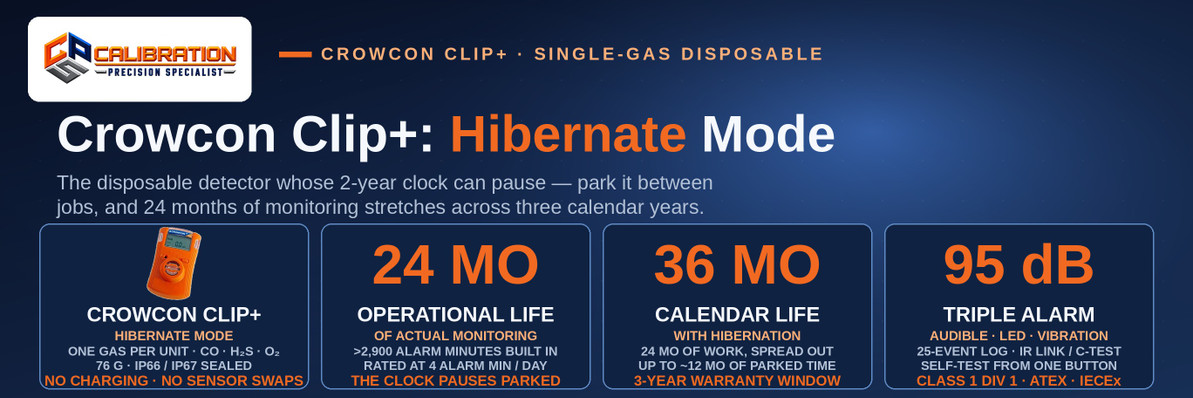
Crowcon Clip+: The Disposable Detector With Hibernate Mode
The Crowcon Clip+ is a sealed, maintenance-free disposable single-gas detector for carbon monoxide (CO), hydrogen sulfide (H2S), or oxygen (O2) — and it is the disposable whose clock can pause. Alongside its 24 months of operational life, with more than 2,900 alarm minutes built in, the Clip+ can be fully shut down in hibernate mode through Crowcon's IR Link or C-Test station, so the same 24 working months can stretch across as much as 3 calendar years. No charging, no sensor to swap, no battery to change — and no life spent ticking away in a drawer between jobs.
Every fixed-life detector fights the same enemy: calendar time. A standard disposable starts spending its two years the day it is activated and never stops — not at night, not on weekends, and not during the eleven months a turnaround spare sits in a cabinet waiting for the next outage. Our spotlight on the Crowcon Clip SGD makes that point plainly: on that model the clock cannot be paused, full stop. The Clip+ is Crowcon's answer to the waste. It is the sibling built for fleets whose work comes in bursts, and hibernate mode is the whole reason it exists.
What Is the Crowcon Clip+?
The Clip+ is Crowcon's fixed-life personal single-gas monitor with the hibernate facility. Each unit watches exactly one gas, chosen at purchase: CO over 0–300 ppm, H2S over 0–100 ppm, or O2 over 0–30% by volume, with standard alarm pairs of 30/100 ppm (CO), 5/10 ppm (H2S), and 19/23.5% vol (O2). It is smaller and lighter than the current Clip SGD — 85 × 50 × 28 mm and just 76 g — clips to a lapel or pocket, and runs on a single button. The display shows remaining life or, configured through the IR link, a real-time reading with 0.1 ppm resolution on the toxic versions. Alarm is triple: audible at a minimum of 95 dB, LEDs, and vibration.
It is certified for classified areas: intrinsically safe to Class I, Division 1, Groups A, B, C and D, T4 (ETL), with ATEX II 1G Ex ia IIC T4 Ga and IECEx Ex ia IIC T4 Ga. The housing is sealed to IP66 and IP67. Operating range is −40 °C to +50 °C for the CO and H2S versions and −35 °C to +50 °C for O2, at 5–95% RH non-condensing. Units carry up to a full year of shelf life before activation — the packaging carries an "activate by" date — which is the first hint that this platform was designed around intermittent use: buy ahead, hold, activate when the work starts.
Hibernate Mode: How It Actually Works
Hibernation on the Clip+ is a full monitor shutdown — not a sleep screen, not a dimmed display. A hibernated unit's screen is blank and it is not sensing gas; in exchange, its operational-life countdown stops consuming the 24 months while it sits. Crowcon builds the function into its fleet tools rather than the unit's single button, and there are two documented routes in the Clip & Clip+ user manual:
- Via the IR Link. Connect the IR Link, open the software, and read the device. Save the event log first — hibernating clears the log stored on the unit, and Crowcon's manual is explicit about saving it before you proceed. Then click the Hibernate button, acknowledge the event-log message, and hold the unit at the link until the software reports "Hibernate OK." Confirm the screen is blank.
- Via the C-Test station. Put the monitor in the C-Test bump-test station and hold the bump test and calibration buttons down together for about two seconds. A green light confirms a successful hibernation, and this route protects your records automatically: the event log is stored to the C-Test's USB memory as part of the process.
Two disciplines follow from the mechanism. First, records: hibernation erases the on-unit event log (the last 25 events — self-tests, alarms, gas tests, calibrations), so the save step is not bureaucracy, it is the difference between a documented fleet and a blank one. Second, return to service: when the work comes back, bring the unit back through the station and bump test it before it goes on a worker's chest. A detector that has been asleep gets proved awake — that is the routine, and it takes minutes.
The Arithmetic: 24 Months of Work, 36 Months of Calendar
Here is the number that makes hibernate mode worth a post of its own. The Clip+ carries 24 months of operational life — the same fixed-life budget as the standard Clip, rated with over 2,900 alarm minutes at about 4 alarm minutes per day. Hibernation does not add operational life; it changes how fast the calendar consumes it. Crowcon's datasheet states the Clip+ operation time as 36 months with standby (hibernate) use, and the warranty writes the same envelope into contract language: the Clip+ is warranted for 3 years from the date of activation or 24 months of operational life, whichever occurs first.
Read those two bounds together and the shape is clear: up to roughly 12 months of the unit's calendar life can be parked time. A detector worn for a six-week turnaround, hibernated for ten months, woken for the next outage, and parked again is spending almost nothing while it waits — one activated purchase covers season after season of intermittent work, inside a hard three-year wall from activation. Compare the standard disposable pattern, where a unit activated for the same first turnaround is dead of old age before the third one. That difference — not the purchase price — is the Clip+ argument.
When Hibernation Wins
- Turnaround and shutdown spares. This is the use Crowcon designed the feature around: site population multiplies for a few weeks, every contractor needs a certified personal monitor, and then the surge ends. Hibernate the surge fleet instead of watching it expire on a shelf.
- Seasonal plants. Facilities that run hard for part of the year — harvest processing, seasonal chemical campaigns, winter-only operations — can park detectors in the off-season and stop paying life for months with no exposure.
- Intermittent crews. Inspection teams, tank-cleaning contractors, and maintenance groups who wear a detector on some jobs and not others stop burning fixed life on office weeks and unrelated work.
- Compliance spares. A small pool of activated spares that must be ready on demand keeps its remaining life instead of expiring quietly in the cabinet between call-outs.
Our guide to disposable single-gas monitors works through where disposables beat serviceable instruments generally; hibernation moves that break-even for any fleet whose detectors spend real time idle after activation.
Clip+ vs. Clip SGD: The Honest Comparison
The Clip SGD is Crowcon's current disposable platform, and for a detector worn continuously it is the straightforward pick: it self-tests every 20 hours, logs 30 events, and its 2-year clock simply runs — no station step, no hibernation routine, nothing to manage. The Clip+ trades that simplicity for control of the calendar: a 25-event log, a one-button self-test that runs the audible, visual, and vibrating alarms plus internal diagnostics, and a clock the fleet manager can stop. Neither is the "better" disposable in the abstract. If your units are worn every shift until they die, hibernation buys you nothing. If your units are activated for projects and then wait, the SGD's always-running clock is a cost the Clip+ was built to remove. The full SGD breakdown is in our Clip SGD spotlight.
The Honest Limits
- Hibernation needs the station. There is no hibernate button on the unit. Parking a fleet is an IR Link or C-Test task — quick, but a fleet-management step, not something a worker does at the truck.
- A hibernated detector protects nobody. The screen is blank because the unit is off. Parked detectors must be stored so they can't be grabbed as live instruments, and woken units get bump tested before use.
- Hibernating wipes the on-unit event log. Save it via the IR Link first, or use the C-Test route, which stores the log to USB automatically. Skip this and the fleet's paper trail goes to sleep permanently.
- Three years is a wall, not a target. The envelope is 3 years from activation or 24 months of operational life, whichever comes first. Hibernation stretches calendar life; it does not stop time, and it adds no operational months.
- Alarm time is still a budget. The life rating assumes about 4 alarm minutes a day inside the 2,900-minute total; Crowcon treats a battery depleted early by more than 2,900 alarm minutes as outside warranty. Chronic leaks spend Clip+ life just like any other detector's.
- It is still one gas, and still sealed. One hazard per unit, no repairs, no sensor swaps. A worker facing two gases needs two units or a multi-gas instrument; a damaged unit is a replaced unit.
Configurations at CPS
The Clip+ was built in factory alarm configurations across its three gases — CO at 20/100, 25/50, 30/100, and 35/50 ppm; H2S at 2/5, 5/10, and 10/15 ppm; O2 at 19/23.5% and 19.5/23.5% vol — and alarm levels can also be changed by the fleet manager through the IR Link or C-Test as site standards evolve. One honest note on price: Crowcon's current book does not carry a clean list price for the Clip+ line, so CPS sets Clip+ configuration pricing from the current book when the listing goes live rather than printing a number here that the book doesn't back. Call 865-900-8844 and tell us the gas and setpoints your program specifies — that is the configuration conversation that matters with this instrument.
Bump Testing and Support at CPS
A hibernating fleet still needs a home base: activation dates tracked, parked and active units kept straight, event logs pulled before units are put to sleep, bump gas on hand for wake-ups. CPS supports the fleets that run Clip+ and Clip SGD units — configuration advice, bump-test help, and replacement planning — alongside full service for the rechargeable instruments in the same plants through our calibration services. When a serviceable unit in your fleet needs a sensor, a calibration, or a repair, that's the same counter.
Frequently Asked Questions
What is hibernate mode on the Crowcon Clip+? Hibernate mode is a full shutdown that pauses the Clip+'s fixed-life countdown. The Clip+ carries 24 months of operational life; while hibernated — screen blank, not sensing gas — that budget is not consumed, so the 24 working months can stretch across as much as 3 calendar years. It is set through Crowcon's IR Link software or C-Test bump station, and it exists only on the Clip+ — the Clip SGD has no hibernate mode.
How do you put a Crowcon Clip+ into hibernation? Two ways, both in Crowcon's manual. Via the IR Link: read the device in the IR Link software, save the event log (hibernating clears the log on the unit), click the Hibernate button, and hold the unit at the link until "Hibernate OK" appears. Via the C-Test station: place the monitor in the station and hold the bump test and calibration buttons together for about two seconds — a green light confirms it, and the event log is stored to the station's USB automatically.
How long can a Clip+ stay in hibernation? Crowcon's bound is the total envelope rather than a per-stint limit: the Clip+ is warranted for 3 years from activation or 24 months of operational life, whichever occurs first, and the datasheet rates operation at 36 months with hibernate use. So across the unit's life, up to about 12 months can be parked time — the 24 operational months simply have to fit inside the 3-year calendar window.
Does hibernation use up any of the Clip+'s life? No — that's the point. Parked months don't consume the 24 months of operational life. What hibernation cannot pause is the calendar bound: 3 years from the activation date, the unit is at the end of its envelope whether it worked the whole time or slept through most of it. Alarm time is also still spent when the unit is awake — the rating carries over 2,900 alarm minutes at about 4 minutes a day.
What gases does the Crowcon Clip+ detect? One gas per unit, chosen when you order: carbon monoxide (0–300 ppm), hydrogen sulfide (0–100 ppm), or oxygen (0–30% by volume). Standard alarm pairs are 30/100 ppm for CO, 5/10 ppm for H2S, and 19/23.5% vol for O2, and factory configurations in the Crowcon book run from CO 20/100 to H2S 2/5. Alarm levels can be changed later through the IR Link or C-Test.
How long does a Crowcon Clip+ last? 24 months of operational life from activation — the same fixed-life budget as the standard Clip — with over 2,900 alarm minutes built in. With hibernation used between jobs, that life can span up to 3 calendar years. Before activation, units carry up to a year of shelf life, governed by the "activate by" date on the packaging. The warranty matches the shape: 3 years from activation or 24 months of operational life, whichever comes first.
Does the Clip+ need to be calibrated? Not in the way a serviceable detector does — it is sealed and maintenance-free, with no sensor or battery to service. What it still needs is bump testing to prove the sensor and alarms respond, and the C-Test station that bump tests it can also hibernate it and manage its records. Crowcon's manual also documents an oxygen fresh-air calibration step from the operator button if an O2 unit needs it.
Is the Crowcon Clip+ intrinsically safe? Yes. It is certified intrinsically safe to Class I, Division 1, Groups A, B, C and D, T4 (ETL), with ATEX II 1G Ex ia IIC T4 Ga and IECEx Ex ia IIC T4 Ga. It is sealed to IP66/IP67, weighs 76 g, and alarms at a minimum of 95 dB with LEDs and vibration.
What is the difference between the Crowcon Clip+ and the Clip SGD? The clock. The Clip SGD is Crowcon's current disposable: its 2-year life runs continuously from activation, with no off switch and no hibernate mode. The Clip+ is the earlier platform that adds hibernation — its 24 operational months can be parked and stretched across 3 calendar years. The SGD counters with a 20-hour automatic self-test and a 30-event log against the Clip+'s 25; the Clip+ counters with size (76 g vs 93–104 g) and calendar control.
How much does a Crowcon Clip+ cost? Crowcon's current price book doesn't publish a clean list price for the Clip+ line, so CPS prices each configuration from the current book when the listing goes live — we won't print a figure the book doesn't back. Call 865-900-8844 with the gas and alarm setpoints your program specifies and we'll quote the configuration. For a continuously worn disposable with published CPS pricing today, see the Clip SGD at $137.50–$226.
The Bottom Line
The Crowcon Clip+ is the disposable for fleets whose work comes in bursts: the same sealed, certified, maintenance-free package as any fixed-life monitor, with the one control the rest of the category lacks — a pause button for its own clock, worked through the IR Link or C-Test. Buy it for turnarounds, seasons, and spares; buy the Clip SGD for detectors that will be worn every day of their two years; and don't let either one sit activated and idle when it doesn't have to.
Not sure whether your fleet's calendar makes hibernation pay? Call 865-900-8844 or reach us through Contact Us. CPS Calibrations · 109 S. Front Street, Rockwood, TN 37854 · Calibration Services
CPS Calibrations · 109 S. Front Street, Rockwood, TN 37854 · Calibration Gas · Calibration Services · Contact Us
Need a calibration you can file?
In-house calibration at CPS in Rockwood, Tennessee — $55 for single-gas instruments, $90 for 4- and 5-gas — every channel, as-found and as-left data, full certificate.
See Calibration Servicesor call 865-900-8844
Recent Posts
-

What Is Remote Monitoring for Fixed Gas Detection?
Remote monitoring for fixed gas detection means a fixed system's live readings, trends, and alarm hi …Nov 23rd 2026 -

What Are the Key Differences Between the GX-6000 and GX-6100?
The RKI GX-6100 is the current replacement for the discontinued GX-6000: both are pumped 6-gas monit …Nov 22nd 2026 -

How to Read a PID Correction Factor Chart
To read a PID correction factor chart, find your vapor’s row, take the factor under your own lamp en …Nov 21st 2026