
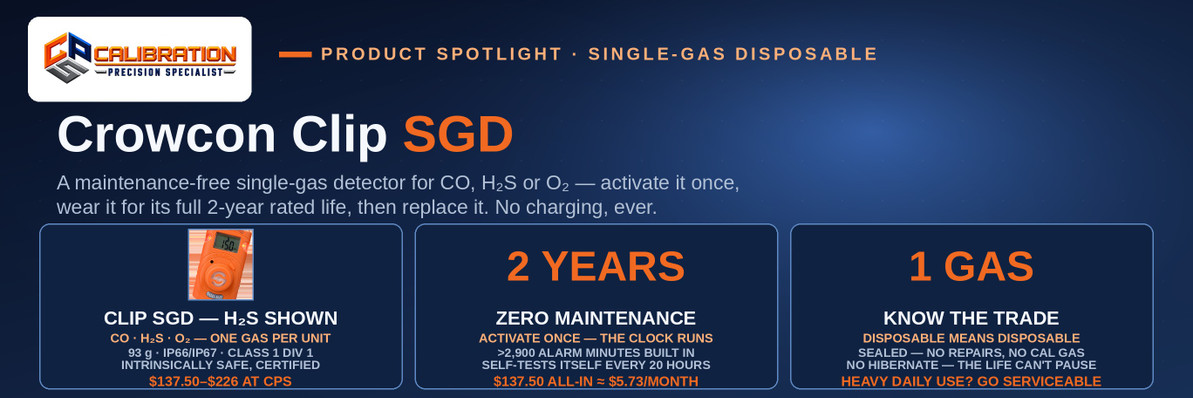
Crowcon Clip SGD: The Disposable Single-Gas Detector — What It Costs and When Disposable Wins
The Crowcon Clip SGD is a sealed, maintenance-free disposable single-gas detector for carbon monoxide (CO), hydrogen sulfide (H2S), or oxygen (O2): you activate it once and it monitors continuously for a 2-year rated life — with more than 2,900 alarm minutes built in — then you replace it. There is no charging, no sensor to swap, and no battery to change. At CPS it costs $137.50–$226 depending on the alarm configuration, with most of the 10 configurations we stock priced at $137.50.
Every safety manager knows the failure mode this design attacks. Serviceable single-gas detectors rarely die dramatically; they fade — a sensor drifts past its useful life, a battery stops holding charge, a calibration gets skipped during a busy quarter, and the unit in the crew's hand is a detector in name only. The Clip SGD removes the maintenance chain entirely: nothing to charge, nothing to replace, nothing to forget. What you give up in exchange is just as real, and this post covers both sides — the math that makes disposable win, and the workloads where a serviceable unit is still the right buy.
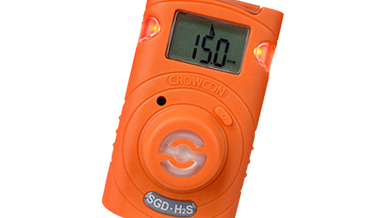
Crowcon Clip SGD Single-Gas Disposable Detector
Crowcon Clip SGD: a maintenance-free disposable single-gas detector for CO, H2S or O2 with a 2-year rated life — $137.50–$226 at CPS. When disposable wins.
$137.50–$226 configured
See the Clip SGDWhat Is the Crowcon Clip SGD?
The Clip SGD is Crowcon's fixed-life personal single-gas monitor. Each unit watches exactly one gas, chosen at purchase: CO over 0–300 ppm, H2S over 0–100 ppm, or O2 over 0–30% by volume. It is small and light — 91 × 54 × 32 mm, 93 g for the toxic-gas versions and 104 g for the O2 version — clips to a lapel or pocket, and runs on one button. The display shows a countdown of remaining life or real-time readings (the H2S version resolves to 0.1 ppm), and alarm is unmistakable: 90 dB audible at 10 cm, LEDs on the top, front, and sides, plus vibration.
It is built for classified areas, not around them. The Clip SGD is certified intrinsically safe to UL-913 and CSA-C22.2 No.157 for Class 1, Division 1 & 2, Groups A, B, C and D (T4), and carries ATEX II 1G Ex ia IIC T4 Ga and IECEx Ex ia IIC T4 Ga. The housing is sealed to IP66 and IP67, and the operating range is −30 °C to +50 °C (−22 °F to +122 °F) at 15–90% RH. In plain terms: it can go anywhere your crew can, including the hazardous locations where a non-certified instrument is not an option.
The Disposable Math: What $137.50 Actually Buys
Run the ownership cost honestly and the Clip SGD's case makes itself. The entire 2-year cost of a standard configuration is the purchase price: $137.50. There is no sensor replacement at month 18, no battery, no charger, no calibration gas consumed by routine calibrations, and no bench time. Spread out, that's about $5.73 a month per protected worker, all-in.
Compare the shape of the cost — not a rival's invoice, just the structure — on a serviceable single-gas unit: the instrument costs more up front, then the sensor and battery become consumables with their own prices and their own failure dates, and every calibration consumes gas and someone's time. Over a long enough life in a well-run program, that structure can win — our guide to disposable single-gas monitors works through exactly where the break-even falls, including the serviceable SENKO alternative. But the serviceable structure only wins if the maintenance actually happens, on schedule, every time. The disposable's structure wins by making the maintenance question disappear.
Crowcon states the life figures plainly, and so will we: the rated operational life is 2 years with over 2,900 alarm minutes, a figure Crowcon bases on 4 alarm minutes per day. The warranty matches the life — 2 years from activation. Units carry a 6-month shelf life before activation, printed on the box label, so stock rotation matters: buy what your crews will activate within that window.
"Maintenance-Free" Still Has a Compliance Layer
Disposable does not mean unverified. The Clip SGD self-tests on activation and every 20 hours, with continuous automatic battery-integrity checks in between. It displays a "bump test due" indication so a functional gas check is never left to memory, and it remembers: the event log holds the 30 most recent events. Through Crowcon's USB IR link accessory, events can be downloaded and alarm levels changed; the Clip SGD docking station (Crowcon's CL-Test) automates bump tests for up to four units at a time and keeps the fleet's settings and records consistent without a service team.
That is the right mental model: you are not maintaining the instrument — you are maintaining the proof. Bump tests, event logs, and activation dates are what an auditor or an incident investigator asks for, and the Clip SGD produces all three with almost no labor.
The Configurations CPS Stocks
Each Clip SGD is factory-set for one gas and one pair of alarm points. CPS stocks 10 configurations:
| Gas | Alarm 1 / Alarm 2 | Crowcon part | Price |
|---|---|---|---|
| CO | 20 / 100 ppm | CL-C-20 | $226.00 |
| CO | 25 / 50 ppm | CL-C-25 | $137.50 |
| CO | 30 / 100 ppm | CL-C-30 | $137.50 |
| CO | 35 / 50 ppm | CL-C-35 | $137.50 |
| H2S | 1.6 / 5 ppm | CL-H-1.6 | $226.00 |
| H2S | 2 / 5 ppm | CL-H-2 | $137.50 |
| H2S | 5 / 10 ppm | CL-H-5 | $137.50 |
| H2S | 10 / 15 ppm | CL-H-10 | $137.50 |
| O2 | 19 / 23.5% vol | CL-O-19 | $137.50 |
| O2 | 19.5 / 23.5% vol | CL-O-19.5 | $137.50 |
Eight of the ten are $137.50. The two $226 versions are the low-alarm specialists: the CO 20/100 for programs that alarm below the common 35 ppm first setpoint, and the H2S 1.6/5 for sites working to the tightest H2S alarm levels. Order the configuration your written program specifies — alarm setpoints are a compliance decision, not a preference. (Crowcon's alarm levels are changeable via the IR link or docking station, but the factory configuration is what your documentation should match.)
See the Crowcon Clip SGD at CPS for the configuration list.
The Honest Limits of Disposable
- One gas per unit. A worker exposed to both CO and H2S needs two units — or a multi-gas instrument. The Clip SGD is a single-hazard answer.
- It is sealed. No repairs, no sensor swaps, no calibration routine like a serviceable detector. If it fails or is damaged, it is replaced.
- Alarm time is a budget. The 2-year life assumes about 4 alarm minutes a day inside the 2,900-minute total. A unit that alarms constantly — parked beside a chronic leak, for instance — spends that budget faster. Fix leaks; don't spend detectors on them.
- The clock cannot be paused. Once activated, a Clip SGD runs continuously until its life is used. Crowcon's hibernate feature belongs to the Clip+ model, not the SGD — so don't buy a case of SGDs for a project that starts next year. Between the 6-month pre-activation shelf life and the non-stop clock, timing is a purchasing decision.
- The event log is a log, not a datalogger. Thirty events is enough for incident review and bump history; it is not continuous exposure recording.
Who Should Buy a Serviceable Unit Instead
If your people wear a detector every shift, all year, in gas that alarms regularly, the disposable math inverts: you'll cycle units faster than the 2-year plan while a serviceable instrument — rechargeable, with replaceable sensors — keeps its cost per year falling the longer it runs. That's the buyer Crowcon's own Gasman is built for, and the same logic covers crews who need one instrument to follow a worker across changing gases with sensor swaps. Disposable wins on coverage, spares, contractors, turnarounds, and programs where maintenance discipline is the thing that keeps failing. Serviceable wins on intensity. Both statements can be true in the same plant, on different crews.
Bump Testing and Support at CPS
A disposable fleet still needs a home base: activation dates tracked, bump gas on hand, event records pulled after an incident, replacements stocked before the countdowns run out. CPS supports the fleets that run Clip SGDs — bump-test help, configuration advice, and replacement planning — alongside full service for the rechargeable instruments in the same plants through our calibration services. When a serviceable unit in your fleet needs a sensor, a calibration, or a repair, that's the same counter.
Frequently Asked Questions
How long does a Crowcon Clip SGD last? Two years of continuous monitoring from activation, with over 2,900 alarm minutes built in (Crowcon's rating assumes about 4 alarm minutes per day). The warranty matches: 2 years from activation. Before activation, units carry a 6-month shelf life, shown on the box label — so rotate stock and don't activate a unit until it's ready to be worn.
What gases does the Clip SGD detect? One gas per unit, chosen when you order: carbon monoxide (0–300 ppm), hydrogen sulfide (0–100 ppm), or oxygen (0–30% by volume). CPS stocks 10 factory alarm configurations across the three gases. A worker who needs two gases covered needs two units or a multi-gas detector.
How much does a Crowcon Clip SGD cost? $137.50–$226 at CPS. Eight of the ten configurations we stock are $137.50; the two low-alarm specialists — CO 20/100 ppm and H2S 1.6/5 ppm — are $226. That price is the full 2-year cost of the instrument: there are no sensor, battery, or charging costs after it.
Does the Clip SGD need to be calibrated? No — not in the way a serviceable detector does. The unit is sealed and maintenance-free, with no sensor or battery to service. What it still needs is bump testing: a functional check with gas, which the unit itself prompts with a "bump test due" indication. Crowcon's CL-Test docking station automates bump tests for up to four units at a time.
Can you turn a Clip SGD off, or hibernate it to save the battery? No. Once activated, the Clip SGD runs continuously for its rated life — there is no off switch and no hibernate mode on this model. (Hibernate is a feature of Crowcon's Clip+, a different instrument.) Plan purchases around that: units have a 6-month shelf life before activation, and the 2-year clock starts when the unit is switched on.
What happens when a Clip SGD reaches the end of its life? The display counts down the unit's remaining life, so the end never arrives unannounced. When the rated life is used up, the unit is done — it can't be re-sensored or re-batteried — and it is replaced with a new one. Retired units should go out through your site's electronic-waste stream under local rules, like other battery-containing instruments.
Is the Clip SGD intrinsically safe? Yes. It is certified to UL-913 and CSA-C22.2 No.157 for Class 1, Division 1 & 2, Groups A, B, C and D (T4), with ATEX II 1G Ex ia IIC T4 Ga and IECEx Ex ia IIC T4 Ga. It is sealed to IP66/IP67 and weighs 93 g (toxic versions) or 104 g (O2).
Does the Clip SGD record anything? Yes — an event log holding the 30 most recent events, downloadable through Crowcon's USB IR link accessory, which is also how alarm levels can be changed. The unit self-tests on activation and every 20 hours, and tracks bump-test due status. It is an event log, not a continuous datalogger.
Can the alarm setpoints on a Clip SGD be changed? Yes. Crowcon states that alarm levels are changeable — through the IR link or the docking station — so a unit can be aligned with a site standard that differs from its factory pair. CPS stocks 10 factory configurations so most programs can buy the setpoints they need off the shelf.
Disposable or serviceable — which is cheaper? It depends on intensity. At $137.50 for a full 2 years (about $5.73/month), a disposable wins for spares, contractors, turnarounds, and any program where maintenance keeps slipping. For crews wearing a detector every shift in gas that alarms often, a serviceable, rechargeable unit spreads its higher price over more years and wins. Our disposable-monitor guide works the comparison in full.
The Bottom Line
The Crowcon Clip SGD is the detector for the fleets that maintenance forgot: $137.50, activated in seconds, certified for classified areas, self-testing every 20 hours, and finished — by design — in 2 years. Buy it for coverage and compliance discipline; buy a serviceable unit like the Gasman for daily heavy use; and don't ask either one to do the other's job.
Not sure which side of the line your crews fall on? Call 865-900-8844 or reach us through Contact Us. CPS Calibrations · 109 S. Front Street, Rockwood, TN 37854 · Calibration Services · Crowcon Clip SGD
CPS Calibrations · 109 S. Front Street, Rockwood, TN 37854 · Calibration Gas · Calibration Services · Contact Us
Need a calibration you can file?
In-house calibration at CPS in Rockwood, Tennessee — $55 for single-gas instruments, $90 for 4- and 5-gas — every channel, as-found and as-left data, full certificate.
See Calibration Servicesor call 865-900-8844
Recent Posts
-

What Is Remote Monitoring for Fixed Gas Detection?
Remote monitoring for fixed gas detection means a fixed system's live readings, trends, and alarm hi …Nov 23rd 2026 -

What Are the Key Differences Between the GX-6000 and GX-6100?
The RKI GX-6100 is the current replacement for the discontinued GX-6000: both are pumped 6-gas monit …Nov 22nd 2026 -

How to Read a PID Correction Factor Chart
To read a PID correction factor chart, find your vapor’s row, take the factor under your own lamp en …Nov 21st 2026