
Crowcon Gasman: A Single-Gas Monitor for Almost Any Gas — Gases, Prices, and How to Choose
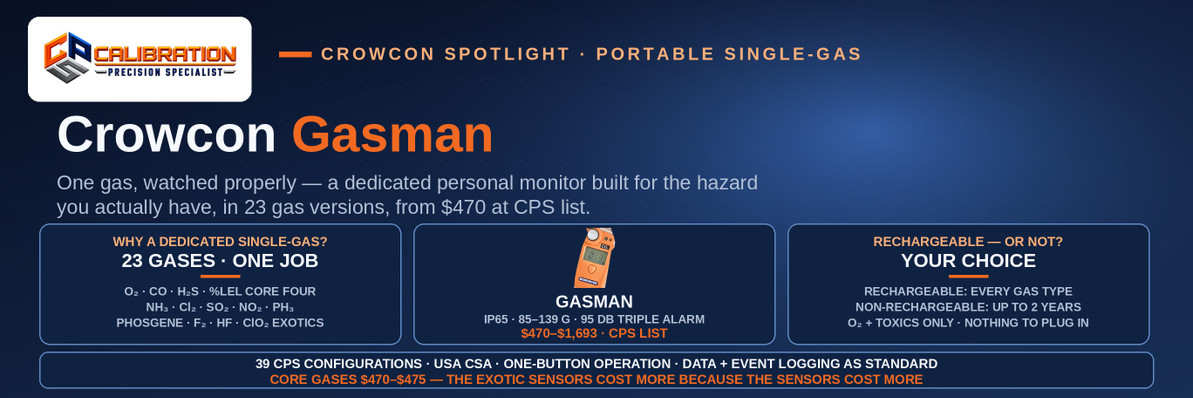
The Crowcon Gasman is a single-gas personal monitor built around one idea: watch the one gas that can hurt your crew, and watch it properly — one-button operation, 95 dB audible alarms with vibration and twin red/blue LEDs, an IP65 housing, and data logging fitted as standard. CPS carries it in 23 gas versions across 39 configurations — oxygen, carbon monoxide, hydrogen sulfide and flammable builds at $470–$475, and exotics like phosgene, hydrogen fluoride and fluorine up to $1,693.32 — every gas in rechargeable form, with non-rechargeable versions that run up to two years for the toxic gases and oxygen.
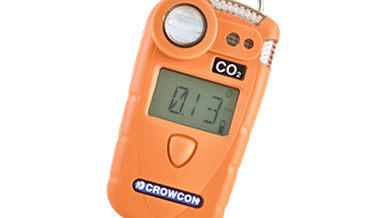
Crowcon Gasman Portable Single-Gas Detector
Crowcon Gasman single-gas monitor: 23 gas versions at CPS — O₂, CO, H₂S and %LEL at $470–$475, exotics like phosgene and HF to $1,693. Rechargeable or 2-year.
$333.96–$1,693.32 configured
See the GasmanWhat the Gasman Is
The Gasman is Crowcon's long-running single-gas personal monitor: a pocket-size instrument (90 × 48 × 24 mm) built around fully interchangeable, intelligent sensor modules. The version you buy is defined by the sensor fitted — a Gasman is an oxygen monitor, or a hydrogen sulfide monitor, or a phosgene monitor — and the platform behind that sensor is the same on every build: a tough polycarbonate housing with full overmoulding, dust- and water-ingress protection to IP65, an operating range of −20 °C to +65 °C, and hazardous-area approvals including CSA Class 1 Division 1 Groups A, B, C and D on the USA builds CPS stocks.
Weight depends on the sensor: 85 g for the toxic versions, 129 g for oxygen, 138 g for flammable and 139 g for CO₂. Response is fast — a typical T90 of 20 seconds for flammable and toxic sensors and 10 seconds for oxygen. Alarms are triple-format: a 95 dB audible alarm with selectable tones, dual red/blue flashing LEDs, and an internal vibrating alarm, with two instantaneous alarm levels plus TWA alarms on the toxic versions. The backlit LCD shows the live reading with peak and TWA recall, and at start-up it warns you when calibration is due within 30 days, overdue, or a service is required. Data and event logging are standard, not an option: 900 hours of logging at the default one-minute interval (54,000 logs) and more than 4,800 events.
When One Gas Beats Four
The standard 4-gas monitor — oxygen, %LEL, CO and H₂S on one instrument — is the right default for confined-space entry and general plant work. But plenty of jobs have exactly one credible gas hazard, and for those a dedicated single-gas monitor is the better tool:
- One known hazard, worn all shift. The H₂S risk at a water treatment plant, CO around boilers and furnaces, ammonia in cold storage, CO₂ in a brewery cellar. A dedicated unit is smaller and lighter than a 4-gas, the display shows one number nobody has to interpret, and the alarm means one thing.
- A gas the standard four can't see. No 4-gas in the standard configuration measures phosgene, chlorine, sulfur dioxide, nitrogen dioxide, ozone or hydrogen fluoride. If that's your hazard, a single-gas monitor isn't the budget option — it's the only personal option short of detector tubes.
- Fleet economics. Issuing a dedicated monitor per worker for the one gas on their route costs less per head than a 4-gas fleet — CPS's core Gasman builds are $470–$475 — and there is one sensor to bump, calibrate and eventually replace instead of four.
- Simplicity under stress. One button, one gas, one alarm meaning. Training takes minutes, and a worker who understands exactly what the instrument watches trusts it more.
The Gas Lineup CPS Sells
Every CPS Gasman is a USA CSA build. Thirty-nine configurations cover 23 gases — here is the lineup as we stock it, grouped the way buyers actually shop:
The everyday core — $470–$475. Oxygen 0–25% vol ($470.00), carbon monoxide 0–500 ppm ($470.00), hydrogen sulfide 0–100 ppm ($470.00), and flammable gas 0–100% LEL ($475.00) in methane, propane, pentane, ethylene and hydrogen builds. Higher-range toxic builds — CO 0–1500 ppm and H₂S 0–500 ppm — are $484.10. Unfiltered flammable versions (methane and ethanol, for applications where a filtered sensor would strip out the gas you're looking for) are $541.78. Hydrogen appears twice in the lineup on purpose: as a %LEL flammable build, and as a 0–2000 ppm version ($1,017.64) for toxic-range monitoring around hydrogen plant and renewable-energy work.
The mid-tier toxics and CO₂ — $747.78–$758.00. Sulfur dioxide 0–20 ppm ($747.78), nitric oxide 0–100 ppm ($753.96), and carbon dioxide 0–5% vol ($758.00) — the CO₂ version is an infrared, safe-area build, the one Crowcon aims at hospitality, cellars and drinks production, where CO₂ is both the product and the asphyxiation risk.
The exotics — $972.32–$1,693.32. This is the part of the Gasman range no ordinary single-gas line covers: hydrogen cyanide 0–25 ppm ($972.32), ethylene oxide 0–10 ppm ($972.32), chlorine 0–20 ppm ($1,027.94), nitrogen dioxide 0–20 ppm ($1,036.18), ammonia 0–100 ppm and 0–1000 ppm ($1,184.50), ozone 0–1 ppm ($1,184.50), phosphine 0–5 ppm ($1,240.12), fluorine 0–1 ppm, hydrogen fluoride 0–10 ppm and chlorine dioxide 0–1 ppm ($1,369.90), and phosgene 0–1 ppm at $1,693.32 — the top of the range. These are the gases of chemical manufacture, semiconductor and fumigation work, where the personal monitor has to match a very specific process hazard.
The full configuration list with ranges and battery options is on the Crowcon Gasman product page.
Rechargeable or Non-Rechargeable?
The Gasman is one of the few monitors that still gives you the choice, and the choice matters more than it looks:
- Rechargeable lithium versions exist for every gas type, flammables included, and run a minimum of 12 hours on the flammable build — a full shift with margin. If your site already runs a charger routine, this is the default pick, and it's the only option for flammable and CO₂ builds.
- Non-rechargeable lithium versions run up to two years with nothing to plug in — issue it, and it simply works until it doesn't. Crowcon offers them for toxic gases and oxygen only (not flammables, not CO₂), which is exactly how CPS stocks them: O₂, CO, H₂S, SO₂, NO₂, NH₃ and the exotic toxics are available either way.
Pick rechargeable for high-use fleets and anywhere a charging habit already exists. Pick non-rechargeable for low-use, spread-out fleets — the spare on the truck, the unit at the remote site — where a monitor that sits flat in a drawer because nobody charged it is worse than one you replace on a schedule.
The Honest Limits
One gas at a time. That's the deal, and it's worth stating plainly: a Gasman fitted with an H₂S sensor tells you nothing about oxygen, CO or flammables in the same space. The intelligent sensor modules are interchangeable, so the same instrument body can be re-roled to a different gas — but it still watches one gas at any given moment, never four at once. For confined-space entry and any task where several gases are credible at the same time, you need a multi-gas instrument — that's the job of the Crowcon T4, Crowcon's portable 4-gas. And like every electrochemical monitor, the Gasman's sensor is a consumable: it drifts, it ages, and it needs bump testing and calibration on schedule to stay honest — which brings us to service.
Calibration and Service
Crowcon builds the reminder into the instrument: the Gasman warns at start-up when calibration is due within 30 days, when it's overdue, or when a service is required, and it can be calibrated through Crowcon's PC software or Checkbox IMH. CPS calibrates Gasman monitors in-house — our published single-gas calibration rate is $55 — and we calibrate every channel we sell, Crowcon included. See our calibration services page for ship-in and on-site options, or send the unit in and we'll return it calibrated, logged and ready for work.
Frequently Asked Questions
What gases can the Crowcon Gasman detect?
The Gasman platform is built around interchangeable intelligent sensor modules, and CPS stocks 23 gas versions: oxygen, carbon monoxide, hydrogen sulfide, flammable gas (%LEL), carbon dioxide, sulfur dioxide, nitric oxide, nitrogen dioxide, chlorine, ammonia, hydrogen, hydrogen cyanide, ethylene oxide, ozone, phosphine, fluorine, hydrogen fluoride, chlorine dioxide and phosgene, among the full configuration list. Each instrument watches one gas — the one its sensor is fitted for.
How much does a Crowcon Gasman cost?
At CPS, Gasman configurations run from $470.00 to $1,693.32 at list. The everyday gases are the least expensive — oxygen, CO and H₂S builds at $470.00, flammable %LEL builds at $475.00 — and the price climbs with the rarity of the sensor, up to the phosgene version at $1,693.32.
Why do the exotic-gas Gasman versions cost so much more?
Because the sensor is the cost. The housing, display and electronics are the same across the range; what changes is the electrochemical cell inside. Common cells for oxygen, CO and H₂S are made in huge volumes, while reactive-gas sensors for phosgene, hydrogen fluoride, fluorine and chlorine dioxide are specialty, low-volume parts — the CPS price book shows the pattern plainly, from $470.00 core builds through $1,369.90 for the F₂/HF/ClO₂ group to $1,693.32 for phosgene.
Is the Crowcon Gasman rechargeable?
You choose. Rechargeable lithium versions are available for every gas type, including flammable and CO₂. Non-rechargeable lithium versions — which run up to two years — are available for toxic gases and oxygen only. CPS stocks both, and the product page marks each configuration clearly.
How long does the Gasman battery last?
Crowcon rates the rechargeable flammable version at a minimum of 12 hours of operation — a full shift with margin — and the non-rechargeable toxic and oxygen versions at up to two years. Which figure applies depends entirely on which battery version you buy, which is why CPS lists the battery type on every configuration.
Is the Gasman waterproof and intrinsically safe?
The Gasman is rated IP65 — dust-tight and protected against water jets — and operates from −20 °C to +65 °C. The USA builds CPS stocks carry CSA approval to Class 1 Division 1, Groups A, B, C and D; the platform also carries ATEX and IECEx approvals.
How much does the Gasman weigh?
By sensor: 85 g for toxic versions, 129 g for oxygen, 138 g for flammable and 139 g for CO₂, in a 90 × 48 × 24 mm housing with an integral alligator clip supplied. Even the heaviest version is light enough to forget it's on your shirt — which is the point of a personal monitor.
Can a Gasman measure more than one gas at a time?
No. A Gasman watches the single gas its sensor module is fitted for. The modules are interchangeable, so one instrument can be re-roled to a different gas, but it never reads two gases simultaneously. If your task needs oxygen, %LEL, CO and H₂S together, you need a multi-gas monitor such as the Crowcon T4.
Does the Gasman data-log?
Yes — logging is fitted as standard. The Gasman stores 900 hours of readings at the default one-minute sample interval (54,000 logs) plus more than 4,800 events, with an adjustable sample rate. That's the record your safety program needs after an alarm event, and it comes out of the box rather than as a paid option.
How often does a Gasman need calibrating, and who does it?
Follow your site program and the manufacturer's schedule — the instrument helps you keep it, warning at start-up when calibration falls due within 30 days or is overdue, and a bump test before use remains standard practice. CPS calibrates Gasman monitors in-house at our published single-gas rate of $55, alongside every other brand we sell and service.
The Bottom Line
If your hazard list is one gas long, the Crowcon Gasman is the monitor built for it: a proven single-gas platform in 23 gas versions, from the $470.00 oxygen build to the $1,693.32 phosgene build nobody else lists, with rechargeable or two-year non-rechargeable power, 95 dB triple alarms, IP65 sealing and data logging as standard. If your hazard list is four gases long, buy the multi-gas instrument instead — we'll tell you so. Talk to CPS Calibrations about which Gasman configuration matches your process: Call 865-900-8844 · 109 S. Front Street, Rockwood, TN 37854.
Need a calibration you can file?
In-house calibration at CPS in Rockwood, Tennessee — $55 for single-gas instruments, $90 for 4- and 5-gas — every channel, as-found and as-left data, full certificate.
See Calibration Servicesor call 865-900-8844
Recent Posts
-

Can You Add a Pump to a SENKO SGT-P or MGT?
Yes — SENKO's SP-Pump101 external sampling pump ($330, part AAA006000) fits the SGT, SGT-P, and MGT, …Nov 12th 2026 -

What Refrigerant Detection Does a Grocery Store Need?
A grocery store needs refrigerant detection in three places: low-mounted carbon dioxide (R-744) sens …Nov 11th 2026 -

What Is LEL and UEL? The Explosive Range, Gas by Gas
The LEL is the lowest concentration of a gas in air that can explode, and the UEL is the highest: me …Nov 10th 2026