
Crowcon T4 Portable 4-Gas Detector: What It Detects, What It Costs, and Who It's For
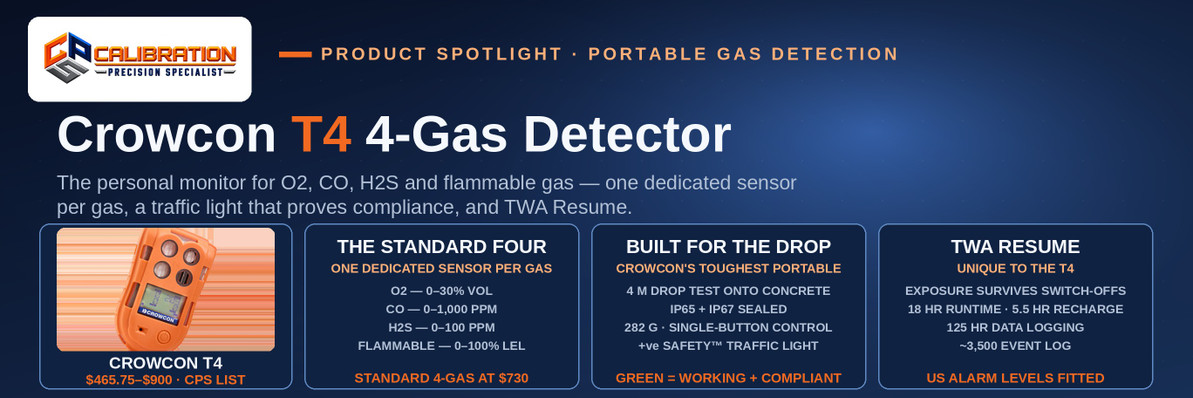
The Crowcon T4 is a personal multi-gas detector that watches the four most common gas hazards — oxygen (0–30% vol), carbon monoxide (0–1,000 ppm), hydrogen sulfide (0–100 ppm) and flammable gas (0–100% LEL) — in a 282 g unit that is drop-tested to 4 m onto concrete and sealed to IP65 and IP67. Its signature features are +ve Safety™, a traffic-light indicator that shows at a glance whether the unit is working and in compliance, and TWA Resume, which keeps a worker's toxic-gas exposure total running across mid-shift switch-offs instead of resetting it. At CPS, US-configured T4s run $465.75–$900 across 2-, 3- and 4-gas versions, with the standard 4-gas model at $730.
Crowcon is the newest line at CPS, and the T4 is its volume personal monitor — the unit a plant hands to every operator, contractor and confined-space entrant. This spotlight covers what it detects, the durability and compliance features Crowcon built its name on here, exactly which configurations we stock and what they cost, and — just as important — the jobs the T4 is not the right tool for.
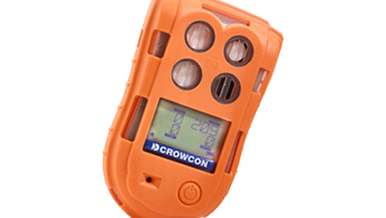
Crowcon T4 Portable Multi-Gas Detector
Crowcon T4 spotlight: the personal 4-gas monitor for O2, CO, H2S and LEL — drop-tested to 4 m, IP65/IP67, TWA Resume. CPS list $465.75–$900 in 2, 3 and 4-gas.
$407.56–$872.51 configured
See the T4What Is the Crowcon T4 — and Who Wears It?
The Crowcon T4 is a wearable personal monitor: it clips to clothing with an integrated alligator clip and sits in the wearer's breathing zone, alarming on the gases that account for most portable-detection incidents. It runs on one large button with an intuitive menu, designed to be operated wearing gloves with minimal training, and its front-mounted backlit display can flip 180° so readings stay readable while the unit is clipped on.
It is aimed at fleet buyers as much as individual wearers — utilities, water and wastewater plants, steel works, oil and gas sites and contractors who issue the same monitor to everyone and need every unit behaving identically. If you are standardizing a crew on one personal 4-gas, this is the class of instrument you are shopping. (New to the category? Our explainer on what a 4-gas monitor detects covers why these four gases are the standard set.)
What Does the T4 Detect?
One dedicated sensor per gas — Crowcon does not share one sensor across two gases on the standard T4 — with these ranges from Crowcon's specification:
| Gas | Range | Resolution |
|---|---|---|
| Oxygen (O2) | 0–30% vol | 0.1% vol |
| Carbon monoxide (CO) | 0–1,000 ppm | 1 ppm |
| Hydrogen sulfide (H2S) | 0–100 ppm | 1 ppm |
| Flammable (LEL) | 0–100% LEL | 1% LEL |
Why those ranges matter: the oxygen channel reads to 30% vol, so it catches oxygen enrichment as well as depletion — enriched air is a fire risk, not a comfort. The CO channel's 1,000 ppm top end captures short-term excursion peaks, not just background levels, and the H2S channel tops out at 100 ppm, the concentration OSHA treats as immediately dangerous to life or health. US-configured units carry US alarm levels: oxygen 19.5/23.5%, LEL 10/20%, CO 35/50 ppm and H2S 10/15 ppm.
Two sensor options are worth knowing about. A long-life oxygen sensor stretches runtime (below) and carries Crowcon's 5-year warranty on that sensor. And an H2-resistant CO sensor is built for places like steel plants, where hydrogen in the air cross-reacts on a standard CO sensor and inflates its readings. Crowcon also notes improved detection of pentane, hexane and other long-chain hydrocarbons on the flammable channel — the heavier vapors basic pellistors under-read.
Built to Be Dropped: Durability, Sealing and the Traffic Light
Crowcon calls the T4 its toughest portable, and the numbers back the claim. It is drop-tested to 4 m onto concrete, wears an integrated rubber boot as standard, and is independently tested to IP65 and IP67 — dust-tight, jet-proof and immersion-proof. An optional clip-on filter cover protects the sensors in the dirtiest environments and pops off for replacement. At 282 g (9.9 oz) and 135 × 80 × 35 mm, it is not the smallest 4-gas on the market, but it is sized to survive being treated like a tool rather than an instrument.
Alarms are the full triple set: audible at over 95 dB, bright red and blue LEDs visible from all angles, and a vibrating alert for high-noise areas.
The feature supervisors notice is +ve Safety™ — Crowcon's traffic-light Positive Safety Indicator. A green light means the unit is operating correctly and is in compliance with your bump-test and calibration policy; red means it needs attention. For a fleet manager walking a muster line or a tool crib, that turns "is this unit actually in date and working?" into a one-second glance instead of a menu dive.
TWA Resume: Exposure That Survives the Lunch Break
Time-weighted average (TWA) alarms protect workers from toxic-gas dose across a whole shift — but most portable detectors assume that switching the unit off means the shift ended. Turn one back on after a break, a drive between sites, or a battery swap and it starts a fresh TWA, quietly discarding the morning's exposure.
Crowcon's TWA Resume — a patented feature unique to the T4 in this class — offers the option to include the previous measurements from the correct time frame, so the 8-hour exposure total stays honest across switch-offs. For plants that have to prove exposure compliance, that record is the difference between a defensible log and an estimate.
The supporting numbers: up to 18 hours of runtime on the rechargeable Li-ion battery (up to 35 hours with the long-life oxygen sensor option) and a typical 5.5-hour recharge, so a T4 covers extended shifts without a mid-shift charge. It logs 125 hours of data at 10-second intervals — roughly 45,000 readings — plus about 3,500 events (alarms, bump tests, calibrations), downloadable through Crowcon's Portables Pro software, and the T4 is Crowcon Connect compatible for fleet reporting.
Which T4 Configurations Does CPS Sell?
We stock US configurations only, in 2-, 3- and 4-gas builds. Versions suffixed CRD include the charging cradle; on the others the charger is separate (single cradle, 10-way cradle and vehicle chargers are the options). Summary of the range:
| Configuration | Gases | List price |
|---|---|---|
| Standard 4-gas | H2S, O2, CO, CH4 %LEL | $730 ($770 with cradle) |
| 4-gas, long-life O2 + H2-resistant CO | H2S, O2, CO, CH4 %LEL | $755 |
| 4-gas, dual H2S/CO sensor + long-life O2 | H2S/CO, O2, CH4 %LEL | $845 |
| 4-gas, H2-resistant CO, with cradle | H2S, O2, CO, CH4 %LEL | $900 |
| 3-gas versions | O2 + CO + LEL, or H2S + O2 + LEL | $465.75–$872.51 by sensors and cradle |
| 2-gas versions | O2 + CO, or O2 + %LEL | $573.39 ($747.27 with cradle) |
The buying logic: the standard 4-gas at $730 is the default fleet unit. Step to the long-life O2 build ($755) when runtime and sensor life matter more than the $25 difference. Choose a 3-gas only when one toxic genuinely isn't present in your process — the savings are real but the missing channel is the one incident investigations ask about. Two-gas builds suit narrow, well-characterized hazards like O2/CO in boiler rooms.
What the T4 Doesn't Do
Honest limits, because they decide real purchases:
- No internal pump. The T4 is a diffusion personal monitor. Crowcon offers an aspirator plate accessory for manual remote sampling (sample hose up to 30 m), but powered pre-entry drawing is a pumped instrument's job. For confined-space pre-entry testing and 5-gas work, look at the pumped Crowcon Gas-Pro instead.
- Four gases maximum, all from the standard set. There is no PID for VOCs, no CO2 channel and no exotic toxic list on the T4. If your hazard assessment names a fifth gas, the T4 is the wrong frame.
- The charger is not always in the box. Non-CRD versions need a cradle or charger added — budget for it, and for a 10-way cradle if you are equipping a fleet.
If your work is personal monitoring against the standard four hazards, none of those limits bite. That is precisely the job the T4 was designed for.
Bump Testing and Calibration
The T4 ships with a bump/calibration plate, and its +ve Safety™ light is tied to your bump and calibration status — a unit that is out of date shows red before it shows a reading you can't trust. Fleets can automate the routine with Crowcon's I-Test bump and calibration station; smaller crews can bump by hand in under a minute.
CPS supports every T4 we sell: our calibration services cover bump testing, calibration and sensor replacement in-house in Rockwood, and we stock the calibration gas the T4's four channels need. We calibrate every channel on the instrument — a 4-gas comes back proven on all four sensors, not just the ones that were easy to reach.
Frequently Asked Questions
How much does a Crowcon T4 cost?
At CPS, US-configured T4s run $465.75–$900 depending on gas configuration and whether the charging cradle is included. The standard 4-gas (H2S, O2, CO and CH4 %LEL) is $730, or $770 with the cradle. Two-gas versions start at $573.39 and 3-gas versions at $465.75.
What gases does the Crowcon T4 detect?
The standard T4 detects four gases with one dedicated sensor each: oxygen (0–30% vol), carbon monoxide (0–1,000 ppm), hydrogen sulfide (0–100 ppm) and flammable gas (0–100% LEL). CPS also stocks 2-gas (O2 + CO, or O2 + LEL) and 3-gas versions, plus options for a long-life oxygen sensor and an H2-resistant CO sensor.
Is the Crowcon T4 intrinsically safe?
Yes. The T4 carries ATEX and IECEx certification (Ex db ia IIC T4 Gb) and UL approval for use in hazardous locations, Class 1 Division 1, Groups A, B, C and D, as to intrinsic safety — so it can be carried into classified areas where flammable atmospheres may occur.
How long does the Crowcon T4 battery last?
Up to 18 hours on its rechargeable Li-ion battery with standard sensors, and up to 35 hours with the long-life oxygen sensor option. A typical recharge takes about 5.5 hours. That runtime covers extended and double shifts without a mid-shift charge.
What is TWA Resume on the Crowcon T4?
TWA Resume is Crowcon's patented feature that keeps a worker's time-weighted average exposure calculation running across switch-offs within the shift. Most detectors reset the TWA when powered back on, treating it as a new shift and discarding earlier exposure; TWA Resume lets the T4 include the previous measurements, so the 8-hour toxic-gas dose stays accurate and provable.
What does the traffic light on the Crowcon T4 mean?
It is Crowcon's +ve Safety™ Positive Safety Indicator. Green means the detector is operating correctly and is in compliance with your site's bump-test and calibration policy. Red means the unit needs attention — a fault, or bump/calibration service due — before it should be relied on.
Can the Crowcon T4 be used for confined space entry?
Yes, as the entrant's personal monitor — that is one of its primary jobs, and our guide to what a confined space is explains when entry rules apply. For pre-entry testing from outside the space, the T4 uses an aspirator plate accessory for manual sampling; if your procedure calls for powered sample draw, a pumped instrument such as the Crowcon Gas-Pro is the better fit.
Does the Crowcon T4 come with a charger?
Versions suffixed CRD include the charging cradle. On other versions the charger is sold separately — Crowcon offers a single-unit cradle charger, a 10-way cradle charger for fleets, and a vehicle charger. Check the configuration name before ordering so the charger is on the same purchase order.
How often does a Crowcon T4 need bump testing and calibration?
Bump test before each day's use and calibrate on your site policy's schedule — the T4's +ve Safety™ indicator tracks that compliance status and shows red when service is due. The included bump/calibration plate makes a manual bump test a sub-minute job, and Crowcon's I-Test station automates bump, calibration and record-keeping for fleets.
How long do Crowcon T4 sensors last, and what do replacements cost?
The electrochemical sensors are consumables and are replaced periodically over the instrument's life; the long-life oxygen sensor option is the exception, carrying Crowcon's 5-year warranty on that sensor. Replacement pricing depends on the gas and sensor type, and the sensors are replaceable — the T4 is a serviceable instrument, not a throwaway. Call CPS at 865-900-8844 for current sensor pricing for your configuration.
The Bottom Line
The Crowcon T4 is the fleet answer to the standard four gases: dedicated sensors with honest ranges, a housing drop-tested to 4 m and sealed to IP65/IP67, a traffic light that tells a supervisor the unit is compliant before it tells the wearer anything else, and TWA Resume keeping exposure records straight across the switch-offs that break other monitors' math. In US configurations at $465.75–$900 — $730 for the standard 4-gas — it earns its place on the crew. Just don't ask it to pump or to find a fifth gas; Crowcon builds the Gas-Pro for that.
Ready to put T4s on your crew, or want a configuration quoted?
Call 865-900-8844 or reach us through Contact Us. CPS Calibrations · 109 S. Front Street, Rockwood, TN 37854 · Crowcon T4 product page · Calibration Services · Calibration Gas
Related reading
- Crowcon T4 vs T4x: which 4-gas detector should you buy?
- Crowcon T4 calibration service — mail in your detector
Need a calibration you can file?
In-house calibration at CPS in Rockwood, Tennessee — $55 for single-gas instruments, $90 for 4- and 5-gas — every channel, as-found and as-left data, full certificate.
See Calibration Servicesor call 865-900-8844
Recent Posts
-
Can You Add a Pump to a SENKO SGT-P or MGT?
Yes — SENKO's SP-Pump101 external sampling pump ($330, part AAA006000) fits the SGT, SGT-P, and MGT, …Nov 12th 2026 -

What Refrigerant Detection Does a Grocery Store Need?
A grocery store needs refrigerant detection in three places: low-mounted carbon dioxide (R-744) sens …Nov 11th 2026 -

What Is LEL and UEL? The Explosive Range, Gas by Gas
The LEL is the lowest concentration of a gas in air that can explode, and the UEL is the highest: me …Nov 10th 2026