
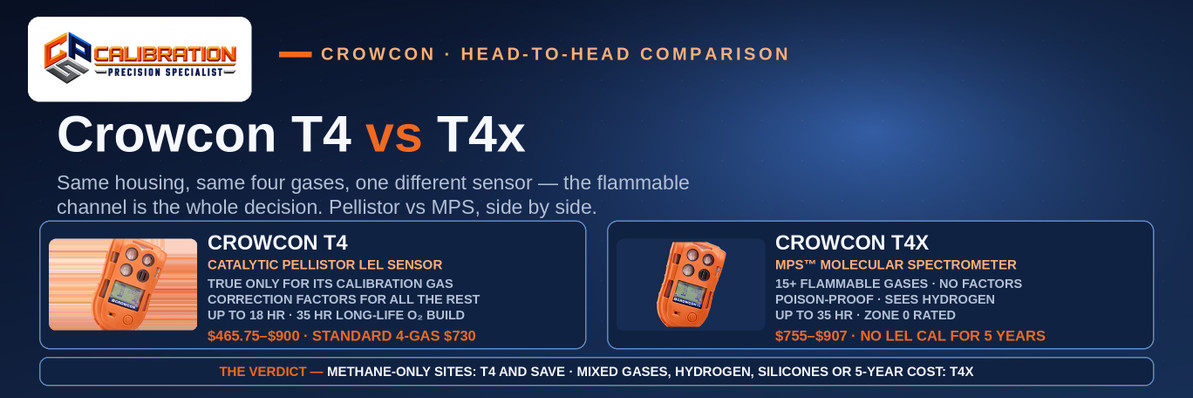
Crowcon T4 vs T4x: Which 4-Gas Detector Should You Buy?
Buy the Crowcon T4 if your flammable hazard is the standard one — methane-based work on sites where a catalytic sensor lives a clean life — because it is the same detector for less money: $465.75–$900 at CPS, with the standard 4-gas at $730. Buy the Crowcon T4x if your flammable picture is more complicated — mixed hydrocarbons, solvent vapors, hydrogen, or silicone-heavy air — because its MPS™ sensor accurately reads 15+ flammable gases with no correction factors, cannot be poisoned, and needs no calibration on the flammable channel for five years, at $755–$907. The housing, weight, operation, alarms, +ve Safety™ traffic light and TWA Resume are identical; the flammable sensor is the whole argument.
This is a comparison we expect to have a lot, because on paper the two detectors look like the same instrument at two prices. They nearly are. The Crowcon T4 and the Crowcon T4x share a platform and differ in exactly one component — how they measure flammable gas — plus the consequences that flow from it: the T4x's standard long-life oxygen sensor, its Zone 0 rating, and its longer runtime. Here is the side-by-side, then the three factors that should actually decide the purchase.
T4 vs T4x at a Glance
| Crowcon T4 | Crowcon T4x | |
|---|---|---|
| Flammable (LEL) sensor | Catalytic pellistor | MPS™ molecular property spectrometer |
| Flammable accuracy | Accurate for its calibration gas; correction factors for other gases (pentane ≈ 2×) | Identifies 15+ flammable gases and mixtures; true %LEL, no correction factors |
| Sensor poisoning | Silicones, lead compounds and high H₂S can kill the bead — silently | No catalyst to poison; sensor self-monitors and reports faults |
| Hydrogen | Detected by the pellistor, with that technology's limitations | Published accuracy of ±5% LEL — and infrared sensors can't see hydrogen at all |
| Oxygen sensor | Standard; long-life O₂ optional (5-year warranty on that sensor) | Long-life O₂ standard (5-year warranty) |
| Oxygen range | 0–30% vol | 0–25% vol |
| CO / H₂S ranges | 0–1,000 ppm / 0–100 ppm | 0–1,000 ppm / 0–100 ppm |
| Battery runtime | Up to 18 hours (up to 35 hours with the long-life O₂ build) | Up to 35 hours |
| Area rating | ATEX/IECEx and UL Class 1 Div 1 (Type 2) | Zone 0 — ATEX Type 1 (II 1 G), IECEx, UL Class 1 Div 1 |
| Flammable-channel calibration | Regular calibration, like every channel | Zero calibration on the MPS sensor over its 5-year-plus life |
| US configurations at CPS | 14 (2-, 3- and 4-gas) | 6 (3- and 4-gas) |
| Price at CPS | $465.75–$900 — standard 4-gas $730 | $755–$907 |
What Is Identical: The Detector Underneath
Everything your crew touches is the same. Both instruments wear the same 135 × 80 × 35 mm housing at 282 g (9.9 oz), with an integrated rubber boot, a 4 m drop rating onto concrete, and IP65/IP67 sealing. Both run on one large button with a glove-friendly menu and a front display that flips 180° while worn. Both alarm the same way — over 95 dB audible, bright red/blue LEDs, vibration — and both carry the two features that make the T4 platform easy to run as a fleet: +ve Safety™, the traffic light that shows green when the unit is working and in compliance with your bump and calibration policy, and TWA Resume, which keeps a worker's toxic-gas exposure total honest across mid-shift switch-offs instead of resetting it. Both log their readings and events, work with Crowcon Connect, and use the same chargers, cradle options, filter plate and I-Test bump and calibration station.
So this is not a good-versus-better detector choice. It is a sensor choice, priced at roughly $100 on like-for-like 4-gas builds — the T4x's range ($755–$907) actually starts inside the T4's ($465.75–$900), because a loaded T4 with the long-life O₂ sensor and H₂-resistant CO costs what a base T4x costs. The three factors below are how to spend that difference — or not.
Decision Factor 1: LEL Sensor Technology and Correction Factors
A catalytic pellistor burns gas on a heated bead, and it is only truthful about the gas it was calibrated on. Calibrate a T4 on methane, then walk it into pentane, hexane or toluene vapor, and the raw reading is wrong until someone applies the right correction factor — for pentane, roughly 2×, as our guide to LEL correction factors works through in detail. Crews get this wrong in predictable ways: the factor table lives in a binder, the atmosphere is a mixture no single factor describes, or nobody told the entrant the meter was calibrated on a different gas. Crowcon does credit the T4's flammable channel with improved detection of pentane, hexane and other long-chain hydrocarbons versus basic pellistors — but the fundamental rule stands: one calibration gas, factors for the rest.
The T4x's MPS™ sensor doesn't burn gas or measure it with light. It analyzes the sample's molecular and thermal properties, identifies which flammable gas — or blend of gases — is actually present, and reports a true %LEL for that gas, compensating for temperature, pressure and humidity in real time. Crowcon calls it TrueLEL™ multi-gas accuracy, and the published figures (0–50% LEL) are: methane ±3% LEL, hydrogen and most hydrocarbons ±5%, isopropanol ±10%, toluene and xylene ±12%. Fifteen-plus gases, mixtures included, one reading, no factor table. It is also the only one of the two that treats hydrogen as a first-class gas — relevant anywhere hydrogen is stored, produced, or vented by charging batteries — where infrared LEL sensors are blind to hydrogen entirely.
The deciding question: is your flammable hazard one known gas, in one known place? Then the pellistor's weakness never gets exercised, and the T4 reads it accurately. The moment your sites see rotating solvents, mixed hydrocarbons, tank work with unknown vapors, or hydrogen, the correction-factor problem becomes a daily operational risk — and that is what the T4x's premium buys out.
Decision Factor 2: Poisoning Environments — Silicones and H₂S
The pellistor's second weakness is worse than inaccuracy, because it is invisible. Sensor poisoning happens when silicones (in sealants, lubricants, release agents and some personal-care products), lead compounds, or heavy H₂S exposure destroy the catalyst's sensitivity. The detector still powers up, still displays zero in fresh air, and still passes a casual glance — it has simply gone blind to flammable gas until the next bump test or calibration exposes it. Poisoning is cumulative and permanent; the bead doesn't recover.
The MPS sensor has no catalyst. There is nothing for a silicone to coat or for H₂S to kill, so the exposures that blind a pellistor leave it unaffected — and instead of failing silently, it continuously self-monitors and reports any problem with its own operation.
The deciding question: what is in your air besides the gas you're measuring? Silicone sealants and lubricants in maintenance work, H₂S-heavy oil, gas and wastewater environments, and lead-bearing processes are exactly the places pellistors die young. Clean utility, water and general industrial sites are where they live full lives. If your environment is a known bead-killer, the T4x isn't a luxury — it's the version whose flammable channel survives your plant.
Decision Factor 3: Battery Life and Five-Year Cost of Ownership
Start with runtime. The standard T4 runs up to 18 hours on a charge — a long shift, covered — and up to 35 hours in the long-life O₂ build. The T4x runs up to 35 hours as standard, because every T4x carries the long-life O₂ sensor and the MPS sensor sips power compared to a heated bead. Both recharge in about 5.5 hours. For multi-shift patterns and remote work, the T4x's runtime is a genuine operational difference; for single-shift crews who charge nightly, it changes nothing.
The bigger money is in the flammable channel's upkeep. A pellistor T4 is calibrated like any 4-gas: the LEL channel consumes calibration gas at every calibration and is part of every bump-test routine, for the life of the instrument — and when a bead is poisoned or reaches end of life, the channel is down until the sensor is replaced. The T4x's MPS sensor is factory calibrated and rated for zero calibration across a 5-year-plus life: no scheduled calibrations on that channel, no calibration gas spent on it, no poisoned-bead replacements. Crowcon quantifies the result as a reduction of over 25% in 5-year total cost of ownership versus the standard T4 — that's the manufacturer's figure, but the mechanism is plain arithmetic: one of four channels leaves the calibration bench for five years.
Read the scope honestly, though. "No calibration" belongs to the MPS sensor only. On both detectors, the CO, H₂S and O₂ electrochemical sensors drift like any other and still need bump tests and periodic calibration — with gas — on your site policy's schedule. The T4x shrinks the calibration workload; it does not abolish it. CPS calibrates every channel on the instruments we service; on a T4x, the flammable channel simply stops being one of the channels that needs it.
The deciding question: multiply it out over your fleet and five years. For one or two detectors, the T4's lower price wins and the upkeep difference is pocket change. For a fleet that burns calibration gas and bench time on every unit, every cycle, the T4x's premium — about $100 on like-for-like 4-gas builds — is recovered in avoided calibrations and avoided sensor replacements, with runtime left over as a bonus.
Buy the T4 When…
- Your flammable hazard is methane or one other known gas, in known places, and your calibration gas matches it.
- Your environment is clean of bead poisons — no heavy silicone use, no chronic high-H₂S exposure.
- You are equipping a fleet on a budget: 14 configurations from $465.75, a standard 4-gas at $730, and 2- and 3-gas builds the T4x doesn't offer for narrow, well-characterized hazards.
- Your crews work single shifts with nightly charging, so 18 hours of runtime is already headroom.
- You want the option list: long-life O₂ and H₂-resistant CO sensors are available on the T4 too — a loaded T4 closes much of the gap for the specific builds that need it.
Buy the T4x When…
- Your sites see mixed or changing flammable gases — solvents, tank and turnaround work, multiple hydrocarbons — where correction factors are a daily liability.
- Hydrogen is part of your hazard picture.
- Your air carries silicones, lead compounds or heavy H₂S that shorten pellistor life.
- You run long or multi-shift patterns and want 35 hours between charges as standard.
- Your classified areas call for the Zone 0 (Type 1) rating.
- You are buying for five-year cost, not sticker price — and want the flammable channel off the calibration schedule for that whole period.
The Honest Limits Both Share
Whichever badge you pick, you are buying the same class of instrument, with the same boundaries:
- Both are diffusion personal monitors — neither has an internal pump. They protect the person wearing them, in the breathing zone they are worn in. Crowcon offers an aspirator plate accessory for manual remote sampling on the T4, but powered pre-entry sample draw is a pumped instrument's job: for confined-space pre-entry testing from outside the space, look at the pumped Crowcon Gas-Pro instead.
- Four gases maximum, from the standard set. Neither detector has a PID channel for ppm-level VOC measurement or a CO₂ channel. If your hazard assessment names a fifth gas, neither T4 is the right frame.
- The electrochemical channels still age. CO, H₂S and O₂ sensors are consumables on both instruments, replaced periodically over their lives — the T4x's long-life O₂ (5-year warranty) and 3-year dual toxic options stretch those intervals but don't end them.
- The MPS sensor has its own fine print (on the T4x): its accuracy is loosest on aromatic vapors (toluene and xylene at ±12% LEL), and Crowcon's datasheet notes cross-responses in extreme atmospheres — strong oxygen enrichment and CO₂ above roughly 5,000 ppm can register as flammable gas. In normal air, neither effect is in play.
Frequently Asked Questions
What is the difference between the Crowcon T4 and T4x?
One sensor. The T4 measures flammable gas with a catalytic pellistor; the T4x uses an MPS™ molecular property spectrometer sensor instead. Everything that flows from that — correction factors, poisoning risk, flammable-channel calibration, hydrogen performance — differs, and the T4x also gets the long-life O₂ sensor and a Zone 0 rating as standard, with up to 35 hours of runtime versus the T4's 18. Housing (282 g), operation, alarms, +ve Safety™ and TWA Resume are the same.
Which is better, the Crowcon T4 or T4x?
Better depends on your atmosphere. For a known single flammable gas on a clean site, the T4 gives the same protection for less money. For mixed gases, solvent vapors, hydrogen, or silicone- and H₂S-heavy air — and for buyers counting five-year cost — the T4x is the stronger instrument. Neither is the wrong detector; they are the same detector aimed at different flammable-gas problems.
Is the Crowcon T4x worth the extra money?
On like-for-like 4-gas builds the premium is about $100 ($755–$907 versus the T4's comparable builds). It buys out three recurring costs: correction-factor errors on non-calibration gases, poisoned pellistor replacements, and five years of calibration labor and gas on the flammable channel. Crowcon rates the saving at over 25% of 5-year total cost of ownership. If none of those three costs apply to your sites, it isn't worth it — buy the T4.
Does the T4x really never need calibration?
Its MPS flammable sensor doesn't: Crowcon rates it for zero calibration and no scheduled maintenance over a 5-year-plus life. The rest of the T4x is a normal detector — the CO, H₂S and O₂ sensors still need bump tests and periodic calibration, and your site policy still applies to the whole instrument. The T4 needs calibration on all four channels, the flammable channel included.
Can the T4x detect hydrogen?
Yes. Hydrogen is one of the MPS sensor's published gases, at ±5% LEL accuracy across 0–50% LEL — and the T4x's available H₂-resistant CO sensor keeps hydrogen from inflating the CO reading. The T4's pellistor detects hydrogen with that technology's limitations, and infrared LEL sensors — the other common alternative — cannot detect hydrogen at all.
What happens if a catalytic LEL sensor gets poisoned?
Silicones, lead compounds or heavy H₂S exposure permanently destroy the bead's sensitivity, and the failure is silent: the detector reads clean air in a flammable atmosphere until a bump test or calibration catches it. That failure mode is specific to catalytic sensors — it is the core reason the MPS sensor in the T4x exists, because a sensor with no catalyst cannot be poisoned and self-monitors instead of failing quietly.
Do I need correction factors with the T4 or the T4x?
With the T4, yes, for any flammable gas other than its calibration gas — pentane reads at roughly twice the raw value, so the factor is about 2×, and mixtures have no single correct factor. With the T4x, no: the MPS sensor identifies the gas or blend present and reports a true %LEL directly, for 15+ flammable gases.
How much do the Crowcon T4 and T4x cost?
At CPS, list: the T4 runs $465.75–$900 across 14 US configurations in 2-, 3- and 4-gas, with the standard 4-gas at $730 ($770 with charging cradle). The T4x runs $755–$907 across six US configurations — dual-toxic 4-gas $755, 3-gas $791, individual-toxics 4-gas $862, with cradle versions at $800, $871 and $907 respectively.
How long do the T4 and T4x batteries last?
The T4 runs up to 18 hours on its rechargeable Li-ion battery, or up to 35 hours in the long-life O₂ build. The T4x runs up to 35 hours as standard, with the MPS sensor and long-life O₂ fitted. Both recharge in about 5.5 hours.
Can the T4 or T4x be used for confined space pre-entry testing?
As the entrant's personal monitor, yes — that is a primary job for both. For testing the space from outside before entry, neither has a built-in pump: the T4 offers an aspirator plate accessory for manual sampling, but powered sample draw calls for a pumped instrument such as the Crowcon Gas-Pro. Buy the T4 or T4x for personal protection; buy a pumped detector for pre-entry testing.
The Bottom Line
The T4 and T4x are the same detector wearing two different answers to the oldest question in flammable-gas detection: how do you know the LEL number is true? The T4's pellistor answer — calibrate on your gas, apply factors to the rest, bump test so a poisoned bead can't hide — has protected crews for decades and still does, at the lower price ($465.75–$900, standard 4-gas $730). The T4x's MPS answer — identify the gas itself, shrug off poisons, skip five years of flammable-channel calibration — costs about $100 more on comparable builds ($755–$907) and earns it wherever the atmosphere is mixed, dirty, hydrogen-bearing or simply expensive to keep calibrating. Know your air, and the choice makes itself.
Still deciding, or want either model quoted for a fleet? Call 865-900-8844 or reach us through Contact Us. CPS Calibrations · 109 S. Front Street, Rockwood, TN 37854 · Crowcon T4 · Crowcon T4x · Calibration Services · Calibration Gas
Already own a T4? Keep it honest with our Crowcon T4 calibration service — mail in your detector and get it back with a full certificate.
Need a calibration you can file?
In-house calibration at CPS in Rockwood, Tennessee — $55 for single-gas instruments, $90 for 4- and 5-gas — every channel, as-found and as-left data, full certificate.
See Calibration Servicesor call 865-900-8844
Recent Posts
-

Can You Add a Pump to a SENKO SGT-P or MGT?
Yes — SENKO's SP-Pump101 external sampling pump ($330, part AAA006000) fits the SGT, SGT-P, and MGT, …Nov 12th 2026 -

What Refrigerant Detection Does a Grocery Store Need?
A grocery store needs refrigerant detection in three places: low-mounted carbon dioxide (R-744) sens …Nov 11th 2026 -

What Is LEL and UEL? The Explosive Range, Gas by Gas
The LEL is the lowest concentration of a gas in air that can explode, and the UEL is the highest: me …Nov 10th 2026