
Crowcon T4x with MPS: What the MPS Sensor Changes — and What It Costs
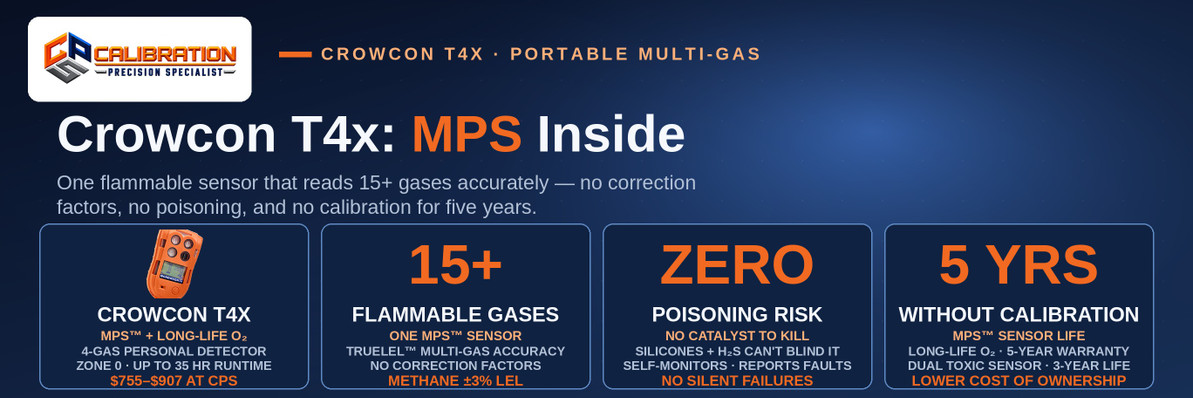
The Crowcon T4x is a personal 4-gas detector — long-life oxygen, carbon monoxide, hydrogen sulfide, and flammables — whose flammable channel is an MPS™ (molecular property spectrometer) sensor instead of a catalytic bead. That one change removes three classic LEL problems at once: the MPS sensor accurately identifies more than 15 flammable gases, including hydrogen and mixed gases, with no correction factors; it cannot be poisoned by silicones or H₂S; and Crowcon rates it for zero calibration over a 5-year-plus life. CPS sells the T4x in six US configurations at $755–$907, each built around the MPS sensor and Crowcon's long-life O₂ sensor.
Everything else about the T4x will look familiar if you know the standard T4 — same housing, same single-button operation, same 282 g. What changed is the sensor technology inside, and it changes how the detector behaves in exactly the situations where conventional LEL sensors are weakest. Here is what the MPS sensor actually does, what the T4x shares with the T4, what CPS's configurations cost, and — just as important — what MPS cannot do.
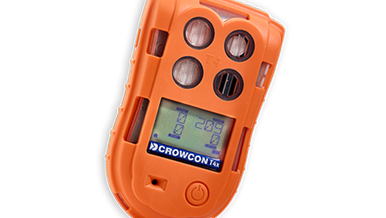
Crowcon T4x Portable Multi-Gas Detector
Crowcon T4x MPS 4-gas detector: one sensor reads 15+ flammable gases with no correction factors or poisoning. Zone 0 rated. CPS prices and honest limits.
$755–$907 configured
See the T4xWhat the T4x Is
The Crowcon T4x is Crowcon's Zone 0 approved personal multi-gas detector for the four most common gas hazards: oxygen depletion, carbon monoxide, hydrogen sulfide, and flammable gases. It is built on the T4 platform, with three sensor technologies doing the work:
- MPS™ flammable sensor — the subject of this post, covered in detail below.
- Long-life O₂ (LLO2) sensor — a lead-free oxygen sensor (RoHS compliant) that Crowcon backs with a 5-year warranty, where a standard O₂ sensor typically needs replacing about every 2 years.
- Dual toxic and H₂-resistant CO options — depending on configuration, CO and H₂S are measured by a combined dual toxic sensor with a 3-year life, or by individual sensors including a hydrogen-resistant CO sensor for sites where hydrogen cross-interference is a problem.
The instrument itself is rated for the harshest areas on site: ATEX and UKCA II 1 G Ex ia IIC T4 Ga (Type 1 — Zone 0), IECEx to the same rating, and UL/cUL Class 1 Division 1 Groups A–D for intrinsic safety. It is drop tested to 4 m onto concrete, sealed to IP65 and IP67, and alarms with a >95 dB audible signal, bright red/blue LEDs, and vibration. Data logging holds 130 hours of readings at 10-second intervals plus up to 3,500 events, and the T4x works with Crowcon Connect for fleet records.
The MPS Sensor, Explained
The problem it replaces
A catalytic (pellistor) LEL sensor burns gas on a heated bead, and it is only accurate for the gas it was calibrated on. Calibrate on methane and then measure pentane, hexane, or toluene, and the raw reading is wrong until you multiply by a correction factor — as our guide to LEL correction factors shows, that factor can approach 2× for pentane. Pick the wrong factor — or walk into a mixture — and the number on the screen is a guess. Infrared LEL sensors avoid some of that, but they cannot see hydrogen at all, because hydrogen does not absorb infrared. And a catalytic bead carries a failure mode nothing else on the detector has: sensor poisoning. Silicones, lead compounds, and high H₂S exposure can kill a bead's sensitivity permanently — silently, so the detector reads clean air in a flammable atmosphere until the next bump test catches it.
What MPS does differently
The MPS sensor does not burn the gas and does not shine light through it. It analyzes the physical — molecular and thermal — properties of the gas sample, identifies which flammable gas (or blend of gases) is present, and reports a true %LEL reading for that gas, with real-time compensation for temperature, pressure, and humidity. Crowcon calls this TrueLEL™ multi-gas accuracy, and the published accuracy figures (0–50% LEL) show what it means in practice:
| Gas | MPS accuracy (0–50% LEL) |
|---|---|
| Methane | ±3% LEL |
| Hydrogen | ±5% LEL |
| Propane, butane, ethane, pentane, octane, MEK, propylene, isobutane, isobutylene | ±5% LEL |
| Isopropanol | ±10% LEL |
| Toluene, xylene | ±12% LEL |
Three consequences follow:
- One sensor, 15+ gases, mixtures included. The MPS datasheet names 15 flammable gases with published accuracy — including hydrogen and long-chain hydrocarbons like pentane, heptane, and octane that defeat simple sensors — and confirms detection of more, among them acetylene, ethanol, and methanol. Because it identifies the gas in real time, it reads blended flammables correctly in a single reading instead of masking one gas behind another, and it never needs a correction factor or a cross-calibration when the target gas changes.
- It cannot be poisoned. There is no catalyst to contaminate, so the silicone and H₂S exposures that blind a pellistor leave the MPS sensor unaffected. The sensor also self-monitors continuously and automatically reports any problem with its own operation, instead of failing quietly.
- Hydrogen is a first-class gas. Infrared can't detect hydrogen at all and pellistors handle it with limitations; the MPS sensor is hydrogen-ready at ±5% LEL — relevant anywhere hydrogen is stored, produced, or generated by charging batteries.
The calibration claim, stated precisely
Crowcon rates the MPS sensor for zero calibration over its 5-year-plus lifecycle: it is factory calibrated, needs no scheduled maintenance, and that is a large part of the T4x's lower cost of ownership — Crowcon claims the T4x cuts 5-year total cost of ownership by over 25% versus the standard T4. Read the claim at its exact scope, though: it covers the flammable sensor. The CO, H₂S, and O₂ sensors in the same instrument are electrochemical cells that drift like any other, and they still need bump tests and periodic calibration. Crowcon still publishes bump-test and calibration procedures for the MPS channel itself (using standard quad gas), and a daily bump test remains the right habit for the instrument as a whole. When the toxic and oxygen channels are due, CPS calibrates every channel — the MPS sensor simply removes the flammable channel from that workload.
What the T4x Shares with the T4
If your crew already runs the standard T4, the T4x asks them to learn almost nothing new — we cover the base model in our Crowcon T4 spotlight. Both instruments share:
- The same 135 × 80 × 35 mm housing at 282 g (9.9 oz), with an integrated rubber boot, 4 m drop rating, and IP65/IP67 sealing.
- The same single-button operation and intuitive menu, usable with gloves, with a front-mounted backlit display that flips 180° for viewing while worn.
- The same triple alarms (>95 dB audible, red/blue LEDs, vibration) and the traffic-light Positive Safety indicator that shows at a glance whether the instrument is working correctly.
- TWA Resume, which keeps measuring toxic-gas exposure across a whole shift even if the detector is switched off in between.
- The same accessories: cradle chargers (single and 10-way), vehicle charger, clip-on dust filter plate, bump/calibration plate, and the I-Test automated bump and calibration station.
- The same sensor ranges on the toxic and oxygen channels: CO 0–1000 ppm, H₂S 0–100 ppm, O₂ long-life 0–25% vol, flammable 0–100% LEL.
The differences are the flammable sensor (pellistor on the T4, MPS on the T4x), the area rating (the T4x's Type 1 / Zone 0 approval goes a step beyond the standard T4's Type 2), and runtime: up to 35 hours with the MPS and long-life O₂ sensors fitted — double the standard T4's typical 18 hours — with a 5.5-hour recharge.
Configurations and Prices at CPS
CPS sells the T4x in six US configurations, all with US alarm settings and the long-life O₂ sensor. Prices are list, from $755 to $907:
| Configuration | What it measures | Price |
|---|---|---|
| Dual-toxic 4-gas | CO + H₂S dual sensor, long-life O₂, MPS flammable | $755 |
| Dual-toxic 4-gas + charging cradle | Same, with cradle charger included | $800 |
| 3-gas (no H₂S) | Long-life O₂, H₂-resistant CO, MPS flammable | $791 |
| 3-gas + charging cradle | Same, with cradle charger included | $871 |
| 4-gas individual toxics | H₂S, long-life O₂, H₂-resistant CO, MPS flammable | $862 |
| 4-gas individual toxics + charging cradle | Same, with cradle charger included | $907 |
Choosing between them is mostly two questions. Do you need H₂S? If not, the 3-gas build saves money and a sensor channel. And do you want the combined dual-toxic sensor (one sensor covering CO and H₂S, 3-year life) or individual toxic sensors with the hydrogen-resistant CO cell — the better pick where hydrogen is present alongside CO, because ordinary CO sensors cross-respond to hydrogen. The cradle versions simply bundle the charging cradle you would otherwise buy separately.
The Honest Limits of MPS
MPS is a genuine step forward, but it is not magic, and Crowcon's own datasheet is candid about the edges:
- It is an LEL measurement, not a toxic measurement. The MPS channel reads flammables from 0–100% LEL. It tells you nothing about ppm-level toxic exposure — that remains the CO and H₂S channels' job — and the T4x has no PID channel for ppm VOC work and no CO₂ channel. If your hazard list includes those, you need a different or additional instrument.
- Accuracy is not uniform across gases. Methane is the tightest at ±3% LEL; the aromatic solvents toluene and xylene are the loosest at ±12% LEL, and Crowcon guarantees full accuracy for methane across the whole environmental range, while other gases are guaranteed near standard conditions (20 °C, 50% RH).
- Extreme atmospheres can cross-talk. Per the MPS datasheet, oxygen enrichment above roughly 21.8% vol can begin to register as flammable gas (about 1.07% LEL per extra 1% vol of O₂), and CO₂ above roughly 5,000 ppm can be misread as flammable (about 1.74% LEL per 1,000 ppm of CO₂) — breathing directly onto the sensor can blip it for the same reason. In normal air, neither effect is in play; in oxygen-enriched processes, it is worth knowing.
- "No calibration" is not "no maintenance." The 5-year zero-calibration claim belongs to the MPS sensor. The electrochemical CO, H₂S, and O₂ sensors still need bump tests and calibration on schedule, and your site policy — not the datasheet — is what an auditor will hold you to.
- The premium is real but smaller than you'd expect. CPS's standard T4 line runs $465.75–$900 across its configurations; the T4x runs $755–$907. On the closest like-for-like 4-gas builds, the MPS version runs about $100 more. The case for the T4x is not the sticker — it is five years without flammable-sensor calibration, poisoning, or correction-factor errors.
Specifications
| Crowcon T4x | |
|---|---|
| Gases | O₂ (long-life), CO, H₂S, flammable (MPS™) |
| Ranges | O₂ 0–25% vol · CO 0–1000 ppm · H₂S 0–100 ppm · Flammable 0–100% LEL |
| Size / weight | 135 × 80 × 35 mm (5.3 × 3.1 × 1.4 in) / 282 g (9.9 oz) |
| Durability | Drop tested to 4 m onto concrete; IP65 and IP67 |
| Alarms | Audible >95 dB · bright red/blue LEDs · vibrating |
| Display | Front-mounted, backlit, optional 180° flip |
| Battery | Rechargeable Li-ion; up to 35 hours with MPS sensor fitted; 5.5-hour recharge |
| Logging | 130 hours of data at 10-second intervals; up to 3,500 events |
| Operating range | −20 °C to +55 °C (−4 °F to +131 °F); 10–95% RH non-condensing |
| Approvals | ATEX/UKCA II 1 G Ex ia IIC T4 Ga (Type 1, Zone 0) · IECEx Ex ia IIC T4 Ga · UL/cUL Class 1 Div 1 Groups A–D (intrinsic safety) · MED |
| Connectivity | Crowcon Connect compatible |
Frequently Asked Questions
What is the MPS sensor in the Crowcon T4x? MPS stands for molecular property spectrometer. Instead of burning gas on a catalytic bead or measuring it with infrared, the MPS sensor analyzes the molecular and thermal properties of the gas sample, identifies which flammable gas or blend is present, and reports a true %LEL reading for it. Crowcon developed it to give one flammable sensor multi-gas accuracy without correction factors, poisoning, or routine calibration.
What gases can the Crowcon T4x detect? Four channels: oxygen (long-life sensor, 0–25% vol), carbon monoxide (0–1000 ppm), hydrogen sulfide (0–100 ppm), and flammable gas (0–100% LEL) via the MPS sensor. On the flammable channel, the MPS sensor accurately identifies more than 15 gases — including methane, hydrogen, propane, butane, ethane, pentane, octane, propylene, isobutane, isobutylene, isopropanol, MEK, toluene, and xylene — and reads mixtures of them in a single reading.
Does the T4x really never need calibration? The MPS flammable sensor does not: Crowcon rates it for zero calibration and no scheduled maintenance over a 5-year-plus life, because it is factory calibrated and continuously self-monitors. The rest of the instrument is different — the CO, H₂S, and O₂ electrochemical sensors still need regular bump tests and periodic calibration, and your site policy still applies to the whole detector.
Can the MPS sensor be poisoned like a catalytic bead? No. Sensor poisoning happens when silicones, lead compounds, or high H₂S exposure destroy a catalytic bead's sensitivity. The MPS sensor has no catalyst — it measures the gas's physical properties — so those exposures do not blind it, and it self-monitors and reports faults rather than failing silently.
Can the T4x detect hydrogen? Yes — hydrogen is one of the MPS sensor's published gases, at ±5% LEL accuracy across 0–50% LEL. That matters because infrared LEL sensors cannot detect hydrogen at all. Several CPS configurations also pair it with a hydrogen-resistant CO sensor, so hydrogen on site does not produce false CO readings.
How much does the Crowcon T4x cost? At CPS, the six US configurations run from $755 to $907 at list. The dual-toxic 4-gas version is $755 ($800 with the charging cradle), the 3-gas version without H₂S is $791 ($871 with cradle), and the 4-gas version with individual toxic sensors and H₂-resistant CO is $862 ($907 with cradle).
What is the difference between the Crowcon T4 and the T4x? The flammable sensor and everything that flows from it. The standard T4 uses a catalytic pellistor: accurate for its calibration gas, correction factors for other gases, poisonable, and in need of regular calibration. The T4x uses the MPS sensor: 15+ gases with no correction factors, poison-proof, and zero flammable-sensor calibration for 5 years. The T4x is also Zone 0 (Type 1) approved where the standard T4 is Type 2, and runs up to 35 hours versus about 18. Housing, weight (282 g), operation, and accessories are the same.
How long does the T4x battery last? Up to 35 hours of runtime with the MPS and long-life O₂ sensors fitted — double the standard T4's typical 18 hours — from a rechargeable Li-ion battery that recharges in about 5.5 hours. That covers multi-shift and long-shift patterns without a mid-week charging routine for most crews.
Is the Crowcon T4x intrinsically safe? Yes. The T4x is ATEX and UKCA approved II 1 G Ex ia IIC T4 Ga — Type 1, which is the Zone 0 rating for areas where an explosive gas atmosphere is present continuously or for long periods — plus IECEx Ex ia IIC T4 Ga and UL/cUL approval for Class 1 Division 1 Groups A, B, C, and D hazardous locations, as to intrinsic safety.
What can the MPS sensor not do? It cannot measure toxic gases at ppm levels — it is a 0–100% LEL flammable sensor, so ppm VOC or CO₂ measurement needs a different instrument. Its accuracy is also looser on aromatic vapors (toluene and xylene at ±12% LEL, versus ±3% for methane), and Crowcon's datasheet notes cross-responses in extreme atmospheres: strong oxygen enrichment and CO₂ above roughly 5,000 ppm can register as flammable gas.
The Bottom Line
The T4x is the T4 your crew already knows, with the flammable channel rebuilt around the one sensor technology that answers the catalytic bead's three oldest problems: wrong-gas readings without correction factors, silent poisoning, and constant calibration. You pay a modest premium over the pellistor T4 — about $100 on like-for-like 4-gas builds — and what you get back is a Zone 0 detector whose flammable sensor reads 15+ gases accurately for five years without a calibration bench. If your sites see mixed hydrocarbons, solvent vapors, hydrogen, or silicone-heavy environments, that trade is easy to defend.
Questions about whether the T4x fits your gas list — or want your current fleet's calibration handled? Call 865-900-8844 or reach us through Contact Us. CPS Calibrations · 109 S. Front Street, Rockwood, TN 37854 · Calibration Gas · Calibration Services
CPS Calibrations · 109 S. Front Street, Rockwood, TN 37854
Need a calibration you can file?
In-house calibration at CPS in Rockwood, Tennessee — $55 for single-gas instruments, $90 for 4- and 5-gas — every channel, as-found and as-left data, full certificate.
See Calibration Servicesor call 865-900-8844
Recent Posts
-

Can You Add a Pump to a SENKO SGT-P or MGT?
Yes — SENKO's SP-Pump101 external sampling pump ($330, part AAA006000) fits the SGT, SGT-P, and MGT, …Nov 12th 2026 -

What Refrigerant Detection Does a Grocery Store Need?
A grocery store needs refrigerant detection in three places: low-mounted carbon dioxide (R-744) sens …Nov 11th 2026 -

What Is LEL and UEL? The Explosive Range, Gas by Gas
The LEL is the lowest concentration of a gas in air that can explode, and the UEL is the highest: me …Nov 10th 2026