
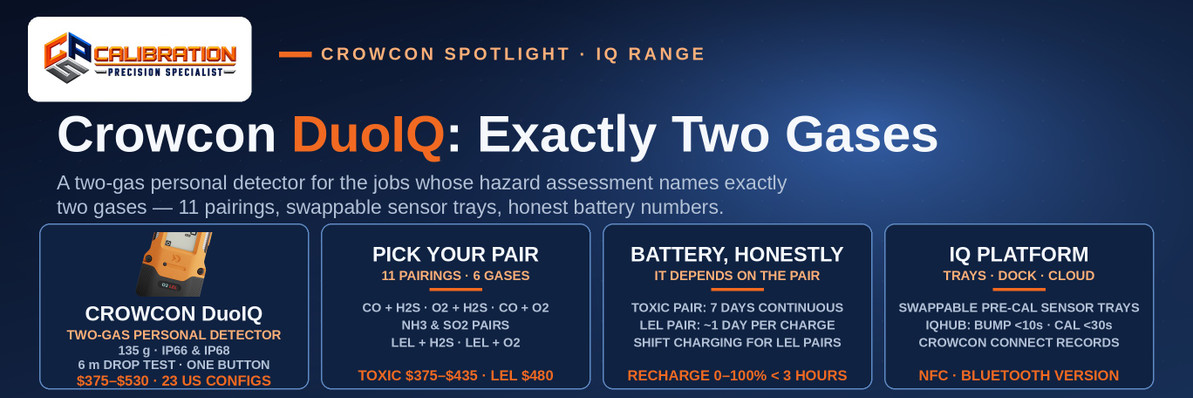
Crowcon DuoIQ: Two-Gas Detection for the Jobs That Need Exactly Two — Pairings and Prices
The Crowcon DuoIQ is a two-gas personal detector for jobs whose hazard assessment names exactly two gases: CPS stocks 11 US pairings — CO + H₂S, O₂ + H₂S, LEL + H₂S, ammonia pairs, and more — across six gases (carbon monoxide, hydrogen sulfide, oxygen, methane %LEL, ammonia, and sulfur dioxide), priced from $375 to $530. The DuoIQ weighs 135 g, is rated IP66 and IP68, and carries its two sensors in pre-calibrated trays you can swap in the field — so the pairing you buy is not the pairing you are stuck with. It is part of Crowcon's IQ range, which means it docks with the IQhub station for bump tests under 10 seconds and calibrations under 30, and reports into Crowcon Connect for compliance records.
Most gas-detection lineups jump straight from one gas to four. Single-gas detectors cover the lone hazard; the standard 4-gas monitor covers the confined-space four. But a large slice of real work lives in between: the hazard assessment names two gases — hydrogen sulfide and oxygen displacement in wastewater, carbon monoxide and hydrogen sulfide around combustion equipment, ammonia and a partner gas in a refrigeration plant — and neither standard answer fits. Two single-gas detectors means two devices to charge, bump, calibrate, and keep track of on the same worker. A 4-gas monitor means paying for two channels the job doesn't have, and maintaining four sensors forever. The DuoIQ exists to close that gap with one small instrument that watches the two gases that are actually there.
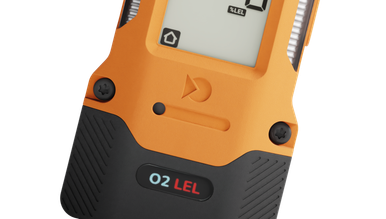
Crowcon DuoIQ Portable Two-Gas Detector
Crowcon DuoIQ two-gas detector at CPS: 11 US pairings (CO+H2S, O2+LEL, ammonia pairs), swappable pre-calibrated sensor trays, IQhub docking — $375–$530.
$375–$530 configured
See the DuoIQWhat Is the Crowcon DuoIQ?
The DuoIQ is the dual-gas member of Crowcon's IQ range, launched in September 2025 alongside the single-gas UnoIQ and the DetectiveIQ area monitor. (The design won a Red Dot Award — nice, but not why you buy a gas detector.) What matters in the field:
- Size and weight: 96 × 55 × 32 mm with the standard sensor tray (106 mm tall with the deep tray), and 135 g. That is shirt-pocket hardware — it rides on a collar or harness without the drag of a full multi-gas unit.
- Ruggedness: IP66 and IP68 sealing and a 6-metre drop test in Crowcon's specification. This is a detector built to be rained on, hosed down, and dropped on concrete.
- Alarms and display: Visual, vibrating, and 95 dB audible alarms with low/high, TWA, and STEL alarm types, on a backlit segment display. One button runs the whole instrument — there is almost nothing to mis-train.
- Response: T90 under 10 seconds, sensor dependent — fast enough that the reading tracks the hazard instead of trailing it.
- Logging: Up to 500 event logs on board, so alarm history survives until it is downloaded or pushed to Crowcon Connect.
- Down-facing sensors: The IQ range faces its sensors downward, which Crowcon designed to reduce contamination and false alarms — sensors pointing down don't collect the dust, water, and debris that sensors pointing up do.
Under the housing, DuoIQ works with every major sensor technology Crowcon lists for it — electrochemical, infrared (IR), pellistor (catalytic), and long-life oxygen — because different gases demand different physics. Which technologies sit inside a given DuoIQ depends on the pairing, and as the battery section below shows, that choice has real consequences.
Why Does a Two-Gas Detector Exist?
Because hazard assessments are specific. A confined-space program monitors the standard four gases because an unknown space can hold any of them. But most routine work isn't an unknown space — it's a known process with known chemistry, and the written assessment typically names one toxic gas plus one condition: the toxic gas and oxygen displacement, or the toxic gas and a flammable risk.
When the assessment names exactly two, the choices used to be bad ones. Two single-gas detectors double everything administrative: two bump tests each morning, two calibrations to track, two batteries to keep charged, two clips fighting for the same spot on the harness — and in practice, the second detector is the one that gets left in the truck. A full 4-gas monitor solves the admin problem by over-buying: two extra channels to purchase, and two extra sensors to replace on schedule whether or not the gases exist at your site. Sensor replacement is the long-term cost driver on multi-gas instruments, so channels you don't need aren't free — they bill you every couple of years, forever.
A two-gas detector is the fit-for-purpose middle: one device, one bump test, one calibration record, one battery — covering exactly the pair the assessment calls for. If your pair is a single fixed gas plus one occasional companion, a dedicated single-gas unit like Crowcon's Gasman may still be the cheaper answer. If the pair travels together everywhere the worker goes, two-in-one wins.
The Pairings CPS Stocks — and What Each One Is For
CPS carries the DuoIQ in 23 US configurations covering 11 pairings and six gases: CO 0–250 ppm, H₂S 0–100 ppm, O₂ 0–25%, methane 0–100% LEL, NH₃ 0–100 ppm, and SO₂ 0–20 ppm. The pairings, at list price:
- CO + H₂S — $375. The combustion pair: boilers, engine rooms, steel and utility work anywhere fuel burns and sour gas can appear. The most common two-toxic job in industry, at the DuoIQ's entry price.
- O₂ + H₂S — $375–$400. The wastewater pair. Sewage and sludge generate H₂S while displacing oxygen; this pairing watches the poison and the air itself.
- CO + O₂ — $375. For work around combustion in enclosed areas, where the risks are carbon monoxide buildup and oxygen depletion rather than a named toxic.
- NH₃ + CO — $435. Ammonia refrigeration and fertilizer operations where engine or boiler CO shares the site with the ammonia hazard.
- NH₃ + H₂S — $435. Agricultural and rendering work, biogas, and wastewater sites where ammonia and hydrogen sulfide come from the same decaying source.
- NH₃ + O₂ — $435. The refrigeration-plant pair: ammonia leak detection plus oxygen displacement in machinery rooms and cold storage.
- CO + SO₂ — $435. Steel, pulp and paper, and sulfur-handling processes, where CO and SO₂ are the twin toxics of combustion and sulfur chemistry.
- SO₂ + H₂S — $435. Sour-process work — refining, geothermal, and chemical plants where both sulfur gases are on the assessment.
- CO + methane %LEL — $480. Utilities and gas-distribution work pairing the toxic (CO) with the flammable (LEL) reading.
- Methane %LEL + H₂S — $480 standard / $505–$530 Bluetooth. The oil-and-gas pair: flammable gas plus the industry's signature toxic. The Bluetooth version adds live data streaming to the Crowcon Companion App and Connect.
- Methane %LEL + O₂ — $480. The classic flammable-atmosphere pair for tank and utility work where those two readings define the entry decision.
The pattern in the pricing is simple: pairs without an LEL channel run $375–$435; any pair with %LEL runs $480; and the Bluetooth version of the LEL + H₂S pairing runs $505–$530. You can see every configuration on the Crowcon DuoIQ product page.
Sensor Trays: The Pair Isn't a Life Sentence
The DuoIQ's defining design decision is that its sensors live in pre-calibrated, swappable trays. On a conventional detector, a failed or expired sensor means a bench repair or a trip back to the manufacturer. On the DuoIQ, the tray swaps in the field, the instrument's intelligent sensor recognition identifies what's installed, and you're back in service without shipping anything anywhere.
That modularity answers the sharpest objection to buying a two-gas detector: what if the job changes? A plant that buys CO + H₂S today and adds an ammonia process next year is not holding a dead instrument — the tray architecture is Crowcon's mechanism for retargeting the detector at different gases, using the plug-and-play combinations the platform supports. It also changes the service math: a drifting sensor is a tray swap and a calibration check, not a repair ticket and a loaner.
Two honest qualifications. First, trays are DuoIQ-specific parts — the flexibility is real, but it lives inside the IQ ecosystem. Second, a pre-calibrated tray is not a calibration exemption: the detector still gets bump-tested before use and calibrated on schedule, like every other instrument we sell. The tray just makes the response to a bad sensor a two-minute job instead of a two-week one.
Battery Life: The Number Depends on Your Pair
This is where the DuoIQ's spec sheet deserves a careful read, because the battery story splits hard by pairing — and it's the clearest example in this lineup of why the configuration, not the headline, is the product.
Crowcon's own datasheet gives a DuoIQ with a toxic-gas and oxygen pairing up to 7 days of continuous runtime — 20 days on 8-hour shift cycles. That is genuinely long: a CO + H₂S DuoIQ can run a full week of round-the-clock shifts per charge, and most users will charge it a handful of times a year in shift service. But a pairing that includes an LEL channel — infrared or pellistor — is rated at about 1 day continuous (3–4 days on shift cycles). The flammable-gas sensor's power appetite is roughly seven times the toxic pair's.
Neither number is a trick; both are physics. IR and pellistor LEL sensors draw real power, and every manufacturer lives with the same trade — Crowcon deserves credit for printing the split in its own specification table instead of advertising the toxic-pair number for the whole line. The practical consequence: if you buy an LEL pairing, plan on between-shift charging (a full recharge takes under 3 hours, 0–80% in 2), which is exactly how the instrument is meant to be run. If your pair is two toxics, battery life effectively stops being a maintenance item at all.
The IQ Platform: IQhub, Crowcon Connect, and the App
A detector's hardware is only half of what a safety manager administers; the other half is proof — bump records, calibration certificates, alarm histories, who wore what. The IQ range is Crowcon's connected answer to that paperwork:
- IQhub is the docking station: drop the DuoIQ in and it runs an automatic bump test in under 10 seconds and a full calibration in under 30 seconds, then pushes the results onward. Manual bump tests and calibrations through the device and PC software remain available for sites without a hub.
- Crowcon Connect is the cloud dashboard behind it: alarm events, exposure records, and compliance status for the fleet in one view, with calibration certificates stored and retrievable for audits. Crowcon includes Connect free for the first 12 months with an IQ purchase.
- NFC and the Companion App: every DuoIQ carries NFC for tap-to-pair identity and setup; the Bluetooth version streams live data to the Companion App on a phone and into Connect. NFC also supports workforce tracking — tapping the detector ties it to the wearer.
For a two-gas fleet, the dock-and-go routine is the real feature: a worker drops the detector on the hub at shift start, the bump test passes in seconds, and the compliance record exists before the coffee does. That is the workflow that keeps a two-gas program from quietly decaying into untested detectors.
DuoIQ vs. Two Single-Gas Detectors vs. a 4-Gas Monitor
- Choose the DuoIQ when the assessment names exactly two gases that travel together, every shift, on the same workers. One device, one bump, one charge (or one per-shift charge for LEL pairs), one calibration record — at $375–$530, priced between the alternatives it replaces.
- Choose two singles when the second gas is only occasionally present, or the two gases live on different workers or different tasks. Two dedicated instruments — a Gasman or a simple single-gas unit per hazard — can cost less and flex independently, at the price of double administration.
- Choose a 4-gas monitor when the work is confined-space entry or genuinely unknown atmospheres, where the full standard four (O₂, %LEL, CO, H₂S) must be watched because any of them can appear. A two-gas detector is a deliberate narrowing — right when the assessment is written and stable, wrong when the atmosphere is a guess.
The Honest Limits
- No pump, no remote sampling. The datasheet's sampling entry is "None" — the DuoIQ is a diffusion instrument. It reads the air at the wearer's collar, not air drawn from a space before entry. It is personal protection, not a pre-entry testing tool; confined-space programs still need a pumped instrument for the draw-down test.
- Two channels is a ceiling. A third hazard — a VOC, a second toxic, CO₂ — is simply not on the instrument. If your assessment grows a third gas, the answer is a different detector, not a setting.
- LEL pairings live on the charger. About a day of continuous runtime means overnight charging is part of the routine, every night, for LEL configurations. Sites that won't enforce that discipline should expect dead detectors.
- Bluetooth is a version, not a switch. CPS's Bluetooth configuration is the LEL + H₂S pairing at $505–$530; standard versions carry NFC only. If live streaming matters, buy the BT version on purpose.
- The wider DuoIQ gas list isn't all on our shelf. Crowcon's datasheet covers chlorine, nitrogen dioxide, ozone, hydrogen, and CO₂ ranges as well; CPS's US pairings at launch cover the six gases listed above. Ask us if a job needs something outside them — configurations change.
Calibration: We Calibrate Every Channel
Two channels or four, the rule doesn't change: bump-test before use, calibrate on schedule, keep the records. The DuoIQ gives you two clean ways to do it — IQhub's sub-30-second automatic calibration for fleets, or manual calibration through the device — and CPS backs both: our in-house lab handles calibration and service for the lines we sell, and for gas detection our commitment is simple: we calibrate every channel the instrument carries. Pre-calibrated trays shorten sensor service; they don't shorten the calibration interval, and we won't pretend otherwise.
Frequently Asked Questions
What two gases can the Crowcon DuoIQ detect at once? Any supported pairing of two channels. CPS stocks 11 US pairings across six gases — CO 0–250 ppm, H₂S 0–100 ppm, O₂ 0–25%, methane 0–100% LEL, NH₃ 0–100 ppm, and SO₂ 0–20 ppm — including CO + H₂S, O₂ + H₂S, LEL + H₂S, LEL + O₂, and ammonia pairings with CO, H₂S, or O₂. The sensors sit in swappable trays, so the pairing is a configuration choice, not two random sensors.
How much does the Crowcon DuoIQ cost? At CPS, $375 to $530 at list, by configuration. Toxic-gas pairings without an LEL channel run $375–$435 (CO + H₂S and CO + O₂ at $375; ammonia and SO₂ pairings at $435). Any pairing with a methane %LEL channel runs $480, and the Bluetooth version of the LEL + H₂S pairing runs $505–$530.
Can you change the gas pairing after you buy a DuoIQ? Yes — that is what the tray design is for. DuoIQ sensors live in pre-calibrated, plug-and-play trays that swap in the field without sending the instrument to the manufacturer, and the detector automatically recognizes the installed tray. Changing jobs can mean changing trays instead of changing instruments, using the combinations the IQ platform supports; the detector still needs its bump test and calibration afterward.
How long does the DuoIQ battery last? It depends on the pairing, and the difference is large. Crowcon's datasheet rates a toxic-gas/oxygen pairing at up to 7 days continuous (20 days on 8-hour shifts), but a pairing with an IR or pellistor LEL channel at about 1 day continuous (3–4 days on shift cycles). A full recharge takes under 3 hours. Plan LEL pairings around between-shift charging.
Is the Crowcon DuoIQ intrinsically safe? Yes — Crowcon's datasheet lists CSA (US) Class I, Division 1, Groups A, B, C, D T4 approval, along with ATEX Ex II 1G Ex ia IIC T4 Ga and IECEx intrinsic-safety approvals, in an IP66/IP68 housing that passes a 6-metre drop test. (A few international marks are noted as pending in the datasheet; the US CSA approval is the one that governs US use.)
Can the DuoIQ be used for confined-space pre-entry testing? No. The DuoIQ is a diffusion-only personal monitor — its datasheet lists sampling as "None," with no pump option — so it cannot draw a sample from a space before entry. It protects the worker wearing it inside the space. Pre-entry testing requires a pumped instrument that can sample the space from outside.
What is IQhub, and does the DuoIQ need it? IQhub is Crowcon's docking station for the IQ range: it runs an automatic bump test in under 10 seconds and a calibration in under 30 seconds, and pushes records to Crowcon Connect. The DuoIQ does not require one — manual bump tests and calibrations work through the device and PC software — but for fleets, the hub is what turns daily compliance into a drop-it-in routine.
DuoIQ or a 4-gas monitor — which do I need? Follow the hazard assessment. If it names exactly two gases that are always present together, the DuoIQ covers them with one device and one calibration record. If the work involves unknown atmospheres or confined-space entry, where oxygen, %LEL, CO, and H₂S all have to be watched because any could appear, you need the 4-gas monitor — a two-gas detector is a deliberate narrowing, not a substitute.
DuoIQ or two single-gas detectors — which is better? If the two gases travel together on the same workers, the DuoIQ: one instrument to charge, bump, calibrate, and track instead of two, and no second detector left behind in the truck. If the gases occur on different tasks or different people, two dedicated single-gas detectors can be cheaper and more flexible. Count the administration, not just the hardware.
Who calibrates the DuoIQ, and how long does it take? Either IQhub — automatic calibration in under 30 seconds with records pushed to Crowcon Connect — or a manual calibration through the device. CPS also calibrates the instruments it sells through our in-house service; whichever route you use, both channels get calibrated, and the bump-test-before-use rule applies every day regardless of the pre-calibrated trays.
The Bottom Line
The DuoIQ is the detector for the written hazard assessment that names exactly two gases. It replaces the two-singles juggle and the over-bought 4-gas with one 135 g instrument, in 11 pairings CPS stocks from $375 to $530 — with swappable sensor trays so the pairing can change when the job does, IQhub docking that makes daily bump tests a 10-second habit, and one clear discipline to plan around: LEL pairings charge between shifts, toxic pairings barely charge at all. Match the pair to the assessment, and it's the right-sized instrument for a job category the industry made do without for too long.
Not sure which pairing your assessment calls for — or whether two-gas is the right call at all? Call 865-900-8844 or reach us through Contact Us. CPS Calibrations · 109 S. Front Street, Rockwood, TN 37854.
CPS Calibrations · 109 S. Front Street, Rockwood, TN 37854 · Calibration Gas · Calibration Services · Contact Us
Need a calibration you can file?
In-house calibration at CPS in Rockwood, Tennessee — $55 for single-gas instruments, $90 for 4- and 5-gas — every channel, as-found and as-left data, full certificate.
See Calibration Servicesor call 865-900-8844
Recent Posts
-

Can You Add a Pump to a SENKO SGT-P or MGT?
Yes — SENKO's SP-Pump101 external sampling pump ($330, part AAA006000) fits the SGT, SGT-P, and MGT, …Nov 12th 2026 -

What Refrigerant Detection Does a Grocery Store Need?
A grocery store needs refrigerant detection in three places: low-mounted carbon dioxide (R-744) sens …Nov 11th 2026 -

What Is LEL and UEL? The Explosive Range, Gas by Gas
The LEL is the lowest concentration of a gas in air that can explode, and the UEL is the highest: me …Nov 10th 2026