
Crowcon Xgard vs XgardIQ: Proven Transmitter or Plug-In Intelligence?
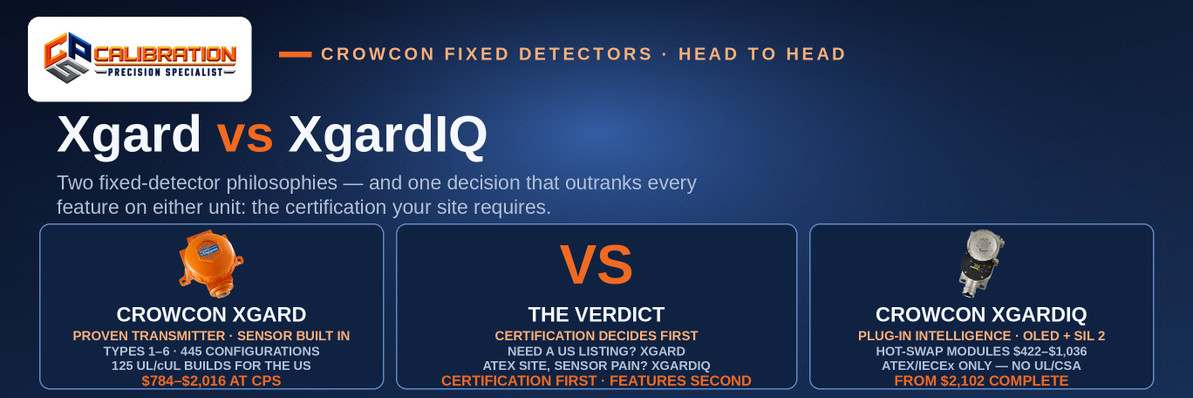
Buy the certification first and the features second. If your site, insurer, or authority having jurisdiction requires a UL- or CSA-listed fixed gas detector, the Crowcon Xgard is the only one of these two you can specify — 125 of its 445 configurations are UL/cUL builds at $784–$2,016, while the XgardIQ has no UL/CSA variant at all. If your plant works to ATEX/IECEx standards, the XgardIQ's hot-swappable plug-in sensor modules, OLED display, and SIL 2 rating make it the stronger long-term buy, from $2,102 per complete detection point. Everything else in this comparison — displays, outputs, maintenance — is secondary to that one line in the certification column.
These are Crowcon's two fixed point detector families, and they embody two philosophies. The Xgard is the proven transmitter: a sensor-and-signal head, sold by type number, that has been specified for decades and does its one job — sense gas, send a standard signal — with the display, relays, and alarming left to a controller. The XgardIQ is plug-in intelligence: a permanent stainless transmitter whose sensor is a replaceable module that swaps in minutes and configures itself. This comparison walks the decision in the order it should actually be made: certification, then sensor maintenance economics, then local interaction, then installed cost. If you want the deep dives first, we cover each detector on its own in the Crowcon Xgard spotlight and the Crowcon XgardIQ spotlight.
Side by Side
| Crowcon Xgard | Crowcon XgardIQ | |
|---|---|---|
| Architecture | Complete detector — sensor built into the unit you buy | Two parts: transmitter + one plug-in sensor module, sold separately |
| Configurations at CPS | 445 book configurations, Types 1–6 | 3 transmitter option builds + 31 sensor modules |
| Sensor service | Spare sensors plug in through the junction box lid; calibration done at the detector | Module hot-swaps with the tool provided, no hot-work permit; auto-configures on plug-in; removed module calibrates on the bench |
| Display | None — no display, relays, or sounder at the detector | 128 × 64 OLED display + +ve Safety status LEDs |
| Outputs | 2-wire 4-20mA sink (Types 1/2) · 3-wire mV bridge (Types 3/4) · 3-wire 4-20mA sink or source (Types 5/6) | 3-wire 4-20mA (auto-sensing sink/source) + RS-485 Modbus RTU; optional HART 7; optional alarm/fault relays |
| Needs a controller? | Yes — a panel, PLC, or controller provides display and alarms | Not necessarily — optional relays can switch local sounders, beacons, or ventilation directly |
| Certifications | ATEX/IECEx across the types, plus 125 UL/cUL Class 1 Div 1 configurations | ATEX/IECEx only — no UL/CSA variant in the current book |
| Functional safety | Not SIL-rated in the Xgard scoping | SIL 2 (IEC 61508 / EN 50402) |
| Housings | Glass-reinforced nylon, aluminium, or 316 stainless | 316 stainless steel only |
| Detector price | $784–$2,016 complete | Transmitter $1,680–$1,904 + module $422–$1,036 |
| Working point from | $784 (plus the controller it lands on) | $2,102 complete |
| Ingress protection | IP65 (IP66 with weatherproof cap) | IP66 |
1. The US Certification Reality — the Decision That Comes First
Start here, because this section can end the comparison in one paragraph. The Xgard is a British-designed range and Crowcon's book is ATEX-first, but the classic Xgard is the one Crowcon fixed family with a real US-certified subset: of its 445 book configurations, 125 are UL/cUL-described, with Class 1 Division 1 approvals across Types 1, 2, 3, 5 and 6 — CPS prices those builds from $784 (Type 3) and $812 (Type 2) up to $2,016 (stainless Type 1). A US plant whose AHJ or insurer expects a listed detector in a classified location can buy an Xgard that answers that requirement.
The XgardIQ cannot — not yet. Its certified builds are ATEX/IECEx only (Ex II 2 G Ex db ia IIC T4 Gb, Zone 1 and 2), and Crowcon's current price book also carries INMETRO (Brazil) and uncertified builds, but no UL or CSA variant of the XgardIQ at all. Crowcon's datasheet lists FM with an asterisk — "contact Crowcon for availability" — which is a conversation, not a listing you can order against. So the rule for a US buyer is blunt: if a US listing is required, specify the Xgard and stop reading comparisons. If your site standard is ATEX/IECEx — common in internationally specified plants — the XgardIQ's certification is exactly right, and the rest of this comparison becomes the real contest.
2. Sensor Maintenance Economics: Swap a Module vs Service a Detector
Every fixed detector's sensor is a consumable. The two families differ in what a sensor event costs you in parts, permits, and downtime.
On the Xgard, the sensor lives inside the detector. Crowcon's design softens that: sensors and sinters swap through the junction box lid, spare sensors simply plug in, and many spares are common across Xgard models, so a mixed-type site keeps a small shelf. The oxygen sensor in Types 1 and 2 is rated for a 2-year life — roughly double a conventional cell — which halves replacement frequency on the channels sites have most of. But the work still happens at the detector, in the classified area, on the detector's schedule: function checks and span calibration are field events, and a failed sensor is a repair at the point of detection.
On the XgardIQ, the sensor is the spare part. Modules hot-swap using the tool provided — no hot-work permit, no special tools, transmitter stays wired and powered — and on plug-in the transmitter reads the module and loads its gas type, range, units, and alarm levels automatically, which removes the wrong-configuration error entirely. The removed module goes to the bench for calibration while its replacement keeps the point live. The economics are in the parts prices: a shelf spare is one module at $422–$1,036, against $2,102 and up for a spare complete XgardIQ point — and against detector-level service on any conventional head. The same swap also changes the detector's gas: the transmitter that read methane last year reads hydrogen sulfide this year, with the wiring, conduit, and control programming untouched. For a site running several points, that module shelf is the strongest operating argument in this comparison.
3. Display and Local Interaction: Blind Head vs Walk-Up Instrument
The Xgard has no display, no alarm relays, and no sounder — by design. It is a sensor-and-transmitter head; the controller it lands on provides the readout, the relays, the sounders, and the event record. On a multi-point system with a proper panel, that is exactly right and keeps the per-point price low. As a standalone alarm, it does nothing — budget the receiving end or the point detects silently.
The XgardIQ is a walk-up instrument. Its 128 × 64 OLED display (yellow on black, readable in dark plant rooms) and +ve Safety indicator let a passing operator confirm the point is healthy without opening anything. Operation is non-intrusive — push-buttons through the display, no magnets, no opening the flameproof enclosure — and the detector posts its own calibration-due and bump-test reminders, runs a guided Smart Bump check, and keeps a built-in event log of alarm, fault, and maintenance events. With the optional relay build, it can switch local sounders, beacons, or ventilation directly on Alarm 1, Alarm 2, and Fault — a complete local alarm point without a dedicated panel. If your operators work at the point of detection rather than in front of a panel, this section — not the sensor — may be what you are actually buying.
4. Installed Cost: Worked Examples
Compare working points, not headline prices — the two families package their costs differently.
Xgard (detector complete; controller, cable, and commissioning are separate on any fixed point):
- Flammable point on an existing mV bridge panel — Type 3, UL/cUL, aluminium: $784
- Toxic/O₂ point, flameproof — Type 2, UL/cUL, aluminium: from $812
- Flammable point on a standard 4-20mA input — Type 5, UL/cUL: from $826
- Toxic/O₂ point, intrinsically safe — Type 1, UL/cUL: from $1,022, plus the zener barrier or galvanic isolator the IS loop requires
- Percent-volume point — Type 6, UL/cUL: $1,260
- Top of range — stainless Type 1 builds: to $2,016
XgardIQ (transmitter + one module = a working point):
- Oxygen point — $1,680 transmitter + $422 oxygen module = $2,102
- Methane point, pellistor — $1,680 + $503 = $2,183
- Methane point, IR, fully optioned transmitter (HART + relays) — $1,904 + $980 = $2,884; top of range $2,940
- Every sensor renewal after that: a module at $422–$1,036, not a detector
The honest reading: the Xgard is cheaper to buy per point — in some builds less than half the XgardIQ's entry — and it is the only route to a UL/cUL point. The XgardIQ's case is lifetime cost and uptime on ATEX/IECEx sites: renewals priced as modules, swaps measured in minutes, no hot-work permits, and calibration moved to the bench. Installation, cabling, and any control-system work sit outside both detectors' prices, and CPS quotes fixed system installation as its own scope.
Choose the Xgard When
- Your AHJ, insurer, or site standard requires a UL/CSA-listed fixed detector — it is the only one of the two that offers one.
- You are replacing heads on an existing panel, especially an mV bridge system (Type 3) or standard 4-20mA inputs (Types 1, 2, 5, 6).
- The detector is one channel of a controller-based system that already provides display, relays, and records.
- You need percent-volume measurement (Type 6 thermal conductivity — CO₂, hydrogen, helium, argon) or a high-temperature flammable point (Type 4, to +150 °C) — duties the XgardIQ module range doesn't cover.
- Housing choice matters: nylon or aluminium keep weight and cost down where stainless isn't needed.
- Per-point purchase price is the deciding number.
Choose the XgardIQ When
- Your site works to ATEX/IECEx standards and no US listing is required.
- Sensor service is your pain: hot-work permits, downtime, and field calibration on multiple points.
- You want a display, status indication, and event log at the point — and optional relays that alarm locally without a panel.
- The gas hazard may change: swap the module, keep the install.
- You need a SIL 2 rated point.
- Stainless construction and IP66 are the environment's default, not an upgrade.
Frequently Asked Questions
What is the difference between the Crowcon Xgard and XgardIQ?
Architecture and certification. The Xgard is a complete fixed detector — sensor built in, no display, signal out to a controller — in 445 configurations across six types, 125 of them UL/cUL builds, at $784–$2,016. The XgardIQ splits the detector into a stainless transmitter ($1,680–$1,904) plus a plug-in sensor module ($422–$1,036) that hot-swaps and self-configures, with an OLED display and SIL 2 rating — but it is ATEX/IECEx certified only, with no UL/CSA variant.
Is the Crowcon XgardIQ UL listed or CSA approved?
No. There is no UL or CSA variant of the XgardIQ in Crowcon's current price book. The certified builds are ATEX/IECEx (Ex II 2 G Ex db ia IIC T4 Gb), with INMETRO and uncertified builds also listed; Crowcon's datasheet shows FM with an asterisk — "contact Crowcon for availability." If your site requires a UL/CSA-listed detector, the Xgard is the Crowcon fixed line to specify.
Is the Crowcon Xgard UL listed?
Versions of it are. Of the 445 configurations in Crowcon's current book, 125 are UL/cUL-described, with Class 1 Division 1 approvals across Types 1, 2, 3, 5 and 6. Certification attaches to the exact configuration, so the listing is checked per build — CPS leads its Xgard range with the UL/cUL subset for US classified locations.
How much does a Crowcon Xgard cost?
$784–$2,016 at CPS list across the 445 book configurations. The UL/cUL builds start at $784 (Type 3), $812 (Type 2), $826 (Type 5), $1,022 (Type 1) and $1,260 (Type 6); stainless housings and intrinsically safe builds sit at the top. The controller, the barrier a Type 1 loop needs, and installation are separate.
How much does a Crowcon XgardIQ cost?
A working point is two parts: the transmitter at $1,680 (4-20mA + Modbus), $1,792 (adding HART or relays) or $1,904 (both), plus one sensor module at $422–$1,036. Complete points run from $2,102 (base transmitter with the oxygen module) to $2,940 (fully optioned transmitter with a top-price IR module).
Do the Xgard and XgardIQ have displays?
The XgardIQ does — a 128 × 64 OLED with +ve Safety status LEDs, push-button operation, and an event log. The classic Xgard does not: no display, no relays, no sounder. Its readings and alarms live on the controller it is wired to, which is what keeps its per-point price low on panel-based systems.
How do you replace an XgardIQ sensor?
By swapping the module. Modules remove and replace with the tool provided, without a hot-work permit or special tools, while the transmitter stays installed and wired. On plug-in, the transmitter auto-configures — it loads the new module's gas type, range, units, and alarm levels automatically. The removed module can then be calibrated on the bench.
Can you change the gas an XgardIQ detects?
Yes — fit a different module. One transmitter watches one gas at a time, and CPS lists 31 modules across pellistor, electrochemical, and infrared technologies: flammables 0–100% LEL, oxygen 0–25% vol, and toxics including CO, H₂S, SO₂, Cl₂, NH₃, and ozone. The transmitter, wiring, and outputs stay exactly as installed.
Does the XgardIQ need a separate controller?
Not necessarily. Its 4-20mA and Modbus outputs feed any PLC, control system, or gas controller, and the optional relay build can switch local sounders, beacons, or ventilation directly on Alarm 1, Alarm 2, and Fault. An Xgard, by contrast, always needs a receiving controller or panel input — it has no display or alarm outputs of its own.
Which should a US plant buy — the Xgard or the XgardIQ?
If your AHJ or insurer requires UL/CSA-listed detectors, the Xgard — it is the only one of the two with US-certified configurations (125 builds, $784–$2,016). If your plant is specified to ATEX/IECEx standards, the XgardIQ's module system, display, and SIL 2 rating justify its higher entry price (from $2,102 per point) over the life of the installation. Decide the certification question first; the features comparison only matters after it.
The Bottom Line
Xgard vs XgardIQ is not old versus new — it is two answers to two different specifications. The Xgard is the proven transmitter: the broadest configuration range in Crowcon's fixed line, outputs for every panel era from mV bridge to 4-20mA, three housings, and the UL/cUL subset a US buyer actually needs, at $784–$2,016 a point. The XgardIQ is the intelligent one: sensors as $422–$1,036 plug-in modules that swap without a hot-work permit and configure themselves, an OLED display and local relays, and a SIL 2 rating — from $2,102 a point, on ATEX/IECEx sites only. Check your listing requirement first. If it says UL or CSA, the decision is already made; if it says ATEX or IECEx, buy the detector whose maintenance model matches how your site actually runs.
Comparing fixed detectors for a new system, or replacing an aging fleet and want the certification and lifetime math run against your gas list? Call 865-900-8844 or reach us through Contact Us. CPS Calibrations · 109 S. Front Street, Rockwood, TN 37854 · Fixed System Installation · Calibration Services
Need a calibration you can file?
In-house calibration at CPS in Rockwood, Tennessee — $55 for single-gas instruments, $90 for 4- and 5-gas — every channel, as-found and as-left data, full certificate.
See Calibration Servicesor call 865-900-8844
Recent Posts
-

What Is Remote Monitoring for Fixed Gas Detection?
Remote monitoring for fixed gas detection means a fixed system's live readings, trends, and alarm hi …Nov 23rd 2026 -

What Are the Key Differences Between the GX-6000 and GX-6100?
The RKI GX-6100 is the current replacement for the discontinued GX-6000: both are pumped 6-gas monit …Nov 22nd 2026 -

How to Read a PID Correction Factor Chart
To read a PID correction factor chart, find your vapor’s row, take the factor under your own lamp en …Nov 21st 2026