
Crowcon XgardIQ: The Fixed Detector With Plug-In Sensor Modules
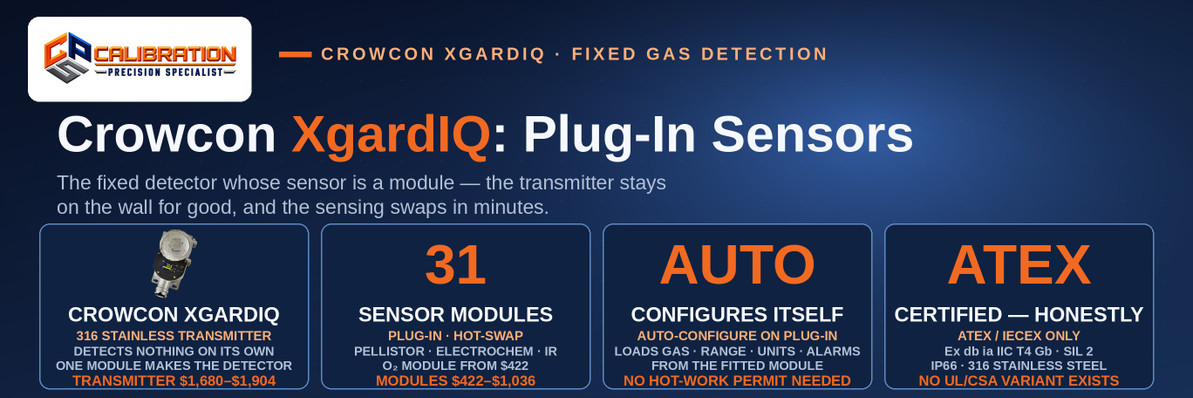
The Crowcon XgardIQ is a fixed gas detector sold as two parts that only work together: a 316 stainless steel transmitter ($1,680–$1,904 at CPS list, depending on HART and relay options) that detects nothing on its own, and one plug-in intelligent sensor module ($422–$1,036) that does the actual sensing. The modules hot-swap in the field without a hot-work permit, and when a module plugs in, the transmitter automatically loads its gas type, range, units, and alarm levels. CPS lists 31 modules — pellistor, electrochemical, and infrared — covering flammable gases, oxygen, and toxics. One limit belongs at the top: XgardIQ is ATEX/IECEx certified, and there is no UL or CSA variant in Crowcon's current price book.
A conventional fixed detector is a single sealed decision. The sensor is part of the instrument, so when the sensor reaches end of life — or the hazard in the area changes from methane to carbon monoxide — the whole detector comes off the wall. XgardIQ is Crowcon's answer to that: keep the transmitter, wiring, and outputs permanently installed, and treat the sensor as a replaceable, interchangeable part. Here is how the two-part system works, what the modules cost, what the transmitter does, what a complete detection point costs — and the certification limit that decides whether this detector is even an option for your site.
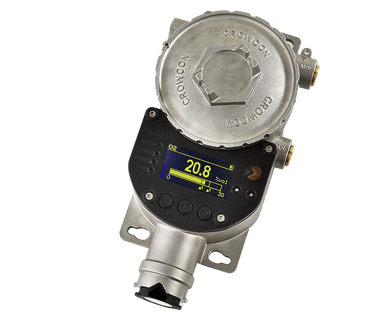
Crowcon XgardIQ Fixed Gas Detector Transmitter
Crowcon XgardIQ fixed detector: a $1,680–$1,904 stainless transmitter plus hot-swappable sensor modules at $422–$1,036. ATEX/IECEx only — no UL/CSA version.
$1,680–$1,904 configured
See the XgardIQTwo Parts, One Detector
The transmitter is the permanent half: a 316 stainless steel housing (278 × 140 × 89 mm, 4.1 kg) with an OLED display, the signal outputs, and three cable entries in M20 or ½" NPT. In Crowcon's ordering code, the transmitter is the `XIQ-ZZ` configuration — ZZ literally means "no sensor module fitted." CPS sells the English-language builds at three price points, and the only thing that moves the price is the option set:
- $1,680 — transmitter with 4-20mA and RS-485 Modbus RTU outputs
- $1,792 — adds HART 7 communications or alarm and fault relay outputs
- $1,904 — HART 7 and relay outputs fitted
The sensor module is the sensing half: a 66 × 53 × 45 mm plug-in unit (a toxic module weighs just 85 g) that carries the sensor, its calibration data, and its identity. Fit one module per transmitter. No module, no detection — that is the trade the design makes, and the rest of this post is about why it is usually a good one.
Why Modules Change the Maintenance Math
On a conventional fixed detector, sensor service happens where the detector is: in the classified area, often under a hot-work permit, with the point out of service while a technician works at height or in a pit. XgardIQ moves most of that work off the wall:
- Hot-swap, no hot-work permit. Crowcon designs the modules to be removed and replaced using the tool provided, without a hot work permit or special tools. The transmitter stays wired and powered; the point is back in service in minutes.
- Auto-configure. When a module plugs in, the transmitter detects it and uploads the appropriate gas type, range, units, and alarm levels from the module. There is no laptop configuration step and no wrong-gas-type setup error — the module tells the transmitter what it is.
- Calibrate on the bench, not on the wall. Swap in a spare module and the removed one can be calibrated and bump-checked in the workshop. The detection point never waits on a calibration.
- Stock modules, not detectors. A spare module costs $422–$1,036. A spare complete detector costs a transmitter plus a module — $2,102 and up. For a site running several XgardIQ points, one shelf spare per gas covers the fleet.
- Change the gas, keep the install. If an area's hazard changes, the wiring, conduit, transmitter, and control-system programming stay; only the module changes. The same transmitter that read methane last year can read hydrogen sulfide this year.
The 31 Modules, in Words
Every module is a complete sensor for one gas, in one of three technologies. CPS's module range from the FY27 book:
| Technology | Gases and ranges | Module price |
|---|---|---|
| Pellistor (catalytic) | Methane, propane, pentane, hydrogen, benzene, heptane, LPG, acetylene — all 0–100% LEL | $502–$532 |
| Electrochemical | Oxygen 0–25% vol; CO 0–250 / 0–500 / 0–1000 ppm; H₂S 0–25 / 0–50 / 0–100 / 0–200 ppm (plus a high-temperature H₂S module); SO₂ 0–10 / 0–100 ppm; Cl₂ 0–5 / 0–10 / 0–20 ppm; NH₃ 0–50 / 0–100 / 0–1000 ppm; ozone 0–1 ppm | $422–$840 |
| Infrared (IR) | Methane and propane 0–100% LEL at $980; ethanol, LPG, and pentane 0–100% LEL at $1,036 | $980–$1,036 |
The pattern matches the physics. The oxygen module is the cheapest part in the system at $422. Pellistor flammable modules cluster around $500. The electrochemical toxics run $530–$790 depending on the gas, with the high-temperature H₂S module at the top at $840. Infrared modules cost the most — $980–$1,036 — because the IR sensor itself costs more, and in return it cannot be poisoned the way a pellistor can and keeps working in low-oxygen atmospheres where a catalytic sensor cannot burn gas. Two honest gaps: Crowcon's datasheet gas list includes hydrogen fluoride, but the HF module is not sellable in the current FY27 book, so CPS does not list it; and there is no module for a second gas — one transmitter watches one gas, full stop.
The Transmitter Itself
The permanent half earns its price in outputs and in how little attention it needs:
- Outputs: 3-wire 4-20mA that auto-senses whether the control system is sink or source (Crowcon calls this Auto-Sense — it removes a classic wiring fault), NAMUR NE43 compliant, plus RS-485 Modbus RTU as standard. HART 7 over the 4-20mA signal is an option, and optional relays provide Alarm 1, Alarm 2, and Fault contacts (SPDT, rated 5A at 230 Vac), configurable for latching, delays, and rising or falling alarms.
- Display and status: a 128 × 64 OLED display (yellow on black, readable in dark plant rooms) and Crowcon's +ve Safety indicator — amber, red, and green LEDs plus a blue +ve Safety LED — so a walk-by check confirms the point is healthy without opening anything.
- Non-intrusive operation: functions are performed through push-buttons on the display, without magnets or special tools and without opening the flameproof enclosure. The detector warns when calibration is due, reminds when a bump test is due, and its Smart Bump routine verifies sensor health and response by following on-screen instructions.
- Records: a built-in event logger stores alarm, fault, and maintenance events, viewable on screen and downloadable to a PC.
- Remote sensor option: the module can sit in a remote sensor housing (105 × 105 × 70 mm) away from the transmitter — for pits, ducts, and other spots where the gas collects somewhere the display can't usefully be.
- Ratings: IP66 ingress protection; transmitter operating temperature −40 °C to +75 °C (module temperature limits vary by sensor — IR modules, for example, run −20 °C to +55 °C); functional safety certified SIL 2 to IEC 61508 / EN 50402; transmitter warranty 3 years.
The Certification Catch — Read This Before You Specify It
This is the section most XgardIQ write-ups skip, and it is the one that decides whether you can use the detector at all. XgardIQ is certified ATEX and IECEx (Ex II 2 G Ex db ia IIC T4 Gb, for Zone 1 and Zone 2 areas). Crowcon's FY27 price book also contains INMETRO (Brazil) builds and builds with no hazardous-area certification. It contains no UL or CSA variant of the XgardIQ at all. Crowcon's own datasheet lists FM among the approvals with an asterisk — "contact Crowcon for availability" — which is not the same thing as a listed, buyable US-certified model.
So the rule is simple: if your facility, insurer, or authority having jurisdiction requires UL- or CSA-listed fixed detectors, do not specify XgardIQ until Crowcon offers a US variant. Within Crowcon's own range, the Xgard family and the Xgard Bright both include UL/cUL builds, and CPS's scoping leads with those subsets for US buyers. If your site works to ATEX/IECEx standards — common in internationally specified plants — XgardIQ's certification is exactly what you need, and the module system below is a genuine operating advantage.
What a Working Detection Point Costs
Because the detector is two parts, the honest price of a working point is transmitter plus one module:
- Oxygen point, ATEX/IECEx: $1,680 transmitter + $422 oxygen module = $2,102
- Methane point, pellistor: $1,680 transmitter + $503 methane module = $2,183
- Methane point, IR, fully optioned transmitter: $1,904 (HART + relays) + $980 IR methane module = $2,884
- Shelf spare for the fleet: one module, $422–$1,036 — against $2,102+ for a spare complete detector
Installation, cabling, and any control-system work are separate, and CPS quotes fixed system installation as its own scope — but the comparison that matters for budgeting is the second one: after the first point, every additional year of sensor life costs a module, not a detector.
Calibration and Service
XgardIQ points still need what every fixed detector needs: scheduled bump tests and calibration, with records. The module system changes where that work happens — a swapped module can be calibrated on the bench while its replacement keeps the point live. CPS calibrates and services the fixed detectors we sell, and our calibration services cover the gas channels on instruments like these alongside the portables we are known for. If you are planning an XgardIQ installation — or replacing an aging fixed fleet and want the module math run against your gas list — call 865-900-8844.
Frequently Asked Questions
How much does a Crowcon XgardIQ cost? A working XgardIQ is two purchases: the transmitter at $1,680 (4-20mA and Modbus), $1,792 (adding HART or relays), or $1,904 (HART and relays), plus one sensor module at $422–$1,036. Complete detection points at CPS list therefore run from $2,102 (base transmitter with the oxygen module) to $2,940 (fully optioned transmitter with a top-price IR module).
Does the XgardIQ transmitter work without a sensor module? No. The transmitter is sold with no sensor fitted (Crowcon's code for it is XIQ-ZZ — ZZ means no module), and it detects nothing until one plug-in sensor module is installed. Budget for transmitter plus module together; the transmitter alone is a display and output unit with no sensing element.
Can you hot-swap XgardIQ sensor modules? Yes. Crowcon designs the modules to be removed and replaced with the tool provided, without a hot work permit or special tools, while the transmitter stays installed and wired. When the new module plugs in, the transmitter's auto-configure function reads the module and loads its gas type, range, units, and alarm levels automatically.
Is the Crowcon XgardIQ UL listed or CSA approved? No UL or CSA variant of the XgardIQ exists in Crowcon's current (FY27) price book. The certified builds are ATEX/IECEx (Ex II 2 G Ex db ia IIC T4 Gb), with INMETRO and uncertified builds also listed. Crowcon's datasheet shows FM with an asterisk — "contact Crowcon for availability." If your site requires a UL/CSA-listed detector, look at Crowcon's Xgard or Xgard Bright lines instead, which do include UL/cUL builds.
What gases can the XgardIQ detect? One gas per transmitter, from 31 CPS-listed modules: flammable gases 0–100% LEL by pellistor (methane, propane, pentane, hydrogen, benzene, heptane, LPG, acetylene) or infrared (methane, propane, ethanol, LPG, pentane); oxygen 0–25% vol; and electrochemical toxics — CO, H₂S (four ranges plus a high-temperature version), SO₂, Cl₂, NH₃, and ozone.
What outputs does the XgardIQ transmitter have? Standard: 3-wire 4-20mA (auto-sensing sink or source, NAMUR NE43 compliant) and RS-485 Modbus RTU. Options: HART 7 over the 4-20mA signal, and alarm/fault relays (Alarm 1, Alarm 2, Fault; SPDT contacts rated 5A at 230 Vac). The transmitter price steps from $1,680 to $1,792 with one of those options, and $1,904 with both.
Can the XgardIQ sensor be mounted away from the transmitter? Yes. Crowcon offers a remote sensor housing (105 × 105 × 70 mm) so the sensor module can sit where the gas collects — a pit, a duct, a low corner — while the transmitter and its display mount where people can read and service them.
How do you calibrate an XgardIQ? Two ways. In place: calibration and bump tests run through the OLED display and push-buttons, without opening the enclosure or using magnets, and the detector itself posts calibration-due and bump-test reminders. Or by swap: fit a spare module, and calibrate the removed module on the bench while the point stays in service. Either way, the events land in the detector's built-in event log.
What is the difference between the XgardIQ and the Xgard? The Xgard is a conventional fixed detector — the sensor is built into the instrument you buy, in a wide range of types including UL/cUL-certified builds. The XgardIQ separates the sensor into a plug-in module: easier sensor service and gas changes, at the cost of buying the detector in two parts, and — in the current book — with ATEX/IECEx certification only, no UL/CSA variant.
Does the XgardIQ need a separate controller? Not necessarily. Its 4-20mA and Modbus outputs feed any plant control system, PLC, or gas controller, and the optional relay build can switch local sounders, beacons, or ventilation directly on Alarm 1, Alarm 2, and Fault. Sites that want a dedicated panel can still wire it to one — the outputs are the standard ones controllers expect.
The Bottom Line
XgardIQ is the fixed detector to look at when sensor maintenance is your pain: transmitters at $1,680–$1,904 stay on the wall for good, sensors become $422–$1,036 plug-in modules that swap without a hot-work permit and configure themselves on the way in, and a shelf of spare modules keeps every point alive through calibrations and sensor end-of-life. The one hard gate is certification — ATEX/IECEx only, with no UL/CSA variant in the current book — so confirm your AHJ's requirement before you fall for the module system.
Questions about whether XgardIQ fits your gas list and your certification requirements — or want a fixed installation quoted? Call 865-900-8844 or reach us through Contact Us. CPS Calibrations · 109 S. Front Street, Rockwood, TN 37854 · Calibration Gas · Calibration Services
CPS Calibrations · 109 S. Front Street, Rockwood, TN 37854
Need a calibration you can file?
In-house calibration at CPS in Rockwood, Tennessee — $55 for single-gas instruments, $90 for 4- and 5-gas — every channel, as-found and as-left data, full certificate.
See Calibration Servicesor call 865-900-8844
Recent Posts
-

What Is Remote Monitoring for Fixed Gas Detection?
Remote monitoring for fixed gas detection means a fixed system's live readings, trends, and alarm hi …Nov 23rd 2026 -

What Are the Key Differences Between the GX-6000 and GX-6100?
The RKI GX-6100 is the current replacement for the discontinued GX-6000: both are pumped 6-gas monit …Nov 22nd 2026 -

How to Read a PID Correction Factor Chart
To read a PID correction factor chart, find your vapor’s row, take the factor under your own lamp en …Nov 21st 2026