
Do You Need a Gas Detector for Welding? When Hot Work Requires Monitoring
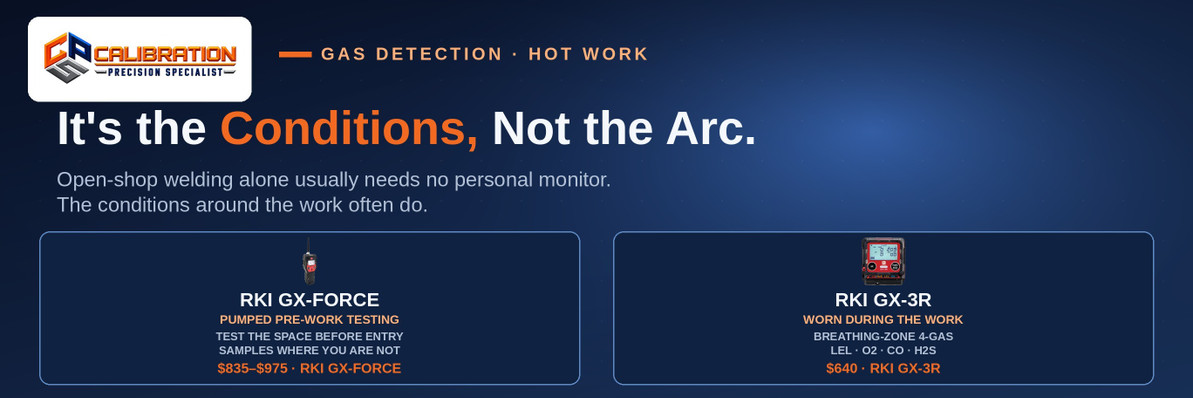
Usually not for the welding itself — open-shop welding on its own does not normally require a personal gas detector — but hot work does require gas monitoring when the conditions around it create an atmosphere hazard: welding in or near a confined space, oxygen enrichment from a leaking oxy-fuel setup (detectors alarm high at 23.5% O₂), carbon monoxide from an engine-driven welder run indoors, or an LEL check before hot work near fuel and flammable storage.
That distinction — the arc versus the conditions — is the whole post. Shops that monitor everything waste effort and teach crews to ignore alarms; shops that monitor nothing because "it's just welding" get caught by the one job where the conditions changed. Here is how to tell which job you are on.
When Does Open-Shop Welding Not Need a Gas Detector?
Start with the honest baseline, because it is the most common case. Welding or cutting in an open, ventilated shop — electric arc processes, workpieces that are ordinary steel, no confined space, no fuel or flammable storage in the work area, no engine-driven equipment running indoors — does not normally call for the welder to wear a personal gas monitor. The controls that matter there are the familiar ones: eye and skin protection, fume extraction or ventilation for welding fume, screens for bystanders, and housekeeping that keeps combustibles away from sparks.
A gas detector measures gas. Where the job creates no credible gas hazard, adding one adds a bump-test and calibration burden without adding protection — and an instrument worn everywhere, alarming at nothing, trains its wearer to treat a real alarm the same way. Monitoring earns its place when one of the five conditions below is true.
Condition 1: Is the Hot Work In or Near a Confined Space?
This is the condition that most often turns welding into monitored work. Hot work inside a tank, vessel, vault, pit, or other confined space — or hot work on the outside of a vessel whose inside atmosphere can be affected, or in an opening where welding gases and fumes can enter a space — belongs under the confined-space program, not the shop's normal routine:
- Test before entry and before the work starts, from outside the space, with a pumped monitor. The full sequence is in how to test a confined space before entry, and what is a confined space draws the line on which spaces qualify.
- Monitor continuously during the work. Welding changes the atmosphere it is performed in — shielding and fuel gases can displace oxygen, and the work itself generates fumes and gases — so a clear pre-entry test is not a guarantee for hour three.
- The entrant wears a monitor, and the attendant outside has readings too. If conditions go wrong, the people making decisions are outside the space.
The instrument for this condition is a pumped 4-gas monitor — the RKI GX-Force ($835–$975) or the pumped SENKO SP-MGTP ($850 base) — because only a pump can draw a sample from inside the space while the tester stays outside it.
Condition 2: Could Oxygen Be Enriched by the Oxy-Fuel Setup?
Oxy-fuel cutting and welding rigs carry pure oxygen under pressure, and oxygen leaks are invisible and odorless. A leaking hose, a bad connection, a valve left cracked — in a pit, a vessel, a small room, or anywhere ventilation is poor — can push the local oxygen concentration above normal air (20.9%).
Enriched oxygen is not a breathing hazard in the way a toxic gas is. It is a fire hazard with the volume turned up: materials that merely smolder in normal air — clothing, gloves, oily rags, hoses, even metals — ignite more easily and burn far more fiercely in enriched oxygen, and a welder is, by definition, holding an ignition source. Two rules follow:
- A 4-gas monitor's oxygen channel alarms on both ends for a reason: low at 19.5% (deficiency) and high at 23.5% (enrichment). If the O₂ channel reads high during oxy-fuel work, stop, find the leak, and ventilate — do not treat a high oxygen reading as good news.
- Never use oxygen to ventilate a space, dust off clothing, or "sweeten" the air. That practice manufactures exactly the enriched atmosphere above, on the worker's own clothes.
Use this when: oxy-fuel equipment is in use in enclosed, low, or poorly ventilated areas, or hoses and bottles are stored and connected inside the work space. In a wide-open bay with sound equipment, the risk is far lower — but the leak check on hoses and connections still belongs in the setup routine.
Condition 3: Is an Engine-Driven Welder (or Generator) Running Indoors?
Engine-driven welders and the generators that support them burn fuel, and their exhaust contains carbon monoxide — colorless, odorless, and fast-acting. Run one inside a building, a parking structure, a basement, or any enclosed or below-grade area and CO can build to dangerous levels while the crew's attention is on the weld. The engine does not have to be next to the welder; exhaust drifts, and CO accumulates where air movement is worst.
This is the welding condition where a personal monitor earns its keep most directly: a 4-gas monitor worn in the breathing zone — the RKI GX-3R ($640) is the standard example — alarms on CO at the person actually breathing it. The better first control, whenever it is possible, is to keep the engine outside and run leads in: a monitor is the backup for the arrangement you could not avoid, not a permit to idle an engine indoors. If engine-driven equipment must run in or near an enclosed area, monitoring is not optional thinking — test the area, monitor the people, and treat a rising CO trend as a stop-and-fix signal, not background noise.
Condition 4: Is There Fuel or Flammable Storage Near the Hot Work?
Sparks and slag travel farther than the welder's attention does. Hot work near fuel storage, solvent stores, paint areas, gas cylinder storage, vehicle fuel systems, or process equipment that held flammables raises a different question than personal exposure: is the atmosphere — or could it become — flammable?
- Test for LEL before the work starts in the immediate area and in any connected low spots, sumps, or adjacent spaces where vapors collect. A pumped monitor lets the tester sample those spots without climbing into them.
- Keep monitoring during the work where the flammable source is live — a tank being repaired, a fuel system opened nearby — rather than treating a morning test as an all-day clearance.
- Any measurable, rising LEL reading is a stop-and-investigate result, not a number to work around. Find the source, ventilate, and re-test before the arc is struck again.
This is permit thinking in its plainest form: the hot-work permit exists to force exactly these questions — what is near the work, what has been tested, who is watching, and what stops the job — to be answered before the spark, in writing.
Condition 5: What Is the Workpiece — and What Was In It?
The last condition is the container itself. Welding and cutting on tanks, drums, lines, and equipment that held fuel, solvents, or chemicals — or whose contents are unknown — is hot work on a potential flammable atmosphere, whatever the shop around it looks like. The atmosphere inside must be tested with a pumped monitor before the work and monitored as the work proceeds, because heating a residue can generate vapor faster than a single pre-test anticipates. "It was empty" is not a test result. If a vessel's history is unknown, treat it as the worst thing it could plausibly have held until testing says otherwise.
Which Gas Detector Does Hot Work Actually Need?
Match the instrument to the condition, the same way you would match it to any other job:
| Job | Instrument | Why |
|---|---|---|
| Testing a space, vessel, or low spot before and during hot work | Pumped 4-gas — RKI GX-Force ($835–$975) or SENKO SP-MGTP ($850 base) | Draws a sample from where the tester is not; the only honest pre-entry and pre-work test |
| Worn by the welder/entrant during monitored work | 4-gas personal monitor — RKI GX-3R ($640) | Breathing-zone LEL, O₂ (both alarms), CO, and H₂S, logging the wearer's actual exposure |
| Open-shop welding, none of the five conditions | No personal gas monitor normally required | Spend the effort on fume ventilation, screens, and housekeeping instead |
Browse the full ranges under portable multi-gas monitors and single-gas monitors, and remember the ownership half of the purchase: calibration gas to bump and calibrate, and calibration itself — in-house at CPS it is $55 for a single-gas instrument and $90 for a four- or five-gas, and we calibrate every channel on the instrument. On-site service costs more and is quoted in writing, because site conditions set the real price. The same "conditions, not the equipment" logic applies to fixed detection — a battery room's hydrogen hazard, for example, exists whether or not anyone is working in it, which is why it gets a fixed point instead of a portable: see hydrogen monitoring in battery rooms.
Frequently Asked Questions
Do welders need to wear a gas detector? Not for ordinary open-shop welding by itself. A welder needs a worn gas detector when the conditions around the work create an atmosphere hazard: working in a confined space, carbon monoxide from engine-driven equipment run indoors, oxygen enrichment risk from oxy-fuel equipment in enclosed areas, or work where flammable vapors may be present. The detector follows the conditions, not the job title.
When does hot work require gas monitoring? Hot work requires gas monitoring when it is performed in or near a confined space (atmospheric testing before and during entry), near fuel or flammable storage or on equipment that held flammables (LEL testing before and during the work), with oxy-fuel equipment where oxygen can accumulate (enrichment monitoring), or alongside engine-driven welders or generators in enclosed areas (carbon monoxide monitoring). If none of those conditions is present — open, ventilated shop work — monitoring is normally not required.
Do you need a gas detector for welding in a confined space? Yes. Confined-space hot work requires atmospheric testing before entry with a pumped monitor used from outside the space, and continuous monitoring while the work is performed — welding itself changes the atmosphere, consuming or displacing oxygen and generating gases and fumes. The entrant wears a monitor, the attendant tracks conditions from outside, and a diffusion-only monitor waved at the opening is not a pre-entry test.
Why is oxygen enrichment dangerous during welding? Because enriched oxygen makes everything burn harder. Above the normal 20.9% oxygen in air, materials that are hard to ignite — clothing, gloves, oily rags, hoses — ignite more easily and burn fiercely, and the welder is holding an ignition source. Leaking oxy-fuel hoses and connections are the usual source. That is why a 4-gas monitor's oxygen channel has a high alarm, typically 23.5%: a high oxygen reading during oxy-fuel work means stop, find the leak, and ventilate.
Can welding produce carbon monoxide exposure? Yes — most significantly from engine-driven welders and generators run indoors or in enclosed, below-grade, or poorly ventilated areas, whose exhaust contains carbon monoxide that builds up colorlessly and odorlessly. The first control is to keep the engine outside and run leads in; where engine-driven equipment must run in or near an enclosed area, the crew should be monitored with a personal 4-gas monitor (the RKI GX-3R, $640, is the standard example) and a rising CO trend treated as a stop-and-fix signal.
Should you check for flammable gas (LEL) before welding near fuel? Yes. Hot work near fuel storage, solvents, gas cylinders, vehicle fuel systems, or equipment that held flammables should start with an LEL test of the work area and any connected low spots, sumps, or adjacent spaces where vapors collect — using a pumped monitor so the tester samples those spots from outside them. Where the flammable source is live during the job, monitoring continues during the work, and any measurable, rising LEL reading means stop, find the source, ventilate, and re-test.
What is the best gas detector for hot work? There are two jobs, so there are two answers. For testing spaces, vessels, and the work area before and during hot work, a pumped 4-gas monitor — RKI GX-Force ($835–$975) or SENKO SP-MGTP ($850 base) — because only a pump samples where the tester is not standing. For wearing during monitored work, a personal 4-gas monitor such as the RKI GX-3R ($640). Crews doing regular permit hot work typically own both: the pumped unit with the entry and permit kit, a personal unit on each entrant.
Do I need a pumped or diffusion detector for welding? Pumped for testing, diffusion for wearing. Testing a confined space, a vessel interior, a sump, or the far side of a work area before hot work requires drawing a sample to the instrument, which only a pumped monitor can do. A monitor worn by the welder during the work is normally a diffusion instrument sampling the breathing zone directly. One instrument cannot do both jobs well — a diffusion unit cannot test a space from outside it, and a pumped unit's hose is a nuisance on a person doing the work.
Does MIG or TIG welding need a gas detector? In an open, ventilated shop, MIG and TIG welding on ordinary steel does not normally require a personal gas detector — the relevant controls are fume ventilation, eye protection, and keeping combustibles clear of the work. The answer changes with the conditions, not the process: MIG or TIG work inside a confined space, on a vessel that held flammables, or next to an engine-driven power source indoors needs the same testing and monitoring as any other hot work. Note that inert shielding gases can displace oxygen in a confined space, which is one more reason entry work is tested and monitored continuously.
How often does a hot work gas detector need bump testing and calibration? Bump test before each day's use — a quick exposure to gas that confirms the sensors respond and the alarms fire — and perform a full calibration when a bump test fails and at the manufacturer's recommended interval. Permit work raises the stakes on both: a test result on a permit is only as good as the instrument's last bump test. Sent to CPS in-house, calibration runs $55 for a single-gas instrument and $90 for a four- or five-gas, and we calibrate every channel; on-site service is quoted in writing.
The Bottom Line
Ask about the conditions, not the arc. Open-shop welding on its own usually needs no personal gas detector — say so plainly and spend the effort on fume control. But the moment the work moves into or near a confined space, onto a vessel that held fuel, beside flammable storage, around an oxy-fuel leak risk, or into the exhaust path of an engine-driven welder indoors, it becomes monitored hot work: a pumped 4-gas test before and during the job ($835–$975) and a personal 4-gas monitor on the worker ($640). The conditions decide — and they can change from one job to the next in the same shop.
Setting up a hot-work monitoring kit, or not sure whether a job crosses the line? Call 865-900-8844 or reach us through Contact Us. Browse portable multi-gas monitors, calibration gas, and our calibration services.
CPS Calibrations · 109 S. Front Street, Rockwood, TN 37854 · Calibration Gas · Calibration Services · Contact Us
Need a calibration you can file?
In-house calibration at CPS in Rockwood, Tennessee — $55 for single-gas instruments, $90 for 4- and 5-gas — every channel, as-found and as-left data, full certificate.
See Calibration Servicesor call 865-900-8844
Recent Posts
-

Can You Add a Pump to a SENKO SGT-P or MGT?
Yes — SENKO's SP-Pump101 external sampling pump ($330, part AAA006000) fits the SGT, SGT-P, and MGT, …Nov 12th 2026 -

What Refrigerant Detection Does a Grocery Store Need?
A grocery store needs refrigerant detection in three places: low-mounted carbon dioxide (R-744) sens …Nov 11th 2026 -

What Is LEL and UEL? The Explosive Range, Gas by Gas
The LEL is the lowest concentration of a gas in air that can explode, and the UEL is the highest: me …Nov 10th 2026