
Docking Stations vs. Manual Calibration: When Does Automation Pay for Itself?
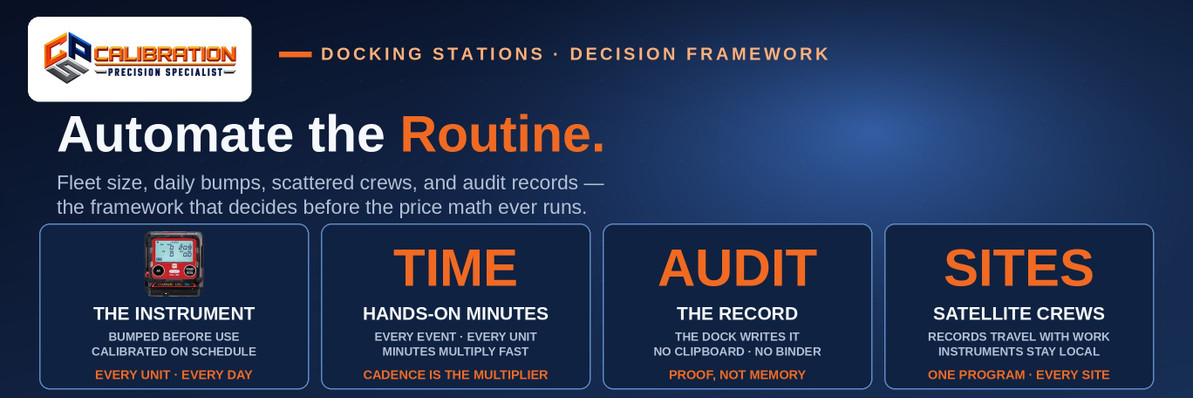
A docking station pays for itself when the manual routine stops scaling: when your fleet grows from a handful of instruments to dozens, when a daily bump-test requirement multiplies a few hands-on minutes per instrument into hours of crew time every week, when the work is spread across rotating crews or satellite sites, or when the calibration record itself has to be automatic to survive an audit. A small, single-site fleet with one person who owns the routine is usually better served by disciplined manual calibration — and the dollar side of this decision, worked per instrument, per year, lives in what a docking station really costs per instrument, per year.
Every fleet eventually asks the question, usually right after a bad morning: a line of instruments waiting for bump tests, one person with the gas cylinder, and a crew standing idle. The instinct is to price a docking station. Price matters — but it is the second question, not the first. The first question is whether your manual routine has outgrown the people running it. This post is the decision framework: fleet size, cadence, time, people, places, and records. When the framework says automation fits, run the money in the cost post linked above, which does that math on configured prices and nothing else. The two posts are designed to be read in that order.
The Three Ways Instruments Get Bumped and Calibrated
Strip away brands and there are three workflows. Manual calibration means a person connects each instrument to calibration gas with a regulator and tubing or a calibration cap, runs the bump or calibration, and writes the record by hand. A docking station automates that same event: the instrument is docked, the station applies the gas, runs the bump or calibration sequence, and stores the result. Outsourced calibration removes the event from your building entirely — instruments go to a service bench, like ours in Rockwood, and come back calibrated with a certificate. None of the three changes the underlying measurement: a bump test confirms the sensors respond and the alarms fire, and a calibration adjusts the instrument against a known gas concentration. What changes is who does the work, how long it takes, and what kind of record it leaves.
Fleet Size: The First Filter
Fleet size bands predict the answer better than any other single factor. A handful of instruments — one crew, one site — is a manual routine measured in minutes a day; automation adds a machine to maintain in exchange for time you were not really losing. Dozens of instruments is the contested middle: the manual routine is now a scheduled job, someone owns it, and its cost is measured in that person's hours and in what happens when they are on vacation. Hundreds of instruments, or dozens spread across shifts that never overlap, is where manual routines break structurally — not because anyone is careless, but because the queue of instruments waiting for one pair of hands becomes the schedule. Be honest about which band you are actually in, including the instruments in trucks and satellite lockers that everyone forgets to count.
Bump-Test Cadence: The Multiplier Nobody Budgets
Calibration happens on a schedule measured in months. Bump testing is where cadence bites. Many safety programs require a bump test before each day's use — which means the manual routine is not an occasional task but a daily one, performed at the worst possible moment: shift start, with a crew waiting. The arithmetic is multiplication, not addition: hands-on minutes per instrument, times instruments, times working days. A routine that feels trivial for five instruments is a standing daily appointment for fifty, and it competes with every other start-of-shift duty the same person owns. If your program's bump cadence is daily and your fleet is past the handful band, cadence alone may justify automation before any other factor is considered. If your program bumps weekly or before specific jobs, the pressure drops accordingly — run your real cadence, not the worst case.
Who Does the Work Today?
Manual calibration quality is person-shaped. One trained, conscientious owner produces excellent manual records — until they are sick, promoted, or gone, and the routine turns out to have lived in their head. Rotating crews produce the opposite profile: the task is everyone's, so technique, gas handling, and record entries vary by who drew the short straw. A docking station's real product in this comparison is consistency: the same sequence, the same way, regardless of who docked the instrument or how busy the morning was. Ask who performs your bumps and calibrations today, who performs them when that person is absent, and whether the records from different people look like they came from the same program. If the honest answer is "it depends on the day," that is a framework point for automation that no price calculation captures.
Records: The Dock Is a Record-Keeping Machine
Every bump and calibration has two products: an adjusted instrument, and a record proving it happened. Manual programs manufacture the second product by handwriting or spreadsheet, after the event, from memory or notes — and that is where audits are lost. A docking station manufactures the record as part of the event itself: instrument, date, result, stored by the station rather than reconstructed by a person. For a fleet whose records are ever reviewed — by a customer, an insurer, a regulator, or your own incident investigation — that difference can outweigh the time savings entirely. The question to ask is not "can we keep manual records?" but "what do our manual records actually look like for an instrument bumped at a satellite site eleven months ago?" If retrieving that record is a research project, the dock is not buying you convenience; it is buying you proof.
Satellite and Remote Crews: Where Instruments and Records Scatter
Central fleets can run a manual routine because the instruments, the gas, the trained person, and the records all live in one building. Satellite operations break all four: instruments sit at remote sites, the nearest trained calibrator is a drive away, and records — if they exist — live in a binder at each site. Automation fits this shape in a specific way: a station at the satellite site keeps the event and its record where the instrument works, without shipping instruments to a central shop and back. The manual alternative that also fits is outsourcing on rotation — instruments travel to a bench like the CPS Calibration Program while spares cover the site. What does not fit is the most common arrangement: a manual routine that depends on someone from the main site remembering to visit.
Where Manual Calibration Still Wins
Honesty cuts both ways. Manual calibration wins when the fleet is small and co-located, when one accountable person owns the routine and documents it well, and when the fleet is mixed — because stations are built for an instrument family, a fleet of many models can need more than one station type, while a person with a regulator serves them all. Manual also wins on flexibility: the same hands that calibrate can inspect, clean, notice a cracked case or a tired sensor, and pull an instrument from service on judgment. A station reports a failed calibration; it does not repair the instrument, replace a sensor, or make that judgment call. Fleets in the small band should spend their effort on making the manual routine disciplined — a set place, a set sequence, a real log — rather than automating a routine that is not yet a burden.
Frequently Asked Questions
What is the difference between a docking station and manual calibration?
The measurement is the same; the workflow is not. Manual calibration means a person connects each instrument to calibration gas, runs the bump test or calibration, and creates the record by hand. A docking station automates the event: dock the instrument and the station applies the gas, runs the sequence, and stores the result. The choice between them is about fleet size, cadence, consistency, and records — and, separately, about cost, which is worked in full in what a docking station really costs per instrument, per year.
How many gas detectors do you need before a docking station makes sense?
Use bands, not a magic number. A handful of instruments at one site is a manual routine measured in minutes — automation rarely earns its keep there. Dozens of instruments is the contested middle, where the answer turns on bump cadence, who does the work, and record quality. Hundreds of instruments, or dozens spread across shifts and sites, is where manual routines break down structurally and automation usually pays for itself in time and consistency. Count every instrument, including the ones in trucks and satellite lockers.
Does a daily bump-test requirement change the decision?
Yes — cadence is the strongest single argument for automation. Calibration is occasional; a before-use bump requirement makes the routine daily, at shift start, with crews waiting. The workload is hands-on minutes per instrument multiplied by fleet size multiplied by working days, so a routine that is trivial for five instruments becomes a standing daily job for fifty. If your program bumps daily and your fleet has outgrown the handful band, weigh cadence first and price second.
How long does manual calibration take per instrument?
Long enough to multiply. Each manual event includes setup — cylinder, regulator, tubing or calibration cap — applying gas and waiting through the instrument's response and adjustment cycle, and then recording the result by hand. Time your own routine with a stopwatch rather than trusting anyone's published figure, including ours; then multiply those honest minutes by your fleet size and your bump and calibration cadence. That product — minutes, not money — is the workload a docking station actually removes.
Do docking stations keep calibration records automatically?
That is one of their main functions. A station generates and stores the record as part of the bump or calibration event — which instrument, when, and what result — instead of relying on a person to write it up afterward. For fleets whose records are reviewed by customers, insurers, regulators, or incident investigators, automatic records are often the deciding factor, ahead of time savings: the manual question is not whether a log exists, but whether a specific instrument's record from months ago, at another site, can actually be produced.
Can one docking station serve different detector models?
Generally no — stations are built for an instrument family, so a mixed fleet can need more than one station type, while a manual routine with a regulator serves every model you own. That is a genuine framework point for manual calibration in small, mixed fleets, and a genuine planning cost for automation in large ones: count station types, not just instruments, before deciding. Your instrument mix belongs in the first conversation about automation, not the last.
What does a docking station not do?
It does not repair instruments, replace sensors, or rescue a channel that has drifted beyond adjustment — it reports the failure, and the instrument still needs service. It does not eliminate calibration gas, which it consumes the same way a manual event does. And it does not exercise judgment: the cracked case, the clogged filter, and the sensor that passes but looks tired are things a person notices during a manual routine. Automation replaces repetition, not inspection.
Is manual calibration less accurate than using a docking station?
No. Both workflows expose the instrument to the same known gas concentrations; a careful manual calibration by a trained person is a fully valid calibration, and CPS's own bench work is performed by technicians, not by docks. What automation changes is consistency and documentation — the same sequence every time, with the record created by the machine. The accuracy question to ask about a manual program is not whether it can be accurate, but whether it stays accurate on the busiest morning, with the backup person running it.
What if my crews work at remote or satellite sites?
Then geography may decide for you. A manual routine depends on instruments, gas, a trained person, and records being in the same place — satellite operations scatter all four. A station at the remote site keeps the event and its record where the instrument works. The other fit is outsourced rotation: instruments travel to a service bench while spares cover the site, which is the shape of the CPS Calibration Program. The arrangement that fails is the informal one — a manual routine that depends on someone from the main site remembering to visit.
Where can I see what a docking station costs per instrument, per year?
In the companion post written for exactly that question: what a docking station really costs per instrument, per year works the math on configured station prices at several fleet sizes, including what the gas does and does not add. This post deliberately carries no prices, because the framework decision — fleet size, cadence, people, records — should be made first. Run the framework, then run the numbers, then call CPS Calibrations at 865-900-8844 if you want either the station or the service behind it.
The Bottom Line
Docking stations vs. manual calibration is a scaling decision, not a shopping decision. Manual wins while the fleet is a handful, the site is one building, the cadence is forgiving, and one accountable person owns a disciplined routine. Automation pays for itself when fleet size, daily bump pressure, rotating crews, scattered sites, or audit-grade records turn that routine into a burden and a risk. Decide on time, people, places, and proof — then check the decision against the per-instrument cost math in the companion post.
Working through the dock-or-manual decision for your fleet? Call CPS Calibrations at 865-900-8844 — we sell the stations, and we run the manual bench and the CPS Calibration Program for fleets that decide the other way.
CPS Calibrations · 109 S. Front Street, Rockwood, TN 37854 · Calibration Services · What a Docking Station Really Costs · The CPS Calibration Program
Need a calibration you can file?
In-house calibration at CPS in Rockwood, Tennessee — $55 for single-gas instruments, $90 for 4- and 5-gas — every channel, as-found and as-left data, full certificate.
See Calibration Servicesor call 865-900-8844
Recent Posts
-

What Is Remote Monitoring for Fixed Gas Detection?
Remote monitoring for fixed gas detection means a fixed system's live readings, trends, and alarm hi …Nov 23rd 2026 -

What Are the Key Differences Between the GX-6000 and GX-6100?
The RKI GX-6100 is the current replacement for the discontinued GX-6000: both are pumped 6-gas monit …Nov 22nd 2026 -

How to Read a PID Correction Factor Chart
To read a PID correction factor chart, find your vapor’s row, take the factor under your own lamp en …Nov 21st 2026