
Does OSHA Require a Bump Test Before Every Shift?
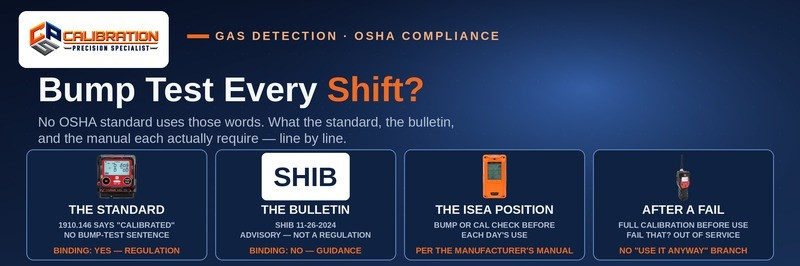
No — no OSHA standard contains the words "bump test before every shift": the confined-space standard, 29 CFR 1910.146(c)(5)(ii)(C), requires that a permit space be tested "with a calibrated direct-reading instrument," and the "before each day's use" bump-test language comes from the International Safety Equipment Association (ISEA), whose 2010 position statement — "a bump test or calibration check of portable gas monitors should be conducted before each day's use in accordance with the manufacturer's instructions" — OSHA endorses in Safety and Health Information Bulletin SHIB 11-26-2024, a document OSHA states is advisory and "creates no new legal obligations." In practice the gap closes from the other side: "calibrated" is judged against the manufacturer's instructions, so an instrument that has not been bump tested or calibration-checked before that day's use is difficult to defend as calibrated.
This is the most misquoted requirement in gas detection. Safety talks state it as an OSHA rule, toolbox posters shorten it to "OSHA requires daily bump tests," and the phrase mutates again into "before every shift" — which is stricter than anything OSHA or ISEA actually wrote. None of that makes morning bump testing optional in any practical sense, and this post is not an argument for skipping it. It is an argument for knowing which document says what, because the three layers — the regulation, the bulletin, and the manufacturer's manual — carry different weight, and the one that binds your program day to day is not the one most people cite.
What Does the OSHA Standard Actually Say?
Start with the regulation itself, because it is the only layer that is law. OSHA's permit-required confined spaces standard, 29 CFR 1910.146, addresses gas detectors at paragraph (c)(5)(ii)(C). Its requirement, in the standard's own words, is that before an employee enters the space, the internal atmosphere "shall be tested, with a calibrated direct-reading instrument, for oxygen content, for flammable gases and vapors, and for potential toxic air contaminants, in that order."
Read that sentence closely. It mandates a calibrated instrument and a testing order — oxygen first, then flammables, then toxics. It does not use the words "bump test," "function check," "each day," or "each shift" anywhere. The same pattern holds in the other standards OSHA's bulletin cites as requiring gas monitors — hazardous waste operations (29 CFR 1910.120) and grain handling facilities (29 CFR 1910.272): the standards require monitoring with maintained, calibrated instruments, and leave the verification method and frequency to be filled in by guidance and by the manufacturer.
OSHA's Compliance Directive CPL 2.100, which tells inspectors how to apply the confined-space standard, fills in the key definition this way: a testing instrument calibrated in accordance with the manufacturer's recommendations meets the "calibrated" requirement — and the best way for an employer to verify calibration is through documentation. That one interpretation is where the manufacturer's manual enters your compliance picture: the standard says "calibrated," the directive says "calibrated means per the manufacturer," and the manufacturer's instructions are where a pre-use bump test or calibration check actually lives.
What Does OSHA's Bulletin Say — and What Is a Bulletin Worth?
The document most "OSHA requires bump testing" claims actually come from is OSHA's Safety and Health Information Bulletin (SHIB) 11-26-2024, Calibrating and Testing Direct-Reading Portable Gas Monitors. It is a thorough, genuinely useful guidance document — and OSHA labels its legal weight on its own face:
"This Safety and Health Information Bulletin is not a standard or regulation, and it creates no new legal obligations. The Bulletin is advisory in nature, informational in content, and is intended to assist employers in providing a safe and healthful workplace."
The bulletin goes further, addressing the General Duty Clause directly: "failure to implement any recommendations in this Safety and Health Information Bulletin is not, in itself, a violation of the General Duty Clause." Citations, OSHA notes, can only be based on standards, regulations, and the General Duty Clause itself.
Inside that advisory frame, the bulletin does three things that matter:
- It endorses the ISEA position on frequency. Quoting ISEA's updated 2010 position statement: "A bump test . . . or calibration check of portable gas monitors should be conducted before each day's use in accordance with the manufacturer's instructions."
- It defines the tests. A bump test (or function check) is "a qualitative function check in which a challenge gas is passed over the sensor(s) at a concentration and exposure time sufficient to activate all alarm settings," whose purpose "is to confirm that gas can get to the sensor(s) and that all the instrument's alarms are functional" — and which "does not provide a measure of the instrument's accuracy." A calibration check, by contrast, compares the reading to the test-gas concentration, with an acceptable response "typically ± 10-20% of the test-gas concentration" (the manufacturer's tolerance governing).
- It sets the failure sequence. "If an instrument fails a bump test or a calibration check, the operator should perform a full calibration on it before using it. If the instrument fails the full calibration, the employer should remove it from service."
So the accurate citation is not "OSHA requires a bump test before every shift." It is: OSHA's standard requires a calibrated instrument; OSHA's bulletin endorses ISEA's before-each-day's-use verification, performed per the manufacturer's instructions. Those are different statements, and only the first one is a regulation — but the second one describes exactly what an inspector will expect to see behind the first.
"Before Each Day's Use" Is Not "Before Every Shift" — and Neither Is "Before Each Use"
Three phrases circulate as if they were interchangeable. They impose three different workloads, so it is worth separating them precisely:
| Phrase | What it literally requires | Where it comes from |
|---|---|---|
| Before each day's use | One bump test or calibration check on each day the instrument is used, before that day's work begins | ISEA's 2010 position statement, endorsed in OSHA SHIB 11-26-2024 |
| Before every shift | A test at the start of every shift — two or three tests a day for a shared instrument on a multi-shift operation | Stricter company policies and site rules; not OSHA's or ISEA's wording |
| Before each use | A test every time the instrument is picked up, including every change of user during a day | Some manufacturers' instructions and some site policies; the most conservative reading |
The governing phrase in the guidance is the first one: before each day's use. An instrument used on Monday and then shelved until Thursday needs its verification on Thursday before work — the obligation attaches to days of use, not to the calendar. Nothing in OSHA's standard or the ISEA statement quoted in the bulletin imposes a per-shift test by name.
Why, then, do so many programs bump test at every shift change and every change of user? For two defensible reasons, neither of which is "OSHA's sentence says so." First, the bulletin directs operators to validate the instrument's operability whenever conditions that can damage it occur or are suspected — its drift-and-damage list includes drops and jostling, over-range exposures, sensor poisons such as silicones and sulfides on catalytic LEL sensors, solvent and corrosive exposure on electrochemical sensors, and extreme temperature, humidity, and particulate conditions. A change of shift is often also a change of custody, and the incoming user has no way to know what the instrument went through on the previous shift. Second, a company's own written policy is enforceable against that company in an audit or an investigation regardless of who wrote the underlying guidance: once your procedure says "every shift," every shift is your standard. The practical recommendation is to write your policy in the guidance's own words — before each day's use, per the manufacturer's instructions, plus a re-test after any drop, immersion, over-range alarm, suspected poison exposure, or change of user — and then follow what you wrote. That policy satisfies the ISEA position, matches most manuals, and covers the change-of-hands gap without inventing an OSHA sentence that does not exist.
One more layer: OSHA notes there are 29 OSHA-approved State Plans, which must be at least as effective as federal OSHA and may have different or more stringent standards. A state-plan state can phrase its own requirements more strictly, so a multi-state employer should check the plan that covers each site rather than assuming the federal wording is the whole answer everywhere.
What Counts as Documentation?
The standard does not hand you a bump-test log form, and the bulletin does not prescribe one either. What the documents do say is consistent and pointed: OSHA "recommends developing standard procedures for calibrating and using DRMs that include documentation to verify the proper maintenance and calibration of the instruments," the bulletin advises that "employers should keep calibration records for the life of each instrument," and the compliance directive treats documentation as the best way to verify that an instrument was calibrated per the manufacturer. In other words, nobody mandates a specific form — and everybody expects a record to exist.
A record that actually proves the program, whether it lives in a docking-station download or a paper log, carries the same fields:
- Date and time of the bump test or calibration check.
- Instrument serial number — the record must tie to one specific detector, not to "the 4-gas meters."
- Result per instrument — pass, or fail with the action taken (full calibration, removal from service).
- The test gas — mix, cylinder lot, and expiration date; OSHA's calibration rules require certified, traceable gas used before its expiration date, and an expired cylinder undermines the record built on it.
- Who performed it.
Docking stations generate most of this automatically, which is a large part of their value for a fleet; a disciplined manual log with the same fields proves the same thing. What does not prove anything is a verbal "we bump them every morning" with no record behind it — that is precisely the gap the documentation language in all three documents is aimed at. For the test itself, our step-by-step guide to how to bump test a gas detector walks the procedure the bulletin describes, and bump test gas vs. calibration gas covers which cylinder does both jobs (the standard 4-gas mix — H₂S 25 ppm / CO 50 ppm / CH₄ 50% LEL / O₂ 12% — is $195 in a 34 L cylinder at CPS).
What Happens After a Failed Bump Test?
Here, guidance and good practice speak with one voice, and there is no branch that ends with "use it anyway":
- 1. Full calibration before further use. The bulletin's sequence is explicit: an instrument that fails a bump test or a calibration check gets a full calibration — a zero-and-span adjustment against certified, NIST-traceable gas — before it is used again.
- 2. If it fails the full calibration, remove it from service. The bulletin directs the employer to take it out of service and contact the manufacturer for assistance or service.
- 3. Prove the rig before you condemn the sensor. Expired gas, the wrong regulator, and a leaking calibration cap fail healthy instruments every week — that differential diagnosis is the whole subject of why bump tests fail. And keep the definitions straight while you work: a bump test proves function, a calibration establishes accuracy, and one never substitutes for the other — the comparison is laid out in bump test vs. calibration.
At CPS, that bench triage is what calibration services do daily: in-house calibration is $55 for a single-gas instrument and $90 for a four- or five-gas instrument, with every channel calibrated — and when a channel will not calibrate, the certificate says so, with the as-found data behind it.
At a Glance: Who Says What
| Source | What it actually says | Is it binding? |
|---|---|---|
| 29 CFR 1910.146(c)(5)(ii)(C) | Test the space before entry "with a calibrated direct-reading instrument" — O₂, flammables, toxics, in that order | Yes — federal regulation |
| OSHA CPL 2.100 | "Calibrated" means calibrated per the manufacturer's recommendations; documentation is the best verification | Inspector guidance applying the standard |
| OSHA SHIB 11-26-2024 | Endorses a bump test or calibration check before each day's use, per the manufacturer's instructions; defines the tests and the fail sequence | No — advisory; "creates no new legal obligations" |
| ISEA position statement (2010) | "A bump test or calibration check … should be conducted before each day's use in accordance with the manufacturer's instructions" | Industry position — the source of the frequency wording |
| Manufacturer's manual (e.g., RKI, SENKO) | Model-specific bump, calibration-check, and full-calibration procedures and tolerances | In effect — it is the benchmark "calibrated" is judged against |
| Your company's written policy | Whatever you wrote — daily, per shift, per user | Binding on you in audits and investigations |
What Should Your Program Do on Monday Morning?
Exactly what it probably already does — with the paperwork and the wording fixed. Bump test or calibration-check every instrument before each day's use, in clean air, with in-date certified calibration gas, following the manual for the model in hand — an RKI GX-3R ($640) and a SENKO pumped unit do not share every menu step. Re-test after any drop, over-range event, suspected poison exposure, or change of user. Log it by serial number. Send failures to a full calibration, and failures of that to the bench, not back to the gang box. Browse the instruments under portable gas detection and portable multi-gas monitors if a retired unit needs replacing. The only thing to change is the citation on the poster: your program does this because the standard demands a calibrated instrument, the manufacturer defines what calibrated takes, and OSHA-endorsed guidance sets the daily verification that proves it — not because an OSHA sentence orders a bump test before every shift. Precision about the rule is what makes the rule hold up when someone — an inspector, an auditor, or a lawyer — reads it closely.
Frequently Asked Questions
Does OSHA require a bump test before every shift?
No. No OSHA standard uses the words "bump test," "every shift," or "each day" for gas detectors. The confined-space standard, 29 CFR 1910.146(c)(5)(ii)(C), requires testing with "a calibrated direct-reading instrument," and the bump-test frequency language — before each day's use — comes from ISEA's 2010 position statement, endorsed by OSHA in Safety and Health Information Bulletin SHIB 11-26-2024, which OSHA states is advisory and creates no new legal obligations. Per-shift testing is a stricter company or site policy, not an OSHA sentence.
Does OSHA require a bump test before each use?
Not in those words either. The frequency OSHA endorses, quoting ISEA, is a bump test or calibration check "before each day's use in accordance with the manufacturer's instructions" — one verification on each day the instrument is used, before that day's work. Testing before each individual use or at every change of user is more conservative than the guidance and is what some manufacturers' instructions and many site policies require; it is a sound practice after any change of custody, because the new user cannot know what the instrument was exposed to earlier in the day.
How often should you bump test a gas detector?
Before each day's use, per the manufacturer's instructions — that is the ISEA position OSHA carries in SHIB 11-26-2024, and it is the frequency to write into your program. Test more often whenever the instrument may have been compromised: after a drop or immersion, an over-range alarm, exposure to sensor poisons such as silicones or sulfides, or extreme temperature and humidity. A bump test proves function only; full calibration runs on the manufacturer's schedule and immediately after any failed bump test or calibration check.
Can OSHA cite you for not bump testing a gas detector?
Not for violating the bulletin — OSHA states that failure to follow SHIB 11-26-2024's recommendations "is not, in itself, a violation of the General Duty Clause," and citations must rest on standards, regulations, or the General Duty Clause. What an inspector can cite is the underlying standard: using an instrument that is not calibrated in accordance with the manufacturer's recommendations for a confined-space entry breaches 1910.146's "calibrated direct-reading instrument" requirement. Skipping the manufacturer-directed pre-use verification is the most common way an instrument ends up in that position, which is why the practical exposure is real even though the bulletin itself is advisory.
What does OSHA require for gas detector calibration in confined spaces?
29 CFR 1910.146(c)(5)(ii)(C) requires that before an employee enters a permit-required confined space, the internal atmosphere be tested with a calibrated direct-reading instrument for oxygen content, for flammable gases and vapors, and for potential toxic air contaminants, in that order. OSHA's compliance directive CPL 2.100 interprets "calibrated" as calibrated in accordance with the manufacturer's recommendations, verifiable through documentation. OSHA's bulletin adds the working rules around it: follow the manufacturer's guidelines, use only certified traceable test gas before its expiration date, and train the operators who perform calibration.
Is a bump test the same as a calibration?
No. OSHA's bulletin defines a bump test as a qualitative function check — challenge gas is passed over the sensors at a concentration and for long enough to activate all alarm settings — that confirms gas can reach the sensors and the alarms work, and that "does not provide a measure of the instrument's accuracy." A calibration check compares the reading against the test-gas concentration (typically within ±10–20% counts as verified accuracy), and a full calibration adjusts the instrument's reading to coincide with the certified concentration. A bump test can never substitute for a calibration.
Do you have to document bump tests for OSHA?
No OSHA standard prescribes a bump-test log or a form for it. What the documents do is converge on records: OSHA recommends procedures that include documentation verifying proper maintenance and calibration, SHIB 11-26-2024 advises keeping calibration records for the life of each instrument, and CPL 2.100 calls documentation the best way to verify an instrument was calibrated per the manufacturer. A useful record carries the date and time, the instrument serial number, the pass/fail result and any action taken, the test-gas mix, lot, and expiration, and who performed the test — docking stations capture these fields automatically.
What happens if a gas detector fails a bump test?
It does not go back into service. The sequence in OSHA's bulletin is fixed: perform a full calibration before using the instrument, and if it fails the full calibration, remove it from service and contact the manufacturer for assistance or service. Before condemning the sensor, prove the test rig — expired gas, a mismatched regulator, or a leaking calibration cap all fail healthy instruments. At CPS, in-house calibration is $55 for a single-gas instrument and $90 for a four- or five-gas, with every channel calibrated.
How long does a bump test take?
About a minute for a diffusion instrument on a calibration cap: fresh-air zero in clean air, apply certified gas, confirm every channel responds and the audible, visual, and vibrating alarms activate, then log the result. Judge the response against the instrument's own specification rather than a stopwatch habit — RKI, for example, specifies the GX-3R's response at within 30 seconds (T90). Pumped instruments and long sample hoses add the time the gas takes to travel the hose before the sensors see it.
Do docking stations satisfy the bump test guidance?
Yes — a docking station performs the same test the manual method does: it applies certified gas, judges the sensor response and alarms, logs the result against the instrument's serial number, and runs a full calibration when a bump fails. What it changes is consistency and paperwork, not the requirement: the verification still has to happen before each day's use. Stations are model-specific, so a mixed RKI and SENKO fleet may need more than one station, or a manual routine for the instruments a station does not take.
The Bottom Line
No OSHA standard orders a bump test before every shift — the regulation requires a calibrated instrument, ISEA's position sets the verification at before each day's use per the manufacturer's instructions, and OSHA's bulletin endorsing that position states plainly that it creates no new legal obligations. Treat the three layers for what they are, and the practical answer is unchanged: verify every instrument before each day's use, re-test after damage, over-range exposure, or a change of user, document it by serial number, and answer a failed bump with a full calibration — or removal from service. A program that can show that record never has to argue about which sentence required it.
Want a second set of eyes on your fleet's bump and calibration routine — or a detector that failed this morning's test? Call 865-900-8844 or reach us through Contact Us. We calibrate every channel, on instruments from RKI, SENKO, and the other lines we service, and we will tell you plainly whether a failure is the gas, the rig, or the sensor.
CPS Calibrations · 109 S. Front Street, Rockwood, TN 37854 · Calibration Gas · Calibration Services · Contact Us
Need a calibration you can file?
In-house calibration at CPS in Rockwood, Tennessee — $55 for single-gas instruments, $90 for 4- and 5-gas — every channel, as-found and as-left data, full certificate.
See Calibration Servicesor call 865-900-8844
Recent Posts
-

What Is Remote Monitoring for Fixed Gas Detection?
Remote monitoring for fixed gas detection means a fixed system's live readings, trends, and alarm hi …Nov 23rd 2026 -

What Are the Key Differences Between the GX-6000 and GX-6100?
The RKI GX-6100 is the current replacement for the discontinued GX-6000: both are pumped 6-gas monit …Nov 22nd 2026 -

How to Read a PID Correction Factor Chart
To read a PID correction factor chart, find your vapor’s row, take the factor under your own lamp en …Nov 21st 2026