
Bump Test Gas vs. Calibration Gas: Are They the Same Thing?
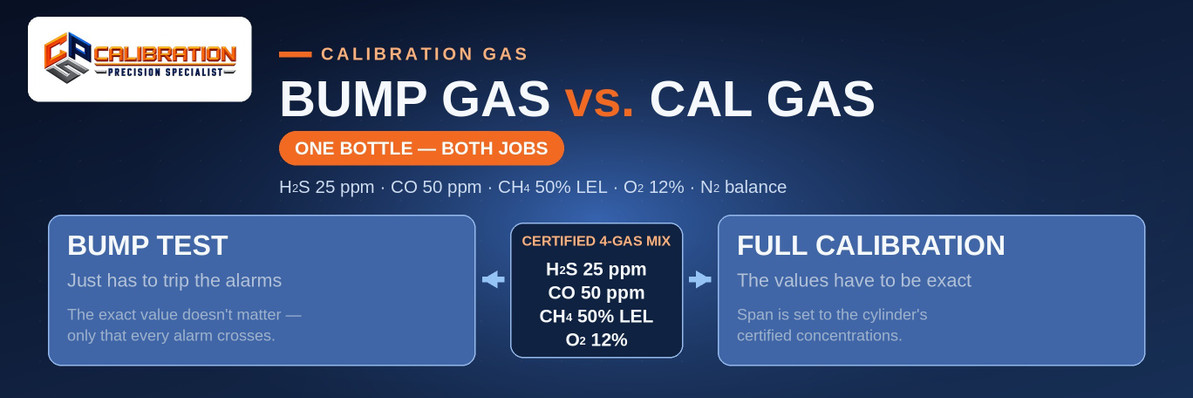
Yes — bump test gas and calibration gas are usually the same cylinder: a standard 4-gas mix (H₂S 25 ppm, CO 50 ppm, methane 50% LEL, O₂ 12%, nitrogen balance — $195 in a 34L cylinder at CPS Calibrations) both trips a detector's alarms for a bump test and sets its span for a calibration, because a bump test only needs each concentration to clear the instrument's alarm setpoints, while a calibration needs those same concentrations to match the instrument's span settings exactly. The two names describe two jobs, not two gases — they only become different products when a cylinder is blended or packaged for one job, like an 11L trigger-valve bump cylinder, or a mix whose concentrations clear the alarms but don't match the span values your instrument expects.
That is the short version. The longer one is about the two different demands each job puts on the gas — because once you see those, every "bump gas" and "calibration gas" label on every shelf sorts itself out.
Are Bump Test Gas and Calibration Gas the Same Thing?
In most cases, yes — literally the same product. CPS's own listings say so in plain language: our 4-Gas Calibration Gas – RKI Equivalent (H₂S 25 / CO 50 / CH₄ 50% LEL / O₂ 12%) is described as "designed for the calibration and bump testing" of compatible instruments, and the same wording runs through the MSA-equivalent 4-gas mix, the 5-gas RKI-equivalent mix, and the single-gas isobutylene 100 ppm cylinder for PID instruments. There is no separate chemistry called "bump test gas." There is certified gas of known concentration, and there are two different tests you can run with it.
What the two tests do with that gas is genuinely different — a bump test proves the sensors respond and the alarms fire, a calibration adjusts the instrument's readings against the known concentration — and we covered that distinction in full in Bump Test vs. Calibration: What's the Difference and When Do You Need Each? This post stays on the narrower question that post raised: whether the cylinder itself has to change when the job changes. It doesn't — as long as it passes two different checks.
What Does Each Job Actually Ask of the Gas?
A bump test asks: is every concentration on the right side of its alarm setpoint? The gas has to push each channel past its alarm — up for the toxic and combustible channels, down for oxygen. On an RKI GX-3R with its factory preset alarms (CO first alarm 25 ppm, H₂S first alarm 5 ppm, LEL first alarm 10% LEL, O₂ low alarm 19.5%), the standard RKI mix clears every one with room to spare: H₂S 25 ppm against a 5 ppm alarm, methane 50% LEL against 10%, CO 50 ppm at the 50 ppm second alarm, and O₂ 12% well below the 19.5% low alarm. The exact values don't matter to a bump test — only that each one crosses.
A calibration asks: do the concentrations match the span settings exactly? During the span step, the instrument adjusts each channel until its reading equals the concentration you told it is in the cylinder. That makes the cylinder's certified values the instrument's definition of truth. Enter 50 ppm H₂S when the bottle actually holds 25 ppm and every reading afterward is wrong by a factor of two — the classic wrong-concentration mistake. A calibration gas isn't a stronger or purer grade of gas; it is gas whose concentration matches what the instrument is set to expect, in date, with its certified values documented — CPS's mixes are NIST-traceable, and each cylinder's QR code pulls up its own Safety Data Sheet and Certificate of Analysis.
So the same cylinder passes both checks when its concentrations both clear the alarms and equal the span settings. That is exactly how standard mixes are blended — the RKI mix's H₂S 25 / CO 50 / CH₄ 50% LEL / O₂ 12% values are simultaneously the span values RKI instruments expect and comfortably past their alarm points. One cylinder, two jobs, no coincidence.
Bump Test Gas vs. Calibration Gas, Side by Side
| Bump test gas | Calibration gas | |
|---|---|---|
| What the job proves or does | Proves each sensor responds and the alarms (audible, visual, vibrating) fire | Sets each channel's accuracy against a known concentration |
| What the concentration must do | Clear every channel's alarm setpoint — above it for toxics and LEL, below it for O₂ | Match the instrument's span setting exactly, channel by channel |
| Does the exact value matter? | No — 25 ppm and 60 ppm CO both trip a 25 ppm first alarm | Yes — span against the wrong value and every later reading is off by that difference |
| Certification and date | Must be in date: expired gas can deliver too little to cross an alarm | Must be certified and in date: an expired cylinder's calibration is built on a guess |
| Typical package | Any size, including small 11L trigger-valve cylinders sold for bump testing | Usually a regulator-ready cylinder (C-10 or CGA-600) sized for repeated span adjustments |
| Can one cylinder do both? | Yes — when its concentrations also match the span settings | Yes — when its concentrations also clear every alarm setpoint |
When Are They NOT the Same Cylinder?
Four situations turn "the same gas" into two different purchases — and none of them is about the label on the bottle.
1. The Mix Clears the Alarms but Doesn't Match the Span
Blends are built to a brand's span values, and brands disagree. The MSA-equivalent 4-gas mix carries H₂S 20 ppm, CO 60 ppm, a pentane-equivalent 58% LEL, and O₂ 15% — every value different from the RKI mix. Flow it into an RKI-set instrument and the bump test passes easily: 20 ppm H₂S, 60 ppm CO, and 58% LEL all clear RKI alarm points, and 15% O₂ falls below the low alarm. But calibrate that instrument against the cylinder as-is, without changing its span settings to the MSA values, and the span is set wrong on all four channels — and the LEL channel is wrong twice over, because a pentane-simulated LEL component is not the methane the RKI sensor configuration expects. Our guide to what calibration gas a 4-gas detector needs works through the brand blends in full. The rule: a cylinder from the "wrong" brand family is bump gas for your instrument, not calibration gas — unless you deliberately re-set the span values to its certified concentrations and the LEL component chemistry matches.
2. The Channel Isn't in the Cylinder at All
A bump test can only test channels the gas actually contains, and a calibration can only span channels that are present. A quad mix has no fifth gas in it: bump a 5-gas instrument with a PID channel using a 4-gas cylinder and the PID channel sees nothing, every time — one of the blend-related causes in why bump tests fail. The fix is a cylinder that carries the fifth component: the 5-gas RKI-equivalent mix adds isobutylene 100 ppm — the standard PID span gas — to the quad blend ($184 in a 34L cylinder), or a dedicated isobutylene 100 ppm cylinder handles the PID channel on its own ($74 in 34L). Same principle at single-gas scale: a channel with no matching gas is a channel that is neither bumped nor calibrated, whatever the cylinder is called.
3. The Cylinder Is Packaged for Bumping Only
The one place "bump test gas" is a real, separate product is packaging. Small 11L cylinders with a trigger valve are sold for quick bump checks — no regulator to fit, squeeze and flow. CPS's RKI-equivalent quad mix comes in that package at $90 (11L, trigger valve, minimum order of 6), and the isobutylene 100 ppm mix at $45 (11L, trigger valve, minimum order of 6). The gas inside is the same certified mix as the larger cylinders, so a trigger cylinder whose concentrations match your span settings is chemically capable of calibrating — but 11L is the smallest size in the range, it isn't fitted for the fixed-flow regulator a calibration routine expects, and in practice these cylinders are bought to live at the bump station. Treat "bump test gas" on a small trigger cylinder as a package description, not a different gas.
4. The Cylinder Has Expired — Then It's Neither
An out-of-date cylinder fails both jobs. Reactive gases degrade in the bottle, so expired gas can deliver too little to cross an alarm — a bump failure that gets blamed on the sensor — and any calibration performed with it is invalid, because the certified values no longer hold. Shelf life is printed on every CPS product page: 24 months for the standard 4-gas mixes, 48 months for the isobutylene 100 ppm cylinder. Check the date before you check anything else; it is the cheapest check on this page.
How Do You Check Whether One Cylinder Covers Both Jobs?
Three comparisons between the cylinder label and your instrument, in order:
- Every channel present? List the gases in the cylinder against the sensors in the instrument — including a fifth PID or toxic channel. A missing gas ends the question.
- Concentrations vs. alarm setpoints (the bump check). Each toxic and LEL value must sit above its channel's first alarm, and the O₂ value below the low alarm (19.5% on the GX-3R's presets). If one value falls short, that channel can never pass a bump with this cylinder.
- Concentrations vs. span settings (the calibration check). Compare the label, value by value, with the span concentrations set in the instrument's calibration menu — H₂S, CO, LEL, and O₂ must match exactly, and the LEL component (methane vs. pentane-simulated) must be the one the instrument is configured for. Then confirm the cylinder is in date.
Pass all three and you own one cylinder that does both jobs. Fail the second and you have bump gas only. Fail the third and you have neither, until the settings or the cylinder change.
What Should You Buy If You Only Want One Cylinder?
Buy the mix blended to your instrument family's span values, in the size your testing volume justifies — the full range is in our calibration gas category:
- RKI-set 4-gas instruments: the RKI-equivalent quad mix — H₂S 25 / CO 50 / CH₄ 50% LEL / O₂ 12% — $195 in 34L, $245 in 60L, $295 in 120L, C-10 connection.
- MSA-set 4-gas instruments: the MSA-equivalent quad mix — H₂S 20 / CO 60 / pentane 58% LEL / O₂ 15% — $195 in 34L.
- 5-gas instruments with a PID channel: the 5-gas RKI-equivalent mix — the quad values plus isobutylene 100 ppm — $184 in 34L, $230 in 60L, $287 in 120L.
- Bump-station-only stock: the same mixes in 11L trigger-valve cylinders — $90 for the quad mixes, $45 for isobutylene 100 ppm, minimum order of 6 — when all the cylinder will ever do is prove alarms respond.
One more delivery point the two jobs share: both are normally run through the same fixed-flow regulator (typically 0.5 LPM) on diffusion instruments and docking stations, matched to the cylinder's C-10 or CGA-600 connection — the gas doesn't change between jobs, and neither does the hardware that delivers it.
The Bottom Line
Bump test gas and calibration gas are the same thing whenever one cylinder's concentrations clear every alarm setpoint and match every span setting — which is how standard mixes like the RKI quad blend (H₂S 25 / CO 50 / CH₄ 50% LEL / O₂ 12%, $195 in 34L) are built. They become different products only at the edges: a blend mixed to another brand's span values, a channel the cylinder doesn't contain, a small trigger-valve package bought for bumping alone, or a cylinder past its date, which is neither. Read the label against your instrument's alarms and span settings before you buy a second cylinder — most shops don't need one.
Not sure which mix your instrument's span settings expect? Tell us the instrument model and we'll match the cylinder to it before you order — call 865-900-8844 or reach us through Contact Us. And if an instrument comes to CPS for service, we calibrate every channel it carries — including a PID channel a quad cylinder can't touch.
Frequently Asked Questions
Is bump test gas the same as calibration gas? Yes, in most cases they are the same cylinder. A standard 4-gas mix (H₂S 25 ppm, CO 50 ppm, methane 50% LEL, O₂ 12%, nitrogen balance) is sold as calibration gas and is designed for both calibration and bump testing — CPS's product listings say so outright. The names describe the two jobs the gas performs, not two different gases: a bump test proves the sensors and alarms respond, a calibration sets the instrument's accuracy against the cylinder's certified concentrations.
Can I use calibration gas for a bump test? Yes — that is what most shops do. Calibration gas works for a bump test whenever each concentration clears its channel's alarm setpoint, and standard mixes are blended to do exactly that: on an RKI GX-3R (preset first alarms: H₂S 5 ppm, CO 25 ppm, LEL 10% LEL, O₂ low 19.5%), the standard RKI mix of H₂S 25 ppm, CO 50 ppm, methane 50% LEL, and O₂ 12% crosses every alarm. One cylinder at the bench normally covers both the daily bump and the scheduled calibration.
Can I calibrate a gas detector with bump test gas? Yes, if the cylinder's certified concentrations match the span values set in the instrument — or you set the span values to the cylinder's certified concentrations before you start. The label doesn't matter; the numbers do. A small 11L trigger-valve "bump" cylinder of the standard RKI quad mix (H₂S 25 / CO 50 / CH₄ 50% LEL / O₂ 12%) contains the same certified gas as the 34L cylinder. What disqualifies a cylinder from calibrating is a concentration mismatch, a missing channel, or an expired date — not the words "bump test" on the box.
Do I need to buy separate bump test gas and calibration gas? No, not for a standard instrument setup. One cylinder matched to your instrument's span settings — for example the RKI-equivalent quad mix at $195 in a 34L cylinder — covers daily bump tests and scheduled calibrations. Buy a second, different cylinder only when something actually differs: a second instrument family with different span values (RKI vs. MSA blends), a fifth channel such as a PID that needs its own gas in the mix, or a dedicated 11L trigger-valve cylinder ($90, minimum order of 6) kept at the bump station for convenience.
What concentration should bump test gas be? High enough to cross every channel's alarm setpoint — above the first alarm for toxic and combustible channels, below the low alarm for oxygen — and it does not need to match any exact value beyond that. The standard RKI quad mix (H₂S 25 ppm, CO 50 ppm, methane 50% LEL, O₂ 12%) clears the RKI GX-3R's preset alarms of H₂S 5 ppm, CO 25 ppm, LEL 10% LEL, and O₂ 19.5% low on all four channels. A mix blended below one channel's alarm will fail that channel's bump no matter how healthy the sensor is.
What happens if I calibrate with the wrong gas concentration? The instrument sets its span to whatever value you entered, so a mismatch becomes a permanent reading error of the same proportion. Enter 50 ppm H₂S for a cylinder that actually holds 25 ppm and the detector reads wrong by a factor of two on that channel afterward — it will still bump test, still alarm, and still be wrong. The certified concentrations on the cylinder label must match the span settings in the instrument exactly, which is why blends are sold by instrument family rather than as a universal 4-gas cylinder.
Can I use MSA calibration gas on an RKI detector? You can bump test with it, but don't calibrate with it as-is. The MSA-equivalent blend (H₂S 20 ppm, CO 60 ppm, pentane-equivalent 58% LEL, O₂ 15%, $195 in 34L) clears an RKI instrument's alarm points, so the bump passes. But its concentrations differ from the RKI span values (H₂S 25, CO 50, methane 50% LEL, O₂ 12%) on every channel, and its LEL component is pentane-simulated rather than methane — calibrating an RKI-set instrument against it without changing the span settings sets all four channels wrong. Match the blend to the instrument family.
Will a 4-gas cylinder bump test or calibrate a PID sensor? No. A quad mix contains only H₂S, CO, a combustible component, and O₂ — there is no PID gas in it, so the PID channel sees nothing and will "fail" every bump and skip every calibration. A 5-gas instrument needs the fifth component in the cylinder: the 5-gas RKI-equivalent mix adds isobutylene 100 ppm, the standard PID span gas ($184 in a 34L cylinder), or a separate isobutylene 100 ppm cylinder ($74 in 34L) can handle the PID channel on its own.
Does bump test gas expire? Yes — the same shelf life as calibration gas, because it is the same gas. CPS lists 24 months for the standard 4-gas mixes and 48 months for the isobutylene 100 ppm cylinder, and the date is printed on the cylinder. Expired gas hurts both jobs: reactive components degrade, so an old cylinder may deliver too little to cross an alarm and fail a healthy instrument's bump test, and any calibration performed with expired gas is invalid because the certified concentrations no longer hold.
How much does one cylinder that does both jobs cost? At CPS Calibrations, $195 buys the 34L cylinder most shops need: either the RKI-equivalent quad mix (H₂S 25 / CO 50 / CH₄ 50% LEL / O₂ 12%) or the MSA-equivalent quad mix (H₂S 20 / CO 60 / pentane 58% LEL / O₂ 15%). The 5-gas mix with isobutylene 100 ppm for PID instruments is $184 in 34L. Larger sizes of the RKI quad mix run $245 (60L) and $295 (120L), and the 11L trigger-valve bump-station cylinders are $90 for the quad mixes with a minimum order of 6. One matched cylinder replaces the separate "bump" and "calibration" purchases entirely.
CPS Calibrations · 109 S. Front Street, Rockwood, TN 37854 · Calibration Gas · Calibration Services · Contact Us
Need a calibration you can file?
In-house calibration at CPS in Rockwood, Tennessee — $55 for single-gas instruments, $90 for 4- and 5-gas — every channel, as-found and as-left data, full certificate.
See Calibration Servicesor call 865-900-8844
Recent Posts
-

What Is Remote Monitoring for Fixed Gas Detection?
Remote monitoring for fixed gas detection means a fixed system's live readings, trends, and alarm hi …Nov 23rd 2026 -

What Are the Key Differences Between the GX-6000 and GX-6100?
The RKI GX-6100 is the current replacement for the discontinued GX-6000: both are pumped 6-gas monit …Nov 22nd 2026 -

How to Read a PID Correction Factor Chart
To read a PID correction factor chart, find your vapor’s row, take the factor under your own lamp en …Nov 21st 2026