
Gas Detector Repair: What's Worth Fixing and What's Not
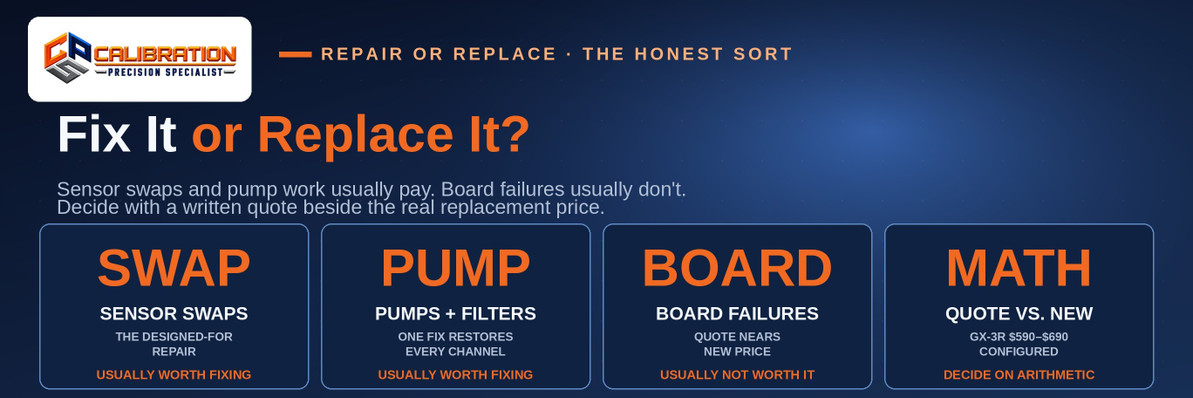
Most gas detector repairs sort cleanly: sensor swaps, pump and filter work, and case-and-clip damage are usually worth fixing, because the instruments are designed for exactly those repairs and the rest of the meter still has life in it; board-level failures and end-of-life instruments with hard-to-source sensors usually are not, because the repair figure approaches the configured price of a new instrument — an RKI GX-3R, for reference, runs $590–$690 configured. The deciding tool is not a rule of thumb but two real numbers: a written repair quote and the live replacement price, compared before any work is approved. At CPS every repair is quoted in writing first, so that comparison is always made with the actual figures, never with a guess.
'Is it worth fixing?' is asked at the worst possible moment — with an instrument already on the bench and a crew already short a meter. It deserves a calmer answer than it usually gets. The truth is that detectors are not one kind of broken: a spent electrochemical sensor and a dead main board are different failures with different economics, and treating every failure as either 'repair everything' or 'just buy new' wastes money in both directions.
This post sorts the common failures into worth-fixing and usually-not, explains the math behind the line, and connects it to the longer view in how much does it cost to own a gas detector for a year — because a repair decision is really a cost-of-ownership decision made one instrument at a time. Nothing here replaces the written quote for your specific instrument; it tells you how to read that quote when it arrives.
Usually Worth Fixing: Sensors, Pumps, Filters, and Hardware
Sensor swaps are the repair these instruments were designed for. Electrochemical and combustible sensors are consumables with a finite working life, and modern portables — the RKI GX-3R class included — use field-replaceable sensors precisely so a spent channel does not retire the meter. When the diagnosis is 'the sensor is done' and the rest of the instrument is sound, the swap plus a calibration restores a fully documented instrument for a fraction of replacement cost. This is the most common repair on any bench, and it is common because it is rational.
Pump, filter, and sample-path work is usually cheap relative to its effect. A weak pump or clogged filter on a pumped instrument degrades every channel at once, and the fix restores all of them together. Cases, clips, boots, and other hardware sit in the same pile: the instrument's measurement core is untouched, so repairing the shell that protects it is money spent on years of remaining sensor platform life. The common thread in this pile: the failure is in a wear part or a protector, not in the instrument's brain — and wear parts are what service exists for.
Usually Not Worth Fixing: Boards and End-of-Life Instruments
A board-level failure changes the math completely. When the fault is in the main electronics rather than a sensor or a wear part, the repair figure climbs toward the price of a new instrument — while delivering back an old instrument with old sensors and no new-instrument warranty story. Set that quote beside a configured new price — a RKI GX-3R runs $590–$690 configured — and for a mainstream multi-gas meter the replacement usually wins on arithmetic alone, before counting the value of a fresh instrument with a full sensor life ahead of it.
End-of-life is the other honest stop. An instrument whose sensors are getting hard to source, whose accessories are discontinued, or which has already absorbed several repairs is telling you its total cost of ownership has turned. Each individual repair can look small; the pile is the problem. The fleet-history view in the CPS Calibration Program exists partly for this: an instrument whose record shows repair after repair is a replacement candidate even if the next single quote looks survivable. And one category is never worth fixing at any price: an instrument whose readings cannot be trusted after repair. If the bench cannot stand behind the as-left numbers, the instrument does not go back into service — full stop.
How to Make the Call: Quote First, Then Arithmetic
The process protects the decision. Any instrument that fails calibration at CPS and needs work beyond it is quoted in writing before any work — the quote names the work and the figure, and the choice is yours. With that figure in hand, the arithmetic is three questions:
- What fraction of replacement is the repair? Compare the quote to the configured price of the equivalent new instrument, not to what the old one cost years ago. A sensor swap that lands at a small fraction of $590–$690 for a GX-3R-class meter is an easy yes; a board repair approaching that range is an easy no; the middle is where the next two questions decide.
- How much life does the repair buy? A new sensor in a sound instrument buys a full sensor life. A board repair buys back an instrument whose other sensors are already part-worn. Price per year of service gained is the honest unit — the same lens the 1-year cost of ownership post applies to the whole fleet.
- What does the downtime cost? A repair waits on approval and possibly parts; a replacement ships as a stocked instrument. If the meter is a spare, downtime is free and repair math wins more often. If a crew is short, the fastest route back to a trusted instrument can be worth more than the price gap.
Notice what is not in the process: pressure. A written quote is valid while you think, compare, and ask questions at 865-900-8844. Declining is always an option — the instrument returns as-is with its as-found record, and the record of a documented failure and a considered decision is itself good safety paperwork.
Frequently Asked Questions
What detector repairs are usually worth the money?
Sensor swaps, first and most often — sensors are consumables, the instruments are designed for field-replaceable sensors, and a swap plus calibration restores a documented instrument for a fraction of replacement cost. Pump, filter, and sample-path work on pumped instruments, because one fix restores every channel at once. And hardware repairs — cases, clips, boots — where the measurement core is untouched. The pattern: the failure lives in a wear part or a protector, and the rest of the instrument has real life left.
What repairs are usually not worth it?
Board-level electronic failures, where the quote climbs toward the configured price of a new instrument while returning an old one — a new RKI GX-3R runs $590–$690 configured, which is the comparison that matters. And repairs on end-of-life instruments: models whose sensors are getting hard to source, or whose record shows repair after repair. Each quote can look small in isolation; the pile is the real cost. An instrument that cannot be trusted after repair is never worth fixing at any price.
How do I decide repair versus replace for my detector?
Get the two real numbers and compare them: a written repair quote, and the configured price of the equivalent new instrument. Then ask what the repair buys in years of service — a new sensor in a sound meter buys a full sensor life, while a board repair buys back part-worn everything else — and what the downtime costs your crew. At CPS the quote comes first and the choice is yours; declining returns the instrument as-is with its as-found record. There is no honest way to make this call with a guessed repair price, which is why we quote in writing rather than ballparking on the phone.
How much does a gas detector repair cost?
There is no honest generic figure, and this post will not invent one — a sensor swap, a pump rebuild, and a board fault are different work at different prices, varying by model and configuration. What is guaranteed is the sequence: diagnosis, then a written quote naming the work and the figure, then your decision, with no repair performed or billed before you approve it. Calibration itself is published and fixed: $55 for a single-gas instrument, $90 for a 4- or 5-gas instrument, in-house at our Rockwood, Tennessee shop — never an on-site price.
Does a repaired detector need to be calibrated again?
Yes — always, and it is not optional paperwork. A sensor swap changes the channel's response by definition, and any repair that opens the instrument can shift readings. At CPS, an approved repair is followed by calibration as configured, and the instrument returns with a certificate showing the original as-found condition and the post-repair as-left readings. A repaired-but-uncalibrated detector going back into service is precisely the failure mode the whole system exists to prevent.
Is it worth repairing a detector just as a spare?
Often, yes — the spare role changes the math in repair's favor. A spare does not need to be the newest instrument; it needs to be trusted, documented, and in calibration. A sensor swap that would be marginal for a front-line meter can be clearly worth it for a unit whose job is to cover bench time, transit, and failures — because the alternative, buying a new instrument to sit on a shelf, ties up the full configured price. Keep the spare's calibration current in the CPS Calibration Program like any other unit's, or it will be out of date on the one day it is needed.
My detector is old but works — when should I stop repairing it?
Watch three signals: sensors for the model getting hard to source, repairs arriving more frequently in its fleet record, and a single quote that is a large fraction of the configured replacement price. Any one of them is a warning; two together usually settle it. The 1-year ownership view in how much does it cost to own a gas detector for a year helps here — an instrument whose annual keep now rivals a new instrument's annual cost has crossed the line, however fond of it the crew may be.
Can CPS repair a brand it doesn't sell?
Calibration and repair are different promises, and this post is about the instruments CPS services. For brands we calibrate but do not sell, the bench work is calibration with the same written-quote rule for anything it finds — and the repair-versus-replace math in this post applies to the quote you receive, whoever issued it. If a needed repair is outside what the bench takes on for a serviced brand, you will be told that plainly, with the instrument returned and its as-found record documented, rather than discovering it from silence.
What happens if I decline a repair quote?
The instrument returns to you as-is, with its as-found record — no repair performed, none billed. That record still does work for you: it documents that the instrument was verified, found failed, and removed from service on a recorded decision, which is the correct posture for an audit. Declining is a legitimate outcome of the process, not a failure of it. The instrument stays out of service until it passes calibration — repaired later, or replaced — but the timing and the choice remain yours.
How long does a repair take?
Call 865-900-8844 and we will confirm the current turnaround for the bench queue. We do not publish a fixed turnaround, because a repair timeline honestly includes two things outside the bench's control: your approval of the written quote, and parts availability for the specific sensor or component your instrument needs. A straightforward sensor swap on an approved quote moves fastest; a board-level diagnosis takes longer to price honestly. Transit time in both directions is the carrier's.
The Bottom Line
Fix the wear parts, question the brain surgery, and never decide without both numbers: a written repair quote and the configured price of the replacement — $590–$690 for a GX-3R-class meter — compared on years of service the repair actually buys. That arithmetic, done calmly, is the whole secret. Everything else is pressure, and a written quote exists precisely so you never have to decide under it.
Detector on the bench, or one you are afraid to send in? Start the ship-in calibration and repair request, or call CPS Calibrations at 865-900-8844. Ship-in address: 109 S. Front Street, Rockwood, TN 37854.
--- CPS Calibrations · 109 S. Front Street, Rockwood, TN 37854 · Cost to Own a Gas Detector for a Year · RKI GX-3R · Calibration Services
Ready to mail in your detector?
Start the ship-in request, pack the meter, and we handle the rest — every channel calibrated as configured, full certificate returned with it.
Start Your Ship-In Requestor call 865-900-8844
Recent Posts
-

What Is Remote Monitoring for Fixed Gas Detection?
Remote monitoring for fixed gas detection means a fixed system's live readings, trends, and alarm hi …Nov 23rd 2026 -

What Are the Key Differences Between the GX-6000 and GX-6100?
The RKI GX-6100 is the current replacement for the discontinued GX-6000: both are pumped 6-gas monit …Nov 22nd 2026 -

How to Read a PID Correction Factor Chart
To read a PID correction factor chart, find your vapor’s row, take the factor under your own lamp en …Nov 21st 2026