
HF and Toxic Gas Monitoring for Fuel Fabrication and Enrichment
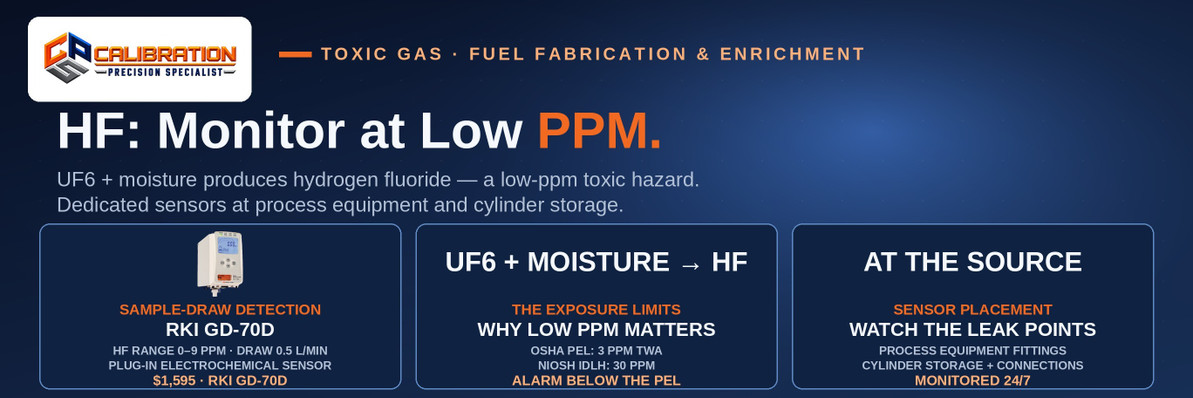
Where uranium hexafluoride (UF6) is handled, contact with moisture produces hydrogen fluoride (HF) — a toxic gas with an OSHA permissible exposure limit of 3 ppm as a time-weighted average and a NIOSH IDLH of 30 ppm. Fuel-fabrication and enrichment facilities therefore monitor for HF continuously at low ppm, using dedicated electrochemical fixed detectors and sample-draw systems — such as the RKI GD-70D ($1,595, HF range 0–9 ppm) — with sensing points at process equipment and cylinder storage.
That chemistry drives everything else in this post: the sensor technology, the ranges, the alarm philosophy, and the placement. HF monitoring is not a standard 4-gas problem with a different label. It is a dedicated, low-ppm measurement, made continuously, at the places UF6 is actually handled.
Why Does UF6 Create an HF Hazard?
UF6 is the process material of uranium enrichment, and it is also handled in fuel fabrication — the operations now associated in the Oak Ridge area with TRISO-X and Centrus-type facilities. UF6 itself is handled in closed process equipment and cylinders. The toxic-gas hazard appears at the interfaces:
- Contact with moisture. When UF6 contacts moisture in air, the reaction produces hydrogen fluoride. A leak does not have to be large for HF to be the hazard people are exposed to — the HF is generated as the UF6 escapes into humid air.
- Cylinder connections. Cylinders are connected, disconnected, heated, and moved. Valves, pigtails, and connection points are the places a release starts, which is why cylinder handling and storage areas belong on the monitoring map.
- Process equipment. Autoclaves, cold traps, piping, valves, and process enclosures are the other leak sources — known, stationary points where a fixed sensing point can watch continuously.
Use this framing when you scope a system: do not monitor "the building" in the abstract. Monitor the equipment and the cylinder operations where UF6 meets air.
Why Is HF a Low-PPM Problem?
| Value | HF concentration | What it means for detection |
|---|---|---|
| OSHA PEL (TWA) | 3 ppm | The legal 8-hour exposure ceiling the program is built around |
| NIOSH IDLH | 30 ppm | Immediately dangerous to life or health — ten times the PEL |
| RKI GD-70D HF range | 0–9 ppm | A range built to read accurately around the PEL, not far above it |
Three consequences follow:
- The range must be low. A detector ranged in hundreds of ppm cannot manage a 3 ppm limit. HF detection lives in single-digit ppm, which is why dedicated electrochemical sensors — built for one toxic gas at low ppm — are the technology for this job.
- Alarm levels are a low-ppm decision. Alarms are set by the facility's own safety program, but the philosophy is consistent: an early warning below the PEL, so a small leak is investigated while it is still small, and a high alarm at a level that triggers evacuation and response. An alarm set only at the IDLH would waste the entire margin the PEL exists to protect.
- No standard portable covers it. A 4-gas monitor (LEL, O₂, CO, H₂S) has no HF sensor and will read normally in an HF release. Personal protection and fixed monitoring for HF both require instruments specified for HF — see the FAQ below.
Fixed Point or Sample-Draw: Which Does an HF Point Need?
Both technologies use dedicated electrochemical sensors. The difference is where the sensor sits relative to the gas:
| Fixed point (diffusion) | Sample-draw | |
|---|---|---|
| How it samples | Gas reaches a sensor mounted at the point itself | A pump draws air through tubing from a sample point to a transmitter elsewhere |
| Sensor location | At the leak source | At working height, where it can be read, calibrated, and swapped |
| Use it when | The point is accessible and a sensor can live and be serviced there | The point is inside equipment, a duct or enclosure, hot, corrosive, or unsafe to service in place |
| Watch-out | The sensor lives in the environment it monitors | The sample must travel the tube — keep runs short and account for draw time |
The RKI GD-70D ($1,595) is the sample-draw example we sell: a built-in pump draws the sample at 0.5 L/min to a plug-in electrochemical sensor — the HF sensor reads 0–9 ppm — the unit runs stand-alone with its own display and alarm relays or sends 4–20 mA to a controller or PLC, and RKI recommends calibration every six months. Sample-draw as a class is bigger than one brand: SENKO also builds sample-draw fixed detectors for toxics — browse the SENKO range — and the wider fixed systems category shows how points and controllers are built. How the signal path works end to end is covered in how a fixed gas detection system works.
Use sample-draw when the sensing point is inside process equipment, a gas cabinet or enclosure, a duct, or anywhere a technician should not have to open equipment or enter a contaminated area just to calibrate a sensor. Use a fixed diffusion point when the sensor can be mounted directly where the gas will reach it, in an area a technician can safely work in. Many fuel facilities end up with both, point by point — the placement method in where fixed gas detectors should be placed is the starting layout exercise.
Where Should HF Sensing Points Go?
Place points at the source, in this priority order:
- Process equipment — at valves, fittings, enclosures, and transfer points where UF6 is piped, heated, or trapped. The sensing or sample point goes close to the likely release point, informed by the room's airflow, not in a convenient corner.
- Cylinder storage and cylinder connection stations — where cylinders wait, and especially where they are connected and disconnected. Connection work is human work, done at breathing height, at known fittings: that combination is exactly what a dedicated point is for.
- Enclosures, ducts, and scrubber-adjacent points — sample-draw territory. The sample point goes inside the enclosure or duct; the transmitter stays outside it.
- Outside the door — alarming matters as much as sensing. Horns, strobes, or controller alarms placed so the next person is warned before entering are part of placement, not an accessory.
One honest limit: HF placement is a site layout, not a formula. Airflow, enclosure design, and the facility's own hazard analysis set the final points and setpoints. Anyone who lays out an HF system from a floor plan alone, without walking the process, is guessing at the one system that should never be guessed.
What Should an HF Alarm Actually Do?
An HF alarm that only makes noise in the room it is protecting has done half its job. A sound alarm philosophy for low-ppm toxics:
- Early warning below the PEL — investigate, find the leak, fix it small.
- High alarm — evacuate the area and start the facility's response procedure.
- Act, don't just warn — through a controller, alarms can start or boost ventilation and notify people outside the area, including at the entrance.
- Fail visibly — flow faults on sample-draw systems and sensor faults must annunciate as trouble, not sit silent. A sample-draw point with a blocked line reads clean air forever unless its fault reporting is wired and watched.
Setpoints themselves belong to the facility's EHS program and its hazard analysis. The detector's job is to read accurately at those low levels and to make sure the alarm reaches people who are not yet in the room.
Calibration and Sensor Life: the Part That Keeps HF Points Honest
An HF point that is never calibrated is a display, not a detector. For the GD-70D, RKI recommends calibration every six months, and the plug-in design is built around that rhythm: the sensor unit pulls from the front of the transmitter, a replacement electrochemical sensor is $525 for most toxics including HF, and each sensor carries its calibration data with it. Budget the same three things for any HF point, whatever the brand: calibration on schedule with the correct gas, sample-line and flow checks on sample-draw points (the line is part of the measurement), and sensor replacement when a sensor will no longer hold calibration. CPS calibration services cover fixed points as part of a facility program, and the gas itself is in our calibration gas range. Facilities within driving distance of our Rockwood shop can also use the in-shop support covered in gas detector calibration and support, 30 minutes from Oak Ridge.
Frequently Asked Questions
Why is hydrogen fluoride a hazard in fuel fabrication and enrichment? Because the process material, uranium hexafluoride (UF6), produces hydrogen fluoride when it contacts moisture in air. Leaks at process equipment, valves, and cylinder connections therefore create an HF exposure hazard even when the release itself is small. That reaction — UF6 plus moisture producing HF — is the reason HF, specifically, is the core toxic-gas monitoring target in enrichment and fuel-fabrication operations.
What are the exposure limits for hydrogen fluoride? OSHA's permissible exposure limit (PEL) for hydrogen fluoride is 3 ppm as an 8-hour time-weighted average, and NIOSH lists the immediately dangerous to life or health (IDLH) concentration as 30 ppm. Those two numbers frame the whole monitoring problem: detection and alarming have to work accurately in single-digit ppm, well below the IDLH, which is why HF requires dedicated low-range sensors.
Can a standard 4-gas detector detect hydrogen fluoride? No. A standard 4-gas monitor measures combustible gas (LEL), oxygen, carbon monoxide, and hydrogen sulfide — it has no HF sensor and will not respond to hydrogen fluoride. HF requires a dedicated electrochemical sensor built for HF, whether in a fixed point, a sample-draw transmitter such as the RKI GD-70D (HF range 0–9 ppm), or a portable instrument specified with an HF channel.
What type of gas detector detects HF at low ppm? A dedicated electrochemical detector ranged for low ppm. Electrochemical cells are the standard technology for single toxic gases at ppm levels, and for HF the instrument's range matters as much as its sensor: the RKI GD-70D's HF sensor reads 0–9 ppm, which is the right scale for managing a 3 ppm PEL. A high-range or %LEL instrument cannot substitute — it is measuring on the wrong scale entirely.
What is sample-draw gas detection, and when should I use it for HF? Sample-draw detection uses a pump to pull air through tubing from a sample point to a sensor in a transmitter mounted somewhere accessible — the GD-70D draws at 0.5 L/min. Use it when the point that needs watching is inside process equipment, an enclosure or duct, or anywhere a sensor cannot be mounted and safely serviced in place. The transmitter stays at working height for reading, calibration, and sensor swaps; the trade-off is sample travel time, so tubing runs are kept as short as the layout allows.
Where should HF detectors and sample points be placed? At the likely release sources, not spread evenly around the room: process equipment valves, fittings, and enclosures where UF6 is handled; cylinder connection stations and cylinder storage; and inside enclosures or ducts via sample-draw points, with the transmitter outside. Alarms should also reach outside the area entrance so the next person is warned before entering. Final placement follows the facility's airflow and hazard analysis — it is a site layout, not a spacing formula.
How much does an HF gas detector cost? The RKI GD-70D sample-draw transmitter is $1,595 at CPS, with its plug-in HF electrochemical sensor (0–9 ppm) at $525 when replacement is due. A complete installed point costs more than the transmitter: add a controller if the point is not running stand-alone, plus tubing or wiring, mounting, and commissioning, which depend on the facility and are quoted in writing after a site review. There is no honest universal installed price for an HF point.
How often does an HF detector need to be calibrated? For the GD-70D, RKI recommends calibration every six months. As a program rule, HF points are calibrated at the manufacturer's recommended interval with the correct calibration gas, sample-draw lines and flow are checked as part of the measurement, and sensors are replaced when they will no longer hold calibration. An uncalibrated low-ppm toxic point is worse than an obvious gap, because everyone in the facility trusts its reading.
What should happen when an HF detector alarms? The facility's own procedure governs, but the system should be built to support it: an early-warning alarm below the PEL prompts investigation while a leak is small; a high alarm triggers evacuation and the emergency response procedure; and through a controller, the system can start or boost ventilation and warn people outside the area, including at the entrance, before anyone walks in. Faults — sensor failure or loss of sample flow — should annunciate as trouble alarms, not fail silently.
Can one detector monitor HF and other toxic gases at the same time? Not in the GD-70D design: each unit monitors one gas at one sample point, with one plug-in sensor, so a location that needs HF and another toxic needs a unit — or at minimum a sensor point — for each gas. That one-gas-per-point discipline is normal in low-ppm toxic monitoring, because each gas needs its own dedicated electrochemical sensor, range, and calibration gas. A row of points, each reading one gas well, is the correct build.
The Bottom Line
HF monitoring in fuel fabrication and enrichment starts with one reaction — UF6 plus moisture produces hydrogen fluoride — and one scale: a 3 ppm PEL and a 30 ppm IDLH demand dedicated electrochemical detection ranged in single-digit ppm, at process equipment and cylinder storage, with sample-draw transmitters wherever the sensing point cannot be serviced in place. A standard 4-gas program does not cover HF at all. The RKI GD-70D ($1,595, HF 0–9 ppm, 0.5 L/min sample draw) is the live example of the right instrument class for these points.
Scoping HF or other toxic points for a fuel facility? Call 865-900-8844 or reach us through Contact Us. Tell us the gas, the point, and where a technician can safely stand — we will spec the point from there: the GD-70D, the wider fixed systems range, calibration gas, and the calibration services that keep low-ppm points honest.
CPS Calibrations · 109 S. Front Street, Rockwood, TN 37854 · Calibration Gas · Calibration Services · Contact Us
Need a calibration you can file?
In-house calibration at CPS in Rockwood, Tennessee — $55 for single-gas instruments, $90 for 4- and 5-gas — every channel, as-found and as-left data, full certificate.
See Calibration Servicesor call 865-900-8844
Recent Posts
-

What Is Remote Monitoring for Fixed Gas Detection?
Remote monitoring for fixed gas detection means a fixed system's live readings, trends, and alarm hi …Nov 23rd 2026 -

What Are the Key Differences Between the GX-6000 and GX-6100?
The RKI GX-6100 is the current replacement for the discontinued GX-6000: both are pumped 6-gas monit …Nov 22nd 2026 -

How to Read a PID Correction Factor Chart
To read a PID correction factor chart, find your vapor’s row, take the factor under your own lamp en …Nov 21st 2026