
Gas Detector Calibration and Support, 30 Minutes from Oak Ridge
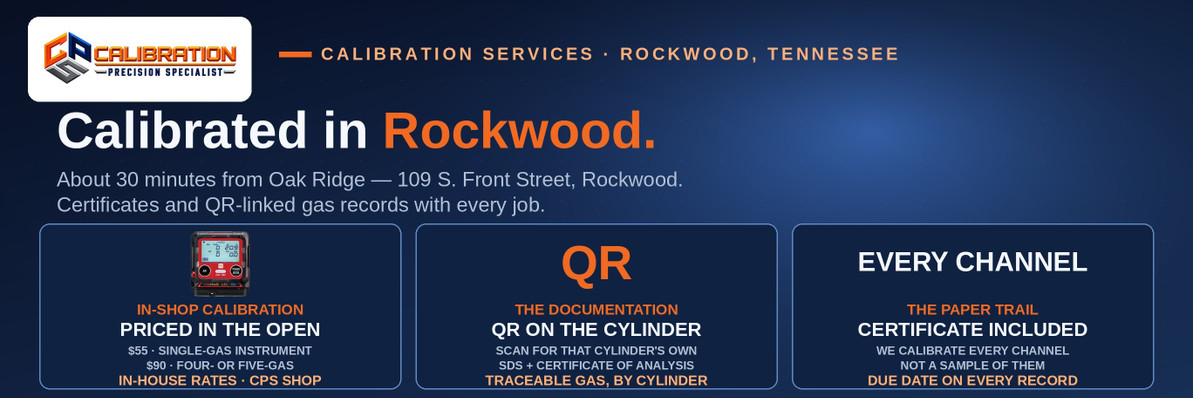
CPS Calibrations calibrates gas detectors in-shop at 109 S. Front Street in Rockwood, Tennessee — about 30 minutes from Oak Ridge — at $55 for a single-gas instrument and $90 for a four- or five-gas instrument, and we calibrate every channel on the instrument. Every calibration leaves with a CPS calibration certificate and a documentation trail that includes the calibration gas used, whose cylinder QR code links to that cylinder's own SDS and Certificate of Analysis.
For facilities in and around Oak Ridge — research, nuclear support, industrial, and contractor programs with QA documentation requirements — that combination is the point of this post: local, priced in the open, and documented well enough to file and defend.
Where Is the Shop, and How Does In-Shop Calibration Work?
We are at 109 S. Front Street, Rockwood, TN 37854, about 30 minutes from Oak Ridge. In-shop calibration works in four steps:
- Call first — 865-900-8844. Tell us the instruments, the gases, and anything acting up. Calling ahead lets us confirm we have the right calibration gas on the shelf and tell you honestly where your job falls in the current workload.
- Drop off or ship in. Bring the instruments to the shop, or ship them to us — many customers do both over a year, dropping a fleet's worth on a drive past and shipping singles between visits. Our in-house calibration page covers the ship-in route.
- We calibrate every channel. Each sensor channel on the instrument is calibrated and checked — a 4-gas monitor gets all four channels calibrated, not a representative one. If a sensor will not hold calibration, you hear about it before anything else is done, with the options stated plainly.
- You get the certificate and the record. The instrument leaves with its CPS calibration certificate and a due date, and the gas used is traceable to its cylinder — see the documentation section below.
How Much Does In-Shop Calibration Cost?
| Instruments calibrated in our shop | In-house rate |
|---|---|
| Single-gas instrument | $55 |
| Four- or five-gas instrument | $90 |
Read that table with its one condition attached, because it matters: these are in-house rates — the price for calibration performed in our shop in Rockwood. They are not on-site prices. On-site calibration costs more and is quoted in writing for your facility, because travel, site conditions, and the number and type of instruments set the real price. Anyone who applies a shop rate to site work is setting you up for a surprise invoice; we would rather state the boundary in the blog post than in a dispute. The full service picture is on our calibration services page.
What the in-house rate buys is the calibration itself, performed on every channel, plus the certificate and documentation below. If an instrument needs a sensor or a repair, that is quoted separately and approved by you before work proceeds — a failed sensor is a finding, not an automatic charge.
How Long Does Calibration Take?
Honestly: it depends, and any shop that guarantees a timeframe sight-unseen is guessing with your compliance schedule. Turnaround turns on three things:
- Workload when your instruments arrive. A single monitor in a quiet week is a different job from a 40-instrument fleet arriving the same morning as two others.
- Instrument condition. A detector that calibrates cleanly moves fast. One that fails, needs a sensor, or needs diagnosis waits on the finding — and on your approval for any parts work.
- Parts, if they are needed. Common sensors are fast; an unusual sensor that has to be ordered sets its own timeline.
So the practical guidance is: call ahead, tell us your due dates, and let us give you a timeframe for your actual instruments in the actual week you need them — a real answer for your job, instead of a generic promise copied onto a website. If a due date is hard, say so on the call; that is exactly the information that lets us sequence the work honestly. The same local support matters after calibration, too — for the fuel-facility programs north of us, our post on HF and toxic gas monitoring for fuel fabrication and enrichment covers the fixed-point side of the programs many Oak Ridge-area detectors serve.
What Documentation Do You Get? The Certificate and the QR Trail
QA-heavy programs do not just need calibrated instruments — they need to prove calibration, later, to an auditor who was not there. The trail has two parts:
The CPS calibration certificate. Every instrument calibrated in our shop leaves with its certificate documenting the calibration performed, with the instrument identified and its next due date shown — the paper you file with the instrument's record. What a certificate does and does not prove is covered in full in what a calibration certificate actually proves.
The calibration gas behind it, traceable by cylinder. Calibration is only as defensible as the gas that performed it, so CPS calibration gas carries its paperwork on the cylinder: scan the QR code on a CPS cylinder and you reach that cylinder's own SDS and Certificate of Analysis — not a generic sheet for the product line, but the documents for that specific cylinder and lot. When an auditor asks which gas calibrated an instrument and what its certified concentrations were, the answer is a scan. The full story is in calibration gas with QR codes: scan the cylinder for its SDS and CoA, and if your program calibrates in-house with its own gas, the Calibration Gas Finder matches your instruments to their correct mixtures.
Use In-Shop Calibration When…
- Your instruments are portable and can travel. Drop-off and ship-in both work; the shop is about 30 minutes from Oak Ridge, which makes drop-off realistic for local fleets instead of a shipping-only relationship.
- You want a known price before the work starts. $55 single-gas / $90 four- or five-gas, stated in advance, for work done in the shop.
- Your program is documentation-driven. Certificates for every instrument, and gas traceability by cylinder QR, are built for QA files and audits.
- An instrument needs diagnosis, not just calibration. A unit that fails bump tests, drifts, or reads erratically gets looked at on the bench, where the finding can be shown and the repair options quoted — not adjusted and handed back with the problem still inside it.
Use quoted on-site service instead when the instruments are fixed in place — wall-mounted fixed points cannot come to Rockwood — or when a fleet is too large or too embedded in daily operations to travel. That work is quoted in writing through calibration services; again, the in-house rates above do not apply to it.
Support Beyond the Calibration Itself
A local shop earns its keep between calibrations as much as during them:
- Calibration gas, without the hazmat surprise. If your crew bumps and calibrates between shop visits, we sell the calibration gas itself — and CPS charges no hazmat fee on calibration gas; we absorb it. A stainless fixed-flow regulator is $205 when your program needs its own hardware.
- Replacement instruments, locally supported. When a monitor reaches the end of its economic life, the standard replacement most of our customers standardize on is the RKI GX-3R ($640) — bought from the same shop that will calibrate it for its whole service life. The fixed-versus-portable decision behind a mixed fleet is in fixed vs. portable gas detection.
- A phone that reaches the shop. 865-900-8844 — the people who answer are the people who do the work.
Frequently Asked Questions
Where can I get a gas detector calibrated near Oak Ridge? At CPS Calibrations, 109 S. Front Street, Rockwood, TN 37854 — about 30 minutes from Oak Ridge. Instruments can be dropped off at the shop or shipped in. In-shop calibration is $55 for a single-gas instrument and $90 for a four- or five-gas instrument, we calibrate every channel on the instrument, and every calibration leaves with a CPS certificate.
How much does gas detector calibration cost? In our shop, $55 for a single-gas instrument and $90 for a four- or five-gas instrument. Those are in-house rates for work performed in Rockwood. On-site calibration is priced differently — it is quoted in writing for your facility, because travel and site conditions set the real cost — so never assume the $55/$90 shop rates apply to work at your site. Sensors or repairs found during calibration are quoted separately and approved by you before work proceeds.
How long does gas detector calibration take? There is no honest universal answer, so we do not publish a guaranteed timeframe. Turnaround depends on the shop's workload when your instruments arrive, the instruments' condition — a clean calibration moves faster than a failed sensor awaiting your approval — and whether any parts have to be ordered. Call 865-900-8844 with your instruments and due dates and we will give you a timeframe for your actual job in that actual week.
What documentation do I get with a calibration? A CPS calibration certificate for the instrument, identifying it and showing its calibration and next due date — the record your QA file needs. Behind it, the calibration gas used is traceable by cylinder: CPS calibration gas cylinders carry a QR code that links to that cylinder's own SDS and Certificate of Analysis, so the certified concentrations behind a calibration can be produced on demand, including during an audit.
What does the QR code on a calibration gas cylinder do? Scanning the QR code on a CPS calibration gas cylinder opens that specific cylinder's Safety Data Sheet (SDS) and Certificate of Analysis (CoA) — the documents for that cylinder and lot, not generic product paperwork. For QA-driven programs that is the difference between proving which certified gas calibrated an instrument and merely asserting it. It also lets a technician check a cylinder's documentation at the bench, in seconds, before the calibration starts.
Do you calibrate every sensor channel, or just some of them? Every channel. A single-gas instrument gets its one channel calibrated; a four- or five-gas instrument gets every one of its channels calibrated and checked. Calibrating a sample of channels would leave the uncalibrated sensors carrying a due date they did not earn, and on a multi-gas monitor any one channel can be the one that matters in an incident — so the certificate covers the whole instrument because the work covered the whole instrument.
Can I ship my gas detector to you instead of driving it over? Yes. Ship-in is a normal route for in-shop calibration — our in-house calibration page covers how it works — and many customers mix routes, dropping instruments off when a trip passes Rockwood and shipping them the rest of the year. The in-house rates are the same either way: $55 single-gas, $90 four- or five-gas, because the rate prices the work in the shop, not how the instrument got to the door.
What happens if my detector fails calibration or needs a sensor? You get the finding, stated plainly, before anything else happens: which channel failed, what it needs — typically a replacement sensor — and what that will cost, quoted for your approval. Nothing is replaced or charged on the back of a calibration without your go-ahead. If an instrument is not worth repairing, we will say that too, and a replacement such as the RKI GX-3R ($640) can be quoted from the same shop that will support it.
Do you sell calibration gas for programs that calibrate in-house? Yes — the full calibration gas range is on our store, matched to instruments through the Calibration Gas Finder, and CPS charges no hazmat fee on calibration gas; we absorb that cost instead of adding it at checkout. Hardware is available too, including stainless fixed-flow regulators at $205. Every CPS cylinder carries the QR code linking to its own SDS and Certificate of Analysis, which is what makes the gas defensible in a QA file.
Do you offer on-site gas detector calibration, and what does it cost? Yes, on-site service is available and is quoted in writing for your facility — there is no published on-site rate, deliberately. Site conditions, travel, and the size and type of the fleet set the real price, and a written quote means the number is settled before the work, not after. The $55 single-gas / $90 four- or five-gas figures in this post are in-house shop rates only and do not apply on site. Call 865-900-8844 to scope a visit.
The Bottom Line
About 30 minutes from Oak Ridge, at 109 S. Front Street in Rockwood, CPS Calibrations calibrates gas detectors in-shop at a published price — $55 single-gas, $90 four- or five-gas, every channel calibrated — with a certificate for every instrument and calibration gas traceable to its cylinder's own SDS and CoA by QR scan. Turnaround is quoted honestly per job rather than promised generically, and on-site work, when a fleet or a fixed system needs it, is quoted in writing — never at the in-house rates.
Due dates coming up, or a QA file that needs a stronger trail? Call 865-900-8844 or reach us through Contact Us. Start with calibration services, in-house calibration, or the calibration gas your own program runs on.
CPS Calibrations · 109 S. Front Street, Rockwood, TN 37854 · Calibration Gas · Calibration Services · Contact Us
Ready to mail yours in?
Start the ship-in request, pack the meter, and we handle the rest — every channel calibrated as configured, full certificate returned with it.
Start Your Ship-In Requestor call 865-900-8844
Recent Posts
-

What Is Remote Monitoring for Fixed Gas Detection?
Remote monitoring for fixed gas detection means a fixed system's live readings, trends, and alarm hi …Nov 23rd 2026 -

What Are the Key Differences Between the GX-6000 and GX-6100?
The RKI GX-6100 is the current replacement for the discontinued GX-6000: both are pumped 6-gas monit …Nov 22nd 2026 -

How to Read a PID Correction Factor Chart
To read a PID correction factor chart, find your vapor’s row, take the factor under your own lamp en …Nov 21st 2026