
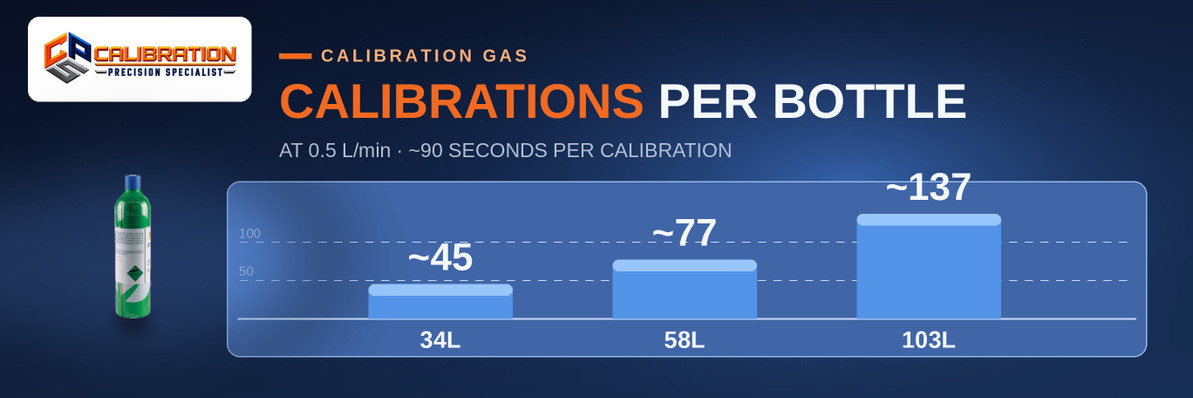
How Many Calibrations Do You Get From a 34L, 58L, or 103L Cylinder?
At the common 0.5 L/min fixed flow rate, a 34L cylinder holds 68 minutes of gas flow, a 58L holds 116 minutes, and a 103L holds 206 minutes — so at 90 seconds of gas per calibration, that works out to about 45 calibrations from a 34L, 77 from a 58L, and 137 from a 103L. Those are ideal counts: real life lands below them, because a fixed-flow regulator flows the whole time it is open, tests get repeated, and the last gas in the cylinder is not all usable.
That is the short version. The rest of this post shows the arithmetic, states every assumption on the table, and explains where the missing calibrations go.
What Is the Formula for Calibrations per Cylinder?
One division:
Calibrations per cylinder = cylinder size in liters ÷ (flow rate in L/min × minutes of gas per calibration)
Every number in this post comes out of that formula, and every argument about cylinder life is really an argument about one of its three inputs:
- Cylinder size is printed on the bottle — 34L, 58L, 103L, and the other sizes in our calibration gas range. That is the total gas volume the cylinder holds, not all of which you will successfully spend on instruments (see the waste section below).
- Flow rate is set by the regulator, not the cylinder. 0.5 L/min is the most common fixed-flow rate across portable gas detectors, and the C-10 fixed-flow regulator we sell ($130, nickel-plated brass) is offered at 0.1, 0.2, 0.25, 0.3, 0.5, 0.75, 1.0, 1.5, and 6.0 L/min — so the rate you actually run matters enormously, as the second table shows.
- Minutes per calibration is how long gas actually flows onto the instrument for one test. This is the input nobody writes down, so we sourced it and labeled it — see below.
Where Do the Times per Test Come From?
We did not invent the times in the worked table. Two of them come straight from manufacturer documentation for equipment we sell:
- Bump test, 20–30 seconds; calibration, 90 seconds. SENKO's docking-station manuals for its MGT and SGT monitors run the bump test for 20–30 seconds and the calibration for 90 seconds. The worked table uses 30 seconds for a bump — the top of SENKO's published bump range, so the bump counts are not flattered.
- Span calibration, 90 seconds. SENKO's MGT user manual states that its standard gas (span) calibration completes automatically in 90 seconds, which is why 90 seconds is the calibration row in the table.
The 60-second and 120-second rows are assumptions, labeled as such — plug-in examples for instruments and stations whose procedures run longer, so you can read your own count off the same arithmetic. Your instrument's manual is the authority for your fleet; if it specifies a different application time, divide by that time instead. Nothing in the tables is a guarantee — they are the ceiling the formula allows, before waste.
How Many Calibrations and Bump Tests Does Each Size Give? (Worked Table)
Assumptions for this table: a 0.5 L/min fixed-flow regulator, the full cylinder volume usable, gas flowing only during the test, and counts rounded down to whole tests. The 30-second row uses SENKO's published bump-test range (20–30 seconds); the 90-second row uses SENKO's published calibration time; the 60- and 120-second rows are stated assumptions for longer procedures.
| Cylinder | Gas per 30-sec bump | Bump tests | Gas per 90-sec calibration | Calibrations | Gas per 60 sec | Tests at 60 sec | Gas per 120 sec | Tests at 120 sec |
|---|---|---|---|---|---|---|---|---|
| 34L | 0.25 L | 136 | 0.75 L | 45 | 0.5 L | 68 | 1.0 L | 34 |
| 58L | 0.25 L | 232 | 0.75 L | 77 | 0.5 L | 116 | 1.0 L | 58 |
| 103L | 0.25 L | 412 | 0.75 L | 137 | 0.5 L | 206 | 1.0 L | 103 |
Read it as minutes if that is easier: at 0.5 L/min, a 34L cylinder is 68 minutes of flow, a 58L is 116 minutes, and a 103L is 206 minutes. However long your procedure holds the gas on, divide the minutes by it.
How Does the Flow Rate Change the Count?
Doubling the flow halves the count; halving the flow doubles it. Same 90-second calibration, three regulator rates CPS actually sells on the C-10 fixed-flow regulator:
| Flow rate | Gas per 90-sec calibration | 34L calibrations | 58L calibrations | 103L calibrations |
|---|---|---|---|---|
| 0.25 L/min | 0.375 L | 90 | 154 | 274 |
| 0.5 L/min | 0.75 L | 45 | 77 | 137 |
| 1.0 L/min | 1.5 L | 22 | 38 | 68 |
This is not an argument for turning the flow down. The correct flow rate is the one your instrument's manufacturer specifies — too little flow and the sensor never sees the full concentration, too much and you can pressurize the calibration cup and skew the reading. The table exists so you can cost and stock cylinders for the rate you are supposed to run, not shop for a rate that makes the bottle last longer.
Fixed-Flow vs. Demand-Flow: Does the Regulator Change the Math?
Yes — because the two regulator types spend gas differently, as our post on fixed-flow vs. demand-flow regulators works through in full:
- Fixed-flow delivers gas at one constant, preset rate from the moment you open the valve until you close it. The formula above applies literally: every second the valve is open — before the instrument is ready, between instruments, while you answer the phone — is gas spent at the preset rate. The count you get is the table count minus your open-valve time.
- Demand-flow stays shut until the instrument's pump draws gas through it, flows at exactly the rate the pump draws, and stops when the pump stops. There is no preset rate to plug into the formula and no open-valve waste — but it only works on pumped instruments. On a diffusion instrument there is no pump to open it, no gas flows at all, and the "failed" bump test that follows is a regulator mismatch, not a bad sensor.
So for a pumped fleet on demand-flow, consumption tracks the instrument's own draw during the test itself, and real-world counts land closer to the formula's ceiling. For a diffusion fleet on fixed-flow, your discipline with the valve is the difference between the table and reality.
Which Cylinder Sizes Does CPS Actually Sell in These Sizes?
Honestly — the three sizes in the title are the industry-standard sizes buyers search for, and our range covers them, but not all from the same product line:
- 34L and 103L in bottled gas: our Isobutylene 100 ppm + O₂ 20.9% calibration gas is sold in a 34 Liter variant at $74 and a 103 Liter variant at $174, alongside 11L ($45, trigger valve, minimum order of 6), 17L, 60L, 66L, 120L, 221L, and 680L variants of the same mix.
- 58L in a calibration kit: the SENSIT Calibration Kit — H2S, 58 Liter ($659.20) includes a 58 liter cylinder of 25 ppm H2S, a regulator, and a hose. SENSIT's regulator line is likewise built for 34/58/103/116 liter cylinders.
- Quad gas: our 4-Gas Calibration Gas — RKI Equivalent (H₂S 25 / CO 50 / CH₄ 50% LEL / O₂ 12%) comes in 11L ($90, trigger valve, minimum order of 6), 34L ($195), 44L ($210), 60L ($245), 66L ($275), and 120L ($295) variants — the same formula sizes it: the 34L at 90 seconds and 0.5 L/min is about 45 calibrations, or about $4.33 of gas per calibration at the $195 price; the 120L is 160 calibrations at the same assumptions, or about $1.84 per calibration at $295.
However you buy it, the size on the label is the numerator. The full range — and the refillable side of the family — is in our calibration gas category and our comparison of disposable vs. refillable calibration gas cylinders.
Why Do You Get Fewer Calibrations Than the Math Says?
Because the formula assumes a perfect bench. Real benches leak gas in at least five places:
- The valve left open. A fixed-flow regulator flows the whole time it is open. Left cracked open, it will quietly drain a cylinder — at 0.5 L/min, a 34L bottle is empty in 68 minutes of open-valve time, whether or not an instrument was anywhere near it.
- Set-up and purge time. Gas flows while you fit the cal cup, check the tubing, and let the reading stabilize — before the timed test the manual counts even starts.
- Repeats. A failed bump that becomes a calibration, a calibration you re-run to be sure, a new hire's practice runs — each one is a full draw at the same rate.
- The unusable tail. As cylinder pressure falls toward the end of the bottle's life, delivery gets unreliable before the bottle is truly empty. Budget the last portion of any cylinder as reserve, not as tests.
- Expired gas. A cylinder that outlives its certified shelf life is not a bargain, whatever the gauge says — reactive mixes age on their own clock, which our post on calibration gas shelf life breaks down by gas family. A big bottle is only cheaper per calibration if you use it while it is still in date.
Treat the tables as the ceiling, track your real count for one cylinder, and stock to the real number. If your actual count is running far below the arithmetic, the gap is almost always open-valve time and repeats — both fixable without buying a bigger bottle.
The Bottom Line
Calibrations per cylinder is a division, not a rating: liters ÷ (flow × time). At the standard 0.5 L/min and a 90-second calibration, a 34L gives about 45 calibrations, a 58L about 77, and a 103L about 137 — and at 30-second bumps, about 136, 232, and 412. Change the flow rate or the application time and the count moves in exact proportion. Demand-flow regulators remove the open-valve waste for pumped instruments; nothing removes the waste from a fixed-flow valve left open, a test run twice, or gas used past its date.
Working out which size your fleet actually burns through? Tell us your instrument, its specified flow rate, and how many instruments you bump and calibrate, and we will size the cylinder to the work — call 865-900-8844 or reach us through Contact Us. And when the instruments themselves come to our lab, we calibrate every channel — with the correct regulator and fresh, in-date gas behind the work. See Calibration Services.
Frequently Asked Questions
How many calibrations do you get from a 34L cylinder? About 45 full calibrations at the standard assumptions — a 0.5 L/min fixed-flow regulator and 90 seconds of gas per calibration (0.75 L per calibration; 34 ÷ 0.75 = 45). At 30 seconds per bump test the same cylinder gives about 136 bump tests, and at a 1.0 L/min flow rate the calibration count drops to about 22. Those are ideal counts before open-valve waste, repeats, and the unusable tail at the end of the bottle.
How many calibrations do you get from a 58L cylinder? About 77 full calibrations at 0.5 L/min and 90 seconds of gas per calibration (0.75 L per calibration; 58 ÷ 0.75 = 77), or about 232 bump tests at 30 seconds each (0.25 L per bump). At 0.5 L/min a 58L cylinder holds 116 minutes of total flow — divide 116 by your procedure's minutes to get your own count.
How many calibrations do you get from a 103L cylinder? About 137 full calibrations at 0.5 L/min and 90 seconds of gas per calibration (0.75 L per calibration; 103 ÷ 0.75 = 137), or about 412 bump tests at 30 seconds each. A 103L holds 206 minutes of flow at 0.5 L/min. The bigger bottle only pays off if you use the gas before its certified shelf life ends.
How many bump tests do you get from a 34L cylinder? About 136 bump tests at 0.5 L/min with 30 seconds of gas per bump (0.25 L per test; 34 ÷ 0.25 = 136). SENKO's docking stations run bump tests for 20–30 seconds, so 30 seconds is the conservative end of a published range; if your procedure applies gas for a full 60 seconds, the same 34L cylinder gives about 68 tests.
How long does a 58L calibration gas cylinder last? In flow time, 116 minutes at the common 0.5 L/min regulator rate — about 77 calibrations at 90 seconds each or about 232 bump tests at 30 seconds each. In calendar time it depends entirely on your test volume: a shop calibrating ten instruments a week spends roughly 7.5 L a week at those assumptions and works through a 58L in about two months, while a cylinder that mostly sits can reach its certified expiration date with gas still in it.
How do you calculate how many calibrations are in a cylinder? Divide the cylinder size in liters by the gas used per calibration: calibrations = liters ÷ (flow rate in L/min × minutes per calibration). Example: a 58L cylinder on a 0.5 L/min regulator with a 90-second (1.5-minute) calibration uses 0.5 × 1.5 = 0.75 L per calibration, so 58 ÷ 0.75 = about 77 calibrations. Use your instrument manual's application time and your regulator's actual preset rate, and treat the result as a ceiling, not a promise.
Does a demand-flow regulator make a cylinder last longer than a fixed-flow regulator? It removes one whole category of waste, for pumped instruments only. A demand-flow regulator flows only while the instrument's pump draws gas and stops when the pump stops, so there is no open-valve drain between tests; a fixed-flow regulator flows at its preset rate the entire time its valve is open. During the test itself both types deliver the gas the test needs — the demand-flow savings are everything that would otherwise flow while no instrument is being tested. Demand-flow does nothing on a diffusion instrument, which has no pump to open it.
What flow rate should I use to calculate calibrations per cylinder? Use the preset rate of the regulator you actually run — 0.5 L/min is the most common fixed-flow rate for portable gas detectors, and it is the rate used in this post's main table. The count is directly proportional: at 0.25 L/min a 90-second calibration uses 0.375 L (a 34L gives about 90), and at 1.0 L/min it uses 1.5 L (a 34L gives about 22). Never choose a flow rate to stretch a cylinder — the instrument manufacturer's specified rate is what makes the calibration valid.
Why do I get fewer calibrations than the calculation says? Because the calculation assumes gas flows only during the timed test. In practice, gas also flows while you set up and stabilize the reading, a fixed-flow valve left open drains the cylinder at its full preset rate (a 34L in 68 minutes at 0.5 L/min), failed tests get repeated, and the last low-pressure portion of a cylinder is not reliably usable. Track one cylinder's real count and stock to that number — the gap between it and the formula is your waste, and most of it is valve discipline and repeats.
Is a bigger calibration gas cylinder cheaper per calibration? Usually, per liter of gas — with a shelf-life catch. Using CPS's RKI-equivalent quad gas at 0.5 L/min and 90 seconds per calibration: the 34L variant is $195 for about 45 calibrations (about $4.33 of gas per calibration), while the 120L variant is $295 for about 160 calibrations (about $1.84 per calibration). The bigger cylinder wins only if your test volume uses the gas before it expires — a half-used 120L that goes out of date costs more per calibration than a fully used 34L.
CPS Calibrations · 109 S. Front Street, Rockwood, TN 37854 · Calibration Gas · Calibration Services · Contact Us
Need a calibration you can file?
In-house calibration at CPS in Rockwood, Tennessee — $55 for single-gas instruments, $90 for 4- and 5-gas — every channel, as-found and as-left data, full certificate.
See Calibration Servicesor call 865-900-8844
Recent Posts
-

What Is Remote Monitoring for Fixed Gas Detection?
Remote monitoring for fixed gas detection means a fixed system's live readings, trends, and alarm hi …Nov 23rd 2026 -

What Are the Key Differences Between the GX-6000 and GX-6100?
The RKI GX-6100 is the current replacement for the discontinued GX-6000: both are pumped 6-gas monit …Nov 22nd 2026 -

How to Read a PID Correction Factor Chart
To read a PID correction factor chart, find your vapor’s row, take the factor under your own lamp en …Nov 21st 2026