
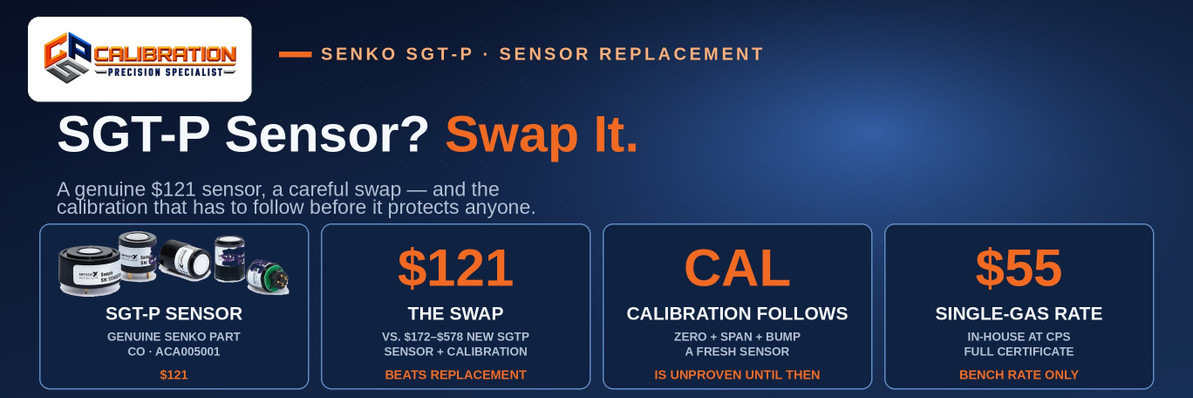
How to Replace a SENKO SGT-P Sensor
Replacing a SENKO SGT-P sensor takes a genuine $121 part — the CO sensor is part ACA005001 (0–2,000 ppm) and the H2S sensor is ACA005003 (0–500 ppm) — a few careful minutes with the detector open, and then the step too many swaps skip: a full calibration, because a fresh electrochemical sensor is unproven until it has been zeroed and spanned against known gas. The swap beats replacement on the math alone — a new maintainable SP-SGTP runs $172–$578 configured and even the disposable SP-SGT runs $163–$412 — but only on an SGT-P: the disposable SGT has no sensor to replace.
First, be sure which instrument is in your hand, because SENKO's naming invites the mistake. The SP-SGT is the disposable: it runs up to 24 months and is then done. The SP-SGTP is the maintainable twin — same compact diffusion format, IP67, audible/visual/vibration alarms — built with a replaceable sensor and a replaceable battery so it stays in service past its first sensor's life. The head-to-head is in SENKO SGT vs. SGTP. This post is the SGT-P job: how to tell the sensor is really the problem, the swap itself, and the calibration that has to follow it.
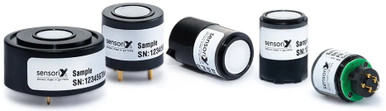
SENKO CO Sensor for SGT-P Replacement Sensor
Genuine SENKO replacement CO sensor (part ACA005001) for the SGT-P — electrochemical, 0–2,000 ppm.
$121
See the SGT-P CO SensorWhich SENKO Do You Actually Have — SGT or SGT-P?
Everything about this job forks on that one letter. If the detector is an SP-SGT, stop here: there is no supported sensor swap, and a failed unit is replaced whole ($163–$412 configured). That is not a flaw — the disposable's bargain is two maintenance-free years for CO and H2S models with nothing to open, ever. If it is an SP-SGTP, the instrument was designed for exactly this moment: the sensor is a service part, the battery is a service part, and the housing, display, and alarms carry on.
Confirm the gas before you order, too. The two stocked SGT-P sensors on our store are the CO sensor, ACA005001 and the H2S sensor, ACA005003, both $121. The SGTP family covers more gases than that — O₂, H₂, SO₂, NH₃, NO₂, Cl₂, HCN, PH₃, ClO₂, HCl — so if your detector is one of those variants, call 865-900-8844 and name the gas and range on the label before assuming the part exists on the shelf.
When Does a $121 Sensor Beat a New Detector?
Run the comparison honestly. A sensor swap is $121 plus a calibration. A new SP-SGTP is $172–$578 depending on gas and range — and a new disposable is $163–$412 for a detector you will throw away on schedule. The swap wins whenever the rest of the instrument is healthy: display readable, alarms sounding, housing and clip intact, battery holding. It loses when the instrument has other damage — a cracked case on an IP67 detector is a sealing failure, not a cosmetic one — or when the detector has been through a severe over-range exposure that leaves you doubting more than the sensor.
The signs the sensor itself is spent are consistent across electrochemical detectors: it fails calibration or drifts back out within days, response gets visibly slow, the zero wanders, or it fails a bump test it used to pass. Age alone is a weaker signal — a lightly used detector stored cool and dry can outlive a hard-used one — which is why this post will not give you a swap-by calendar date. Test first, then spend $121 on evidence.
How Do You Replace the SGT-P Sensor, Step by Step?
- Work clean, dry, and powered down. Electrochemical sensors are chemistry in a can: fingerprints, dust, and solvent fumes on the sensor face become reading errors. Power the detector off and work away from the process area.
- Open the housing as the manual directs and note how the old sensor sits before you touch it — orientation and seating are the whole job. If a step in the manual and a step here ever disagree, the manual wins.
- Handle the new sensor by its body, never its face. Lift the old sensor out, seat the replacement fully and squarely — a sensor sitting slightly proud leaks sample air around its seal and reads low forever after.
- Close up and power on, then let it settle. A fresh electrochemical sensor needs time in clean air to stabilize its zero before anyone judges it. A reading taken in the first minutes is the sensor waking up, not the sensor lying.
- Then calibrate — the next section is not optional. A swapped sensor that has not been spanned is a detector displaying numbers nobody has verified.
One more discipline: keep the old sensor until the new one has passed calibration. If the replacement misbehaves, the old part is your comparison evidence, and swapping back for one test tells you whether the fault followed the sensor or lives in the instrument.
Why Must a Calibration Follow Every Sensor Swap?
Because calibration is what connects this specific sensor to reality. Every electrochemical sensor leaves the factory with its own sensitivity; the detector's stored calibration belongs to the sensor that just came out. Zero the new sensor in clean air, span it against the documented gas for its channel — CO for ACA005001, H2S for ACA005003 — and bump-test it before it goes back on a belt. The as-found/as-left habit matters here too: record what the new sensor read before adjustment, so the next technician has a baseline instead of a mystery.
If you would rather the bench did it, that is a normal mail-in: CPS calibrates single-gas instruments in-house for the published $55 rate, with a full certificate. The process is the same as any ship-in — see how mail-in gas detector calibration works — and calibration services covers the wider bench. Send the detector with the new sensor fitted, or send both parts and say so on the note; either way it comes back calibrated, not just assembled.
Frequently Asked Questions
How much does a SENKO SGT-P replacement sensor cost?
One hundred twenty-one dollars at CPS Calibrations for either stocked sensor: the CO sensor, part ACA005001 (0–2,000 ppm), or the H2S sensor, part ACA005003 (0–500 ppm). Both are genuine SENKO electrochemical replacement sensors for the SGT-P. Add a calibration after the swap — do it yourself with the correct gas, or mail the detector in for the $55 published single-gas in-house rate.
Can you replace the sensor in a SENKO SP-SGT?
No. The SP-SGT is the disposable model: it is built to run up to 24 months — CO and H2S versions are maintenance-free across that period — and then be replaced whole, at $163–$412 configured. The maintainable model with the replaceable sensor and battery is the SP-SGTP. The comparison is in SENKO SGT vs. SGTP on our blog.
How do I know my SGT-P sensor is spent?
By test, not by calendar: a sensor that fails calibration, drifts back out of tolerance within days, responds noticeably slowly, will not hold a zero, or fails a bump test it used to pass is telling you it is done. A detector that passes a bump and holds calibration is still working, whatever its age. That is why no honest post gives a swap-by date for these sensors.
Do I have to calibrate after replacing the sensor?
Yes — without exception. The detector's stored calibration belongs to the old sensor; the replacement has its own sensitivity. Zero it in clean air, span it against the documented gas for its gas channel, and bump-test it before it protects anyone. An uncalibrated fresh sensor displays precise-looking numbers that nobody has verified.
Which gases does the SGT-P come in?
The SP-SGTP family is offered for O₂, CO, H2S, H2, SO₂, NH₃, NO₂, Cl₂, HCN, PH₃, ClO₂, and HCl, some in multiple ranges. The two replacement sensors stocked on our store are CO (ACA005001, 0–2,000 ppm) and H2S (ACA005003, 0–500 ppm), both $121. For another gas variant, call 865-900-8844 with the gas and range from the detector's label.
Is a sensor swap cheaper than a new SP-SGTP?
On verified store prices, yes, when the rest of the instrument is sound: $121 for the sensor plus a calibration, against $172–$578 configured for a new SP-SGTP. The swap stops winning when the housing is cracked (an IP67 seal you cannot trust), the display or alarms are failing, or the detector took a severe over-range hit that makes you doubt more than the sensor.
Can I swap a CO sensor into an H2S SGT-P?
Do not treat the sensors as interchangeable experiments. Fit the genuine sensor made for the detector's gas and range — ACA005001 for CO, ACA005003 for H2S — and calibrate for that gas. A detector's alarms, ranges, and calibration are all set for the gas on its label; changing the gas a personal detector measures is a re-specification decision, not a parts swap.
How long does the swap itself take?
The physical swap is minutes of careful work: power down, open the housing per the manual, seat the new sensor fully and squarely, close up. The honest total is longer — the new sensor needs clean-air settling time, then a zero, a span calibration, and a bump test before it goes back into service. Budget the calibration, not just the screwdriver time.
What if the new sensor still fails calibration?
Swap the old sensor back for one test. If the fault follows the sensor, the replacement part is the problem — call us. If the fault stays with the instrument, the detector itself needs bench diagnosis, and that work is quoted in writing before it is done when you send it to CPS. Keep the old sensor until the new one has passed; it is your comparison evidence.
Does CPS replace SGT-P sensors?
Yes — or you can fit the part yourself and send the detector in for calibration only. CPS calibrates single-gas instruments in-house at the published $55 rate with a full certificate (as-found and as-left data), and any work beyond calibration is quoted in writing first. Call 865-900-8844, or start from our calibration services page.
The Bottom Line
An SGT-P that fails on a tired sensor is a $121 repair, not a $172–$578 replacement — fit the genuine sensor for its gas (ACA005001 for CO, ACA005003 for H2S), seat it cleanly, and then do the part that makes it a detector again: zero, span, and bump-test it, or mail it to CPS for the $55 single-gas in-house calibration and a certificate that proves the new sensor reads true.
Need the sensor, or the calibration after it? Call CPS Calibrations at 865-900-8844, or ship the detector to 109 S. Front Street, Rockwood, TN 37854.
--- CPS Calibrations · 109 S. Front Street, Rockwood, TN 37854 · SENKO CO Sensor for SGT-P · SENKO SP-SGTP · Calibration Services
Need a calibration you can file?
In-house calibration at CPS in Rockwood, Tennessee — $55 for single-gas instruments, $90 for 4- and 5-gas — every channel, as-found and as-left data, full certificate.
See Calibration Servicesor call 865-900-8844
Recent Posts
-

What Is Remote Monitoring for Fixed Gas Detection?
Remote monitoring for fixed gas detection means a fixed system's live readings, trends, and alarm hi …Nov 23rd 2026 -

What Are the Key Differences Between the GX-6000 and GX-6100?
The RKI GX-6100 is the current replacement for the discontinued GX-6000: both are pumped 6-gas monit …Nov 22nd 2026 -

How to Read a PID Correction Factor Chart
To read a PID correction factor chart, find your vapor’s row, take the factor under your own lamp en …Nov 21st 2026