
How Mail-In Gas Detector Calibration Works
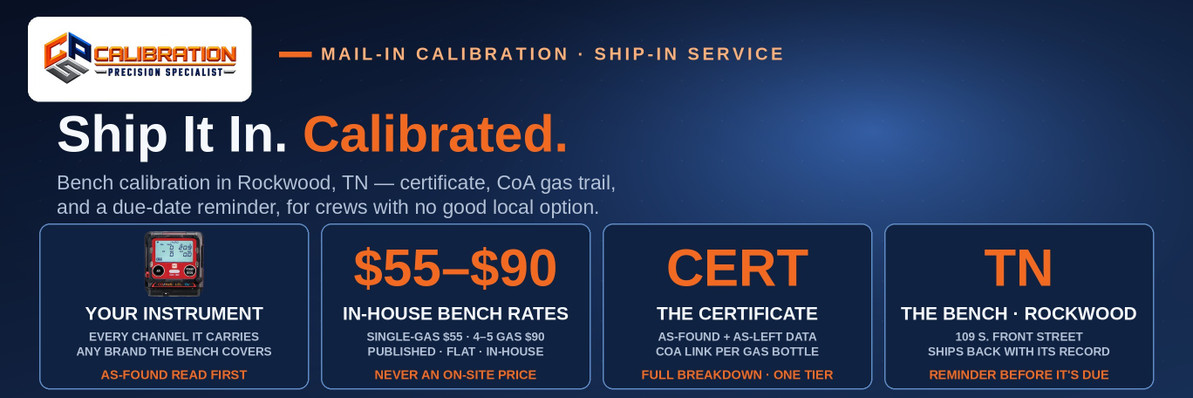
Mail-in gas detector calibration works like this: you ship the instrument to CPS Calibrations at 109 S. Front Street, Rockwood, TN 37854; we bench-calibrate every channel it carries at published in-house rates — $55 for a single-gas instrument, $90 for a 4- or 5-gas instrument — recording as-found readings before any adjustment; and the instrument ships back with a certificate showing as-found and as-left data and a Certificate of Analysis link for each calibration gas bottle used, while its record and next due date are kept in the CPS Calibration Program. It exists for the common case: a crew whose nearest trustworthy bench is not local at all.
Most gas detectors in this country do not live near a calibration bench. They live on trucks, in plants, and at fire departments and contractors whose 'local option' is a distributor counter that ships the instrument somewhere else anyway — with no published rate, no certificate standard, and no record that follows the instrument. Mail-in calibration cuts out the middleman by being the somewhere else, directly. This post is the hub for how CPS's ship-in service works end to end; the details live in the program series it links: the CPS Calibration Program, who can calibrate my gas detector, and the certificate and reminder posts below.
How Does Mail-In Calibration Work, Step by Step?
- Step 1 — Tell us what is coming. Call 865-900-8844 or start from calibration services. We confirm the instrument is one our bench covers (service coverage is broader than the brands we stock — if it measures gas, ask), confirm the in-house rate for it, and confirm the expected turnaround for the current bench queue before you ship. No surprises are built later.
- Step 2 — Pack the instrument, not the gas. Send the instrument and its charger if it has one. Do not send calibration gas cylinders — we calibrate with our own documented gas; yours stays home. Pack it like the precision instrument it is: padded, in a box that can survive the trip twice. Put your company name, a contact, and the instrument's serial number inside the box as well as on it.
- Step 3 — Ship it to Rockwood. Address: CPS Calibrations, 109 S. Front Street, Rockwood, TN 37854. Keep your tracking number — it is your receipt until the instrument is checked in here. Shipping to us is your cost; return shipping is also the customer's cost, arranged when the service is booked, so the rate you were quoted is the service rate and freight stays visible instead of buried in it.
- Step 4 — The bench calibration. The instrument is checked in against its serial number, and we calibrate every channel it carries. The bench work records as-found readings first — what the instrument was actually reading when it arrived, before anything is adjusted — then adjusts and records as-left readings. If an instrument fails, needs a sensor, or needs repair, that work is quoted in writing before it is done; a calibration booking is never a blank check for repairs.
- Step 5 — The certificate and the gas trail. Every calibration returns a certificate with the full breakdown — as-found and as-left data for every channel, not a pass/fail sticker. The gas behind the numbers is documented too: when a calibration gas bottle enters service at CPS, the supplier QR code on it is scanned and its Certificate of Analysis link is stored on the bottle's record, and the certificate carries a clickable CoA link for each bottle used on your instrument. What is on the certificate, field by field, is its own post: What's on a CPS calibration certificate.
- Step 6 — Return, record, reminder. The instrument ships back with its certificate. Its record does not stay in a drawer here, either: it lives in the CPS Calibration Program, where the instrument's fleet calibration history builds up calibration by calibration, and calibration due-date reminders reach you before the next calibration comes due. No contract, no monthly fee — the record-keeping is part of the calibration.
How Much Does Mail-In Calibration Cost?
The service rate is published and flat: $55 for a single-gas instrument, $90 for a 4- or 5-gas instrument — our in-house bench rates, and the same rates a walk-in customer pays in Rockwood. Two honest boundaries around those numbers. First, they are in-house rates: they apply to instruments calibrated at our bench, and they are never the price of on-site work, which is quoted in writing for the job. Second, they are the service rate: shipping in both directions is the customer's cost, and if an instrument needs a sensor or a repair beyond calibration, that work is quoted in writing for your approval before it happens. The total you commit to is always known before it is spent.
Who Is Mail-In Calibration For?
Anyone whose local option is not an option: the contractor three states from the nearest bench, the small department whose distributor 'handles calibration' by mailing it out at an unlisted rate, the plant whose instruments come due during a shutdown week when nobody can drive them anywhere. It is also for fleets — ship a rotation of instruments and keep working units on site while the rest are on the bench, with each instrument's history kept straight by serial number in the program. If you are comparing mail-in against driving to a bench or paying for an on-site visit, the comparison that matters is total downtime plus total cost plus the quality of the record you get back — and on the record, a bench certificate with as-found data and a CoA gas trail is the standard to hold any option to.
What If My Detector Needs More Than Calibration?
Then you find out the right way: in writing, before money moves. The as-found readings and the bench check tell us whether the instrument calibrated back into specification or whether a sensor is spent, a pump is weak, or something is damaged. Calibration that succeeds is billed at the flat rate. Work beyond it — sensors, parts, repair — is quoted in writing first, and the decision is yours: approve it, or have the instrument returned as-is with its as-found record, which is itself useful information for a replacement decision. Either way the instrument comes back with documentation of exactly where it stands.
Frequently Asked Questions
How does mail-in gas detector calibration work?
You ship the instrument to CPS Calibrations, 109 S. Front Street, Rockwood, TN 37854. We bench-calibrate every channel it carries — recording as-found readings before adjustment and as-left readings after — and ship it back with a certificate showing both, plus a Certificate of Analysis link for each calibration gas bottle used on it. The instrument's record is kept in the CPS Calibration Program and you get a reminder before the next due date. Call 865-900-8844 first so the rate and current turnaround are confirmed before the instrument leaves your shelf.
How much does it cost to mail in a gas detector for calibration?
The calibration itself is a published flat in-house rate: $55 for a single-gas instrument and $90 for a 4- or 5-gas instrument — the same rates as dropping the instrument off at the Rockwood bench. Shipping is separate: sending the instrument to us is your cost, and return shipping is the customer's cost, arranged when the service is booked. If the instrument needs a sensor or repair beyond calibration, that work is quoted in writing for your approval before it is done, so the calibration rate is never a foot in the door for a bigger bill.
How long does mail-in calibration take?
Turnaround is confirmed when you book the service, because it depends on two honest variables: the current bench queue and what the instrument turns out to need. A straightforward calibration moves with the queue; an instrument that needs a sensor or a repair waits on your written approval of the quote and on parts. We would rather give you the real number for this week on the phone — 865-900-8844 — than publish a turnaround we cannot keep. Shipping time in both directions is the carrier's, and tracking numbers on both legs keep the instrument accounted for.
What should I include in the box with my gas detector?
The instrument, its charger if it uses one, and a note inside the box with your company name, a contact name and phone number, and the instrument's serial number. Do not send calibration gas cylinders — CPS calibrates with its own documented gas, and your cylinders stay home. Pack the instrument padded and protected: it is a precision measuring device making the trip twice, and a box that survives a warehouse conveyor is the right standard.
Will I get a calibration certificate with a mail-in calibration?
Yes — a full certificate, not a sticker. It shows the as-found readings recorded when the instrument arrived and the as-left readings after calibration, for every channel the instrument carries. It also carries the gas trail: each calibration gas bottle at CPS has its Certificate of Analysis link stored from the supplier QR code scanned when the bottle entered service, and that CoA link appears on the certificate for the bottles used on your instrument, so the numbers trace back to documented gas.
Can you calibrate a gas detector brand you don't sell?
In most cases, yes. CPS's service coverage is broader than its stocking list — the bench calibrates gas monitors across the brands crews actually run, not only the brands on our shelves, and we calibrate every channel an instrument carries. The one-minute version of the answer for your specific model is a phone call: 865-900-8844. If an instrument is genuinely outside what our bench can document properly, we will tell you that before you spend money shipping it.
What happens if my detector fails calibration?
You get the as-found record showing how far out it was, and a written quote for what it needs — a sensor, a part, a repair — before any of that work is done. Approve it and the instrument is repaired and calibrated; decline it and the instrument is returned as-is with its documentation, and you have a dated, factual basis for a repair-or-replace decision. A failed calibration is never silently converted into a repair bill.
Who pays for shipping on a mail-in calibration?
You do, in both directions — and the rates are set up that way on purpose. The published $55 and $90 in-house rates are the service itself, kept flat and comparable to walk-in pricing, rather than padded with an averaged freight charge. You ship the instrument to Rockwood at your cost with whatever carrier and speed your downtime allows; return shipping is the customer's cost, arranged when the service is booked. Keep your tracking number until the instrument is checked in here.
Is mail-in calibration as good as on-site calibration?
It is a different service, not a lesser one. Mail-in calibration happens on a bench, with the instrument given a full as-found/as-left documented calibration and a certificate with the calibration-gas CoA trail. On-site calibration brings a technician to installed systems and large fleets where instruments cannot travel — and it is quoted in writing for the job, never billed at the $55/$90 in-house rates. For portable instruments that can be shipped, the bench is usually the most thorough and most economical route; for fixed systems, on-site is the only route.
How do I know when my mailed-in detector is due again?
The CPS Calibration Program keeps it for you. Every instrument CPS calibrates has a record — its calibration history by serial number, building up visit by visit — and due-date reminders go out before the next calibration comes due, so the date is flagged while there is still time to schedule the shipment instead of after an audit finds it expired. There is no contract and no monthly fee for the program; the record and the reminders come with the calibration.
The Bottom Line
Mail-in calibration is the bench coming to you by box: ship the instrument to Rockwood, get a documented bench calibration at a published flat rate — $55 single-gas, $90 for 4- and 5-gas — with as-found and as-left data and the calibration gas's CoA trail on the certificate, and a record and reminder that outlast the shipment. For any crew with no good local option, it turns 'somewhere, eventually, maybe documented' into a known process with a known price.
Ready to ship an instrument in? Call CPS Calibrations at 865-900-8844 to confirm the rate and turnaround, then send it to 109 S. Front Street, Rockwood, TN 37854.
CPS Calibrations · 109 S. Front Street, Rockwood, TN 37854 · Calibration Services · The CPS Calibration Program · What's on a CPS Calibration Certificate
Ready to mail yours in?
Start the ship-in request, pack the meter, and we handle the rest — every channel calibrated as configured, full certificate returned with it.
Start Your Ship-In Requestor call 865-900-8844
Recent Posts
-

Can You Add a Pump to a SENKO SGT-P or MGT?
Yes — SENKO's SP-Pump101 external sampling pump ($330, part AAA006000) fits the SGT, SGT-P, and MGT, …Nov 12th 2026 -

What Refrigerant Detection Does a Grocery Store Need?
A grocery store needs refrigerant detection in three places: low-mounted carbon dioxide (R-744) sens …Nov 11th 2026 -

What Is LEL and UEL? The Explosive Range, Gas by Gas
The LEL is the lowest concentration of a gas in air that can explode, and the UEL is the highest: me …Nov 10th 2026