
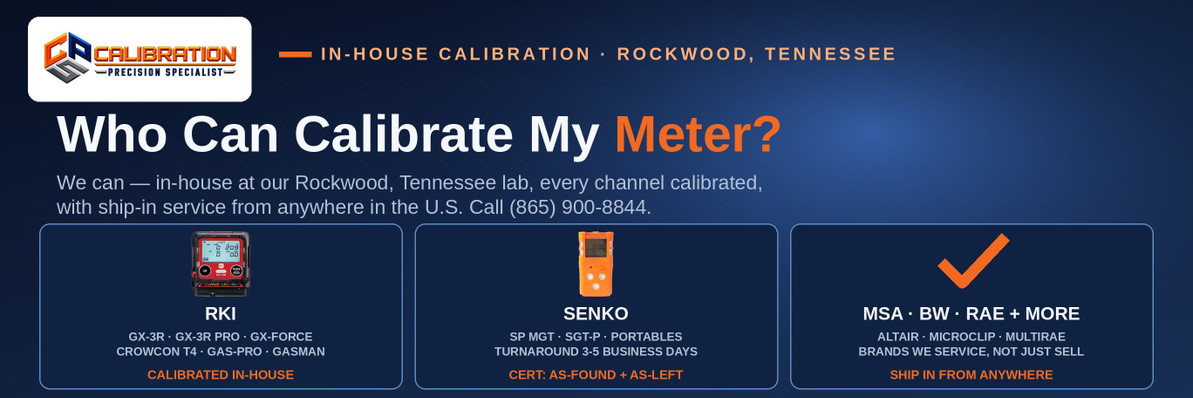
Who Can Calibrate My Gas Detector? GX-3R, Crowcon, SENKO & More — Calibrated In-House
CPS Calibrations in Rockwood, Tennessee calibrates RKI, Crowcon, and SENKO portable gas detectors in-house — the RKI GX-3R and GX-3R Pro, the Crowcon T4 and Gas-Pro, and the SENKO SP MGT among them — along with MSA, Honeywell (BW and RAE), and most other major brands, and you can ship your meter to our lab from anywhere in the U.S. Call (865) 900-8844 for a written quote, and a written quote right now locks your calibration pricing for 6 months.
"Who can calibrate my meter?" is usually asked under time pressure: the due-date sticker says this month, the local shop closed or never existed, and sending the instrument back to the manufacturer means weeks without it and a service bill nobody budgeted for. There is a third option. Our bench in Rockwood, Tennessee calibrates portable gas detectors in-house for customers in every state — most of our calibration work arrives by mail, gets calibrated on every channel, and ships back with a certificate that shows exactly what we found and exactly what we set. This post is the whole picture: the brands and models we calibrate, how ship-in works step by step, what lands back in the box, and what happens if your meter fails.
Which Brands and Models Does CPS Calibrate?
We calibrate and service most major portable gas detector brands. The meters that cross our bench most often:
| Brand | Models we calibrate in-house |
|---|---|
| RKI Instruments | GX-3R and GX-3R Pro, GX-Force, and the wider RKI portable line |
| Crowcon | T4, Gas-Pro, Gasman, Clip SGD, and Crowcon's other portable monitors |
| SENKO | SP MGT multi-gas, SGT-P maintainable single-gas, and SENKO portable monitors |
| MSA | The ALTAIR line — ALTAIR 4XR, ALTAIR 5X, and the single-gas ALTAIR models |
| Honeywell BW | MicroClip XL, MicroClip XT, and the MicroClip family |
| Honeywell RAE | MultiRAE, QRAE 3, and the RAE portable line |
Also calibrated on the same bench: Industrial Scientific (MX6 iBrid, Ventis MX4), Dräger (X-am series), SENSIT (GOLD G2, HXG-3), GMI (PS200), Gas Clip Technologies (MGC, SGC), and Teledyne. If your fleet is mixed — and most fleets are — one shipment can carry all of it, and every instrument comes back with the same certificate standard. The full service picture lives on our calibration services page; if your model isn't named anywhere in this post, call and ask before you assume — the bench covers more than a web page can list.
How Does Ship-In Calibration Work?
Four steps, and the first one takes about two minutes:
- Start an RMA on this site — or call (865) 900-8844 and we'll start it with you. The RMA tells us what's coming, who's sending it, and how you want it shipped back. Prefer paper first? Request a written quote and we'll put your pricing in writing before anything moves.
- Pack the meter and ship it to our lab at 109 S. Front Street, Rockwood, TN 37854. One instrument or a whole fleet — pad it like the instrument it is, and keep the RMA number with the shipment.
- We calibrate it on the bench. Every channel is calibrated against NIST-traceable calibration gas, and you get email updates at every step — checked in, on the bench, done, on its way back. Our standard in-house turnaround is 3–5 business days from the day your instruments arrive at the lab.
- It ships back calibrated, documented, and tracked. The meter returns with its certificate, a new due-date sticker, and its next calibration already on a reminder schedule — details in the next section.
One more reason to start now rather than at the due date: a written quote right now locks your calibration pricing for 6 months. Get the quote while the meter is on your mind, and the rate in that quote is the rate you pay when you send the instrument in — even if that's a few due dates from now. Call (865) 900-8844 and ask for the quote in writing.
What Do You Get Back With Your Calibrated Detector?
The meter, calibrated — and the paperwork that proves it, in full. Every CPS calibration includes:
- A calibration certificate with the complete breakdown: as-found readings and as-left readings for every channel, and the calibration gas Certificate of Analysis listed right on the certificate. One certificate tier — the full data is the standard, not an upgrade.
- A new due-date sticker on the instrument, so the next due date is visible at a glance.
- A QR sticker that pulls up the unit's live certificate and its full service history — scan it in the field or in an audit and the documentation is just there.
- Enrollment in the CPS Calibration Program, free: a heads-up 30 days before anything falls due, the email trail at every step, and records organized per instrument.
That certificate is the point of sending a meter to a bench instead of winging it: when an auditor, an insurer, or your own safety review asks what a channel read before and after calibration, the answer is on one page, traceable to NIST-standard gas.
What Happens If Your Meter Fails Calibration?
Then the calibration has done its second job: catching a meter that was about to lie to somebody. Here is how it goes:
- Most failed calibrations turn out to be a depleted sensor. Sensors are consumables; a channel that can't reach its span value is usually a sensor at the end of its life, not a broken instrument.
- You hear the as-found results before anything is replaced. The certificate reports what the meter actually read — pass or fail, the as-found data is on it either way. We don't quietly pass a meter that didn't, and we don't replace parts without you knowing why.
- In most cases it never makes a second trip. We stock replacement sensors for the major brands we service, so a failed meter is typically repaired and then calibrated in the same visit, and the certificate shows the full story: as-found failure, sensor replaced, as-left pass.
Staring at a meter that failed its bump test this morning and not sure which case you're in? Call (865) 900-8844 and describe what it's doing — we'll tell you straight whether it sounds like a sensor, a calibration, or something simpler.
In-House or On-Site: Which Do You Need?
Ship-in (in-house) calibration is the default this post describes, and it fits most operations: any brand above, any fleet size, from anywhere in the country. On-site calibration — our technician comes to your facility and calibrates the fleet where it sits — is available for fleets of 10 or more instruments. Two things to know about on-site, plainly: it is priced by written quote based on fleet size and location, and it costs more than in-house calibration — the in-house terms never apply when we come to you, because a traveling technician is a different cost than a bench. If downtime is your real problem and the fleet is big enough, on-site buys the fleet back in a day; if the meters can travel, in-house is the economical route. Our post on in-house vs. on-site calibration works through the decision properly.
Want to Calibrate It Yourself Instead?
Plenty of GX-3R owners do, and honestly, it's a learnable job — our step-by-step how to calibrate an RKI GX-3R walks RKI's own procedure with the right gas and the right regulator. The bench earns its keep in the cases DIY doesn't cover: the certificate an auditor accepts, the fleet that needs twenty meters back in a week, the channel that won't calibrate and needs a diagnosis instead of another try, and the due dates somebody else remembers for you. Whichever route you take, the interval question matters more than the method — how often should gas detectors be calibrated is the honest answer, and a bump test before each day's use is the daily half of it.
Frequently Asked Questions
Who can calibrate my RKI GX-3R?
CPS Calibrations can — in-house at our lab in Rockwood, Tennessee, and you don't have to be in Tennessee. Ship the GX-3R (or GX-3R Pro) to us from anywhere in the U.S. and it is calibrated on every channel — LEL, O2, CO, H2S, and the toxic channel on a Pro — against NIST-traceable gas, and returned with a certificate showing as-found and as-left readings and the gas Certificate of Analysis. Start an RMA on our calibration services page or call (865) 900-8844 for a written quote before you ship.
Where can I get my MSA ALTAIR calibrated?
At CPS Calibrations, by mail. We calibrate the MSA ALTAIR line — ALTAIR 4XR, ALTAIR 5X, and the single-gas ALTAIR models — in-house in Rockwood, Tennessee, with the same certificate standard as every brand on our bench: as-found and as-left data on every channel, the gas CoA listed on the certificate, a due-date sticker, and a QR sticker to the live record. Ship-in turnaround is 3–5 business days from arrival, and a written quote right now locks your calibration pricing for 6 months.
Can I mail my gas detector in for calibration?
Yes — most of our calibration work arrives exactly that way. Start an RMA on this site (about two minutes), pack the instrument, and ship it to CPS Calibrations, 109 S. Front Street, Rockwood, TN 37854. You'll get email updates at every step, and the RMA form lets you choose how the instrument ships back to you. One meter or a fleet, from any state — contact us or call (865) 900-8844 if you'd rather talk it through first.
How much does it cost to calibrate a 4-gas meter?
It depends on the meter, its channels, and what the as-found readings say it needs — which is why we quote calibration in writing rather than guessing at it on a web page. Call (865) 900-8844 for a written quote for your exact instruments; the quote is free, it puts your pricing in writing before anything ships, and a written quote right now locks that pricing for 6 months. If your fleet also needs sensors or repair, the quote conversation covers that too, before any money moves.
How long does ship-in calibration take?
Our standard in-house turnaround is 3–5 business days from the day your instruments arrive at our Rockwood, Tennessee lab — plus shipping time in each direction, which depends on where you are and the return option you pick on the RMA form. Email updates land at every step, so you're never guessing where a meter is: checked in, on the bench, calibrated, and on its way back.
What do I get with the calibration?
The calibrated meter, a certificate with the full breakdown — as-found and as-left readings for every channel, with the calibration gas Certificate of Analysis listed on it — a new due-date sticker, a QR sticker that pulls up the live certificate and the unit's full service history, and free enrollment in the CPS Calibration Program, which emails you a reminder 30 days before the next calibration falls due. There is one certificate tier: the complete data is the standard, not an upsell.
What happens if my gas detector fails calibration?
Usually, it means a sensor is depleted — that's the most common cause, and it's the failure a calibration exists to catch. You'll see the as-found readings on the certificate either way; nothing gets quietly passed. We stock replacement sensors for the major brands we service, so in most cases the instrument is repaired and calibrated without a second shipment — and you'll know the as-found results and your options before any sensor is replaced.
Do you calibrate brands you don't sell?
Yes. The service bench is broader than the sales catalog: we calibrate most major brands — RKI, MSA, Honeywell BW and RAE, Industrial Scientific, Dräger, SENSIT, SENKO, GMI, Gas Clip Technologies, Teledyne, and more — whether or not the instrument was bought from us. If a fleet came from three different suppliers over ten years, it can still go on one bench, under one certificate standard, in one shipment.
How often should a gas detector be calibrated?
Follow the manufacturer's schedule for your model — most manufacturers recommend a full calibration every six months, plus a bump test before each day's use to confirm the sensors respond and the alarms fire. A failed bump test means calibrate now, whatever the calendar says. CPS Calibration Program enrollment means the due dates are tracked for you, with a heads-up 30 days before anything lapses.
Do you offer on-site calibration?
Yes, for fleets of 10 or more instruments: our technician comes to your facility and calibrates the entire fleet where it sits, so nothing ships and nothing waits. On-site work is priced by written quote — based on fleet size, location, and site conditions — and it costs more than in-house calibration; in-house pricing and terms never apply on-site. Call (865) 900-8844 for a written on-site quote, or send smaller fleets in-house, where the 3–5 business-day bench turnaround applies.
The Bottom Line
If your meter is due and you're asking who can calibrate it, the answer is a bench in Rockwood, Tennessee that takes meters by mail from every state: CPS Calibrations calibrates RKI, MSA, Honeywell BW and RAE, SENKO, Crowcon, and most other major brands in-house, on every channel, with the full as-found and as-left certificate — and a failed meter gets an honest diagnosis and, in most cases, a sensor and a calibration in the same trip.
Call (865) 900-8844 for a written quote — and do it while the quote locks your calibration pricing for 6 months — or start with our calibration services page and open an RMA when you're ready. The meter comes back calibrated, documented, and on a reminder schedule. The only step that's yours is the first one, and it takes about two minutes.
CPS Calibrations · 109 S. Front Street, Rockwood, TN 37854 · Calibration Services · Request a Quote · Contact Us
Ready to mail yours in?
Start the ship-in request, pack the meter, and we handle the rest — every channel calibrated as configured, full certificate returned with it.
Start Your Ship-In Requestor call 865-900-8844
Recent Posts
-

Can You Add a Pump to a SENKO SGT-P or MGT?
Yes — SENKO's SP-Pump101 external sampling pump ($330, part AAA006000) fits the SGT, SGT-P, and MGT, …Nov 12th 2026 -

What Refrigerant Detection Does a Grocery Store Need?
A grocery store needs refrigerant detection in three places: low-mounted carbon dioxide (R-744) sens …Nov 11th 2026 -

What Is LEL and UEL? The Explosive Range, Gas by Gas
The LEL is the lowest concentration of a gas in air that can explode, and the UEL is the highest: me …Nov 10th 2026