
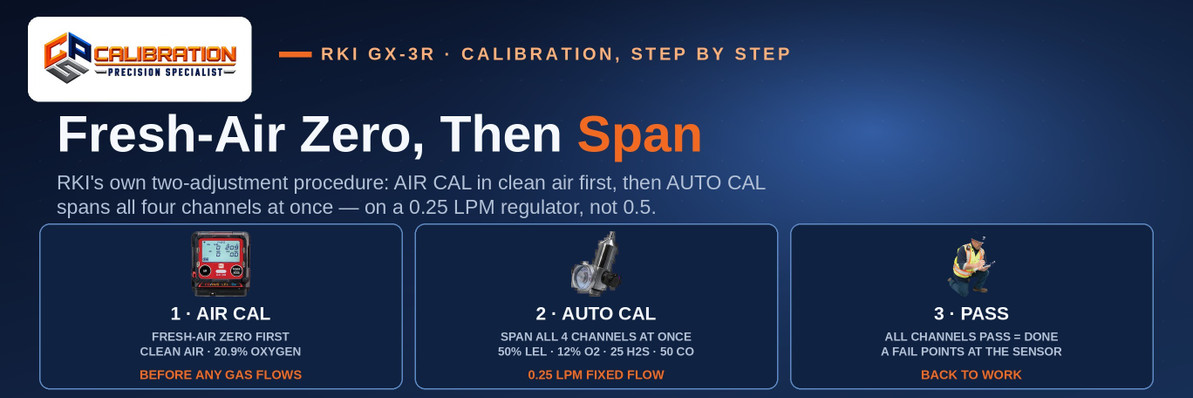
How to Calibrate an RKI GX-3R: Fresh-Air and Span Calibration, Step by Step
To calibrate an RKI GX-3R, you make two adjustments in User Mode, in this order: AIR CAL, which sets the fresh-air zero in clean air (20.9% oxygen), and AUTO CAL, which spans all four channels at once against a 4-gas cylinder — 50% LEL methane, 12% oxygen, 25 ppm H2S, 50 ppm CO — fed through the calibration cup on a 0.25 LPM fixed-flow regulator, flowing the gas for 1 minute before the instrument sets the calibration. Anything less than both adjustments is not a full calibration; it is a bump test.
The GX-3R is the most common 4-gas monitor we see, and its calibration is genuinely a do-it-yourself job — RKI built the whole procedure into two menu items. But it has to be done completely and in order: the fresh-air adjustment first, the span second, with the gas and the flow rate RKI actually specifies. This post walks the procedure exactly as RKI's operator's manual lays it out in Chapter 5, with the gear list linked to the actual products, the checks to make before gas ever flows, and an honest section on the point where you stop adjusting and start replacing — or send the instrument to a bench. If you would rather not do it yourself at any point in what follows, CPS calibrates GX-3Rs in-house for $90 — skip to the end for how that works.
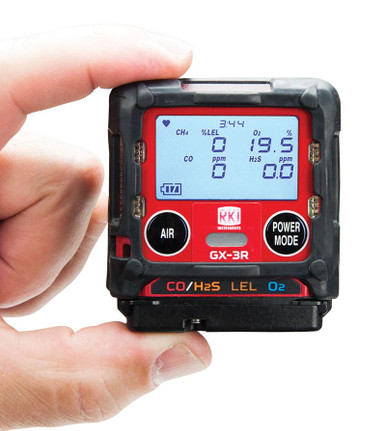
RKI GX-3R 4-Gas Monitor – LEL, O₂, CO & H₂S
How to calibrate an RKI GX-3R: AIR CAL fresh-air adjustment, then AUTO CAL span with a 4-gas cylinder (50% LEL / 12% O2 / 25 ppm H2S / 50 ppm CO) on a 0.25 LPM fixed-flow regulator — RKI's own procedure, step by step.
$590–$690 configured
See the GX-3RWhat Do You Need to Calibrate a GX-3R?
RKI's own preparation list for a span adjustment is short: known concentrations of the gases being detected, a 0.25 LPM fixed flow regulator, non-absorbent tubing, and a calibration cup. Here is the working kit, with the details that matter:
| Item | What to get | Why it matters |
|---|---|---|
| The instrument | RKI GX-3R 4-Gas Monitor — $640 | The standard 4-gas: LEL, O2, CO, H2S. Charged, warmed up, and in a non-hazardous location before you start. |
| Calibration gas | 4-Gas Calibration Gas – RKI Equivalent — CH4 50% LEL / O2 12% / H2S 25 ppm / CO 50 ppm in nitrogen; 34 L $195, 60 L $245, 120 L $295 | These are the factory Cylinder A values the GX-3R displays at AUTO CAL, and they sit inside RKI's calibration limits on every channel (LEL 5–75%, O2 0–18%, H2S 1–200 ppm, CO 15–2,000 ppm). One cylinder spans all four channels at once. |
| Regulator | C-10 Fixed Flow Regulator — $130; order the 0.25 LPM version (R-025) | RKI specifies 0.25 LPM fixed flow for the GX-3R — not the 0.5 LPM used on so much other gear. The C-10 inlet matches the 34 L cylinder above. Fixed flow, not demand flow — here is why the two regulator types are not interchangeable. |
| Calibration cup | RKI Calibration Adapter for GX-3R (81-1192) — $10.60 | The cup that seals over the GX-3R's sensors and delivers gas evenly. One ships with the instrument; this is the replacement when it cracks or walks off. |
| Zero air (when the room air isn't clean) | Zero Air — Oxygen 20.9% in Nitrogen — from $59 | AIR CAL needs genuinely fresh air. If the air where you're standing can't be trusted, this cylinder through the cup is the clean-air substitute — see the zero section below. |
| Tubing | Non-absorbent tubing, regulator to cup inlet | RKI specifies non-absorbent tubing so the tubing itself doesn't soak up the reactive gases (H2S especially) and starve the sensors. |
Questions before you begin — a value that doesn't match, a fitting that doesn't look right, a cylinder you're not sure about? Call us at (865) 900-8844. Five minutes on the phone before gas flows is cheaper than a failed calibration, a wasted cylinder, or a monitor you no longer trust. That is a standing offer, not a sales line: we would rather talk you through it than repair the aftermath.
First, Get Into User Mode
Calibration on the GX-3R lives in User Mode, under the GAS CAL menu. Two things to know before you go in: while the instrument is in User Mode it is not operating as a gas detector — RKI prints that as a warning — so do this somewhere non-hazardous, and don't wear it for protection mid-calibration.
- Take the GX-3R to a non-hazardous location and turn it off.
- Press and hold AIR, then press and hold POWER MODE. When you hear a beep, release both buttons.
- If a password screen appears, a password has been set on this unit (the factory setting is OFF) — enter it with AIR and POWER MODE. Otherwise you land directly in User Mode, with BUMP as the first menu item and an M at the top of the screen confirming you're in User Mode.
From here, AIR scrolls and POWER MODE selects. Everything below happens inside GAS CAL.
Step 1: AIR CAL — Set the Fresh-Air Zero
The fresh-air adjustment tells the instrument what clean air looks like: zero on the combustible and toxic channels, 20.9% on oxygen. Every later reading is measured against this zero, which is why RKI puts it first — a full calibration is AIR CAL and AUTO CAL, in that order, every time.
- Find a genuinely fresh-air environment: normal oxygen content (20.9%) and free of toxic and combustible gases. Not the plant floor, not beside a running engine or a process vent. If the air around you fails that description, your zero will be wrong in exact proportion to how dirty the air is — see the zero-air note below.
- In User Mode, press AIR to scroll to GAS CAL, then press and release POWER MODE. The AIR CAL menu item appears.
- Press and release POWER MODE to enter AIR CAL. The screen shows the four channels at their fresh-air values: 0 %LEL, 20.9% O2, 0 ppm CO, 0.0 ppm H2S.
- Make sure the GX-3R has been turned on for at least 45 seconds before continuing — RKI asks for this on both adjustments, so the sensors are awake and settled.
- Press and hold AIR until the screen prompts you to release it.
- If the adjustment passes, the instrument returns to the GAS CAL menu. If it fails, "FAIL AIR" displays — press and release POWER MODE to acknowledge it. A failed fresh-air adjustment usually means the air wasn't fresh, or a sensor has drifted too far to zero; don't just retry it in the same air and hope.
When the room air isn't clean: AIR CAL is only as honest as the air it's done in. Zeroing in contaminated air teaches the instrument that contamination is zero — the dangerous kind of wrong, because every later reading is shifted by that error. If you can't get to air you trust, the alternative is a zero air cylinder (20.9% oxygen in nitrogen) fed through the calibration cup, so the instrument breathes known-clean gas while you run the same AIR CAL steps. For the bigger picture on the two cylinders every calibration uses, see zero gas vs. span gas.
Before the Span: Two Checks That Prevent Most Failures
Most failed AUTO CALs are lost before the gas flows, on one of these two screens:
- Do the instrument's stored values match your cylinder? In GAS CAL, scroll to AUTO CAL, and use AIR to reach CAL--P. The values there must match the concentrations printed on your cylinder label. As shipped, the GX-3R's Cylinder A values are 50% LEL, 12.0% O2, 50 ppm CO, and 25.0 ppm H2S — exactly the mix in the cylinder linked above, which is why that cylinder is the painless choice. If a previous owner set different values for a different mix, either edit CAL--P to your cylinder or use the cylinder the values describe. The oxygen value deserves a special look: the 4-gas cylinder holds 12% oxygen, not zero — the instrument must be told 12.0, and it already is, from the factory.
- Are the right gases assigned to the cylinder you're about to flow? As shipped, all four standard gases are assigned to Cylinder A, so one cylinder calibrates all four channels in a single application. If the assignments were changed (each gas can be assigned its own cylinder), AUTO CAL will walk you cylinder by cylinder — workable, but know which world you're in before you start.
Step 2: AUTO CAL — Span All Four Channels
- Install the calibration cup onto the GX-3R. Use the label and imprinting on the cup to get its orientation right relative to the instrument, and push it on all the way — a cup sitting crooked leaks span gas and fails calibrations that should pass.
- Connect the regulator to the cup's inlet with the tubing.
- In User Mode, press AIR to scroll to GAS CAL → POWER MODE → scroll with AIR to AUTO CAL → POWER MODE. The display shows the gases assigned to Cylinder A with their calibration values (50 / 12.0 / 50 / 25.0), alternating "CYL A" and "AUTO CAL" at the bottom.
- Scroll with AIR if needed to the Auto Cal screen for the cylinder you're calibrating (Cylinder A, as shipped).
- Confirm the instrument has been on for at least 45 seconds, then press and release POWER MODE. The gas readings flash, and the bottom of the screen alternates "APPLY" and "AUTO CAL".
- Screw the regulator onto the cylinder — and if the cylinder contains H2S (this one does), vent the regulator while you install it: open the regulator knob counterclockwise as you thread it on. RKI calls this out specifically for toxic-gas cylinders, because it keeps air from being pushed into the cylinder and degrading the gas.
- Let the gas flow for 1 minute. Watch the readings climb toward the cylinder values and settle — CH4 toward 50 %LEL, O2 falling toward 12.0%, CO toward 50 ppm, H2S toward 25 ppm.
- Press and release POWER MODE. The instrument sets the calibration and tells you the outcome: it indicates that all channels passed, or it indicates which channels failed, with a FAIL display.
- Close the regulator, unscrew it from the cylinder, and remove the calibration cup. Press and release POWER MODE to return to Measuring Mode. (Changed your mind mid-application? Pressing AIR and POWER MODE together backs out of the gas application screen without calibrating.)
That's the whole procedure. A GX-3R that passes AIR CAL and AUTO CAL with the right gas, at the right flow, with values that match the cylinder, is calibrated — document the date, because the instrument's calibration reminder counts from it.
A Bump Test Is Not a Calibration
These two get conflated constantly, so plainly: a bump test exposes the sensors to gas long enough to prove they respond and the alarms fire. A calibration adjusts the instrument's readings against known gas. RKI's rule, from the manual: bump test the GX-3R before each day's use — in User Mode's BUMP item, or by applying gas in Measuring Mode — and the instrument does not need to be calibrated unless it fails the bump test or doesn't respond appropriately in Measuring Mode. Passing bumps mean the daily check is doing its job; a failed bump is what sends you to the procedure above. Our post on how to bump test a gas detector covers the daily check itself, and bump test vs. calibration covers the distinction in full. Calibration intervals beyond that are use-dependent: RKI puts typical frequencies from monthly to quarterly, with daily-use instruments toward the weekly-to-monthly end — our calibration frequency guide works through choosing an interval.
One channel keeps its own calendar: if your GX-3R carries the H2-compensated CO sensor, its hydrogen response needs to be set monthly and whenever that sensor is replaced — the one exception to the calibrate-on-condition rhythm above.
What If It Fails? When to Stop and What It Means
A failed calibration is information, not an inconvenience to retry away. Work it in this order:
- FAIL AIR: the zero couldn't be set. Almost always the air (not fresh — redo it in genuinely clean air or on zero air) or a sensor too far gone to zero. Retrying in the same air proves nothing.
- One channel FAILs AUTO CAL while the others pass: that channel's sensor couldn't reach the span value. First confirm the unglamorous causes — cylinder not empty and not past its date, CAL--P value for that channel matches the label, cup seated, correct 0.25 LPM regulator, full 1-minute flow. If all of that is right and the channel still fails, the sensor is at or near end of life. RKI builds the diagnosis in: if you enable MAX SPAN display, the instrument shows the maximum adjustment it could make — and if that maximum sits close to the calibration gas value, the sensor should be replaced soon. A combustible sensor near the end also starts limiting the gas-conversion list in Display Mode (the list shows as LIMITED) — RKI's instruction for that one is blunt: replace the sensor as soon as possible.
- Readings won't settle during the 1 minute of flow: suspect flow and leaks before sensors — wrong regulator flow rate, a cracked cup, tubing that absorbs the gas (RKI specifies non-absorbent tubing for a reason), or a cylinder nearly empty.
This is the point to pick up the phone: if a channel won't calibrate after the checks above, call CPS at (865) 900-8844. We will tell you straight whether you're looking at a sensor (GX-3R sensors are replaceable, and we stock them), a sick instrument, or something simpler you can fix on the spot — and if it needs a bench, our in-house calibration service is $90 for a 4-gas GX-3R, every channel calibrated, with as-found and as-left data on the certificate. What we won't do is tell you to keep re-running AUTO CAL until it passes; a sensor forced through is a sensor lying politely.
Calibrating a Fleet? The Docking Station Does This Automatically
Everything above is the manual procedure, one instrument at a time — right for a monitor or three. For a fleet, RKI's SDM-3R docking station ($1,322) automates bump tests and calibrations, keeps the records, and removes the human steps (cup, regulator, timing) from the routine. It doesn't change the chemistry — same gas, same two adjustments — it just makes a dozen GX-3Rs behave like one chore instead of twelve.
Frequently Asked Questions
How do you calibrate an RKI GX-3R?
In User Mode (hold AIR, then hold POWER MODE from off, release at the beep), run GAS CAL → AIR CAL in fresh air first — hold AIR until prompted to release — then GAS CAL → AUTO CAL with the calibration cup fitted and a 4-gas cylinder (50% LEL CH4, 12% O2, 25 ppm H2S, 50 ppm CO) flowing through a 0.25 LPM fixed-flow regulator for 1 minute, and press POWER MODE to set it. The instrument reports PASS for all channels or names the channels that failed. Both adjustments, in that order, are a full calibration.
What calibration gas does an RKI GX-3R need?
The standard RKI 4-gas mix: methane at 50% LEL, oxygen at 12%, hydrogen sulfide at 25 ppm, and carbon monoxide at 50 ppm, in a nitrogen balance. Those concentrations are the GX-3R's factory Cylinder A calibration values, and they fall inside RKI's allowed calibration ranges on every channel (combustible 5–75% LEL, oxygen 0–18%, H2S 1–200 ppm, CO 15–2,000 ppm). CPS's 34 L cylinder of this mix is $195; see what calibration gas you need for a 4-gas detector for the wider selection logic.
What regulator do you need to calibrate a GX-3R?
A 0.25 LPM fixed-flow regulator — that is the flow rate RKI specifies for the GX-3R in the operator's manual, and it is lower than the 0.5 LPM commonly used elsewhere, which is exactly why it's worth stating plainly. The fitting must match your cylinder: the 34 L RKI-equivalent cylinder CPS sells uses a C-10 connection, and the matching C-10 fixed-flow regulator is $130 (order the 0.25 LPM version, R-025). A demand-flow regulator is the wrong tool for a diffusion instrument on a cup.
How often should you calibrate an RKI GX-3R?
RKI's manual ties frequency to use: instruments used daily may need calibration weekly or monthly, instruments used a few times a year may need it before each use, and typical frequencies run monthly to quarterly. Separately, bump test before each day's use — and a failed bump test or a sluggish response means calibrate now, whatever the calendar says. The exception is the H2-compensated CO sensor, whose hydrogen response is set monthly and at sensor replacement.
What's the difference between AIR CAL and AUTO CAL on a GX-3R?
AIR CAL sets the zero: in fresh air it tells the instrument that combustible and toxic channels read 0 and oxygen reads 20.9%. AUTO CAL sets the span: with calibration gas flowing, it adjusts each channel's response to the known concentration (50% LEL, 12% O2, 25 ppm H2S, 50 ppm CO). Zero without span leaves the readings unanchored at working concentrations; span without a fresh-air zero first builds the adjustment on a dirty baseline. RKI requires both for a full calibration.
Can you calibrate a GX-3R without fresh air?
Not honestly in dirty air — AIR CAL in contaminated air sets a false zero and shifts every later reading. The two legitimate routes are to move the instrument to air that is genuinely fresh (20.9% oxygen, no toxic or combustible gas) or to feed it zero air — 20.9% oxygen in nitrogen — from a cylinder through the calibration cup while running the AIR CAL steps. What you can't do is zero it in plant air and trust it afterward.
What does FAIL mean on a GX-3R calibration?
The instrument displays FAIL and indicates which channels failed to calibrate — on AIR CAL it shows "FAIL AIR" for a fresh-air adjustment that couldn't be made. A span failure on one channel, with gas, values, flow, and cup all verified correct, means that channel's sensor could not reach the calibration value: it is at or near end of life and should be replaced, not re-run until it squeaks through. If you're staring at a FAIL and aren't sure which cause you're looking at, call CPS at (865) 900-8844 and we'll walk the checks with you.
How long does it take to calibrate a GX-3R?
The RKI procedure itself is short: the instrument needs to be on for 45 seconds before each adjustment, and the span gas flows for 1 minute before you press POWER MODE to set the calibration. Most of the real time is setup — fitting the cup, checking CAL--P against the cylinder label, venting the regulator as you install it — so budget a few minutes per instrument once the kit is laid out, and longer the first time while the menu path is new.
Why won't my GX-3R calibrate?
The usual causes, in the order we'd check them: the calibration values stored in the instrument (CAL--P) don't match the cylinder label — especially oxygen, which is 12% in a 4-gas mix, not zero; the regulator is the wrong flow (the GX-3R wants 0.25 LPM fixed flow) or is a demand-flow type; the calibration cup isn't seated or is cracked; the gas application was cut short of the full minute; the cylinder is empty or past its shelf life; or the failing channel's sensor is spent. Rule out the first six before condemning the seventh — but if the seventh is where you land, that's a sensor replacement, and calibration attempts won't revive it.
How much does it cost to have an RKI GX-3R calibrated professionally?
At CPS, in-house calibration is $90 for a four- or five-gas instrument (single-gas is $55) — send the GX-3R in and it comes back calibrated on every channel with a certificate carrying the full as-found and as-left data. Details are on our calibration services page, or call (865) 900-8844 to book it in. Doing it yourself with your own cylinder and regulator costs nothing per calibration once you own the kit — the $195 cylinder spans a lot of instruments — which is why the right answer depends on how many monitors you run and how much you value the paperwork being someone else's problem.
The Bottom Line
Calibrating a GX-3R is a two-adjustment job done in User Mode: AIR CAL in air you trust (or on zero air), then AUTO CAL with the standard 4-gas mix at 0.25 LPM for one minute, values checked against the cylinder before gas flows. Bump tests are the daily proof it responds; calibration is the adjustment when it doesn't — and a channel that fails with everything else verified right is a sensor asking to be replaced, not a prompt to try again harder.
Stuck anywhere in this procedure — a menu that doesn't match, a value that won't settle, a FAIL you can't interpret? Call CPS Calibrations at (865) 900-8844 and we'll talk you through it, or send the instrument in and we'll calibrate it on our bench for $90 and return it with the full certificate. Nobody's safety program was ever improved by guessing at a calibration.
CPS Calibrations · 109 S. Front Street, Rockwood, TN 37854 · Calibration Gas · Calibration Services · Contact Us
Need a calibration you can file?
In-house calibration at CPS in Rockwood, Tennessee — $55 for single-gas instruments, $90 for 4- and 5-gas — every channel, as-found and as-left data, full certificate.
See Calibration Servicesor call 865-900-8844
Recent Posts
-
Can You Add a Pump to a SENKO SGT-P or MGT?
Yes — SENKO's SP-Pump101 external sampling pump ($330, part AAA006000) fits the SGT, SGT-P, and MGT, …Nov 12th 2026 -

What Refrigerant Detection Does a Grocery Store Need?
A grocery store needs refrigerant detection in three places: low-mounted carbon dioxide (R-744) sens …Nov 11th 2026 -

What Is LEL and UEL? The Explosive Range, Gas by Gas
The LEL is the lowest concentration of a gas in air that can explode, and the UEL is the highest: me …Nov 10th 2026