
Methane Monitoring in Buildings Built Over Landfills and Old Fill
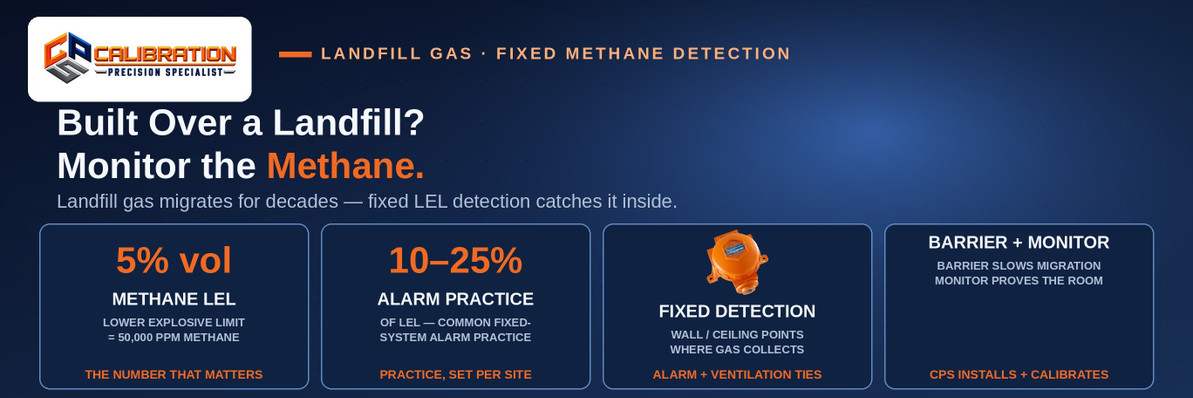
A building over a landfill or old fill needs fixed methane monitoring because the ground beneath it generates landfill gas for decades: methane that migrates through soil and into the structure must be detected where it collects, with alarms set well below methane's lower explosive limit of 5% by volume — common fixed-system practice alarms at 10–25% of that limit. A vapor barrier slows the migration; fixed LEL detection and alarms are the layer that proves the occupied building is staying clear, and reports it the day it is not.
Redevelopment keeps putting good buildings on complicated ground: the closed municipal landfill that becomes a warehouse district, the old fill under a school site, the industrial parcel whose buried history is documented in the Phase II and engineered around in the design. The engineering answer usually includes a vapor barrier and, often, a sub-slab venting or depressurization system — the subject of our hub post on vapor intrusion mitigation monitoring. For methane specifically, that answer is only half the system. This post is about the other half.
Why Does Ground Over a Landfill Keep Making Methane?
Because the fuel is still there. Landfill gas is produced by the decomposition of buried organic material, and decomposition runs on a timescale of decades, not construction seasons. The gas generated in the waste mass is principally methane and carbon dioxide, and it does not stay politely in place: it moves through the soil along pressure gradients and along the easy paths — utility trenches and corridors, granular backfill, and the foundation elements of whatever gets built on top. "Old fill" belongs in the same sentence as "landfill" for exactly this reason: uncontrolled historic fill often contains the same organic material, with none of the documentation.
A building changes the migration picture in one important way: it gives the gas somewhere to collect. Soil gas entering through slab cracks, joints, sumps, and penetrations reaches enclosed indoor spaces — and methane, which is lighter than air, rises and accumulates at the tops of those spaces: ceiling voids, enclosed mechanical rooms, elevator shafts, and any pocket where air does not turn over. Outdoors, migrating methane disperses. Indoors, in a closed room, it can build toward the concentration that matters.
What Concentration Matters? The LEL, and the Alarm Practice Below It
Methane's lower explosive limit (LEL) is 5% methane by volume in air — 50,000 ppm. Below that concentration the mixture is too lean to ignite; at and above it, an ignition source has a fuel-air mixture to work with. Every methane monitoring decision is measured against that single number, and fixed detection is designed to act long before a room approaches it:
| Level | Methane by volume | What it means |
|---|---|---|
| 10% of LEL | 0.5% vol (5,000 ppm) | Low end of common fixed-system alarm practice — early warning, ventilate and investigate |
| 25% of LEL | 1.25% vol (12,500 ppm) | High end of common alarm practice — respond now, before levels climb further |
| 100% of LEL | 5% vol (50,000 ppm) | The lower explosive limit itself — the concentration monitoring exists to never reach indoors |
One framing note, because accuracy matters more than punch here: the 10–25% of LEL band is practice, not a universal law. Alarm setpoints on a given building are set by its design — the engineer's documents, the site's regulatory conditions, and the jurisdiction's requirements. Many jurisdictions do regulate landfill-gas protection for buildings, some in considerable detail; the requirements vary enough, jurisdiction to jurisdiction and project to project, that the only honest universal statement is this: read your project's governing documents and your authority having jurisdiction's rules, and set the alarms there. What does not vary is the physics in the table, or the principle that alarms belong at a fraction of the LEL, not at it.
Why Pair Monitoring With the Barrier Instead of Trusting the Barrier?
Because the barrier and the monitor answer different questions. The barrier — with sub-slab venting where the design calls for it — is a migration control: it makes entry harder and gives soil gas a preferred path that is not the building. It is passive, it is buried, and after the slab is poured it cannot be inspected. The monitor is the verification layer, and it covers the barrier's three blind spots:
- Preferential pathways beat membranes. Gas that cannot cross a membrane travels along it — to the penetration, the joint, the utility corridor that enters the building above the barrier line. Detection in the occupied space is what catches the pathway nobody drew.
- Conditions change. Waste keeps generating, groundwater and barometric pressure shift migration patterns season to season, and buildings get renovated — new penetrations, new enclosed rooms, new air-handling patterns. A design assumption from construction year one is monitored, or it is merely hoped.
- The audience is different. The barrier protects the building; the alarm protects the people, in real time. A rising methane level in an occupied mechanical room is an event someone must act on that day — ventilate, restrict ignition sources, investigate — and only detection with alarms produces that action.
The same logic runs through the whole cluster: for contractors whose projects carry this scope, our partner post covers who handles the monitoring and alarm scope when the barrier crew does not self-perform it.
What Does a Fixed Methane Monitoring System Look Like?
In outline, the same architecture as any fixed gas detection, placed for a rising gas:
- Detection points high in the spaces at risk — near ceilings and at the tops of enclosed rooms, shafts, and voids where methane collects, covering the rooms the design identifies: typically the lowest occupied level's enclosed spaces, mechanical and utility rooms, and collection points along entry pathways.
- Alarms that reach people: local audible/visual alarm in the space, plus reporting to a panel, building system, or telemetry path so an event at night is an event someone knows about. Alarm actions — ventilation start, for example — are tied in where the design requires them.
- Calibration on a schedule. An LEL sensor that is never calibrated is a guess with a part number. Every channel is calibrated at commissioning and kept on a calibration record — we calibrate every channel a system carries, and the record is the document the owner produces when the jurisdiction, the insurer, or a buyer asks how the system is maintained.
CPS Calibrations installs this scope turnkey under our fixed system installation work: detection points, alarms and reporting, startup testing with recorded readings, and calibration from day one. Fixed systems are quoted in writing per project — point count, alarm architecture, and the design's requirements decide the price, and we will not pretend otherwise on a web page. Call 865-900-8844 with the drawings and the design's monitoring section, and the conversation starts from your documents, not from a catalog.
Frequently Asked Questions
Why do buildings over landfills need methane monitoring?
Because the waste mass under the building continues to generate landfill gas — principally methane and carbon dioxide — for decades after burial. That gas migrates through soil and along utility corridors and backfill, enters buildings through slab openings, and, being lighter than air, accumulates at the tops of enclosed indoor spaces. Monitoring is how the building knows the gas is arriving, at concentrations far below danger, instead of discovering it at a dangerous one.
What is methane's lower explosive limit (LEL)?
5% methane by volume in air — 50,000 ppm. Below the LEL the mixture is too lean to ignite; at or above it, an ignition source can ignite the mixture. Fixed methane detection is specified as a percentage of that limit, so a reading of "25% LEL" means 1.25% methane by volume — one quarter of the way to the explosive threshold.
At what level should methane alarms be set in a building?
Common fixed-system practice sets alarms in the 10–25% of LEL range — 0.5% to 1.25% methane by volume — so occupants and responders act while levels are still a fraction of the explosive limit. The governing setpoints for a specific building come from its design documents and jurisdictional requirements, which vary; alarm levels are a design decision, not a number to copy from another project or improvise during installation.
Is methane monitoring legally required for buildings on landfill sites?
In many jurisdictions, yes — landfill-gas protection for buildings, which can include monitoring, is code- or ordinance-driven in much of the country, and individual sites often carry monitoring conditions from their regulatory closure or redevelopment approvals. The requirements vary substantially by jurisdiction and project, so the controlling answer for a given building is in its local code, its permits, and its design documents. What is uniform is the underlying hazard and the detection practice used to manage it.
Where should methane detectors be placed in a building?
High. Methane is lighter than air, so it rises and collects at the tops of enclosed spaces — near ceilings, in ceiling voids, and at the high points of mechanical rooms, shafts, and other enclosed volumes the design identifies as collection risks, particularly on the lowest occupied level and along gas entry pathways. Placement follows the gas's behavior and the project's design; a detector mounted at breathing height for a rising gas reads the room's cleanest air.
Does a vapor barrier eliminate the need for methane monitoring?
No. A barrier reduces migration across the slab, but gas travels along preferential pathways — penetrations, joints, utility corridors — that reach the building by routes a membrane does not close, and a buried barrier cannot be inspected or report its own condition after construction. Monitoring verifies what the occupied space is actually experiencing, and alarms while there is time to act. The two are complementary layers, which is why landfill-gas designs so often carry both.
What is the difference between methane monitoring for vapor intrusion and for explosion protection?
They are the same instruments serving two framings of one hazard. The vapor-intrusion framing asks whether soil gas is entering the building at all — a performance question about the mitigation system. The explosion-protection framing asks whether methane in occupied space is approaching a fraction of its 5%-by-volume explosive limit — a life-safety question with alarms attached. A fixed LEL detection system with properly set alarms answers both at once.
How often do fixed methane detectors need calibration?
On the interval the manufacturer specifies for the sensor, recorded like any other life-safety instrument. LEL sensors drift and can be desensitized by exposure history, so an uncalibrated point cannot be trusted at exactly the moment it matters. CPS calibrates every channel at commissioning and carries fixed systems on a calibration schedule with records — the maintenance file is part of what a monitoring system owes its owner and its jurisdiction.
Can methane monitoring be added to an existing building over fill?
Yes — fixed detection is routinely retrofitted: detection points are surface- or conduit-mounted devices in the identified spaces, alarms and reporting are added as new devices, and telemetry can carry the reporting where wiring is impractical. The design questions come first — which spaces, which setpoints, whose requirements — and they are answered from the building's documents and a site survey, not from a product list.
What should happen when a building's methane alarm activates?
Treat it as the early warning it is designed to be: at practice alarm levels (10–25% of LEL) the concentration is a fraction of the explosive limit, and the correct responses are the ones in the building's alarm plan — ventilate the space, keep ignition sources out of it, notify the responsible party, and have the cause investigated with calibrated instruments before the space returns to normal use. An alarm that produces a shrug has failed even if the sensor worked; the response plan is part of the system.
The Bottom Line
Landfill gas generation outlives every construction schedule: methane at a 5%-by-volume explosive limit will keep arriving under buildings on landfill and fill ground for decades, and the only layer that reports its arrival indoors is fixed LEL detection, alarmed at a fraction of the limit and calibrated on the record. Barriers slow the gas. Monitors prove the room.
Building on landfill or fill ground, with a monitoring scope in the design? Call CPS Calibrations at 865-900-8844 — we install and calibrate fixed methane detection turnkey, quoted in writing from your drawings.
*CPS Calibrations · 109 S. Front Street, Rockwood, TN 37854 · Fixed System Installation · Vapor Intrusion Mitigation Monitoring*
Need a calibration you can file?
In-house calibration at CPS in Rockwood, Tennessee — $55 for single-gas instruments, $90 for 4- and 5-gas — every channel, as-found and as-left data, full certificate.
See Calibration Servicesor call 865-900-8844
Recent Posts
-

What Is Remote Monitoring for Fixed Gas Detection?
Remote monitoring for fixed gas detection means a fixed system's live readings, trends, and alarm hi …Nov 23rd 2026 -

What Are the Key Differences Between the GX-6000 and GX-6100?
The RKI GX-6100 is the current replacement for the discontinued GX-6000: both are pumped 6-gas monit …Nov 22nd 2026 -

How to Read a PID Correction Factor Chart
To read a PID correction factor chart, find your vapor’s row, take the factor under your own lamp en …Nov 21st 2026