
Vapor Barrier Contractors: Who Handles Your Monitoring and Alarm Scope?
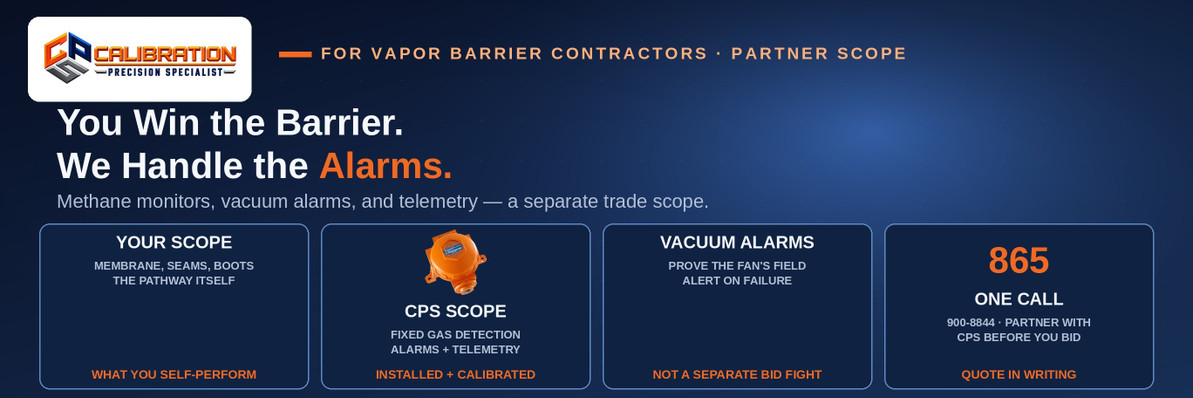
On most vapor mitigation projects, the monitoring and alarm scope — fixed methane monitors, sub-slab vacuum alarms, and telemetry — is a separate gas-detection trade from the barrier itself, and the cleanest way for a barrier contractor to deliver it is to sub it to a gas-detection shop. CPS Calibrations performs that scope as a partner sub-scope for vapor barrier and mitigation contractors: detection points, alarms, and telemetry installed, commissioned, and calibrated, quoted in writing, so the barrier crew stays on the membrane and the monitoring line in the spec is somebody's named job.
This post is addressed to one reader: the contractor who installs vapor barriers and mitigation systems. You know your trade cold — membrane, seams, boots, detailing, smoke testing, and a slab that passes inspection. This is not a post about that work. It is about the other pages of the same specification — the pages that show up in Division-scoped submittals and punch lists, written by an engineer who quite reasonably assumed that somebody on the project team does instruments:
- Fixed gas detection in the occupied space — methane monitors where the design gas is landfill gas, alarming locally and, often, to a panel or building system.
- Vacuum monitoring and alarms on the sub-slab system — the proof that the depressurization field exists, with an alarm state when it does not.
- Telemetry — readings and failures reported off the wall: to a gateway, to a dashboard, to a text message received by a human who is responsible for acting on it.
- Commissioning documentation — startup readings, alarm tests, and calibration records that the engineer of record files and the owner relies on.
None of that is membrane work. All of it lands on your project anyway.
Why Does the Monitoring Scope Keep Landing on the Barrier Crew?
Because the barrier is the visible system, and everything attached to it looks — from a distance — like one scope. The engineer designs one mitigation system; the drawings show one slab, one fan, one set of monitoring points. When the bid set does not break the instrument work out as its own line, it defaults to the contractor holding the mitigation scope: you. From there, one of three things happens, and two of them are bad:
- It gets value-engineered into silence. The monitoring is descoped or deferred, the system is turned over unproven, and everyone's exposure — yours included, because your name is on the system — runs until the first annual review or the first transaction asks for records that do not exist. We wrote the hub post on exactly this failure: vapor intrusion mitigation monitoring.
- It gets self-performed with borrowed capability. A detector gets mounted, an alarm gets wired, and the calibration, the alarm setpoints, and the alert path get approximated. Fixed gas detection is unforgiving about approximation: a methane point alarmed at the wrong level, or never calibrated, is a liability wearing a conduit. Alarm practice on fixed methane systems is commonly set in the 10–25% of LEL range against methane's 5%-by-volume explosive limit — a design decision, per project, not a number to improvise on a ladder.
- It gets subbed to the trade that does it daily. Which is the option this post is selling.
What Does the CPS Sub-Scope Actually Cover?
Everything on the instrument side of the system, end to end:
| Scope item | What CPS does |
|---|---|
| Fixed gas detection | Methane (LEL) detection points in occupied and collection spaces, mounted and wired, tied to local alarms and panels as the design requires |
| Vacuum monitoring + alarms | Sub-slab pressure/vacuum monitoring points and sensors, alarm state on loss of the pressure field — the detail is in our sub-slab telemetry post |
| Telemetry | Gateway and alert configuration: the readings go somewhere, and a fan failure becomes a text and an email to named people, not a discovery at the next inspection |
| Commissioning | Startup readings recorded, every alarm function-tested, alert delivery confirmed with the recipients — the written record the engineer files |
| Calibration | Every gas channel calibrated at startup and entered into a calibration record — we calibrate every channel, and the schedule for the next one exists from day one |
The landfill-gas version of the detection scope is its own conversation — see methane monitoring in buildings built over landfills and old fill. The working arrangement is deliberately simple: our scope is quoted in writing for the project, scheduled against your slab and your fan startup, and documented to the engineer like any other submittal. Our fixed system installation practice is the same work we do standing alone for owners and engineers; as your sub, it simply wears your project's name.
What Does Partnering Change at Bid Time?
Three practical things. First, the line item exists. When the spec carries monitoring, your bid carries a real number from the trade that will perform it — not an allowance, not a hope, not a change order waiting for its moment. Second, the submittal exists. Detector cut sheets, alarm logic, telemetry description, and a calibration plan are documents we produce routinely; they go into your submittal package instead of being assembled the week they are due. Third, the punch list shrinks. The monitoring items that typically survive to substantial completion — the untested alarm, the unconfigured alert, the missing calibration certificate — are the entire scope for us, so they close during the work, not after it.
And one thing it does not change: the barrier stays yours, visibly and contractually. We are not a barrier contractor and we do not bid membrane work. The monitoring scope is the whole of our interest in your project — which is exactly why it is safe to hand to us.
How to Set It Up
Call before you bid, not after you win. With the spec section and the drawings in front of us, we will scope the detection points, the vacuum monitoring, the telemetry path, and the commissioning record, and give you a written number to carry. If the project is already awarded and the monitoring line is already a problem, call anyway — mid-project is when this scope usually finds us, and it is still cheaper than the punch-list version.
Partner with CPS on the monitoring and alarm scope: 865-900-8844. Bring the next set of drawings. We will bring the instruments.
Frequently Asked Questions
Why is monitoring a separate scope from the vapor barrier at all?
Because the trades and the liabilities are different. Barrier work is membrane craft: placement, seams, boots, and detailing, verified by inspection and smoke testing at installation. Monitoring work is instrument craft: gas sensors, alarm setpoints, pressure sensing, telemetry, and calibration, verified by readings and records over the system's operating life. Engineers design them as one system, but they are performed, warranted, and maintained by different trades — and a specification that never separates them leaves the instrument half to whoever is standing closest.
What monitoring items show up most often on barrier projects?
Fixed methane detection with alarms in occupied space on landfill-gas and fill sites; sub-slab vacuum monitoring with an alarm or telemetry alert on loss of the pressure field; and commissioning documentation — startup readings, alarm tests, and calibration certificates — for the engineer of record. Telemetry is appearing in more specifications every year, because owners have learned that an unmonitored fan failure is discovered months late.
Can CPS work as a subcontractor under our contract?
Yes — that is the arrangement this post describes. CPS performs the monitoring and alarm scope as a sub-scope under the barrier or mitigation contractor's project: quoted in writing, scheduled around the slab and fan work, documented to the engineer of record. We also contract the same scope directly for owners and engineers on projects where the scopes were bid separately.
Does CPS install vapor barriers or fans?
No. CPS does not install membrane, and we do not bid barrier work — that stays with the barrier contractor, entirely. Our scope begins where the instruments begin: detection, vacuum monitoring, alarms, telemetry, commissioning, and calibration. Contractors partner with us precisely because we are never competing for their work on the same project.
Who sets the alarm levels on the methane monitors?
The design does — alarm levels are set per the project design and the engineer's requirements. Fixed methane alarm practice commonly falls in the 10–25% of LEL range (methane's lower explosive limit is 5% by volume), but the governing numbers on your project are the ones in the design documents. CPS installs, sets, tests, and documents the alarms to those documents; we do not improvise setpoints in the field.
What commissioning documentation does the engineer get?
A startup record for the monitoring scope: as-installed detection points and monitoring points, recorded startup readings, an alarm function test for every alarm (including delivery of telemetry alerts to their named recipients), and calibration certificates for every gas channel. That file is what the engineer closes the monitoring section of the spec with — and what the owner produces at the first annual review.
When should we bring CPS in — bid time or after award?
Bid time is better: the monitoring line goes into your proposal as a real quoted number with a real submittal behind it, and scheduling is planned instead of improvised. After award works too — much of this scope reaches us mid-project, when the monitoring items are the ones still open. Either way the first step is the same: send the spec section and drawings, and we scope it in writing.
What does the monitoring sub-scope cost?
It is project-specific — detection point count, vacuum monitoring points, telemetry path, and commissioning requirements vary too much for a shelf price, and any shop that quotes one sight-unseen will make it up in change orders. CPS quotes the scope in writing from the drawings and the monitoring section of the spec, as a number a contractor can carry in a bid. Call 865-900-8844 and send the set.
Who handles calibration and service after turnover?
CPS does, as part of the same relationship: every gas channel we install is calibrated at startup and carried on a calibration record, and the calibration services side of the house keeps the schedule from then on. That continuity is half the value of subbing the scope to a calibration shop rather than an installer who leaves at substantial completion — the instruments' history lives in one place.
Our project is outside Tennessee. Will CPS travel for the monitoring scope?
The scope is field installation work, quoted per project, and travel is part of that quote where the project fits our crew and schedule. CPS is based in Rockwood, Tennessee; the honest answer comes from the specific project — drawings, location, and dates. Call 865-900-8844 and we will tell you plainly whether it fits, before anyone carries a number that depends on us.
The Bottom Line
The barrier is your trade and the monitoring is ours: methane monitors, vacuum alarms, telemetry, commissioning, and calibration are a gas-detection scope that happens to live on your project. Sub it to the shop that does it daily, carry a real number at bid time, and close the monitoring line at startup instead of at the punch list.
Barrier contractors — partner with CPS Calibrations on the monitoring and alarm scope. Call 865-900-8844 with the next set of drawings, and we will quote the instrument scope in writing.
*CPS Calibrations · 109 S. Front Street, Rockwood, TN 37854 · Fixed System Installation · Calibration Services*
Need a calibration you can file?
In-house calibration at CPS in Rockwood, Tennessee — $55 for single-gas instruments, $90 for 4- and 5-gas — every channel, as-found and as-left data, full certificate.
See Calibration Servicesor call 865-900-8844
Recent Posts
-

What Is Remote Monitoring for Fixed Gas Detection?
Remote monitoring for fixed gas detection means a fixed system's live readings, trends, and alarm hi …Nov 23rd 2026 -

What Are the Key Differences Between the GX-6000 and GX-6100?
The RKI GX-6100 is the current replacement for the discontinued GX-6000: both are pumped 6-gas monit …Nov 22nd 2026 -

How to Read a PID Correction Factor Chart
To read a PID correction factor chart, find your vapor’s row, take the factor under your own lamp en …Nov 21st 2026