
Sub-Slab Depressurization Telemetry: Proving the System Is Running, 24/7
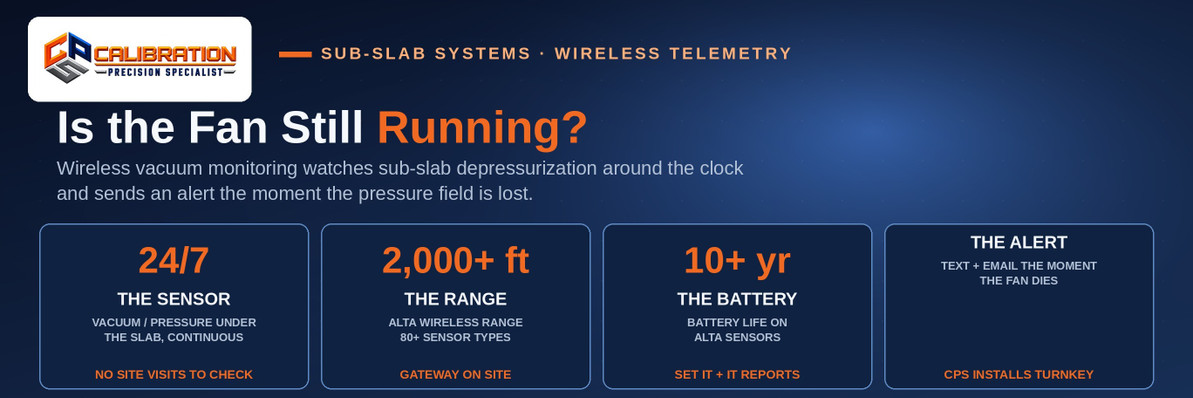
Sub-slab depressurization telemetry is continuous wireless monitoring of the vacuum a mitigation fan maintains under a slab: a pressure sensor at the sub-slab monitoring point reports through a gateway around the clock, and the moment the pressure field is lost — a dead fan, a tripped breaker, a damaged vent — the system sends a text and email alert to the people responsible for the building. It turns "the fan was running at the last inspection" into proof the system is running today. CPS Calibrations installs these monitoring systems turnkey; call 865-900-8844 for an installed system.
A sub-slab depressurization (SSD) system has exactly one moving part, and everything depends on it. The fan holds the collection layer beneath the slab at a lower pressure than the occupied space above, so soil gas flows to the vent stack instead of into the building. While the fan runs, the system works. The fan is also an appliance motor, expected to run continuously for years, in an attic, a closet, or on a roof — and like every appliance motor, it will eventually stop. The only engineering question is who finds out, and when.
This post is about the instrument layer that answers that question continuously. It is the telemetry installment of this series; the hub post covers the whole proof scope — vapor intrusion mitigation monitoring.
What Does the Traditional Check Actually Prove?
The conventional verification model is a site visit: a technician reads the vacuum at the system's monitoring points with a manometer, records it in the O&M log, and leaves. That reading is real, and the log matters. But understand what it proves: the system was running at that moment, on that day. The day after the visit, the evidentiary clock resets to zero. A fan failure the following week sits undetected until the next scheduled visit — which, on the inspection intervals O&M plans commonly use, can mean months of a building believing it is mitigated while its only active component is off.
Periodic inspection also samples the wrong thing if it is the only thing: a system can pass every scheduled reading and still have been down for most of the interval between two of them. Owners, engineers, and regulators have absorbed this lesson across every other kind of monitored system — alarms report continuously because failures do not schedule themselves. Sub-slab systems were simply late to get the same treatment, because until wireless sensing matured, wiring a pressure sensor under a finished slab to a reporting point was disproportionately expensive for a one-fan system.
How Does Wireless Telemetry Watch a Sub-Slab System?
The architecture is three pieces, and none of them requires opening the slab:
- A wireless pressure/vacuum sensor at the monitoring point. SSD systems are built with sub-slab monitoring points; the sensor reads the differential pressure — the vacuum the fan is maintaining — at that point, continuously, and reports it by radio.
- A gateway on site. The gateway collects the sensor's reports and carries them to the monitoring platform. The platform CPS installs on is Monnit's ALTA wireless line: sensors rated at 2,000+ feet of wireless range through typical construction and 10+ years of battery life, which is what makes a sealed, set-and-forget sensor at a slab penetration practical — there is no battery route to run and no conduit to trench.
- Alerts and a record, configured at startup. Readings accumulate into a history the engineer can review, and thresholds — set against the design vacuum the engineer of record established for the system — trigger SMS text and email alerts to named recipients when the pressure field is lost or degrades.
The alert threshold deserves one honest sentence: there is no universal "correct vacuum" number, because the vacuum a system must hold is a design value from the site's diagnostics. Telemetry does not invent that number; it enforces the one already in the design, every hour of every day, instead of at inspection intervals.
The same platform extends naturally as a site's monitoring grows — the ALTA line spans 80+ sensor types, so the gateway that watches sub-slab vacuum can also carry, for example, temperature, water, or additional pressure points the building's program adds later. That breadth is a large part of why CPS standardized its installed telemetry work on it. (The general question of who puts wireless sensors in professionally has its own post in this series: who installs Monnit wireless sensors.)
What Changes When the System Reports for Itself?
Four things, all of them visible in the file at the next annual review:
| Without telemetry | With telemetry |
|---|---|
| Fan failure discovered at the next scheduled inspection | Fan failure discovered by text alert when it happens |
| O&M log shows readings on visit days only | Reading history covers every day, including the ones nobody visited |
| "System operational" is an attestation | "System operational" is a data export |
| A failure found late becomes a data gap to explain to the regulator | A failure found immediately becomes a work order, a repair date, and a closed event in the log |
None of this eliminates inspections — sensors themselves need verification, fans need service, and O&M plans still govern the site. Telemetry changes what inspections are: instead of visits that discover the system's state, they become visits that verify a system whose state is already known.
How CPS Installs It
CPS installs sub-slab telemetry as a turnkey system under our fixed system installation practice:
- Survey the system as built — monitoring points, fan and vent layout, the design vacuum from the engineer's documents, and where a gateway gets power and coverage.
- Install the sensor and gateway, commission the radio link end to end, and confirm readings at the platform against a reference reading at the monitoring point.
- Configure the alerting with the recipients in the loop — thresholds set to the design, alert contacts named by the owner or engineer, and a live test: the fan is switched off, the pressure field falls, and every named phone receives the alert before we call the job done.
- Hand over the record — the reading history starts at commissioning, so the system's file has no blank first chapter.
The installed system is quoted in writing per project — building layout, monitoring point count, and alerting requirements set the scope. To get one installed, call 865-900-8844 and tell us about the system you need watched.
Frequently Asked Questions
What is sub-slab depressurization telemetry?
It is continuous remote monitoring of an SSD system's operating state: a sensor reads the vacuum (differential pressure) the fan maintains at a sub-slab monitoring point, reports it wirelessly through a gateway to a monitoring platform, and generates text and email alerts when the pressure field is lost or falls outside its set threshold. Instead of proving the system ran on inspection day, it produces a continuous record that the system is running — and an immediate alarm on the day it stops.
How does the sensor read vacuum without opening the slab?
SSD systems are constructed with sub-slab monitoring points — access points into the collection layer used for diagnostic and O&M vacuum readings. The telemetry sensor connects at such a point and measures the same differential pressure a technician would read with a manometer on a site visit, except it reads continuously. No slab work is required on a system that has monitoring points; adding a point to a system that lacks one is a small, defined construction task scoped during the survey.
What happens when the fan fails on a telemetered system?
The vacuum under the slab decays toward zero, the sensor's readings cross the alert threshold, and the platform sends SMS text and email alerts to the contacts configured at startup — typically the owner's facilities contact and the engineer or service provider responsible for the system. The failure becomes a same-day work order instead of a discovery at the next inspection, and the reading history documents exactly when the field was lost and when it was restored.
What vacuum level triggers the alert?
The threshold is set against the design vacuum the engineer of record established for that system — there is no universal setpoint, because the pressure field a given fan must hold depends on the building's sub-slab diagnostics and design. At commissioning, CPS sets the alert threshold from the design documents and verifies it with a live fan-off test, so the alert fires on a real loss of field, not on normal fluctuation.
What platform and hardware does CPS install?
CPS installs telemetry systems built on Monnit's ALTA wireless sensor line: 80+ sensor types in the line, sensors with 2,000+ ft wireless range and 10+ year battery life, gateways that carry the readings to the monitoring platform, and SMS/email alerting configured for the site's contacts. The system is installed and configured turnkey by CPS — survey, sensors, gateway, thresholds, alert testing, and handover of the reading record. Call 865-900-8844 for an installed system.
Does telemetry replace the O&M inspections in the system's plan?
No. The operation, maintenance, and monitoring plan still governs the site, and scheduled inspections still verify sensors, fans, and the system as a whole. Telemetry changes the value of those inspections — the inspector reviews a continuous record instead of sampling a moment — and it removes the long blind interval between visits during which a failure could previously hide. Engineers should treat it as strengthening the O&M program, not substituting for it.
How long do the wireless sensors run before needing attention?
The ALTA sensors CPS installs are rated for 10+ years of battery life, which is the property that makes sealed sensors at slab monitoring points practical — no power wiring and no battery maintenance route. Sensor readings are verified against reference readings at commissioning and during scheduled system inspections, so the long battery life never becomes an excuse for an unverified instrument.
Can telemetry be added to an SSD system that is already installed?
Yes — retrofit is the common case. The sensor works at the system's existing monitoring point, the gateway needs only power and radio coverage of the sensor location, and alerting is configured in the platform. Nothing about the fan, vent piping, or slab changes. The survey confirms the monitoring point, the design vacuum to set thresholds against, and gateway placement; installation follows from there.
Who receives the alerts, and can the list change?
Whoever the owner and engineer name — facilities staff, the environmental consultant, the service provider, or several at once — by text and email. The contact list and thresholds are configuration, not hardware, so they can be updated as responsibilities change. At startup CPS confirms delivery with a live test to every named recipient; an alert list that has never been test-fired is a hope, not a system.
What does an installed sub-slab telemetry system cost?
It is quoted per project: monitoring point count, building construction and gateway placement, and alerting/record requirements set the installed scope, and CPS quotes the installed system in writing after the survey. There is no honest shelf price for a system whose job is to match a specific building's mitigation design. Call 865-900-8844, describe the system, and the quoting starts with a survey.
The Bottom Line
A sub-slab system with a dead fan is not a mitigation system, and the only thing worse than the failure is the months-long silence around it. Wireless vacuum telemetry — sensor at the monitoring point, gateway on site, text alerts to named people, a continuous record for the file — replaces that silence with proof, 24/7, for the life of the system.
SSD system you need watched around the clock? Call CPS Calibrations at 865-900-8844 for a turnkey installed telemetry system — surveyed, installed, alert-tested, and handed over with its record running.
*CPS Calibrations · 109 S. Front Street, Rockwood, TN 37854 · Fixed System Installation · Vapor Intrusion Mitigation Monitoring*
Need a calibration you can file?
In-house calibration at CPS in Rockwood, Tennessee — $55 for single-gas instruments, $90 for 4- and 5-gas — every channel, as-found and as-left data, full certificate.
See Calibration Servicesor call 865-900-8844
Recent Posts
-

What Is Remote Monitoring for Fixed Gas Detection?
Remote monitoring for fixed gas detection means a fixed system's live readings, trends, and alarm hi …Nov 23rd 2026 -

What Are the Key Differences Between the GX-6000 and GX-6100?
The RKI GX-6100 is the current replacement for the discontinued GX-6000: both are pumped 6-gas monit …Nov 22nd 2026 -

How to Read a PID Correction Factor Chart
To read a PID correction factor chart, find your vapor’s row, take the factor under your own lamp en …Nov 21st 2026