
Vapor Intrusion Mitigation Monitoring: The Part of the System That Proves It Works
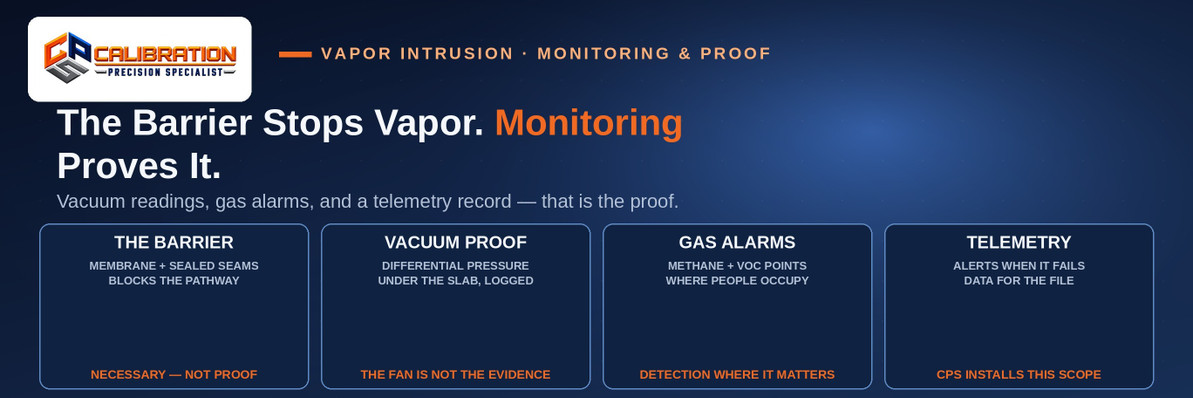
A vapor intrusion mitigation system is only proven to work by its monitoring: continuous or logged vacuum (differential-pressure) readings under the slab, gas alarms where a specific gas drives the design, and telemetry that alerts someone when the system fails. The barrier and the fan are the mitigation — the monitoring, alarm, and telemetry scope is the separate part of the system that proves performance over the years the building is occupied.
Ask a room of project teams what a vapor intrusion (VI) system consists of and you will hear two items: a vapor barrier under the slab, and a sub-slab depressurization fan. Both are real, and both are necessary. Neither one proves anything. A membrane cannot report that its seam was cut by a later trade. A fan cannot report that it stopped running in March. The documents that close VI projects — and the engineers, regulators, and property owners who rely on them for years afterward — rest on a third scope that is routinely under-specified, under-bid, or quietly dropped: the monitoring that demonstrates, on an ordinary Tuesday three years after construction, that the system is still doing its job.
This post is the hub for that scope: what "proof" actually consists of on a VI system, why it is a separate trade from the barrier, and how each piece is covered in the companion posts in this series.
What Is Vapor Intrusion, and Why Does It Need a System at All?
Vapor intrusion is the migration of volatile chemicals from contaminated soil or groundwater into a building. Soil gas moves through the ground, finds the openings every slab has — cracks, expansion joints, sumps, elevator pits, and the annulus around every utility penetration — and enters indoor air. The sources are the familiar brownfield inventory: former dry cleaners, fuel sites, industrial fill, and landfills.
The standard engineering response has two layers:
- Block the pathway. A vapor barrier membrane under the slab, with sealed seams and sealed penetrations, resists vapor entry.
- Reverse the pressure gradient. Sub-slab depressurization (SSD) keeps the collection layer beneath the slab at a lower pressure than the building above it, using a fan and vent piping. Soil gas is drawn toward the vent instead of toward the occupied space.
EPA's vapor intrusion guidance framework treats mitigation in exactly these terms — and treats it as a long-term obligation. A mitigation system is not a construction deliverable that ends at substantial completion; it is an operating system with an operation, maintenance, and monitoring life that runs as long as the contamination beneath the building does. That single fact is what makes monitoring part of the system rather than an accessory to it.
Why Doesn't the Barrier Prove the System Works?
Because a barrier is passive, invisible once the slab is poured, and unverifiable after the fact without instruments. Three failure modes make the point:
- Damage after installation. The membrane is installed early and worked over by every trade that follows. A cut, puncture, or unsealed penetration made after the barrier crew leaves is invisible — unless a vacuum reading or a gas reading says the system's performance changed.
- Fan and power failures. Sub-slab depressurization depends on a fan running continuously for years. Fans fail, breakers trip, and vent piping gets damaged. Nothing about a silent fan announces itself to the occupants above it.
- Pressure fields shrink. The vacuum a fan establishes across a collection layer is a physical field with edges. Changes in the building — new penetrations, HVAC changes, additions — can change where that field reaches. The design intent is a pressure relationship; only a pressure measurement confirms it still exists.
None of this argues against barriers or fans. It argues that a system whose entire purpose is to maintain a condition must include the instruments that verify the condition. In every other branch of gas safety, that principle is uncontroversial: nobody installs a fixed gas detector without an alarm, and nobody calls a calibration complete without a record. VI systems deserve the same standard.
What Does VI Monitoring Actually Consist Of?
Four elements, each answering a different question:
| Element | The question it answers | What it is |
|---|---|---|
| Vacuum / differential-pressure monitoring | Is the depressurization field still there? | Pressure sensing at sub-slab monitoring points, read on a schedule or continuously, compared against the design vacuum set by the engineer of record |
| Gas detection and alarms | Is the gas of concern reaching occupied space? | Fixed detection points (methane is the common landfill case) with local and remote alarms where people occupy the building |
| Telemetry and alerting | Will anyone know the day it fails? | Wireless or networked monitoring that reports readings and sends an alert — text and email — when vacuum is lost or an alarm trips |
| The record | Can you prove it later? | Logged readings, alarm history, and calibration records that an engineer, regulator, or buyer can review years after installation |
Two honest qualifications belong in every specification. First, there is no universal vacuum number: the differential pressure a given system must hold is a design value, set by the engineer of record from the site's diagnostics. Anyone who quotes one number for every building is guessing. Second, monitoring intervals and reporting duties vary with the site's regulatory program and the engineer's operation and maintenance plan. The instruments are the constant; the paperwork wrapped around them is project-specific.
The companion posts take each element in turn: sub-slab depressurization telemetry covers continuous vacuum watching and failure alerts; methane monitoring in buildings built over landfills and old fill covers the gas-alarm element; and the construction-phase cousins — community air monitoring during remediation and gas monitoring during brownfield excavation — cover the monitoring that runs while the site is being dug up, before any barrier exists.
Who Installs the Monitoring Scope?
Usually, nobody — and that is the gap this series exists to close. The barrier contractor's trade is membrane, seams, and boots. The fan is often set by a mechanical or radon-style installer. The monitoring scope — pressure sensors, fixed gas points, alarm panels, telemetry gateways, alert configuration, commissioning, and calibration — is gas-detection trade work, and it is nobody's line item unless the specification makes it one.
That is the scope CPS Calibrations performs. Under our fixed system installation work, CPS installs the monitoring, alarm, and telemetry layer of VI systems turnkey: the sensors and detection points, the alarm and notification path, the telemetry that turns a silent failure into a text message, and the calibration that keeps every channel honest — we calibrate every channel a system carries, on the record, from day one. For barrier and mitigation contractors, that scope is available as a partner sub-scope rather than a second trade to staff — see vapor barrier contractors: who handles your monitoring and alarm scope?
For engineers of record, the practical ask is small: write the monitoring scope into the specification as its own line, with its own acceptance test — readings logged, alarms demonstrated, alerts received by the people who will actually get them at 2 a.m. A system specified that way arrives proven. A system specified as "barrier plus fan" arrives assumed.
How CPS Handles a VI Monitoring Install
The sequence is the same one we run on fixed gas detection, applied to a mitigation system:
- Walk the design. We work from the engineer's drawings and O&M plan: which points get pressure monitoring, which spaces get gas detection, what the alarm and notification list looks like.
- Install the layer. Sensors, detection points, alarm devices, gateway and telemetry hardware — mounted, wired or wirelessly commissioned, and labeled to match the plan.
- Prove it at startup. Vacuum readings recorded at the monitoring points, alarms function-tested, alerts sent and confirmed received. The startup record becomes page one of the system's file.
- Calibrate and keep the record. Gas channels are calibrated at commissioning and entered into a calibration record, so the first annual check is a date on a calendar, not a reconstruction.
Installation work is quoted in writing for each project — the scope depends on the building, the design, and the monitoring plan, and anyone who prices it sight-unseen is guessing with your compliance file. Start with a call: 865-900-8844.
Frequently Asked Questions
What is vapor intrusion mitigation monitoring?
It is the instrument layer of a vapor intrusion system: vacuum or differential-pressure monitoring that confirms the sub-slab depressurization field is still established, fixed gas detection and alarms where a specific gas such as methane is a design concern, telemetry that reports readings and alerts someone when the system fails, and the logged record of all three. The barrier blocks the pathway and the fan creates the pressure gradient — monitoring is what proves both are still working while the building is occupied.
Does a vapor barrier by itself prove a building is protected?
No. A barrier is passive and, once the slab is poured, invisible. It cannot report a seam cut by a later trade, an unsealed penetration, or a failed fan, and there is no way to verify its performance years later without instruments. Barriers are a necessary layer of the system; the proof comes from pressure and gas measurements taken after installation and over the system's operating life.
What vacuum should a sub-slab depressurization system hold?
The vacuum a system must hold is a design value set by the engineer of record, based on diagnostic testing of that building's sub-slab conditions — there is no universal number that applies to every site, and any source quoting one without reference to a specific design is oversimplifying. What monitoring must do is measure the actual differential pressure at the system's monitoring points and compare it, on the record, against that design value.
How often should a VI system be checked?
The inspection and monitoring schedule comes from the site's operation, maintenance, and monitoring plan, which is set under the project's regulatory program and the engineer's design — it varies by site. The practical difference telemetry makes is that a continuously monitored system does not wait for the next scheduled check to discover a dead fan: the failure generates an alert when it happens, and the scheduled inspections then verify a system that has been reporting all along.
What happens when a sub-slab fan fails and nobody knows?
The depressurization field collapses, and the building returns to whatever the barrier alone provides — with soil gas free to follow the pressure gradient into occupied space through slab openings. Because fans fail silently and buildings give no sign, an unmonitored failure can persist for months or years. That is the specific failure mode continuous vacuum monitoring with failure alerting exists to eliminate.
Is methane monitoring part of vapor intrusion monitoring?
It can be, where methane is a gas of concern — classically on buildings over landfills or old fill, where the hazard is both vapor intrusion and accumulation of a flammable gas. Methane's lower explosive limit is 5% by volume, and fixed LEL detection with alarms is the instrument layer for that risk. The landfill case has its own post in this series: methane monitoring in buildings built over landfills and old fill.
Who is responsible for installing VI monitoring — the barrier contractor or someone else?
Whoever the specification assigns it to — and in many specifications, nobody is assigned, which is why systems get turned over unmonitored. Barrier contractors specialize in membrane work; monitoring, alarms, and telemetry are gas-detection trade work. CPS Calibrations performs that scope as a turnkey installation, either contracted by the owner or engineer or as a sub-scope under the barrier contractor.
Can monitoring be added to an existing VI system that has none?
Generally yes. Existing systems typically have — or can accept — sub-slab monitoring points for pressure measurement, and wireless telemetry can be added without opening the slab, because the sensors and gateway do not depend on the original construction. Gas detection points in occupied space are new devices on walls and ceilings, installed like any fixed detection. The starting point is a survey of what the existing system has and what its O&M plan requires.
What records should a monitored VI system produce?
A startup record (as-found vacuum readings at the monitoring points, alarm function tests, alert delivery confirmed), a continuing log of pressure readings and any alarm events with their resolution, and calibration records for every gas channel in the system. Together those records are what an engineer reviews at annual certification, what a regulator asks for, and what a buyer's environmental consultant will want in a transaction.
What does CPS Calibrations do on a VI project, exactly?
CPS installs the monitoring, alarm, and telemetry scope: sub-slab vacuum/pressure monitoring points and sensors, fixed gas detection and alarms, telemetry gateways and alert configuration, startup testing with a written record, and calibration of every gas channel. The work is quoted in writing per project. CPS does not install the vapor barrier itself — that stays with the barrier contractor, whose work our instruments then verify.
The Bottom Line
A vapor intrusion system without monitoring is a claim, not a result: the barrier blocks and the fan pulls, but only vacuum readings, gas alarms, telemetry, and a kept record prove the system is working on every day of the building's occupied life. Write the monitoring scope into the specification as its own line — and put a gas-detection shop's name on it.
Engineer, remediation team, or barrier contractor with a VI system to prove? Call CPS Calibrations at 865-900-8844 — we install the monitoring scope turnkey and hand you the record that proves it.
*CPS Calibrations · 109 S. Front Street, Rockwood, TN 37854 · Fixed System Installation · Calibration Services*
Need a calibration you can file?
In-house calibration at CPS in Rockwood, Tennessee — $55 for single-gas instruments, $90 for 4- and 5-gas — every channel, as-found and as-left data, full certificate.
See Calibration Servicesor call 865-900-8844
Recent Posts
-

What Is Remote Monitoring for Fixed Gas Detection?
Remote monitoring for fixed gas detection means a fixed system's live readings, trends, and alarm hi …Nov 23rd 2026 -

What Are the Key Differences Between the GX-6000 and GX-6100?
The RKI GX-6100 is the current replacement for the discontinued GX-6000: both are pumped 6-gas monit …Nov 22nd 2026 -

How to Read a PID Correction Factor Chart
To read a PID correction factor chart, find your vapor’s row, take the factor under your own lamp en …Nov 21st 2026