
OTIS OI-6940-XP Quad Multi-Gas Detector Head
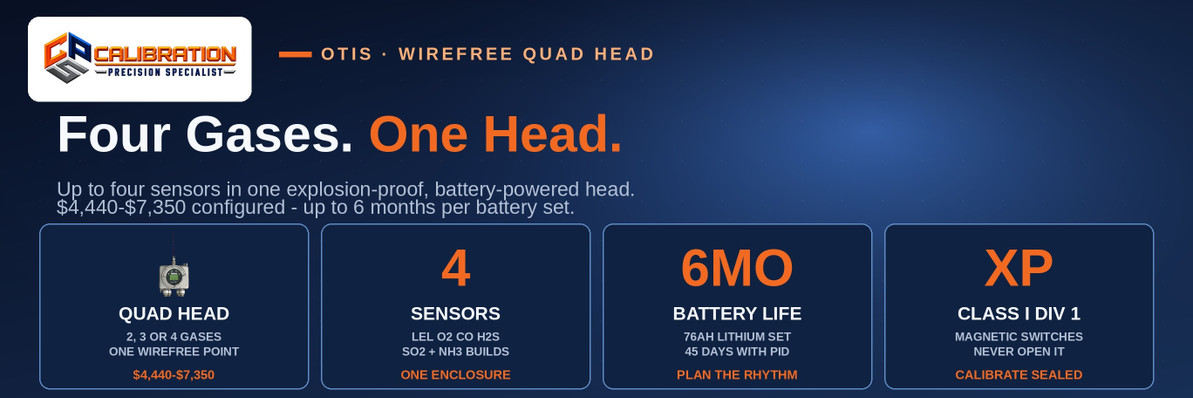
The OTIS OI-6940-XP WireFree Quad puts up to four gases in one battery-powered, explosion-proof detector head for Class I Division 1 locations — popular builds combine LEL, oxygen, carbon monoxide, hydrogen sulfide, sulfur dioxide, and ammonia in 2-, 3-, and 4-gas configurations at $4,440–$7,350 configured — reporting over GEN II 900 MHz or 2.4 GHz WireFree radio, running up to 6 months on four 3.6V/19Ah lithium-thionyl chloride cells (76Ah total), with a 160x104 sunlight-readable display showing all channels at once and magnetic switches that allow calibration without opening the enclosure.
A single-gas head answers one question. Most classified areas ask four at once: is fuel building up, is oxygen displaced, and are the two toxics that ride along with the process — carbon monoxide and hydrogen sulfide — present? The traditional answer is four separate heads, four cable runs, four radio or wiring points, and four enclosures to open at calibration time. The Quad's answer is one enclosure carrying up to four sensor housings, one battery set, and one wireless reporting point.
That consolidation is why the price is quoted as a configured range. The 20 factory configurations on our store run $4,440–$7,350: the figure moves with how many sensors are fitted and which gases they are. A 2-gas LEL/O2 head and a 4-gas head with a PID-class build are not the same instrument, and this post quotes the range rather than pretending otherwise. The single-sensor sibling family is covered in OTIS OI-6900 WireFree detector heads.
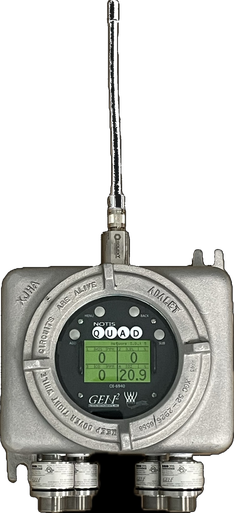
OTIS OI-6940-XP WireFree Quad Multi-Gas Detector Head
Battery-powered WireFree head carrying up to four gases in one explosion-proof enclosure.
$4,440–$7,350 configured
See the OI-6940-XPWhere Does One Quad Head Replace Four Single Heads?
Anywhere the hazard is a mixture rather than a single gas, and the location makes wiring expensive. Tank farms, compressor areas, loading racks, and process units routinely need combustible gas, oxygen, and one or two toxics watched at the same point — because the same leak event changes all of them. Four single heads mean four mounting jobs, four power or battery points, and four radio associations; one Quad means one of each, with all four channels on one display and one data stream to the controller or gateway.
The honest limit: consolidation concentrates risk in one enclosure. If the head comes down for service, all four channels at that point are down with it. Plants that need independent redundancy at a critical point still split channels across heads. The Quad wins where the four gases genuinely belong together — same event, same location, same response.
What Do the Battery Numbers Actually Mean?
The Quad runs on four 3.6V/19Ah lithium-thionyl chloride cells — 76Ah total, non-rechargeable. OTIS rates battery life at up to 6 months, and that rating carries a condition buyers miss: it applies to electrochemical and low-power infrared sensor builds. Add a PID (VOC) sensor and battery life falls to about 45 days, because a PID lamp draws continuously in a way an electrochemical cell does not.
Why that matters for specification: battery life is a maintenance-interval decision. A 6-month electrochemical build fits a twice-a-year service visit. A 45-day PID build needs a battery plan roughly eight times as often — which may still be right for the application, but it should be chosen knowingly, not discovered at month two. When you price a configuration, price its service rhythm with it.
How Do You Calibrate a Sealed Explosion-Proof Head?
Through the enclosure wall. The Quad provides 4 push buttons plus 4 magnetic non-intrusive switches, so calibration and setup happen without opening the explosion-proof enclosure in the classified area — the step that would otherwise require a hot-work decision or moving the head. The 160x104 sunlight-readable graphical LCD shows all channels simultaneously, so the technician sees every channel's response during the same gas application sequence.
Each sensor element also carries an adjustable background gas setting (1–10% of full scale), which matters in areas with a known, constant background: the head can be set to treat that background honestly instead of alarming on the normal state of the room. An optional OI-501-7 remote sensor mounting kit covers the case where one sensor needs to sit apart from the head. Fixed heads like this one are serviced where they are installed — see fixed system installation and our calibration services for how CPS handles installed systems.
Frequently Asked Questions
How much does the OTIS OI-6940-XP cost?
$4,440–$7,350 configured at CPS Calibrations, across 20 factory configurations. The price is the base unit plus each fitted sensor, so it moves with the gas count (2, 3, or 4 housings) and the sensor types. Custom combinations — formaldehyde, chlorine, PID for VOCs, phosphine — are quoted exactly before anything ships.
What gases can the OI-6940-XP detect?
The popular factory builds combine LEL (combustible gas), oxygen, carbon monoxide, hydrogen sulfide, sulfur dioxide, and ammonia in 2-, 3-, and 4-gas configurations, using electrochemical, low-power infrared, and PID sensor elements. Formaldehyde, chlorine, PID VOC, and phosphine builds are available as custom configurations — call 865-900-8844 and we will confirm the exact build and price.
How long do the OI-6940-XP batteries last?
Up to 6 months on four 3.6V/19Ah lithium-thionyl chloride cells (76Ah total) for electrochemical and low-power infrared builds. A PID (VOC) sensor cuts that to about 45 days. The cells are non-rechargeable, so battery life should be planned as a service interval when the configuration is chosen.
Is the OI-6940-XP explosion-proof?
Yes — it is built for Class I Division 1 hazardous locations, with up to four sensor housings in a single explosion-proof enclosure. Magnetic non-intrusive switches allow calibration without opening the enclosure, which is what keeps routine service practical in a classified area.
Does the OI-6940-XP need wiring?
No signal or power wiring — it is battery-powered and reports over GEN II WireFree radio at 900 MHz or 2.4 GHz to an OTIS controller or gateway, through an external N-female antenna connector. That is the point of the WireFree design: multi-gas coverage at points where pulling cable is the expensive part of the job.
Can I see all four gases at once?
Yes. The 160x104 sunlight-readable graphical LCD shows all channels simultaneously, so a technician standing at the head — or calibrating it — sees every fitted gas on one screen rather than paging channel by channel.
What is the background gas setting for?
Each sensor element has an adjustable background gas setting of 1–10% of full scale. In an area with a known constant background of the target gas, the setting lets the head account for that background instead of treating the room's normal state as an alarm condition.
Can a sensor be mounted away from the head?
Yes — an optional OI-501-7 remote sensor mounting kit is available for cases where one sensor needs to sit apart from the main enclosure while the head itself stays accessible.
How is the OI-6940-XP calibrated?
In place, through magnetic non-intrusive switches that work through the enclosure — the head is never opened in the classified area for routine calibration. CPS calibrates and services the fixed systems it sells; installed heads are serviced on site, not mailed in. Call 865-900-8844 to schedule fixed-system service.
OI-6940-XP or four OI-6900 single heads — which is better?
It depends on whether the gases belong together. One Quad gives one mounting point, one battery set, and one radio point for up to four channels — the cheaper, cleaner install when one event drives all four gases. Separate heads give independent redundancy: one head down does not take the other channels with it. The single-head family is covered in our OI-6900 post; tell CPS the application and we will spec it honestly either way.
The Bottom Line
The OI-6940-XP earns its place where four gases, one classified location, and no cable run meet: up to four sensor housings in one explosion-proof, battery-powered head, $4,440–$7,350 configured, up to 6 months between battery sets on electrochemical and low-power IR builds, and calibration that never opens the enclosure. Specify the gas combination first — the price, the battery rhythm, and the service plan all follow from it.
Need a calibration you can file?
In-house calibration at CPS in Rockwood, Tennessee — $55 for single-gas instruments, $90 for 4- and 5-gas — every channel, as-found and as-left data, full certificate.
See Calibration Servicesor call 865-900-8844
Recent Posts
-

What Is Remote Monitoring for Fixed Gas Detection?
Remote monitoring for fixed gas detection means a fixed system's live readings, trends, and alarm hi …Nov 23rd 2026 -

What Are the Key Differences Between the GX-6000 and GX-6100?
The RKI GX-6100 is the current replacement for the discontinued GX-6000: both are pumped 6-gas monit …Nov 22nd 2026 -

How to Read a PID Correction Factor Chart
To read a PID correction factor chart, find your vapor’s row, take the factor under your own lamp en …Nov 21st 2026