
Oxygen Depletion vs. Enrichment: Why Both Ends of the O2 Scale Are Dangerous
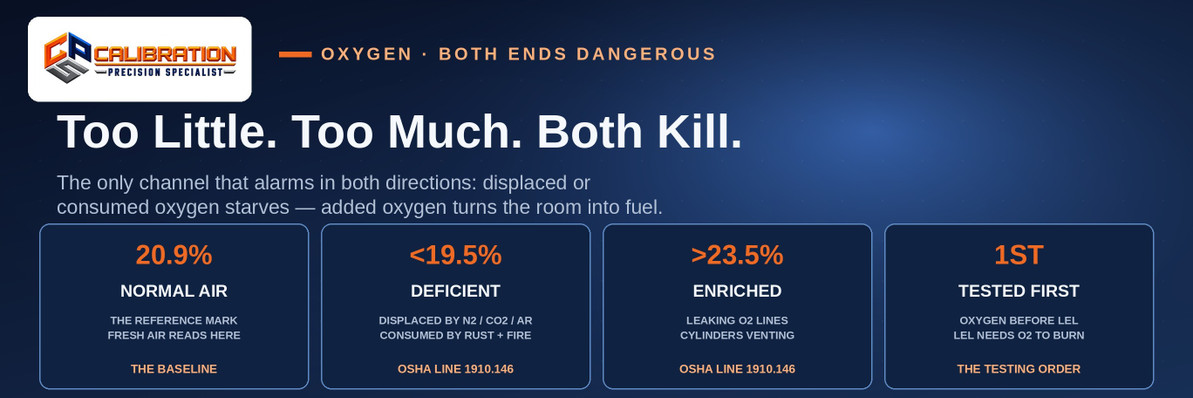
Oxygen depletion and oxygen enrichment are opposite failures of the same number: normal air is 20.9% oxygen, an atmosphere below 19.5% O2 is oxygen-deficient under OSHA's confined-space definitions (29 CFR 1910.146) and progressively impairs the people breathing it, while an atmosphere above 23.5% O2 is oxygen-enriched and makes ordinary materials ignite easily and burn fiercely — which is why the oxygen channel is the only one on a gas detector that must alarm in both directions, and why it is tested first.
Every other channel on a 4-gas monitor watches for something being present that should not be, or present in excess. Oxygen is different: the hazard is the air itself drifting off its normal composition, and it can drift either way. A space does not need a toxic gas in it to kill — it only needs its oxygen pushed down by displacement or consumption, or pushed up by an oxygen leak. Understanding which direction a space has moved, and why, is the whole of oxygen safety, and it starts with the three numbers: 20.9% is normal air, below 19.5% is deficient, above 23.5% is enriched. What counts as a space where this matters is covered in what is a confined space; this post is about the scale itself.
What Is Oxygen Depletion, and What Causes It?
Depletion means the oxygen fraction has fallen below its normal 20.9% — and there are only two ways that happens: something else takes the oxygen's place, or something uses the oxygen up. Displacement is the first: nitrogen, carbon dioxide, and argon are all used deliberately in industry — purging and inerting lines and vessels, blanketing tanks, shielding welds, suppressing fire — and all three are odorless and colorless. When one of them leaks or is vented into an enclosed space, it does not add a poison; it dilutes and pushes out the air, and the oxygen percentage falls with nothing to smell and nothing to see. Carbon dioxide adds a second hazard of its own on top of the displacement, but nitrogen and argon are dangerous purely because they are not air. Consumption is the second mechanism, and it is slower and easier to miss: rusting and oxidation literally remove oxygen from the air of a sealed steel space over time; fermentation and decomposition consume oxygen in tanks, pits, and agricultural and wastewater settings; and combustion — an engine, a heater, a cutting torch — burns oxygen as fuel. A space that was safe when it was sealed can be deficient when it is opened, with no leak and no spill to blame. The closely related hazard picture for the inert gases themselves is covered in oxygen deficiency hazards from nitrogen, argon, and helium.
The cruelty of depletion is how it presents. The depleted atmosphere is not attacking the body; it is simply failing to supply it. Breathing feels normal at first because the urge to breathe is driven mostly by carbon dioxide, not by oxygen shortage — so a worker can be progressively impaired, judgment and coordination going first, in an atmosphere that feels like air. That is why the deficiency line is set at 19.5% with margin above the levels where impairment becomes severe: the number on the instrument is the warning the body does not reliably give.
What Is Oxygen Enrichment, and Why Is It a Fire Hazard?
Enrichment is the mirror failure: the oxygen fraction rises above its normal level because oxygen itself is leaking or venting into the space — from a cylinder, a manifold, a damaged line or fitting on oxygen equipment, or oxygen vented during a process. Above 23.5%, OSHA's definitions call the atmosphere oxygen-enriched and hazardous, and the hazard is not breathing. Short exposure to moderately enriched air is not the problem. Fire is the problem. Combustion is a reaction with oxygen; raise the oxygen concentration and you change the rules for everything in the space. Materials that smolder reluctantly in normal air burn readily. Clothing, hair, and porous materials can absorb and hold enriched oxygen and then ignite from a spark that would have been harmless in air — and once burning in an enriched atmosphere, materials burn faster, hotter, and far harder to extinguish. Oils and greases, which must be kept away from oxygen equipment for this reason, become eager fuel. The enriched space converts the whole inventory of ordinary things — coveralls, wooden blocking, a rag — into a fuel load waiting for an ignition source, in an environment full of the tools that provide one. Enrichment also announces itself even less than depletion: oxygen is as colorless and odorless above 23.5% as below 19.5%, and nothing about the air feels different to the person standing in it while their clothing saturates.
Why Is Oxygen Tested First in a Confined Space?
The confined-space testing sequence is oxygen first, then flammable gases and vapors, then toxic gases and vapors — and the order is not bureaucratic; it is mechanical. The combustible channel on a typical 4-gas monitor is a catalytic LEL sensor, and a catalytic sensor works by burning gas on a heated element. Burning requires oxygen. In an oxygen-depleted or inerted atmosphere, the catalytic sensor under-responds or cannot respond at all — it can report a reassuringly low LEL in an atmosphere whose flammable content it simply could not burn. So an LEL reading taken before the oxygen reading is a number built on an unverified assumption. Confirm the oxygen first and the LEL reading that follows has a foundation: you know the sensor had the oxygen it needed to do its job. Oxygen is also the fastest-moving of the hazards — a displacement event can take a space from normal to deficient in the time a slower hazard is still being sampled — and the channel that can be wrong in both directions and that validates the next channel in line goes first. The full testing routine, including where and how long to sample, is in how to test a confined space before entry.
How Do You Protect Against Both Ends of the Scale?
The defenses are the same habits pointed at two targets. Measure, do not guess: a calibrated, bump-tested oxygen channel is the only reliable sense for either direction — we calibrate every channel on an instrument, and the O2 channel's two alarm directions are part of that work. Ventilate and re-test: forced air restores a depleted space toward 20.9%, and testing confirms the ventilation is actually doing it rather than stirring a pocket. Control the sources: inert-gas systems, purge points, and oxygen lines and cylinders near enclosed spaces are engineered, inspected, and treated as atmosphere-changing equipment, because they are. Respect both alarms equally: a low-oxygen alarm and a high-oxygen alarm are both stop-work signals. Crews drill the low alarm; the high alarm deserves the same instant obedience, because the enriched space's accident is a fire that behaves like nothing the crew has seen in normal air. And never use oxygen for anything but its purpose — never to ventilate a space, dust off clothing, or substitute for compressed air; each of those manufactures an enriched atmosphere on purpose. If your instruments' oxygen channels are due, suspect, or reading oddly against fresh air, that is a bench question: call CPS Calibrations at 865-900-8844, or start from calibration services.
Frequently Asked Questions
What is an oxygen-deficient atmosphere?
Under OSHA's confined-space definitions in 29 CFR 1910.146, an oxygen-deficient atmosphere is one containing less than 19.5% oxygen by volume. Normal air is 20.9% oxygen, so deficiency means the air has been diluted or its oxygen consumed — by inert gases such as nitrogen, carbon dioxide, or argon displacing it, or by rusting, fermentation, decomposition, or combustion using it up. The danger is progressive impairment of the people breathing it, in air that gives little warning by feel.
What is an oxygen-enriched atmosphere?
An oxygen-enriched atmosphere is one containing more than 23.5% oxygen by volume, per the same OSHA definitions — usually because oxygen is leaking or venting from cylinders, lines, or equipment into an enclosed space. The primary danger is not breathing it; it is fire. In enriched air, materials that barely burn normally — including clothing and porous materials that have absorbed oxygen — ignite more easily and burn fiercely, and fires are harder to extinguish.
What is the normal oxygen level in air?
Normal air is 20.9% oxygen by volume. That figure is the reference point for the whole scale: a reading meaningfully below 20.9% means something has displaced or consumed oxygen even before the 19.5% deficiency line is crossed, and a reading above 20.9% means oxygen is being added from a source. A calibrated oxygen channel resting in fresh air should read 20.9% — a fresh-air reading that disagrees is itself diagnostic information.
Why is low oxygen dangerous if there is no toxic gas present?
Because the body runs on the oxygen itself. An inert gas like nitrogen is not a poison; a nitrogen-displaced atmosphere is dangerous purely because it does not contain enough oxygen to sustain judgment, coordination, and ultimately consciousness. Worse, the breathing urge is driven mainly by carbon dioxide buildup, not oxygen shortage, so a depleted atmosphere can impair a worker progressively without the air hunger that would warn them to leave.
Why is too much oxygen dangerous?
Because it rewrites the fire rules. Combustion feeds on oxygen, so above the 23.5% enrichment line, ordinary materials ignite more readily and burn faster and hotter; clothing and hair can become saturated with oxygen and catch from a minor spark; oils and greases become eager fuels. The enriched atmosphere turns the contents of the space — and the worker's own clothing — into fuel, in exactly the industrial settings where ignition sources are routine.
What causes oxygen levels to drop in a confined space?
Two mechanisms: displacement and consumption. Displacement is another gas — nitrogen, carbon dioxide, or argon from purging, inerting, blanketing, welding shielding, or a leak — pushing air out of the space and diluting its oxygen. Consumption is oxygen being used up in place: rust and oxidation in sealed steel spaces, fermentation and decomposition, and combustion from engines, heaters, or hot work. A space sealed while safe can be deficient when opened, with no leak to find.
What causes oxygen levels to rise in a confined space?
An oxygen source releasing into the space: a leaking cylinder, manifold, hose, or fitting on oxygen equipment, or process oxygen vented where it can accumulate instead of dispersing. Because oxygen is colorless and odorless, an enriched buildup is undetectable without an instrument — and while the level is rising, porous materials and clothing in the space are absorbing oxygen and becoming easier to ignite.
Why do you test oxygen before LEL in a confined space?
Because the LEL reading depends on it. The standard testing order is oxygen first, then flammable gases and vapors, then toxic gases and vapors. A catalytic LEL sensor works by burning gas, and burning requires oxygen — in a depleted or inerted atmosphere the sensor under-responds and can report a falsely low LEL. Confirming a breathable, normal oxygen level first is what makes the combustible reading that follows trustworthy.
Can you smell or feel low or high oxygen?
No. Oxygen itself has no odor or color, and neither do the common displacing gases nitrogen and argon. Low oxygen does not produce reliable air hunger, because the urge to breathe tracks carbon dioxide rather than oxygen; high oxygen produces no sensation at all while it saturates materials around you. For both directions, a calibrated oxygen channel on a gas detector is the only sense that works — which is why the channel has alarms at both ends of the scale.
What should you do if the oxygen reading is below 19.5% or above 23.5%?
Do not enter, and if you are inside, get out — both readings define a hazardous atmosphere under the confined-space standard, in opposite ways. A deficient space is then ventilated with fresh air and re-tested until it holds at normal levels, and the displacement or consumption source is identified. An enriched space has its oxygen source isolated and is ventilated back toward 20.9% before any hot work or entry resumes — and materials that sat in the enrichment are treated as ignition-prone until they have aired out in normal air.
The Bottom Line
Oxygen is the two-ended hazard: below 19.5% the air cannot sustain the people in it, displaced by nitrogen, carbon dioxide, or argon or consumed by rust, fermentation, and combustion; above 23.5% the air turns everything in the space — clothing included — into ready fuel for a fiercer fire. Neither direction can be smelled or felt, both are defined lines rather than judgments, and oxygen is read first because the catalytic LEL channel behind it cannot be trusted until the oxygen it needs to burn gas is confirmed. Watch both ends of the scale, or you are only watching half of it.
Questions about an oxygen channel that reads oddly in fresh air, or instruments due for calibration? Call CPS Calibrations at 865-900-8844 — 109 S. Front Street, Rockwood, TN 37854.
--- CPS Calibrations · 109 S. Front Street, Rockwood, TN 37854 · What Is a Confined Space · How to Test a Confined Space Before Entry · Calibration Services
Need a calibration you can file?
In-house calibration at CPS in Rockwood, Tennessee — $55 for single-gas instruments, $90 for 4- and 5-gas — every channel, as-found and as-left data, full certificate.
See Calibration Servicesor call 865-900-8844
Recent Posts
-

Which GfG Portable Gas Detector Is Best for You?
The right GfG portable is decided by three questions — how many gases, pumped or diffusion, and PID …Nov 24th 2026 -
What GfG Fixed Gas Detection Systems Are There? Every Transmitter and Controller Explained
GfG’s fixed gas detection line at CPS is 39 products in two layers: 23 transmitters and detection sy …Nov 24th 2026 -
What GfG Portable Gas Detectors Are There? Every Model Explained
GfG’s portable line at CPS is 14 products built around six instruments: the Micro IV single-gas dete …Nov 24th 2026