
PureAire MPS Flammable Gas Monitors
The PureAire MPS Flammable Gas Monitor uses a Molecular Property Spectrometry (MPS) sensor to detect, classify, and quantify multiple flammable gases with TrueLEL accuracy from a single long-life sensor — immune to poisoning, with zero drift and no routine calibration required over a 15+ year sensor life — sold at $2,765 in four factory configurations: general LEL gases, hydrogen, hexane, and acetylene, in an explosion-proof Type 4X/IP66 enclosure with 4-20 mA and RS-485 outputs and dual alarm relays.
Traditional LEL channels share a quiet asterisk: a catalytic or infrared LEL sensor is calibrated on one gas and infers the others through correction factors. Change the vapor and the reading's accuracy changes with it — sometimes modestly, sometimes enough to matter at an alarm decision. The MPS approach measures the gas's molecular properties instead, so the sensor identifies which flammable gas (or mixture) it is seeing and quantifies it on its own terms. That is what 'TrueLEL' claims, and it is the reason a dedicated MPS monitor exists beside the general LEL channel on a multi-gas transmitter.
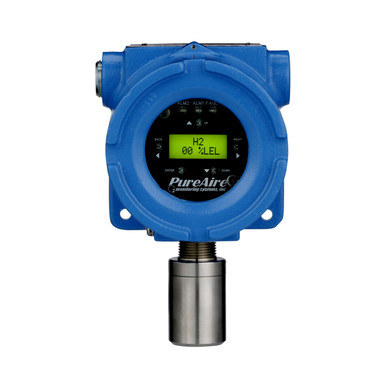
PureAire MPS Flammable Gas Monitor - LEL Gases
MPS flammable monitor with TrueLEL accuracy — one sensor that classifies the gas it sees.
$2,765
See the MPS MonitorWhy Four Builds at the Same $2,765?
- LEL Gases (product 600): the general-purpose configuration for an unknown or mixed flammable profile — the default for facilities that cannot name one vapor.
- Hydrogen (product 601): factory-configured for H2 — the gas catalytic LEL sensors handle worst and battery rooms, electrolysis, and hydrogen handling handle daily.
- Hexane (product 602): configured for C6H14, a solvent vapor profile common in extraction and processing.
- Acetylene (product 603): configured for C2H2, the welding and chemical-feedstock gas with its own wide flammable behavior.
Same enclosure, same outputs, same price — the configuration names the vapor profile the monitor is factory-set to quantify best. If your hazard is genuinely mixed or unknown, that is what the general LEL build is for; if it is one named gas every day, buy its build.
No Poisoning, No Routine Calibration — What That Changes
Catalytic LEL sensors die by exposure: silicones, sulfur compounds, and leaded vapors poison them, sometimes permanently, and the failure is silent — the sensor simply reads low forever after. The MPS sensor has no catalyst to poison. PureAire's record states it plainly: immune to poisoning, zero drift, immune to temperature and humidity fluctuation, no routine calibration required, sensor life 15+ years, with a fail-safe design and built-in self-test reporting faults through the standard mA signal.
Hold the honesty line, though: 'no routine calibration' is the manufacturer's specification for this sensor, not a repeal of your site's verification policy. Many facilities still bump or verify fixed points on principle and on insurer or corporate schedule. What MPS removes is the drift-driven calibration treadmill and the poisoning failure mode — the two reasons LEL points dominate fixed-system maintenance budgets. Compare the rest of the PureAire fixed line in PureAire universal gas detectors.
The Enclosure and Integration Details
The monitor is explosion-proof for hazardous locations — Class I & II, Division 1, Groups B, C, D, E, F, G; Class III; Type 4X / IP66; ATEX Ex d IIC; IECEx Ex db IIC T4 Gb — with a back-lit LCD and a menu-driven magnetic keypad, so setup happens without opening the enclosure. It can be remotely mounted up to 30 feet from its display point on customer-supplied cable. Outputs are 4-20 mA analog and RS-485 digital, with user-adjustable dual alarm relays, integrating with centralized systems and PureAire multi-channel controllers.
That integration profile is why the MPS monitor drops into existing fixed systems rather than demanding its own: the same 4-20 mA every other point produces, plus a digital channel for those who use it.
Frequently Asked Questions
How much does a PureAire MPS flammable monitor cost?
$2,765 at CPS — the same price for all four factory configurations: LEL gases, hydrogen, hexane, and acetylene. Each is a single-configuration product, so $2,765 is the price, not a range.
What is an MPS sensor?
Molecular Property Spectrometry. Instead of burning gas on a catalyst or inferring from one infrared wavelength, the MPS sensor measures the gas's molecular properties to detect, classify, and quantify it — which is how one sensor reports TrueLEL across multiple flammable gases.
What does TrueLEL mean?
PureAire's term for an LEL reading that is accurate for the gas actually present, not only for the gas a conventional sensor was spanned on. Because the MPS sensor classifies the gas it sees, its %LEL quantification follows the real vapor instead of a correction-factor estimate.
Can the MPS sensor be poisoned?
No — poisoning is a catalytic-sensor failure mode, and the MPS sensor has no catalyst. PureAire specifies the sensor as immune to poisoning, with zero drift and immunity to temperature and humidity fluctuation.
Does the MPS monitor need calibration?
PureAire specifies no routine calibration required, over a 15+ year sensor life, with built-in self-test and fail-safe fault reporting via the mA signal. Sites with their own verification policies can still check the point on schedule — the sensor removes the drift treadmill, not your policy.
Which MPS configuration should I buy?
The one that names your vapor: hydrogen, hexane, or acetylene builds for those dedicated hazards, and the general LEL Gases build for unknown or mixed flammable profiles. All four are $2,765 with the same enclosure and outputs.
What area ratings does the monitor carry?
Explosion-proof for Class I & II, Division 1, Groups B, C, D, E, F, G; Class III; Type 4X / IP66; ATEX Ex d IIC and IECEx Ex db IIC T4 Gb, per the product record — covering the common classified industrial locations for flammable monitoring.
What outputs does it provide?
4-20 mA analog and RS-485 digital communication, plus user-adjustable dual alarm relays — integrating with centralized systems and PureAire multi-channel controllers. A back-lit LCD with magnetic keypad gives local display and setup without opening the enclosure.
How is this different from a general LEL transmitter channel?
A general LEL channel is spanned on one gas and corrects for others, and its catalytic or IR sensor carries drift and (for catalytic) poisoning maintenance. The MPS monitor is a dedicated flammable instrument whose sensor classifies the gas for TrueLEL accuracy and is specified maintenance-free for 15+ years.
Can the MPS monitor be mounted remotely?
Yes — it can be remotely mounted in hazardous environments up to 30 feet away using customer-supplied cable, per the product record, which helps where the sensing point and the readable point are not the same place.
The Bottom Line
The MPS monitor is the dedicated answer to flammable monitoring's two oldest asterisks: at $2,765 in four builds, its sensor classifies the gas for TrueLEL accuracy, cannot be poisoned, and is specified to run 15+ years without routine calibration. General LEL channels still have their place — but where flammables are the primary hazard and the vapor is known or mixed, this is the instrument built specifically for the job.
Need a calibration you can file?
In-house calibration at CPS in Rockwood, Tennessee — $55 for single-gas instruments, $90 for 4- and 5-gas — every channel, as-found and as-left data, full certificate.
See Calibration Servicesor call 865-900-8844
Recent Posts
-

What Is Remote Monitoring for Fixed Gas Detection?
Remote monitoring for fixed gas detection means a fixed system's live readings, trends, and alarm hi …Nov 23rd 2026 -

What Are the Key Differences Between the GX-6000 and GX-6100?
The RKI GX-6100 is the current replacement for the discontinued GX-6000: both are pumped 6-gas monit …Nov 22nd 2026 -

How to Read a PID Correction Factor Chart
To read a PID correction factor chart, find your vapor’s row, take the factor under your own lamp en …Nov 21st 2026